
Table of Contents
Oats Investment Report
Category: AI meeting notetaker (open-source, on-device) — funnel product for an AI management system
Company Stage: Pre-Series-A startup (Ariso, founded April 2025); Oats launched September 2026
Founder or Founders: Erkang Zheng (Founder & CEO), Max Heckel (CTO); core team of approximately 5 listed on the company page
Headquarters: Austin, Texas
Funding: Not publicly disclosed (Ariso funding records are obfuscated in public databases)
Business Model: Oats itself is free and open source; monetization is indirect, through the paid Ariso platform (individual plan $1/day after a free start; custom team pricing)
Product Hunt Launch Date: September 16, 2026
Report Date: September 17, 2026
| Investment Metric | Assessment |
|---|---|
| Venture Potential | 50/100 |
| Unicorn Path | Conditional |
| Valuation Attractiveness | Not Assessable |
| Evidence Confidence | 50/100 |
| Final Decision | Watch |
Executive Summary
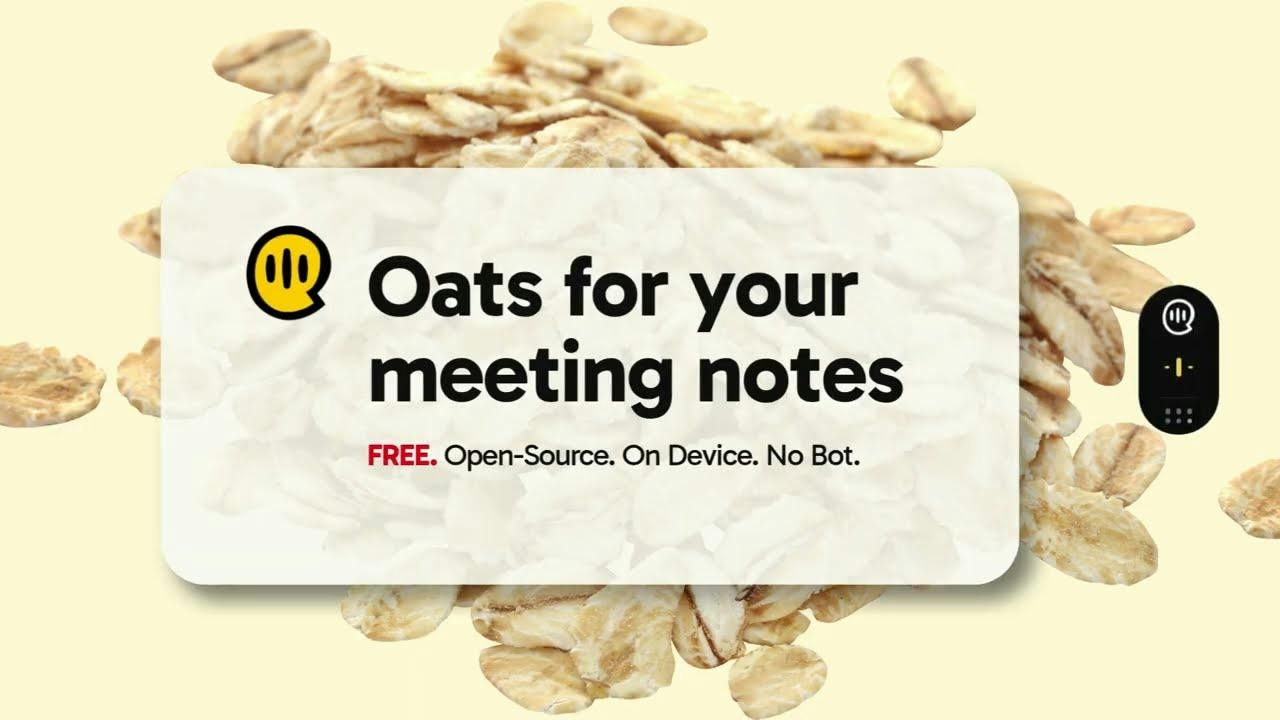
Oats is a free, open-source AI meeting notetaker for macOS and Windows built by Ariso. It records meetings locally without a bot joining the call, transcribes and summarizes on-device using local LLMs, stores everything on the user’s own machine, and exposes its full source code on GitHub. Optional cloud features — enhanced transcription, speaker recognition, coaching, and automatic follow-up tracking — connect to Ariso’s paid backend, with a stated no-model-training policy. producthunt
Oats serves privacy-sensitive knowledge workers and teams who dislike meeting bots, and it functions primarily as a distribution wedge for Ariso’s core product: “Ari,” an AI chief of staff and management system that captures meetings, decisions, and commitments, and sells at $1/day for individuals with custom team pricing. producthunt
The strongest investment signal is the founder. Erkang Zheng previously founded JupiterOne, a cybersecurity company that raised $119M and reached a valuation above $1 billion at its June 2022 Series C. A repeat founder with a verified unicorn outcome and a security background — directly relevant to Oats’s privacy positioning — is a materially stronger starting point than a typical Product Hunt launch. The market also has a proven unicorn outcome: Granola, a bot-free meeting notetaker, raised $125M at a $1.5 billion valuation in March 2026. intelcapital
The central concern is that Oats itself generates no revenue and competes in a commoditizing category where Zoom, Microsoft Teams, and Notion bundle meeting notes for free, and where free open-source alternatives already exist. The venture case depends entirely on converting free Oats users into paid Ariso subscriptions — a linkage with no public evidence. github
Final decision: Watch. The founder and category precedent justify attention, but the revenue engine sits behind an unproven conversion step, and Oats launched one day before this report.
Product Overview
Customer problem: AI meeting notetakers typically require a bot to join calls, send conversations to third-party clouds, and lock core features behind subscriptions. Privacy-sensitive users — lawyers, security teams, healthcare, finance — face a genuine tradeoff between convenience and confidentiality. producthunt
How it works: Oats runs as a menu-bar app that records system audio locally. Transcription and summarization run on-device with local models, producing a digest, full summary, per-person action items, and a conversation quality score. Notes are saved locally as Markdown (an Obsidian-compatible file), making export trivial. producthunt
Core features: bot-free local recording; on-device transcription and notes; action-item extraction; per-user quality scoring; local Markdown storage; open-source codebase auditable and forkable on GitHub; optional Ariso cloud backend for multi-language transcription, speaker recognition, coaching, assessments, and automated follow-up tracking. producthunt
Target users: privacy-conscious professionals and small teams, especially those blocked from cloud notetakers by policy or preference.
Pricing: Free, including local operation with on-device LLMs. Cloud-enhanced features route through Ariso, whose individual tier is free to start then $1/day, with custom company-wide pricing and six free months for teams of 25 or fewer. producthunt
Primary benefit: usable AI meeting notes with zero privacy compromise and zero cost.
Replaces: Granola, Otter.ai, Fireflies, Fathom, tl;dv — and native options like Zoom AI Companion or Teams Copilot for users who won’t send audio to a vendor cloud.
Founder and Team Assessment
Verified through independent sources: Erkang Zheng founded JupiterOne in 2018, led it to a $70M Series C in June 2022 at an estimated valuation above $1 billion, with $119M total raised from Tribe Capital, Intel Capital, Sapphire, Bain Capital Ventures, and others. His LinkedIn confirms he is now founder of Ariso (April 2025–present) while retaining ties to JupiterOne. This is a genuine, verifiable unicorn-founder credential — rare at this stage. intelcapital
The Ariso team page lists approximately five people: Zheng (CEO), Max Heckel (CTO), Shawn Zhu (Founding Engineer), Erica Price (UX), and Chihan Tung (Operations). A conflict exists with the LinkedIn company page, which claims 11–50 employees — we treat the smaller, page-listed team as more credible and note the discrepancy. No job listings were found. ariso
Founder-market fit is strong: JupiterOne’s entire premise was asset visibility across enterprise systems, and Ariso’s pitch — “one connected brain for the company” with per-user encryption and zero-trust architecture — is the same graph-of-everything thesis applied to work rather than security. Key-person risk is high: Zheng appears to still be associated with JupiterOne while running Ariso. ariso
Founder Assessment: A verified unicorn-founder with directly relevant technical and security DNA, but a small team and a potentially divided founder commitment.
Market Opportunity
The initial segment is narrow: privacy-constrained professionals who cannot use cloud notetakers — estimate several million potential users across regulated industries, security teams, and privacy-sensitive SMBs in the US and EU. Oats itself captures no revenue from them; the monetizable population is those who convert to Ari at roughly $365/year, or teams at custom pricing. ariso
The category, however, has demonstrated venture-scale outcomes. Granola — also bot-free — grew from a $250M valuation in May 2025 to $1.5B in March 2026, raising $192M in total by expanding from notes toward an enterprise context platform. That trajectory (notetaker → organizational memory → workflow platform) is exactly the journey Ariso describes on its own site. The realistic addressable market supports venture-scale revenue only via this expansion; the standalone free notetaker does not. ariso
Traction and Growth Signals
- Product Hunt (September 16, 2026): 4.0 rating from 1 review, ~395 followers, launched one day before this report. producthunt
- GitHub: the repository (ariso-ai/oats) was created in September 2026 — star count, forks, and contributor activity are not yet meaningful. github
- Community engagement on the launch is genuine but small — feature questions about export, editing, and local models, answered substantively by the team. producthunt
- Ariso-level signals: LinkedIn following of ~1,400; named-customer testimonials on the website; a Series A-adjacent profile exists on Dealroom and Crunchbase with obfuscated funding data. ariso
Missing: user count, downloads, paid conversions to Ariso, revenue, retention, and any post-launch momentum data. The most important missing metric is the Oats-to-Ariso conversion rate, which is the entire business case.
Traction Assessment: Launch-day attention only; commercially unverified, with monetization one step removed from the free product.
Competitive Position
| Competitor | Type | Notes |
|---|---|---|
| Granola | Direct (paid) | $125M Series C at $1.5B valuation, March 2026; bot-free notetaker expanding to enterprise context techcrunch |
| Otter.ai, Fireflies, Fathom, tl;dv | Direct | Established cloud notetakers |
| Zoom AI Companion, Teams Copilot, Gemini in Meet | Bundled free | Platform owners give notes away github |
| Meetily, OpenOats, Whisper-based tools | Free open source | Self-hosted local alternatives already exist github |
| Notion AI Meeting Notes | Indirect | Bundles notes into an existing workspace |
Oats’s differentiation — open source, fully on-device, no bot, no subscription — is real for the privacy niche, and the security pedigree backs the claims credibly. But if Zoom or Microsoft shipped on-device private notes natively tomorrow, there is no strong answer for why most users would keep Oats; the answer is limited to auditability and the Ariso ecosystem, which most users have not adopted. In the paid tier of the market, Granola has $192M of capital and a proven enterprise motion. ariso
Defensibility Assessment: Low.
Business Model and Economics
Oats generates no direct revenue — it is explicitly “free forever” and positioned as “our first step toward open-sourcing more of what we build at Ariso”. Monetization runs through Ariso: $1/day (~$365/year) per individual, custom team pricing, and a free-for-six-months offer for teams of 25 or fewer. producthunt
- Cost structure is favorable: on-device inference shifts compute costs to the user; the free cloud backend has no stated limits, which could become a cost center.
- The conversion assumption is unvalidated: nothing public shows that free-notetaker users upgrade to an AI management system — a significant behavioral jump from utility to daily workflow dependency.
- Open-source duality: open source builds trust and distribution for the privacy segment, but also invites free forks that remove any payment surface.
- Enterprise potential exists (SOC 2, per-user encryption, org rollups) but no enterprise customers are publicly verifiable. ariso
Free-to-paid conversion, retention, and CAC are all unknown and would need verification before any economic judgment.
Unicorn Path
Assume a 10x ARR multiple for an AI work-management platform at growth stage. Required revenue: $1B ÷ 10 = $100M ARR. At Ari’s $365/year individual pricing, that is roughly 275,000 paying subscribers; at an assumed $50–100 per seat per year blended for company-wide deployments, it requires 1–2 million seats, or several thousand mid-sized company contracts at $50K–$250K.
The category precedent is real — Granola reached $1.5B on precisely this notetaker-to-platform trajectory — but for Ariso it requires: converting Oats’s free users into paid Ari subscribers at meaningful rates, moving from individuals to company-wide deployments, surviving competition from Granola (funded), Lindy, Glean, and platform-native assistants, and raising significant capital. None of these is evidenced today. techcrunch
Unicorn Path: Conditional — possible only if the free notetaker successfully feeds a paid management-platform business at venture scale.
Valuation Assessment
Ariso’s funding history, investors, and valuation are not publicly disclosed; Crunchbase lists the company with obfuscated funding data and Dealroom provides no round details. No SAFE, priced round, or investor announcement was found. With no verified revenue, retention, or financing terms, no valuation range can be responsibly constructed. app.dealroom
Valuation Attractiveness: Not Assessable. Required: current ARR, Oats-to-Ariso conversion, retention, gross margin, burn and runway, round size or SAFE cap, post-money valuation, and investor ownership.
Key Risks
- Zero direct revenue — the product under review is free; the entire case rests on an unproven conversion to Ariso. ariso
- Category commoditization — Zoom, Teams, and Notion bundle meeting notes free; open-source rivals already exist. github
- Funded direct competitor — Granola has $192M raised and a $1.5B valuation on the same expansion thesis. techcrunch
- Founder bandwidth — Zheng retains ties to JupiterOne while running Ariso. linkedin
- Tiny team scale — roughly five people against well-capitalized competition. ariso
- Free-tier cloud cost exposure — unlimited free cloud features with no pricing firewall could create negative-margin usage.
- Open-source fork risk — the privacy value proposition can be self-hosted without ever touching paid Ariso.
- No verified customers — website testimonials are company-curated and unaudited. ariso
Final Assessment
Venture Potential: 50/100
| Category | Score |
|---|---|
| Market Size and Expansion Potential | 13/20 |
| Traction and Growth Evidence | 5/20 |
| Founder and Team | 12/15 |
| Product Strength | 6/10 |
| Distribution Potential | 7/15 |
| Business Model and Economics | 4/10 |
| Defensibility | 3/10 |
| Total | 50/100 |
Strongest elements: a verified unicorn founder with directly relevant security pedigree, a category with a demonstrated $1.5B comparable in Granola, and a genuinely differentiated privacy product. Weakest elements: no revenue from the product itself, unproven conversion to the paid platform, and low defensibility in a commoditizing space.
Evidence Confidence: 50/100
Verified: founder identity and full JupiterOne track record (multiple independent sources), company existence and Austin headquarters, team composition, product existence, and pricing. Company-reported: security claims, testimonials, and the LinkedIn employee count (11–50), which conflicts with the five-person team page. Unknown: funding, revenue, users, retention, conversion, and valuation. ariso
Final Decision: Watch
Venture Potential (50/100) sits at the boundary of “promising but insufficiently validated,” the Unicorn Path is Conditional on an unobserved conversion step, Valuation is Not Assessable, and the product launched one day ago. The founder would merit a founder meeting on credentials alone, but the free product’s role as a funnel means no commercial signal yet exists to diligence. If Ariso discloses funding or demonstrates Oats-to-Ariso conversion, this decision should be revisited promptly.
Upgrade Conditions
- Disclosed conversion from free Oats users to paid Ari subscribers (even 2–3% would be informative)
- Verified paying teams or the first $500K–$1M of Ariso ARR
- Meaningful GitHub adoption (thousands of stars, active contributors) sustaining post-launch
- A disclosed funding round with credible institutional investors
- Named, referenceable enterprise customers on the Ariso platform
Downgrade Conditions
- Zero measurable conversion from Oats to paid Ariso after 6–12 months
- Granola or a platform vendor shipping competitive on-device private notes
- Free cloud features creating uncontrolled infrastructure costs
- Founder attention shifting back to JupiterOne or elsewhere
- Fork or community fork cannibalizing the privacy niche at zero cost
Questions for Further Diligence
- How many Oats downloads and monthly active users exist since launch?
- What percentage of Oats users connect the Ariso cloud backend, and what share of those convert to paid?
- What is Ariso’s current ARR and monthly growth?
- What are 30/90/180-day retention rates for Ari users?
- What does the $1/day tier cost to serve — what is gross margin per active user?
- How is the free cloud backend cost-controlled, and what are its limits?
- Has Ariso raised external capital, at what valuation, and from whom?
- How is Zheng’s time split between Ariso and JupiterOne?
- What is the pipeline and pricing of company-wide Ariso deployments?
- What prevents Granola, with $192M raised, from shipping an open-source on-device client for the privacy segment?
- How are medical, legal, or financial conversations handled under regulatory frameworks (HIPAA, privilege)?
- What is the roadmap for making the open-source core and paid cloud boundary sustainable against forks?
Sources
- Product Hunt – Oats
- Ariso – Oats product page
- GitHub – ariso-ai/oats
- Ariso official website
- Ariso team page
- Ariso – LinkedIn company page
- Erkang Zheng – LinkedIn
- JupiterOne – $70M Series C at $1B+ valuation
- SecurityWeek – JupiterOne unicorn valuation
- TechCrunch – Granola raises $125M at $1.5B valuation
- Crunchbase – Ariso profile (secondary)
- GitHub topics – ai-meeting-assistant alternatives (secondary)