
Table of Contents
Harden Investment Report
Category: AI-agent security; developer endpoint security
Company Stage: Pre-seed / beta
Founder or Founders: Pushpak Pujari and Pushpendre Rastogi
Headquarters: Palo Alto, California
Funding: $2 million pre-seed, founder-reported; independently verified round terms not found
Business Model: Free local developer product with custom-priced enterprise deployment, compliance and support
Product Hunt Launch Date: September 9, 2026
Report Date: September 12, 2026
| Investment Metric | Assessment |
|---|---|
| Venture Potential | 63/100 |
| Unicorn Path | Conditional |
| Valuation Attractiveness | Not Assessable |
| Evidence Confidence | 52/100 |
| Final Decision | Watch |
Executive Summary
Harden’s Agentic Integrity Foundation, or AIF, is a local security layer for AI coding agents. It intercepts supported tool calls before execution, compares the proposed action with the developer’s request, session context and security rules, and then allows, rewrites, escalates or blocks the action. It is designed for developers and organizations that want greater coding-agent autonomy without giving agents unrestricted access to repositories, credentials, cloud systems and production infrastructure.
The product addresses a credible emerging problem. Coding agents increasingly execute shell commands, modify files and interact with external services; conventional endpoint, identity and data-loss controls do not necessarily understand whether an individual action remains consistent with the developer’s original intent. Harden’s local processing, multi-agent support and pre-execution position are sensible product choices (official website; technical research).
The strongest investment signal is the founding team. CEO Pushpak Pujari reports product leadership experience at Verkada, Amazon’s Alexa organization, AWS IoT and Sony, while CTO Pushpendre Rastogi has a Ph.D. from Johns Hopkins and prior AI research experience at Amazon and Google DeepMind (Pujari profile; Rastogi biography). That combination provides credible enterprise-product, machine-learning and security-adjacent capability.
The principal concern is that commercial validation is almost entirely absent. Revenue, paid customers, enterprise contracts, retention, installation count, active usage and gross margin are not publicly disclosed. The company says it is working with early proofs of concept, but no referenceable enterprise customer is identified on its public materials. Product Hunt and GitHub attention are too recent to establish sustained demand.
Product quality appears promising, company quality appears above average for a pre-seed startup, but venture-scale potential remains unvalidated. Final decision: Watch, with an upgrade to DD contingent on verified enterprise conversions, repeat usage and evidence that Harden can become a broad agent-security platform rather than a narrow coding-agent utility.
Product Overview
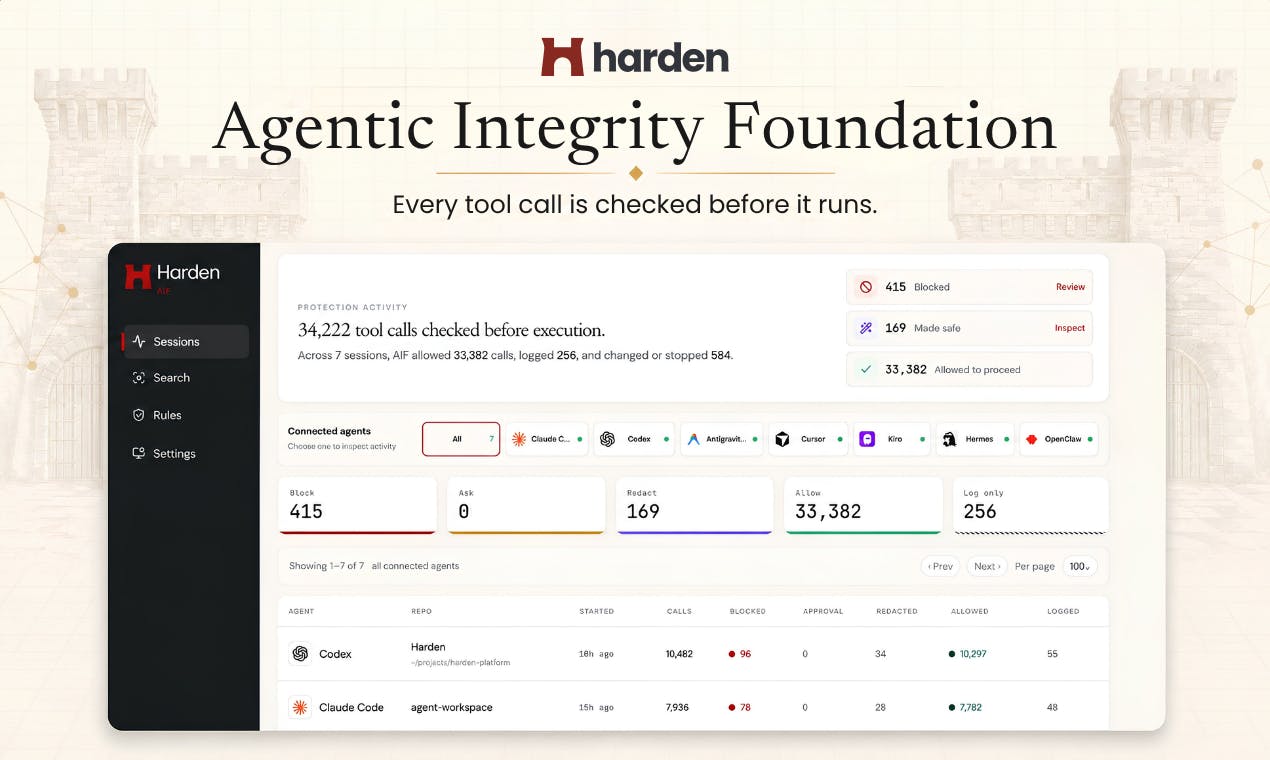
Harden sits between a coding agent and the tools that agent attempts to use. It evaluates commands, file operations and supported external tool calls before execution. Depending on the result, it can allow the action, redact sensitive information, request approval, propose a safer retry or block the call.
The product currently supports agents including Claude Code, Codex, Cursor, Gemini CLI, Kiro, OpenClaw and Hermes through native hooks or bridge mechanisms. The local dashboard stores decisions and audit history on the developer’s device (GitHub repository; trust documentation).
The individual product is free and requires no account. Enterprise functionality—including compliance reporting, managed installation, air-gapped or zero-telemetry deployment, support SLAs and custom terms—uses custom pricing (official website). Windows is not supported, and the full local model currently requires Apple Silicon with at least 16 GB of unified memory. Linux and Intel-based macOS support rely on other product configurations; the exact protection parity should be verified.
The product replaces repeated manual approval of coding-agent actions and supplements secret scanners, endpoint security, sandboxing and identity controls. Its core customer benefit is allowing agents to operate more autonomously while preserving a separate security decision point.
A material disclosure issue exists: structured metadata on Harden’s website describes the CLI as “open source,” but the official trust page explicitly says AIF is closed source, and the public GitHub repository contains documentation and an issue tracker rather than the product source. The governing beta license is proprietary and restricts reverse engineering and competitive use. The trust page and license are the more authoritative sources; therefore, this report treats AIF as closed-source freeware.
Product quality: Technically thoughtful and well documented for a beta, but independent field validation is lacking and platform coverage remains incomplete.
Founder and Team Assessment
Pushpak Pujari is the co-founder and CEO. His public profile lists senior product roles at Verkada, Amazon AGI/Alexa, AWS IoT and Sony, plus an MBA from Wharton and an engineering degree from IIT Delhi (LinkedIn). This background is relevant to enterprise sales, security-oriented product development and edge deployment.
Pushpendre Rastogi is co-founder and CTO. His personal academic page documents a Johns Hopkins computer-science Ph.D., published machine-learning research and prior roles in Amazon Alexa, Amazon Prime Research and Google DeepMind (personal website). His background is directly relevant to training and evaluating a specialized local security model.
LinkedIn identifies Harden as founded in 2025, with 2–10 employees and seven profiles associated with the company (company profile). This is a platform estimate rather than verified payroll data. Harden’s careers page advertises multiple technical and forward-deployed roles, which is consistent with active hiring but also implies an expanding cost base (careers page).
No previous founder exits were verified. Both founders appear full-time from their profiles, although contractual commitment and vesting require diligence. With a small team and a model-intensive security product, key-person risk is high.
Founder Assessment: Strong technical and enterprise-product fit, but startup commercialization and security-company scaling remain unproven.
Market Opportunity
The initial customer is a technology company using multiple AI coding agents with access to source code, credentials, cloud infrastructure or production systems. The economic buyer is likely the CISO, application-security leader, platform-engineering leader or developer-productivity team.
GitHub reports more than 225 million developers and four million organizations on its platform (GitHub). Only a small subset has sufficient coding-agent deployment and risk exposure to purchase a specialized security layer.
A bottom-up analyst scenario is:
- Four million GitHub organizations.
- Assume 1% have material autonomous-agent usage and enterprise security requirements: 40,000 potential organizations.
- Assume annual contract values of $25,000–$100,000 for fleet management, policy, compliance and support.
- Implied serviceable revenue opportunity: approximately $1–4 billion annually.
These penetration and pricing assumptions are illustrative, not company data. Current enterprise pricing is undisclosed.
Adjacent expansion could include personal agents, CI/CD agents, MCP security, agent identity, policy management, runtime audit, application scanning and broader AI governance. Acquisitions of AI-security companies such as Protect AI by Palo Alto Networks and Lakera by Check Point demonstrate strategic interest, although disclosed transaction values were not found in the cited announcements.
The market could support a venture-scale company, but Harden must prove that coding-agent endpoint security becomes a separate purchasing category rather than a feature of existing endpoint, code-hosting or AI-security platforms.
Traction and Growth Signals
Harden ranked #2 on Product Hunt on September 9, 2026 (Product Hunt awards). Its founder reported 399 points and 112 comments. The page showed approximately 1,400 followers but only two reviews shortly after launch (Product Hunt reviews). This is launch attention, not commercial traction.
The public GitHub repository had approximately 728 stars and 389 forks as of September 12 (GitHub API). However, the repository is primarily a documentation and issue-tracking surface for a closed-source binary, so forks are not evidence of open-source adoption.
Harden reports 34,222 inspected tool calls across seven displayed sessions on its website. Its trust page separately reports 24,809 internal dogfood decisions over one week, with a 0.25% wrong-hard-block rate. These figures are company-generated, reflect internal usage rather than independent customers, and should not be interpreted as user traction.
The company reports early proofs of concept but does not disclose names, paid status or deployment scale. Current revenue, growth, installations, active developers and enterprise conversion are unknown.
Traction Assessment: Positive launch interest and internal product usage, but commercially unverified.
Competitive Position
Direct competitors include AI-agent security platforms such as Zenity, Noma Security and Check Point’s Lakera-based agent-security offering. Broader platforms such as Palo Alto Networks’ Prisma AIRS can bundle runtime protection with wider AI-security capabilities.
Indirect alternatives include endpoint detection, data-loss prevention, identity controls, sandboxing, secret scanners, manually configured allowlists and the approval systems built into coding agents. Free alternatives include restrictive agent permissions, containers and manual approval of sensitive commands.
Harden differentiates through local inference, pre-execution enforcement, session-context reasoning and support for multiple coding agents. A local product can improve privacy and reduce cloud inference cost. Its proprietary model and training corpus may provide defensibility if performance improves with real-world feedback.
Switching costs are currently low. The product is v0.x, organizational policy management is not yet demonstrated publicly, and enterprises could remove it if an agent vendor or endpoint-security provider offers equivalent controls.
If the largest platform launched the same feature within six months, why would customers stay? The credible answer would be superior cross-agent coverage, local privacy, independently governed policy and materially better detection. Harden has not yet proved these advantages at enterprise scale.
Defensibility Assessment: Medium-Low
Business Model and Economics
The free individual product is a distribution channel. Enterprise revenue is expected from fleet deployment, compliance reporting, air-gapped operation, managed installation, support and contractual protections. Pricing and average contract value are not disclosed.
Local inference should reduce Harden’s recurring cloud-model expense, but it transfers hardware requirements to the customer and creates compatibility and support costs. Enterprise economics will also depend on forward-deployed engineering, security reviews, model updates and maintaining integrations as coding-agent hook interfaces change.
Potential gross margins could resemble enterprise software if installations and model updates are standardized. They could be materially lower if each customer requires custom policies, private-cloud deployment or extensive integration work. No public evidence establishes gross margin, sales-cycle length, CAC or expansion revenue.
Unicorn Path
An 8× ARR multiple is assumed for a high-growth enterprise cybersecurity software company. This is an analytical assumption, not Harden’s current multiple.
Required ARR = $1 billion ÷ 8 = approximately $125 million.
At an assumed $50,000 enterprise ACV:
$125 million ÷ $50,000 = approximately 2,500 enterprise customers.
Alternatively, at a $100,000 ACV, approximately 1,250 customers would be required. Both ACVs are analyst assumptions because Harden provides only custom pricing.
Reaching this scale would require Harden to expand from a free endpoint utility into a fleet-wide security platform with centralized policy, audit, identity integration, threat intelligence, cross-agent coverage and enterprise-grade deployment. Gross margin would likely need to exceed approximately 70%, with strong annual retention and expansion.
Unicorn Path: Conditional
Valuation Assessment
Founder materials report a $2 million pre-seed round and reference Afore Capital and Ahead VC. No formal funding announcement, post-money valuation, SAFE cap or complete investor list was found. Current fundraising status is not publicly disclosed.
Relevant strategic activity includes the acquisitions of Protect AI and Lakera, but the cited official announcements do not provide transaction values or sufficient operating metrics to derive a valuation for Harden.
Valuation Attractiveness: Not Assessable
Assessment requires current ARR, enterprise pipeline, conversion rates, retention, gross margin, burn, runway, cap table, SAFE terms, round size, proposed valuation and liquidation preferences.
Key Risks
- No verified commercial traction: Revenue and paid deployments are unknown.
- Incumbent bundling: Major security and development platforms can integrate similar controls.
- Closed-source trust barrier: A privileged security product must convince customers to trust an opaque binary.
- Benchmark limitations: Results are company-run; several benchmarks were adapted from their official protocols, and SLEIGHT AUROC was below the reported GPT baseline.
- Agent integration fragility: Hook changes can create coverage gaps or fail-open behavior.
- Limited platform support: Windows is unsupported, and full-model hardware requirements constrain adoption.
- False positives and workflow friction: Even a low error rate may create significant interruption at enterprise call volumes.
- Enterprise deployment cost: Air-gapped and custom environments may require service-heavy implementation.
- Messaging inconsistency: Website metadata describes an open-source CLI, while the trust documentation and license establish that AIF is closed source.
- Key-person risk: Core model and product expertise is concentrated in two founders.
Final Assessment
Venture Potential: 63/100
| Category | Score |
|---|---|
| Market Size and Expansion Potential | 17/20 |
| Traction and Growth Evidence | 6/20 |
| Founder and Team | 13/15 |
| Product Strength | 8/10 |
| Distribution Potential | 7/15 |
| Business Model and Economics | 5/10 |
| Defensibility | 7/10 |
| Total | 63/100 |
The strongest elements are founder-market fit, market timing and a coherent technical approach. The weakest are commercial evidence, distribution beyond launch channels and uncertain enterprise economics.
Evidence Confidence: 52/100
Verified evidence covers product behavior, license terms, public repository statistics, founder identities, technical backgrounds, pricing structure and Product Hunt ranking. Benchmarks, internal usage and funding are company- or founder-reported. Revenue, customers, retention, growth, unit economics, burn and valuation remain unavailable.
Final Decision: Watch
Harden is too early for formal investment due diligence based solely on public evidence. The product is credible and the team is strong, but there is no verified proof that enterprises will pay for a separate coding-agent security layer or deploy it broadly.
Upgrade Conditions
- At least 10 paying enterprise customers with referenceable deployments.
- $1 million or more in ARR or equivalent contracted recurring revenue.
- Six-month enterprise retention above 80%.
- Verified gross margin above 70%.
- Independent red-team and benchmark validation.
- Centralized fleet policy, reporting and identity integrations.
- Clear reconciliation of open-source versus proprietary-product messaging.
- Repeatable acquisition beyond Product Hunt and founder-led sales.
Downgrade Conditions
- Proofs of concept fail to convert into paid contracts.
- Material false-positive or fail-open incidents.
- Coding-agent vendors bundle equivalent local controls.
- Security customers reject the closed-source binary.
- Integration maintenance costs grow faster than revenue.
- Misleading benchmark, customer or funding claims are identified.
Questions for Further Diligence
- What are current ARR, MRR and contracted enterprise revenue?
- How many installations, weekly active developers and paying organizations use AIF?
- How many enterprise proofs of concept have converted to paid deployments?
- What are 30-, 90- and 180-day developer and organization retention?
- What is the production false-positive rate across independent customer environments?
- How often do agent-version changes create fail-open or unsupported states?
- What is enterprise ACV, sales-cycle length and customer acquisition cost?
- What are gross margin and support cost per enterprise deployment?
- What portions of the $2 million financing are equity, SAFEs or other instruments?
- What are the current valuation, cap table, runway and monthly burn?
- Why does website metadata describe the CLI as open source when the product license and trust page describe it as closed source?
- What proprietary data, integrations or model performance would prevent incumbent security vendors from replicating the product?
Sources
- Harden on Product Hunt
- Official Harden website and pricing
- Harden technical research and benchmark methodology
- AIF trust and transparency documentation
- AIF GitHub repository
- AIF proprietary beta license
- Pushpak Pujari profile
- Pushpendre Rastogi biography
- Harden company profile
- GitHub platform statistics
- Palo Alto Networks–Protect AI acquisition
- Check Point–Lakera acquisition