
Table of Contents
Die With Me Investment Report
Category: Consumer social / developer-tooling crossover (Mac menu-bar presence app for AI coding-tool users)
Company Stage: Pre-launch-scale solo hobby-stage project; no company, funding, or revenue structure publicly disclosed
Founder or Founders: “Weiwei” (solo builder; last name, legal entity, and professional background not publicly disclosed) diewithme
Headquarters: Not publicly disclosed
Funding: Not publicly disclosed; no funding announcements found
Business Model: Free product; no pricing, paid tier, or monetization model published diewithme
Product Hunt Launch Date: September 17, 2026 hunted
Report Date: September 20, 2026
| Investment Metric | Assessment |
|---|---|
| Venture Potential | 29/100 |
| Unicorn Path | Improbable |
| Valuation Attractiveness | Not Assessable |
| Evidence Confidence | 38/100 |
| Final Decision | Pass |
Executive Summary
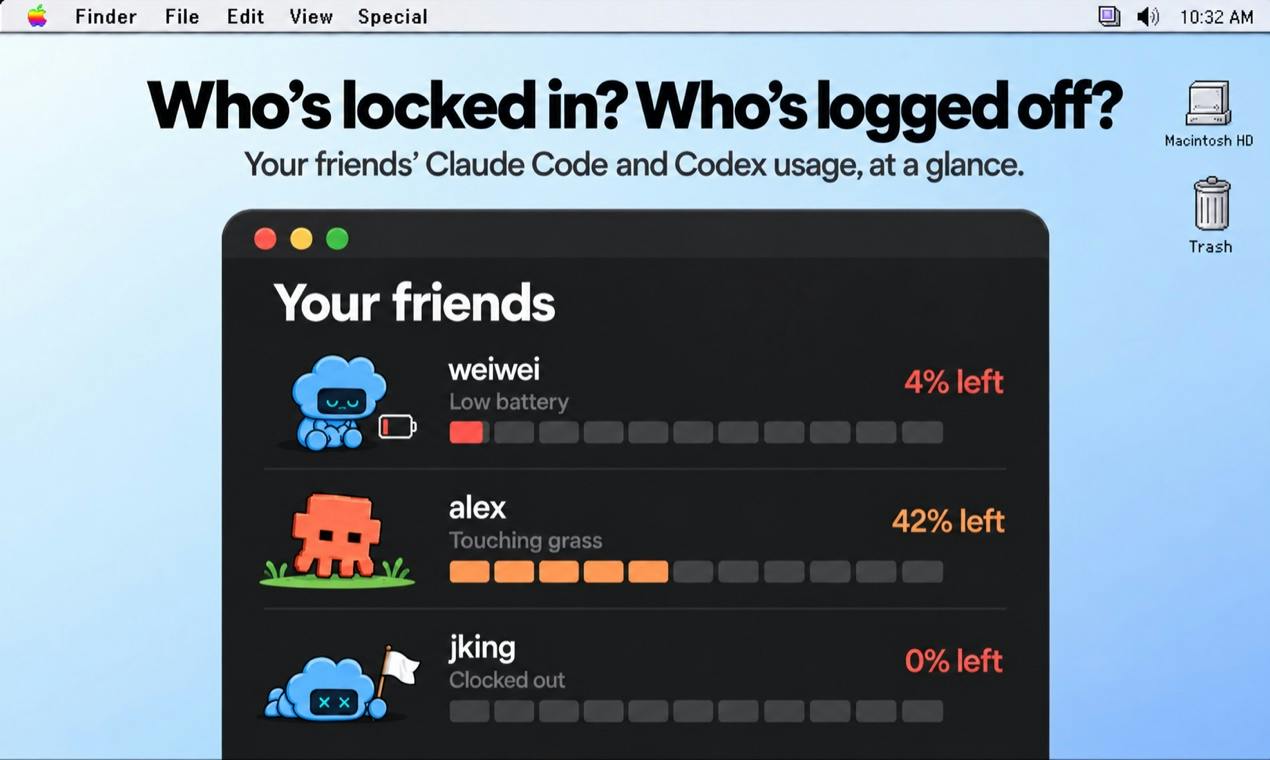
Die With Me (“LLM edition”) is a free Mac menu-bar app that recreates the AIM buddy-list experience for AI coding: it shows your friends’ remaining Claude Code and Codex usage allowances as little mascots, lets you set a status, visit friends’ rooms, and — the core conceit, borrowed from the 2018 low-battery chat app of the same name — unlocks a chatroom only when your session or weekly allowance drops to 20% or less. Your AI “clocks out,” and you wait out the rate limit with other exhausted builders. diewithme
The product serves a narrow, culturally coherent segment: heavy Claude Code and Codex users on Mac who share the ritual of hitting usage limits and want lightweight social presence while building. The strongest positive signal is genuine community resonance — an #8 finish on Product Hunt’s September 17, 2026 daily leaderboard, 88 upvotes, roughly 33 comments, a hunt by Chris Messina, and an immediate Hacker News “Show HN” discussion within 24 hours. The invite-gated mechanics and charming execution suggest a capable, taste-driven builder. hunted
The most important investment concern is that there is no business here in any conventional sense: no monetization, no disclosed company entity, a founder identifiable only by first name, no team, no funding, and no verified user or revenue data. The app’s data access depends on unofficial methods of reading Claude Code and Codex usage that the platforms do not expose publicly — a fragile, unlicensed dependency. producthunt
Venture Potential scores 29/100 (weak venture case). The unicorn path is Improbable. Valuation Attractiveness is Not Assessable because no round, revenue, or terms exist. Final decision: Pass — an appealing community artifact that currently has no venture-scale commercial model, founder structure, or defensibility.
Product Overview
The customer problem is partly real and partly invented. Real: developers on subscription tiers of Claude Code and Codex hit session and weekly usage limits and experience idle, frustrating wait periods. Invented (deliberately): the product wraps that friction in nostalgia — the AIM away-message era of ambient, low-pressure online presence. producthunt
How it works: install the Mac app, connect Claude Code by signing in (Codex usage is fetched via the existing sign-in), claim a username, and add friends via friend codes. Everyone’s remaining “energy” appears as mascots in the menu bar that get sleepier as allowances run out. When your lowest remaining allowance across tools reaches 20% or less, the “cooldown club” chatroom opens; when usage resets, you leave. The app also features a “Codex reset watch” that checks for reported usage resets every five minutes, powered by a third-party service (“Codex Resets”). Rankings are available across Friends and Global lists, ordered by who is closest to running out. diewithme
Core features: buddy-list presence, statuses, friend rooms, mascot lounge, invite allocation (members get daily invitation spots), and the gated chatroom. Platforms: Mac only, distributed via the website (not the App Store), invite-gated; a Windows waitlist exists. Pricing: free, with no paid tier or visible monetization. The alternative it replaces is loose, ambient presence on Discord or Slack, or standalone usage dashboards that show your own tokens without any social layer. diewithme
Founder and Team Assessment
The founder is identifiable only as “Weiwei,” who describes herself in the site’s builder note as someone who “likes bringing people together,” typically by organizing events and meetups. No last name, LinkedIn company page, GitHub organization, prior companies, exits, or funding history could be found. The Product Hunt launch was hunted by Chris Messina, a well-known hunter — a modest quality signal, but not evidence of institutional backing. diewithme
Technical capability is evidenced only by the shipped product: a polished, multi-service native Mac app with presence, invites, chatrooms, and animated mascots is a real build, and the launch copy and community handling are well executed. Commercial capability, founder-market fit beyond community-organizing instincts, team size, hiring signals, and full-time commitment are all unverifiable. Key-person risk is total, and the founder cannot be independently verified beyond these self-reported materials. diewithme
Founder Assessment: Evident product taste and community instincts, but identity, background, and commercial capability remain unverified — and unverifiable from public sources.
Market Opportunity
The initial target customer is narrow and specific: a Mac-using developer or “vibe coder” on a paid Claude or OpenAI subscription who works with Claude Code or Codex daily, hits rate limits weekly, and has friends doing the same. Claude Code and Codex are heavily used among professional and enthusiast developers — a pool plausibly in the low millions of paying users globally, but that is an analyst assumption, not verified data.
Willingness to pay is the central problem: the app is free, and the behavior it gamifies (waiting out a rate limit) is itself an artifact of current subscription-limit designs that Anthropic and OpenAI will keep changing. Monetization for a whimsical presence layer over someone else’s metering system is unproven anywhere in the market.
A bottom-up view (analyst assumption): even if 1 million active Claude Code/Codex users existed on Mac, realistic adoption for a novelty social layer at, say, 3–5% would be 30,000–50,000 users, and with no revenue per user, addressable revenue is approximately zero under the current model. Adjacent expansion (Windows support is waitlisted, more AI tools, team/company presence for AI usage) could widen the funnel, but none of it changes the absence of a revenue model. Timing is genuinely favorable for the cultural moment — rate-limit frustration is a shared experience in 2026 — which explains the launch resonance but not a durable market.
Traction and Growth Signals
- Product Hunt: launched September 17, 2026; 88 upvotes and roughly 33 comments per the tracker Hunted.Space, which placed it #9 on the daily leaderboard, while Product Hunt’s own daily leaderboard shows it at #8 — a minor conflict with no material impact; either way it was a top-10 finish of that day. The page has about 131 followers. producthunt
- Hacker News: a “Show HN” thread appeared September 18, 2026, indicating organic secondary-community pickup. news.ycombinator
- Distribution mechanics: invite-gated activation with daily invitation spots per member — a deliberate scarcity loop, but also a cap on growth. diewithme
- App Store/Play: not listed; distributed only via the website. diewithme
- Users, retention, usage, revenue, funding: not publicly disclosed. No reliable public information was found.
The most important missing metrics are active users, chatroom engagement, retention across usage-reset cycles, and any intent to monetize. Three days post-launch, nothing distinguishes durable usage from launch-day novelty.
Traction Assessment: Positive launch-day community response, but commercially unverified and monetization-free.
Competitive Position
Direct competitors: none with this exact framing; the closest analogues are Claude Code usage dashboards (open-source tools like ccusage and similar trackers) and general AI-usage monitors. Indirect competitors: Discord and Slack servers where AI builders already congregate, and the original 2018 Die With Me (by Dries Depoorter and David Surprenant), which is unrelated to this product but owns prior brand association — the Product Hunt URL suffix “-2” exists precisely because of that collision. Free alternatives: group chats, shared status updates, or simply waiting. apps.apple
Large-platform replication risk is severe in both directions. Anthropic or OpenAI could natively expose usage presence (or eliminate rate-limit friction entirely, dissolving the premise). Discord could ship “AI usage” statuses. The app’s differentiation is purely experiential — charm, nostalgia, and design execution — with no proprietary data, no formal platform API access (usage is read through methods the makers decline to detail, “the same way those dashboards do it” ), and network effects that only become defensive at a scale the niche likely cannot reach. To the question “why would users stay if a large platform shipped this,” there is no strong answer beyond community affection. producthunt
Defensibility Assessment: Low
Business Model and Economics
There is no business model. The product is free, has no published pricing, no paid tier, no advertising, and no disclosed path to revenue. Gross margin is not meaningful to assess because revenue is zero. Cost structure appears modest — a bundled native app, a backend for presence and chatrooms, and polling of usage data — but infrastructure and support costs are not disclosed. Customer acquisition is organic/community-driven (Product Hunt, Hacker News, invite mechanics) with no paid channels observed. diewithme
If a model were eventually attempted, plausible options would be a consumer subscription, cosmetic mascot monetization, or B2B team-presence analytics — but each would require product and positioning changes that today’s brand (explicitly anti-productivity, cozy, invite-only) does not suggest. None of these can be evaluated on current evidence.
Unicorn Path
Assume a consumer social multiple of roughly 5x revenue — generous for a niche consumer network. Required revenue ≈ $1 billion ÷ 5 = $200 million ARR. With no pricing, the customer arithmetic cannot even be constructed; at a hypothetical $5/month subscription, it would require approximately 3.3 million paying subscribers, from a global population of heavy Claude Code/Codex users on Mac that plausibly numbers in the low millions, before accounting for the near-certain ceiling on willingness to pay for a rate-limit waiting room.
Reaching that scale would require a strategic transformation the current product forecloses: monetizing a deliberately cozy, invite-gated novelty app; expanding cross-platform beyond Mac; building retention across usage-reset cycles; and surviving any change by Anthropic or OpenAI to how limits are metered or exposed. The combination of a tiny monetizable market, platform dependency, and no revenue model puts a $1B outcome beyond realistic reach under any foreseeable version of the current concept.
Unicorn Path: Improbable
Valuation Assessment
No funding history, investors, rounds, SAFE caps, or valuations are publicly known; the founder’s identity is not even fully public. There is no revenue to multiple. Comparable consumer social seed financings are not meaningful benchmarks for a free, unmonetized, three-day-old solo project.
“Valuation Attractiveness: Not Assessable.” Assessing it would require: verified user counts, retention, any monetization plan and early conversion data, a legal entity, a cap table, and current round terms or fundraising intent. None of these exist publicly.
Key Risks
- No revenue model — the product has no monetization, pricing, or disclosed commercial intent. diewithme
- Total platform dependency — usage data is read through unofficial methods against services that do not expose public APIs; any change by Anthropic or OpenAI could break the product’s core function. producthunt
- The product’s premise is someone else’s flaw — if AI providers raise limits or change metering, the “die together” ritual disappears.
- Founder un-verifiability — no last name, entity, or track record; key-person and continuity risk are absolute. diewithme
- Brand collision and potential trademark exposure — the name is already strongly associated with the well-known 2018 Dries Depoorter app. apps.apple
- Novelty-driven churn — the hook is a joke/meme structure; sustained usage across reset cycles is unproven.
- Invite gating caps growth — deliberate scarcity limits the network effects the concept depends on. diewithme
- Mac-only distribution — a minority platform within an already narrow segment.
Final Assessment
Venture Potential: 29/100
| Category | Score |
|---|---|
| Market Size and Expansion Potential | 6/20 |
| Traction and Growth Evidence | 4/20 |
| Founder and Team | 4/15 |
| Product Strength | 6/10 |
| Distribution Potential | 6/15 |
| Business Model and Economics | 1/10 |
| Defensibility | 2/10 |
| Total | 29/100 |
The strongest elements are product charm and cultural timing (top-10 PH day finish, immediate HN pickup, credible execution). The weakest are the complete absence of a business model, unverifiable founder structure, low defensibility, and platform dependency on unlicensed data access.
Evidence Confidence: 38/100
Verified: the product exists and functions as described (website, PH launch, HN thread), it is free and invite-gated, it launched September 17, 2026, and it was hunted by Chris Messina. Company-reported: the builder’s note, mascot/room features, and usage-reading claims. Unknown: founder surname and background, legal entity, headquarters, team, funding, users, retention, revenue, and any monetization intent. A minor data conflict exists on the daily leaderboard position (#8 on Product Hunt’s leaderboard vs. #9 on Hunted.Space). diewithme
Final Decision: Pass
Die With Me is a delightful, well-executed cultural artifact with genuine launch resonance, but it is not a venture investment: no revenue model, no defensible position, an unverifiable founder structure, an Improbable unicorn path, and a business premise built on top of another company’s rate-limiting behavior. Nothing here supports even formal due diligence, and no valuation information exists. Pass does not mean the product is bad — it is likely to succeed as exactly what it appears to be: a beloved community project.
Upgrade Conditions
- A verified legal entity, full founder identity, and committed full-time team.
- A demonstrated monetization path with measurable conversion (e.g., paid cosmetics or subscription) and sustained retention across multiple usage-reset cycles.
- Verified user scale beyond the invite-gated launch cohort (e.g., 100,000+ monthly active users).
- Platform-resilient or multi-tool data access that survives API changes by Anthropic or OpenAI.
- Evidence of retention-driven network effects rather than novelty usage.
Downgrade Conditions
- Anthropic or OpenAI blocking unofficial usage reads, or raising limits enough to dissolve the core ritual.
- A trademark dispute with the original Die With Me’s creators. apps.apple
- Usage collapsing after the launch novelty window.
- Founder abandoning the project — a realistic outcome for an unmonetized side project.
Questions for Further Diligence
- What are current registered users, weekly active users, and chatroom participation rates?
- What share of users returns across at least three usage-reset cycles?
- How exactly is Claude Code and Codex usage data being read, and what happens when either vendor changes it?
- Has either Anthropic or OpenAI contacted the team about its data-access methods?
- Is a legal entity incorporated, and who owns it?
- Is there any monetization roadmap, and what would users plausibly pay for?
- Why invite-gating, and what is the intended steady-state community size?
- Who is Weiwei — full background, prior work, and time commitment to the project?
- Has any funding been raised or sought, and is any planned?
- What is the plan for Windows and non-Mac users, and what share of demand is waitlisted?
- How are the “Codex Resets” third-party data and the 5-minute polling loop funded and maintained?
- Is there any trademark clearance work on the “Die With Me” name?
Sources
- Product Hunt — Die With Me producthunt
- Official website — diewithme.co diewithme
- Hunted.Space launch dashboard (secondary source) hunted
- Product Hunt daily leaderboard, September 17, 2026 producthunt
- Hacker News — Show HN: Die With Me news.ycombinator
- Name-collision context: original Die With Me App Store listing apps.apple
- Laughing Squid — original 2018 Die With Me coverage laughingsquid