
Table of Contents
MCPJam Investment Report
Category: Developer tools — open-source testing, evaluation, and observability platform for MCP (Model Context Protocol) servers and AI-app integrations
Company Stage: Seed-stage startup; product open-sourced May 2025, company formed September 2025, backed by Open Core Ventures github
Founder or Founders: Matthew Wang (co-founder and original CEO; previously Software Engineer at Asana, Duke CS/Economics) and Prathmesh Patel (CEO since March 2026; former Asana API & Developer Platform Tech Lead) linkedin
Headquarters: MCPJam Inc., 455 Market St, San Francisco, CA mcpjam
Funding: Backed by Open Core Ventures; amount and valuation not publicly disclosed linkedin
Business Model: Open-core SaaS with usage credits (Free / Pro $24/mo / Team $199/mo / Enterprise) mcpjam
Product Hunt Launch Date: Second launch the week of September 17, 2026; first launch January 20, 2026 producthunt
Report Date: September 20, 2026
| Investment Metric | Assessment |
|---|---|
| Venture Potential | 55/100 |
| Unicorn Path | Conditional |
| Valuation Attractiveness | Not Assessable |
| Evidence Confidence | 55/100 |
| Final Decision | Watch |
Executive Summary
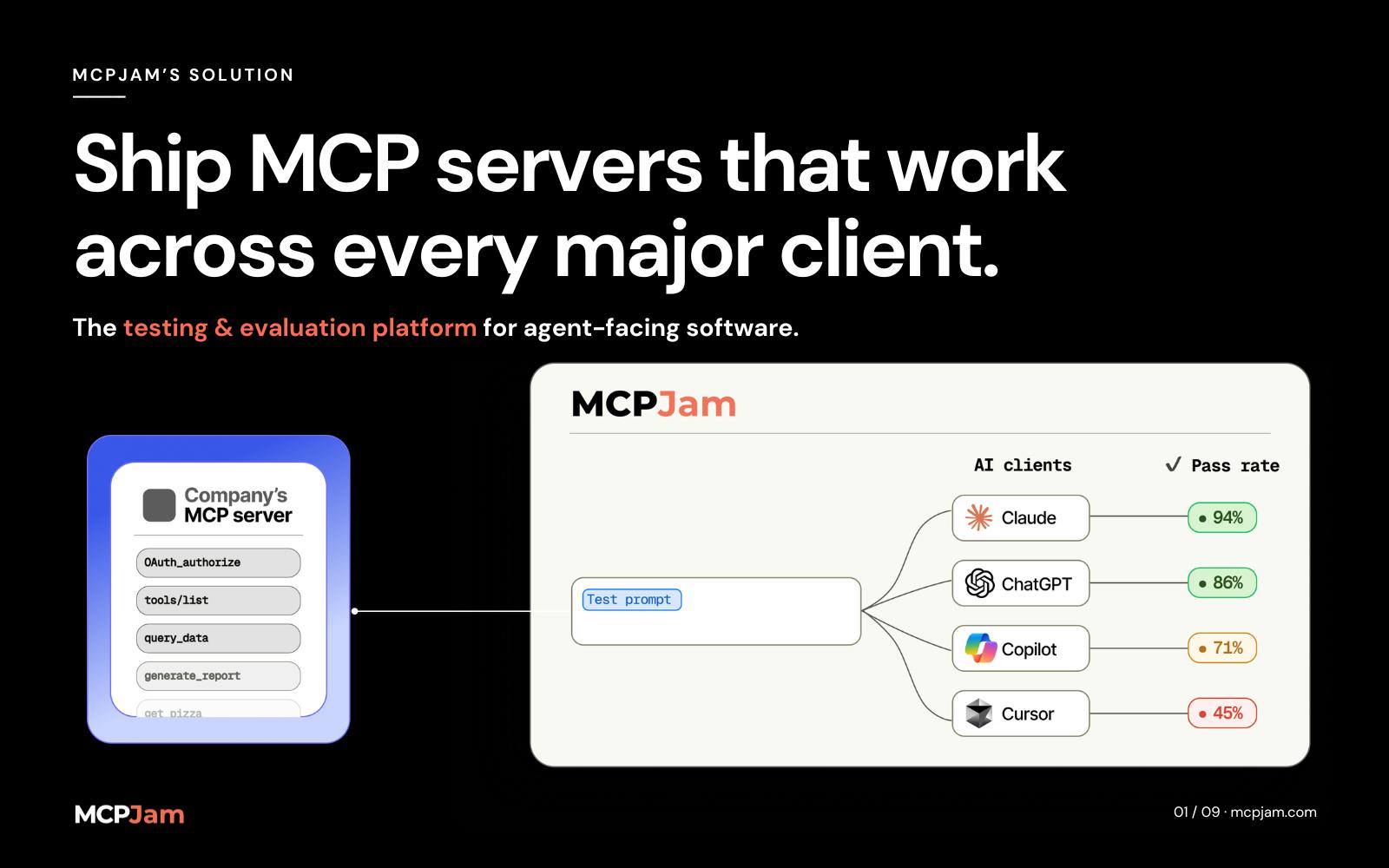
MCPJam is an open-source testing and evaluation platform for developers building MCP servers and MCP/ChatGPT apps. It lets teams interactively test tools, prompts, resources, and OAuth flows with full JSON-RPC observability, run LLM-based evaluations across 170+ models and 16 client configurations, and gate CI/CD pipelines on regressions — essentially “Postman plus evals” for the emerging MCP ecosystem. github
The company serves engineering teams shipping agent integrations for ChatGPT, Claude, and Copilot — a segment that did not exist before the MCP standard’s adoption. It claims more than 106,000 developers and 300+ enterprise users — company-reported figures that are plausible given roughly 2,100+ GitHub stars and an active release cadence, but not independently verified. producthunt
The strongest positive signal is founder-market fit and timing: both co-founders come from Asana’s API and developer-platform organization, MCP adoption is accelerating across OpenAI, Anthropic, and Microsoft ecosystems, and MCPJam is an early mover in MCP-specific testing and evaluation with genuine functional differentiation over Anthropic’s own free MCP Inspector. linkedin
The most important concerns are threefold. First, commercial traction — revenue, paying customers, retention — is entirely undisclosed. Second, the original CEO, Matthew Wang, appears to have moved on: his LinkedIn shows him as CTO at another company (Traack) since March 2026, even as his personal site still lists him as MCPJam’s CEO, a conflict that raises leadership-continuity questions. Third, defensibility is capped by the existence of a free, official inspector from the protocol’s own maintainers. linkedin
Venture Potential scores 55/100 — promising but insufficiently validated. The unicorn path is Conditional on MCP Jam expanding from niche testing into a broader agent-integration reliability platform while the MCP standard itself survives and consolidates. With no disclosed round size or valuation, Valuation Attractiveness is Not Assessable. Final decision: Watch, pending verification of commercial traction and leadership stability.
Product Overview
The problem: MCP servers and ChatGPT apps fail in ways traditional API testing cannot catch — an LLM may call a tool with the wrong arguments, miss it entirely, or time out for the agent, even when the server is technically correct. Developers shipping agent integrations previously tested by hand in a live chat window.
MCPJam’s workflow: connect a local or remote server (STDIO, SSE, or Streamable HTTP), then use the Inspector to manually run tools, prompts, resources, and elicitation flows with full JSON-RPC trace visibility; chat against frontier models to see how an agent actually uses the server; run structured evals with expected tool calls across multiple LLMs; and run connectivity, OAuth-conformance, and regression checks in CI (GitHub Actions and other systems) to gate PRs. A desktop app, CLI, and SDK are offered, plus workspaces with shared server groups and team sync. producthunt
Target users are platform and integration engineers at companies building MCP servers for enterprise AI clients. Pricing is a generous free tier (200 credits/day, unlimited seats), Pro at $24/month ($288/year, 5,000 credits), Team at $199/month ($2,388/year, 50,000 credits, RBAC, SSO), and custom Enterprise terms. The core client, CLI, and SDK are open source “free, forever” on GitHub. mcpjam
The product replaces manual testing in Claude/ChatGPT windows and supplements Anthropic’s official MCP Inspector, which handles basic connectivity but lacks LLM-driven evaluation, multi-client simulation, and CI gating. agnost
Founder and Team Assessment
The founding story is verifiable in outline. Matthew Wang, a Duke CS/Economics graduate and former Asana engineer, began building the open-source MCP inspector in May–June 2025 and co-founded MCPJam in September 2025 with Open Core Ventures backing. Prathmesh Patel — former technical lead for Asana’s API & Developer Platform team, which built Asana’s own MCP platform — has been CEO since March 2026 and is also a Duke graduate. linkedin
This is strong founder-market fit: both founders built API platforms for an enterprise SaaS company and now sell tooling to teams doing the same thing for AI clients. A Head of Growth (Sophie Vo, Columbia MBA) has been added, indicating early go-to-market investment. Total team size appears to be small (single digits) — not formally disclosed. linkedin
The unresolved issue is leadership continuity. Wang’s LinkedIn shows his MCPJam CEO role ending March 2026 and a current CTO position at Traack, while his personal website still presents him as “Co-Founder & CEO at MCPJam, where I lead a small team”. This is a material conflict between two primary sources; the LinkedIn role history is treated as more reliable here. A CEO transition seven months after the company’s formation, with the departing founder’s continued self-description as CEO, requires explanation in diligence. linkedin
Founder Assessment: Strong founder-market fit and technical credibility, but the unresolved CEO transition and undisclosed team size leave execution risk unquantified.
Market Opportunity
The initial customer is narrow: engineering teams at software companies shipping MCP servers or ChatGPT/Claude apps — i.e., the emerging “agent-integration platform” function. Their problem is reliability: an integration that misbehaves in an AI client damages both the shipper’s and the platform’s user experience. Willingness to pay follows the developer-tooling pattern — individual developers use the free tier, teams pay for CI gating, RBAC, and eval history. mcpjam
Bottom-up estimate (analyst assumption, not verified data): if the MCP ecosystem supports on the order of 20,000–50,000 organizations actively building agent integrations by 2026–2027, and 5–10% adopt a paid testing/evals platform at a blended $2,400–$10,000 per year (Team to Enterprise mix), the near-term addressable revenue is roughly $25–150 million ARR. That can support a meaningful venture business, but not automatically a large one — the ceiling depends on MCP becoming the durable standard for tool integration, which is plausible but not assured. Adjacent expansion is credible: agent-integration observability, security/compliance gating for enterprises, and testing for agentic workflows more broadly. Timing is favorable — MCP moved from an Anthropic-spec oddity to cross-industry adoption in roughly two years, creating a tooling vacuum.
Traction and Growth Signals
- Product Hunt: second launch the week of September 17, 2026 (4.5 rating from 2 reviews, 456 followers); first launch January 20, 2026. producthunt
- GitHub: ~2,100–2,200 stars and ~265 forks on the open-source repository, with sustained releases and a published security-advisory process. ossinsight
- Company-reported usage: 106,000+ developers and 300+ enterprises — not independently verifiable, and inconsistent with no disclosed paying-customer count. producthunt
- Distribution: npm package, Docker images, docs site, and a LinkedIn-visible growth function. docs.mcpjam
- Hiring: a Head of Growth hire is the only visible signal; no job listings were found. linkedin
- Funding: Open Core Ventures backing disclosed on LinkedIn; one secondary database (Parsers VC) lists Swift Ventures as a portfolio investor — unverified. linkedin
- Revenue, paying customers, retention, and conversion: not publicly disclosed.
The most important missing metrics are ARR, paid-team conversion from the free tier, and logo retention. A past RCE vulnerability in inspector versions ≤1.4.2 (disclosed and patched January 2026) is a caution flag for a security-adjacent tool, though disclosure handling was appropriate. github
Traction Assessment: Credible developer-community traction and real product velocity, but commercial traction is unverified.
Competitive Position
Direct competitor: Anthropic’s official, free, open-source MCP Inspector (connectivity, basic tool testing) — the incumbent baseline that MCPJam must out-feature permanently. Adjacent competitors: eval platforms (Braintrust, LangSmith, Galileo) expanding toward MCP testing, and Postman-style API tooling adding MCP support. Ecosystem comparables: well-funded MCP-infrastructure startups such as Manufact ($6.3M seed led by Peak XV) and Klavis AI, and Alpic ($6M pre-seed for MCP-native cloud) — evidence that investors are funding this layer, and that MCPJam’s testing niche sits adjacent to, not inside, those capital pools. agnost
MCPJam’s differentiation is real today: multi-client simulation, 170+ model coverage, OAuth conformance checking, CI gating, and eval tracking do not exist in the official inspector. Distribution advantages include open-source discovery via GitHub/npm and first-mover brand within “MCP testing” searches. But switching costs are low, no proprietary data exists yet, and the protocol’s owner could bundle richer testing into its own stack. If Anthropic shipped full eval and CI features in the official Inspector within six months, MCPJam’s defense would rest on multi-vendor neutrality (testing for Claude, ChatGPT, and Copilot clients in one place) — a credible but narrow answer, since neutrality is exactly what an ecosystem-neutral tool must sell. agnost
Defensibility Assessment: Low-to-Medium
Business Model and Economics
The model is open-core SaaS with metered credits: free tier for individuals, $288/year Pro, $2,388/year Team, custom Enterprise. Gross-margin potential is high — the variable cost is largely LLM inference for eval and chat runs (the “credits” unit), infrastructure for traces and logs, and support. The credit structure passes inference costs through to usage-based pricing, which is structurally sound: heavier usage buys more credits at $9–10 per 1,000, so revenue scales with the dominant variable cost. The key unknowns are the cost per credit (i.e., real gross margin), free-to-paid conversion, and whether teams renew after initial integration projects conclude — MCP testing may be project-scoped rather than continuous, which would depress net revenue retention. mcpjam
Customer acquisition is organic-first (GitHub, npm, docs, Product Hunt), typical for dev tools and efficient if the 106,000-developer claim is accurate. Enterprise expansion (SSO, audit logs, advanced RBAC) is the natural ACV ladder. No revenue, conversion, or retention data is available to validate any of this. mcpjam
Unicorn Path
Assume a revenue multiple of 10x ARR, appropriate for a high-growth developer-tooling SaaS with open-source distribution (comparable to premium dev-tool financings; public comparables trade higher but with far more scale). Required revenue ≈ $1 billion ÷ 10 = $100M ARR. At the Team tier ($2,388/year), that implies roughly 42,000 paying team accounts, or a realistic blend of perhaps 5,000–15,000 customers at blended ACVs of $7,000–$20,000 moving up the enterprise ladder.
That is achievable only if three strategic conditions hold: (1) MCP becomes the durable standard for agent-tool integration across vendors; (2) MCPJam converts from a testing utility into a continuous reliability/observability platform enterprises pay for year-round, not just at integration time; and (3) the company survives the official-tooling and eval-platform competition long enough to build workflow lock-in and proprietary benchmarking data. Each is plausible; the conjunction is not assured, and the outcome requires business-model expansion beyond the current niche.
Unicorn Path: Conditional
Valuation Assessment
Known: Open Core Ventures backing (venture-studio model) and a possible additional investor per a secondary database. Unknown: round size, post-money valuation, SAFE caps, current fundraising status, and all revenue metrics. Comparable financings (Manufact at $6.3M seed for MCP infrastructure; Alpic at $6M pre-seed) suggest the category attracts seed capital, but MCPJam’s specific terms are not public. linkedin
“Valuation Attractiveness: Not Assessable.” Required information: current ARR and growth, paid-customer count and retention, gross margin, round size and valuation, cap table, and any liquidation preferences.
Key Risks
- Protocol concentration risk — the entire business exists only if MCP remains the dominant agent-integration standard; a fragmentation or displacement event is existential.
- Official free competitor — Anthropic’s own Inspector could absorb the feature set, since the protocol owner ships the baseline for free. github
- Unverified commercial traction — the 106,000-developer claim is company-reported with no revenue or retention disclosure. producthunt
- Leadership transition — the founding CEO’s apparent departure in March 2026, with conflicting self-descriptions across his own profiles. linkedin
- Project-scoped demand — testing may cluster at integration time, limiting renewal and net revenue retention.
- Eval-platform encroachment — Braintrust, LangSmith, and similar funded platforms expanding into MCP testing.
- Security product risk — the January 2026 RCE vulnerability in the inspector itself, though disclosed and patched. github
- Small-team execution risk — a single-digit team competing against well-funded adjacent players.
Final Assessment
Venture Potential: 55/100
| Category | Score |
|---|---|
| Market Size and Expansion Potential | 12/20 |
| Traction and Growth Evidence | 9/20 |
| Founder and Team | 9/15 |
| Product Strength | 7/10 |
| Distribution Potential | 10/15 |
| Business Model and Economics | 5/10 |
| Defensibility | 3/10 |
| Total | 55/100 |
The strongest elements are product differentiation within a genuinely new category, open-source distribution, and unusually good founder-market fit. The weakest are unverified commercial traction, low structural defensibility against the protocol’s owner, and total dependence on MCP’s survival as a standard.
Evidence Confidence: 55/100
Verified: product scope and features (GitHub, docs), pricing, entity and San Francisco address, GitHub traction, both co-founders’ identities and Asana backgrounds, OCV backing, and both PH launches. Company-reported: the 106,000-developer and 300-enterprise claims. Estimated: the addressable-market sizing. Unresolved conflicts: the CEO-transition discrepancy between Wang’s LinkedIn and personal site. Unknown: revenue, funding amount, valuation, team size, retention, and current fundraising status. linkedin
Final Decision: Watch
MCPJam sits in a real, growing category with a differentiated product and credible founders, but the investment case currently rests on unverified company-reported usage, zero disclosed commercial metrics, a leadership transition that needs explanation, and defensibility constrained by the protocol owner’s free tooling. Venture Potential (55) is in the “promising but insufficiently validated” band, and the unicorn path is conditional. Formal due diligence would be premature until basic commercial evidence exists. The company should be re-examined as its next milestones land.
Upgrade Conditions
- Verified ARR above $1M with disclosed paying-customer count and logo retention.
- Clarity on leadership: a stable, committed full-time founding team with the CEO transition explained.
- Demonstrated enterprise conversion (SSO/audit-tier customers, multi-year contracts).
- GitHub/community traction continuing to compound (e.g., 5,000+ stars, sustained npm adoption) beyond launch spikes.
- A funding round with disclosed terms at a defensible valuation.
Downgrade Conditions
- Anthropic shipping evals and CI gating into the official Inspector.
- Material slowing of MCP adoption or fragmentation of the standard.
- Inability to convert the claimed developer base into measurable paid revenue.
- Further founder departures or evidence the company is not the CEO’s primary commitment.
- Another significant security vulnerability in the tooling itself.
Questions for Further Diligence
- What are current ARR, paying-customer count, and monthly revenue growth since January 2026?
- How many of the claimed 300+ enterprises are paying, and at what tier?
- What is free-to-paid conversion, and 30/90/180-day team retention?
- What is the cost per 1,000 credits, and what gross margin does that imply?
- Is revenue concentrated in integration-launch projects or recurring reliability usage?
- What exactly happened in the March 2026 CEO transition, and what is Matthew Wang’s current involvement?
- What are team size, open roles, and hiring plan?
- How much capital has Open Core Ventures deployed, at what valuation, and is a new round being raised?
- How would the company respond if Anthropic shipped full eval and CI features in the official Inspector?
- What share of usage tests Claude versus OpenAI/Microsoft clients, and how exposed is revenue to any single vendor’s ecosystem?
- How was the January 2026 RCE vulnerability discovered and remediated, and what is the security roadmap?
Sources
- Product Hunt — MCPJam producthunt
- Official website — mcpjam.com pricing mcpjam
- MCPJam GitHub repository github
- MCPJam documentation docs.mcpjam
- Inspector feature page (open-source commitment) mcpjam
- Prathmesh Patel — CEO, LinkedIn linkedin
- Matthew Wang — LinkedIn linkedin
- Matthew Wang — personal site mattwang
- Sophie Vo — Head of Growth, LinkedIn linkedin
- Privacy policy (entity and address) mcpjam
- OSSInsight — GitHub analytics (secondary) ossinsight
- GitHub security advisory GHSA-232v-j27c-5pp6 github
- Competitor context: official MCP Inspector; Agnost testing comparison (secondary) agnost
- Market context: Manufact $6.3M seed (FinSMEs); Alpic pre-seed (Partech) finsmes