Table of Contents
GBrain Investment Report
Category: AI agent memory and team workspace
Company Stage: Early-stage; Y Combinator Spring 2026 company ycombinator
Founder or Founders: Brad Gessler, Garry Tan, and Jamison Mercurio, according to GBrain; Y Combinator lists Gessler and Mercurio as active founders ycombinator
Headquarters: San Francisco, California ycombinator
Funding: GBrain names Y Combinator, Initialized, Transpose Platform, and angels as backers; amounts and terms are not publicly disclosed gbrain
Business Model: Hosted subscription per workspace, plus purchases of additional usage credit; free-to-run open-source components gbrain
Product Hunt Launch Date: September 2026; exact launch day not independently verified producthunt
Report Date: September 26, 2026
| Investment Metric | Assessment |
|---|---|
| Venture Potential | 58/100 |
| Unicorn Path | Conditional |
| Valuation Attractiveness | Not Assessable |
| Evidence Confidence | 49/100 |
| Final Decision | Watch |
Executive Summary
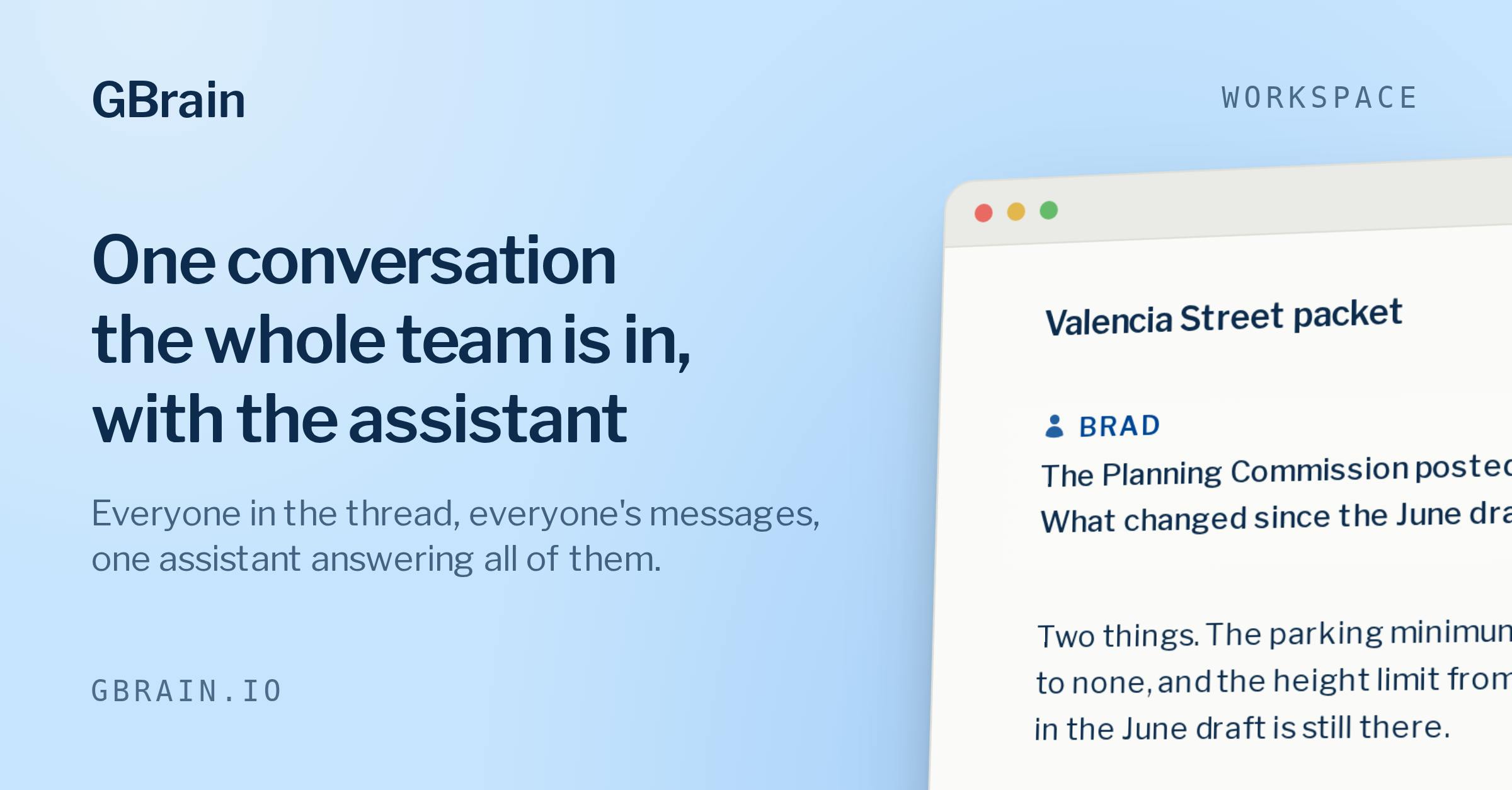
GBrain offers a shared memory, chat workspace, connected accounts, and scheduled jobs that teams can use across AI clients including ChatGPT, Claude, and Cursor. Its hosted service costs $199 per workspace per month and includes $100 in monthly usage credit. The underlying GBrain knowledge layer is available as open-source software. gbrain
The initial proposition is credible for small, AI-intensive teams: preserve decisions and context when people or AI tools change, while administering connected accounts in one place. Editable files and a model-independent design make the product more distinctive than a memory feature confined to one assistant. These are product advantages, not evidence that customers will pay or stay. github
The strongest observable signals are the founders’ relevant experience and sustained software development. Y Combinator identifies Gessler as a Poll Everywhere co-founder and former CTO, and Mercurio as a former Meta engineer and startup founder. The public repository showed approximately 30,300 stars, 1,086 commits, and a September 25 commit when reviewed; these figures demonstrate developer interest and activity, not hosted-service revenue. ycombinator
The central concern is commercial validation. Public sources reviewed do not establish paying-workspace count, revenue, retention, gross margin, or repeatable acquisition. GBrain also asks customers to entrust it with sensitive organizational context and account access, while its own privacy page says it lacks SOC 2 or comparable third-party certification. Watch, rather than formal due diligence, until paying-team retention and economics become demonstrable. gbrain
Product Overview
A team’s decisions may be scattered across conversations, notes, email, and separate AI assistants. GBrain’s proposed replacement is one shared workspace: team members can correct its notes, connect accounts with specified permissions, query knowledge through a browser or compatible AI clients, and schedule jobs such as a daily activity brief. GBrain describes the notes as portable Markdown files. The hosted service runs on dedicated compute; the open-source layer also supports self-managed setups. github
The target user appears to be a technically comfortable founder or small team using several AI tools and business applications. Explorer is the publicly advertised paid plan at $199 monthly per workspace, irrespective of team size, with $100 of usage credit; additional credit can be purchased. Open-source deployment is an alternative, but it is not the same as obtaining the entire hosted stack for free: a Product Hunt maker says the rest of that stack is not currently self-hostable. No mobile-app distribution was verified. gbrain
Product quality: Promising design and substantial visible engineering, but independent tests of reliability, answer quality, onboarding time, and production performance were not established by this research. github
Founder and Team Assessment
GBrain names Gessler as CEO, Tan and Mercurio as co-founders, and says the three build the product. Y Combinator independently hosts a company listing showing a three-person team in San Francisco, but its active-founder entries name only Gessler and Mercurio. Tan’s exact operating commitment and equity role therefore need clarification; the differing presentations should not be flattened into an assumption that all three work full-time. ycombinator
Y Combinator reports Gessler’s Poll Everywhere technical leadership and Mercurio’s previous founding and engineering roles. The public repository supports technical execution, while commercial execution at GBrain remains unproven. The YC listing showed no open jobs; that does not establish a hiring plan. The small team creates key-person and support-capacity risk for a hosted, security-sensitive service. ycombinator
Founder Assessment: Strong apparent technical and relevant startup experience; commercial execution and each founder’s ongoing commitment require verification.
Market Opportunity
The narrow initial segment is US-based, roughly 20–99-person, knowledge-intensive companies whose staff regularly use multiple AI assistants. They may pay to reduce repeated setup and recover shared decisions, but their willingness to pay for GBrain is unverified. Pew, using Census-based estimates, places 8% of roughly six million US small employer firms in the 20–99-employee band—about 480,000 firms across all industries, not 480,000 qualified buyers. pewresearch
An illustrative, analyst-assumed filter of 100,000–300,000 suitable firms, at the published $2,388 annual workspace price, yields approximately $239 million–$716 million in annual subscription spending if every selected firm bought. Neither the filter nor adoption rate is measured; this is a market-sizing scenario, not a sales forecast. The reachable initial market is smaller and contested. International teams, larger organizations, governance features, and additional automation could expand it, but no enterprise pricing or proven expansion revenue was found. gbrain
Traction and Growth Signals
The Product Hunt page showed 119 points, a #11 day rank, and 130 followers when retrieved. Its comments include founder explanations of credential handling and the open-source option. These are launch-attention signals, not measures of customers, satisfaction, or recurring usage. producthunt
The stronger public signal is continuing code development: the repository displayed approximately 30,300 stars, 4,500 forks, 1,086 commits, and a September 25 latest commit. Those counts may include interest in the free project and cannot be attributed to paid workspace demand. No reliable public figures were found for downloads, active hosted teams, paying customers, ARR, revenue growth, renewal cohorts, customer references, or post-launch paid conversion. gbrain
Traction Assessment: Meaningful developer attention and product activity; commercial traction remains unverified.
Competitive Position
Mem0 directly addresses persistent memory across agents, while Glean offers cross-application enterprise knowledge retrieval and governance. Claude’s shared projects provide an incumbent alternative within one AI ecosystem. Free substitutes include GBrain’s own open-source components and manually maintained shared documents plus separately configured connectors. GBrain’s proposed distinction is the combination of shared, editable memory, multi-client access, account permissions, and scheduled work at one workspace price. gbrain
If a major AI platform shipped equivalent shared memory and connections within six months, why would teams stay? A possible answer is neutrality across AI clients, accumulated corrected records, and trusted workflows—but customers can export notes, and no proprietary dataset, network effect, or measured switching cost has been demonstrated. Larger platforms already bundle adjacent capabilities; integrations also leave GBrain exposed to their API and policy changes. gbrain
Defensibility Assessment: Low today. A durable advantage would require proof that cross-platform use and accumulated team workflows produce materially better retention than bundled alternatives.
Business Model and Economics
At list price, a continuously subscribed workspace represents $2,388 in annual subscription billings, before discounts, cancellations, and additional credit purchases. This is not verified average contract value. The $100 monthly credit is a customer-facing allowance, not evidence of $100 in company cost. Gross margin cannot be inferred without actual credit redemption, underlying model and search costs, dedicated-compute expense, payment fees, support time, and pricing of incremental credits. gbrain
Per-workspace pricing makes adoption by a growing team attractive but does not automatically increase subscription revenue as seats expand. GBrain must show either profitable additional usage, higher-priced plans, or another expansion mechanism. The crucial AI-economics test is whether revenue per active workspace rises—or costs remain bounded—as prompts, retrieval, scheduled jobs, and support use increase. Founder-led setup may help early conversions but may not scale efficiently. gbrain
Unicorn Path
For an illustrative high-growth software outcome, assume 8× annual recurring revenue. This is an analytical scenario, not a verified GBrain or comparable-company trading multiple. A $1 billion valuation would then require roughly $125 million ARR. At $2,388 annually per continuously paying workspace, that means about 52,300 workspaces before discounts or churn, with no credit top-ups counted. At the illustrative 480,000-firm all-industry US 20–99-employee ceiling, this would equal about 11% penetration—even though only a subset fits the product. gbrain
That makes the present flat-price, small-team proposition an ambitious standalone route. A more credible route would add international reach, larger-team or enterprise pricing, demonstrably profitable automation usage, and repeatable distribution. It would also require procurement-grade controls: GBrain states it has no current SOC 2 or comparable certification and no contractual uptime SLA in its standard terms. Required gross margin, customer lifetime, and viable enterprise contract value are not assessable publicly. gbrain
Unicorn Path: Conditional—possible through a broader, higher-value platform, not established by today’s disclosed plan or adoption evidence.
Valuation Assessment
GBrain names YC, Initialized, Transpose Platform, and angels as early backers; YC lists the company in its Spring 2026 batch. A round amount, latest valuation, SAFE cap, current fundraising status, ownership structure, and comparable transaction tied to verified GBrain revenue were not found. Competitors establish that the category exists, but their products do not supply a responsible valuation for this company. ycombinator
Valuation Attractiveness: Not Assessable. An investment-price judgment requires verified ARR and growth, retention, gross margin, burn and runway, plus round size, valuation or cap, ownership sought, and liquidation preferences. Product quality and repository popularity cannot substitute for those inputs.
Key Risks
- Unverified paid demand: Public developer interest may convert poorly into $199-monthly workspaces. gbrain
- Unverified retention: Shared memory must remain useful after initial setup, not merely during a launch trial. gbrain
- Limited subscription expansion: Adding teammates does not increase the published workspace fee. gbrain
- Unknown unit economics: Dedicated compute, AI usage, and hands-on support could compress margins; actual costs are undisclosed. gbrain
- Security and procurement friction: Connected accounts and sensitive team data raise the bar; third-party certification and a standard contractual SLA are absent. gbrain
- Incumbent bundling: Claude already offers shared projects, while established knowledge platforms offer broader connectors and governance. glean
- Integration dependency: Changes to connected services’ APIs, prices, or terms may disrupt access. gbrain
- Key-person and role ambiguity: YC’s active-founder list differs from GBrain’s three-founder presentation. ycombinator
Final Assessment
Venture Potential: 58/100
| Category | Score |
|---|---|
| Market Size and Expansion Potential | 15/20 |
| Traction and Growth Evidence | 5/20 |
| Founder and Team | 12/15 |
| Product Strength | 8/10 |
| Distribution Potential | 9/15 |
| Business Model and Economics | 5/10 |
| Defensibility | 4/10 |
| Total | 58/100 |
Technical execution and a coherent cross-platform customer problem are the strongest elements. Missing commercial metrics, uncertain expansion economics, and readily bundled alternatives are the weakest. The score reflects an investment thesis, not a measurement of product performance. gbrain
Evidence Confidence: 49/100
Pricing, product documentation, legal terms, repository activity, and YC’s company listing are publicly observable. Investors and aspects of founder involvement are company- or founder-reported; the YC listing provides a narrower active-founder description. Market filters and the unicorn calculation are explicitly analyst scenarios. Revenue, customers, retention, margins, acquisition costs, burn, valuation, and current round terms remain unavailable publicly. ycombinator
Final Decision: Watch
GBrain looks like a serious early product from a technically credible team, and a venture-scale expansion is conceivable. It does not yet meet the evidentiary threshold for formal investment due diligence on commercial traction: repository popularity and Product Hunt attention do not establish paying, retained teams. Unknown unit economics and valuation reinforce the Watch decision rather than implying the company is poor. gbrain
Upgrade Conditions
- Verify a meaningful cohort of paying workspaces, their acquisition sources, and 90- and 180-day renewal or retention.
- Demonstrate repeatable acquisition beyond the founders’ networks, Product Hunt, and open-source interest.
- Show positive workspace-level contribution after redeemed AI credits, compute, payment fees, and support; establish an enterprise pricing and governance path.
- Provide founder commitments, financials, customer references, cap table, and financing terms sufficient to justify DD.
Downgrade Conditions
A sustained fall in releases, poor paid renewal, usage costs exceeding workspace contribution, loss of a crucial integration, or a substantiated security or privacy failure would weaken the case. Materially misleading traction claims would warrant a separate integrity assessment. gbrain
Questions for Further Diligence
- What are current MRR, paying-workspace count, and monthly net revenue growth, excluding promotional first-month payments?
- How many workspaces and active users use the hosted service weekly, and what share of trials become paying workspaces?
- What are 30-, 90-, and 180-day workspace retention, renewal rates, and revenue retention by signup cohort?
- Which channels produce paid customers, and what are acquisition cost and payback by channel?
- What are gross margin and contribution margin per workspace after redeemed credits, model calls, search, dedicated compute, and support?
- How much additional usage credit does a typical paying workspace buy, and at what gross margin?
- Which documented customer workflows make teams renew rather than use Claude projects, Mem0, or the free repository?
- Can you demonstrate source-level permissions, revocation, auditability, and an independent security review with customer data?
- What are each founder’s operating role, time commitment, equity ownership, and hiring responsibilities?
- What are monthly burn, cash runway, cap table, current round size, valuation or SAFE cap, and investor rights?
- What product and pricing milestones would make larger organizations viable customers, and when would contractual SLAs or third-party certification be available?
Sources
- Product Hunt listing and maker comments. producthunt
- GBrain product site and pricing. gbrain
- GBrain founders and backers and Y Combinator company listing. ycombinator
- GBrain open-source repository, privacy policy, and terms. gbrain
- Pew Research’s Census-based small-business analysis; competitor product sources: Mem0, Glean, and Claude Projects. pewresearch