
Table of Contents
AI Toolbox 3.0 Investment Report
Category: AI productivity / browser-extension SaaS
Company Stage: Bootstrapped early-revenue stage
Founder or Founders: Adi Leviim; Mohammad El-Esawi
Headquarters: Not publicly disclosed; Chrome Web Store developer address is Ramla, Israel
Funding: Not publicly disclosed; no reliable funding announcement found
Business Model: Freemium subscription, lifetime licenses, and per-seat team plans
Product Hunt Launch Date: September 6, 2026
Report Date: September 9, 2026
| Investment Metric | Assessment |
|---|---|
| Venture Potential | 63/100 |
| Unicorn Path | Conditional |
| Valuation Attractiveness | Not Assessable |
| Evidence Confidence | 56/100 |
| Final Decision | Watch |
Executive Summary
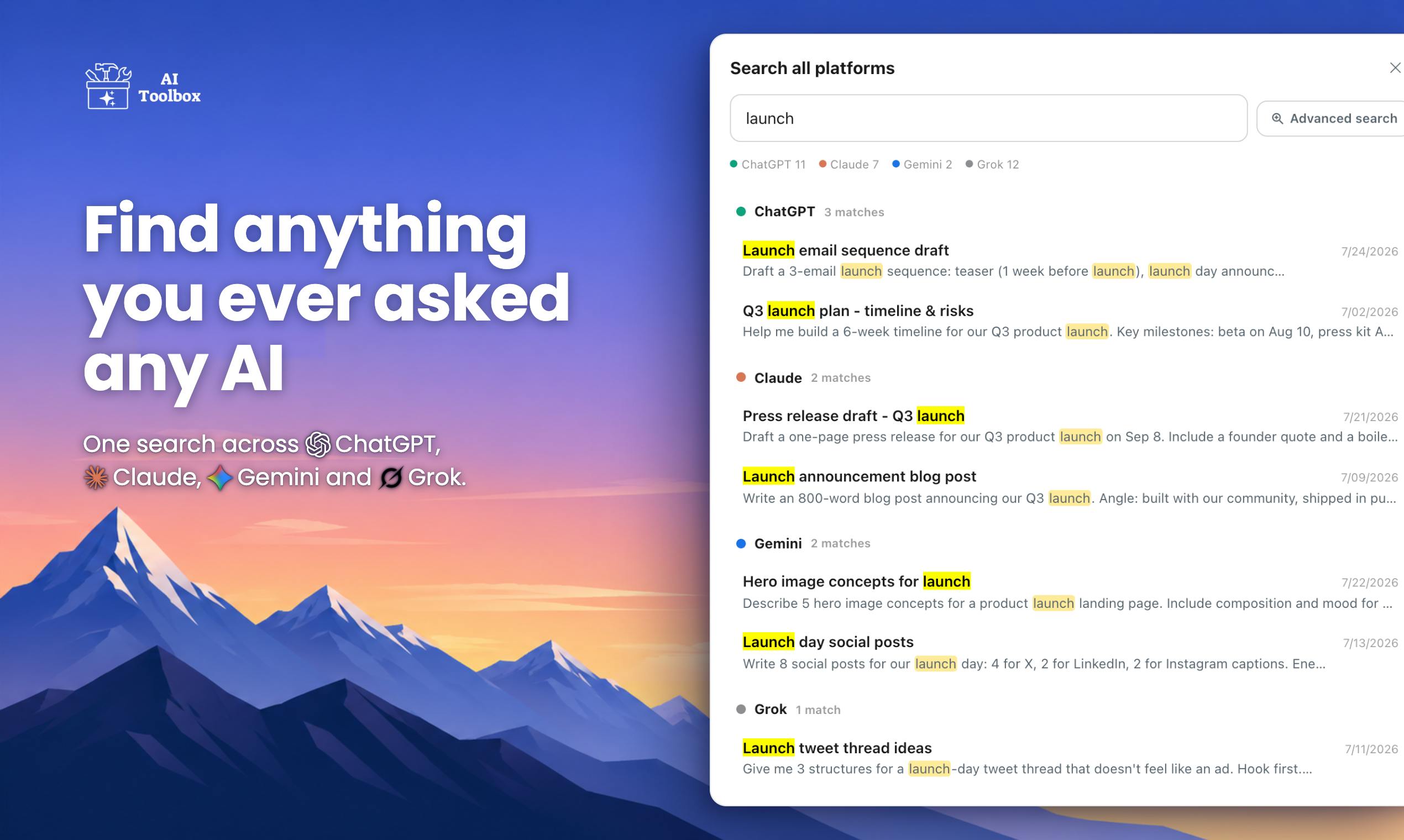
AI Toolbox is a browser extension that adds cross-platform search, folders, prompts, bookmarks, bulk management, and export to ChatGPT, Claude, Gemini, and Grok. It targets heavy AI-chat users whose work is fragmented across long conversation histories and multiple assistants. The product has a free tier, individual subscriptions, lifetime licenses, and a team plan (website; pricing).
Product quality appears relatively strong. Chrome-Stats records approximately 40,000 users, a 4.68/5 rating from 760 ratings, and an update on September 7, 2026, suggesting meaningful adoption, customer satisfaction, and continued development (Chrome-Stats). The September 6 Product Hunt launch ranked first for the day and passed 400 votes, but this is launch attention rather than commercial validation (Product Hunt; company history).
Company quality is less certain. The two founders appear technically capable and have shipped a broad product with low reported infrastructure costs. A recent founder interview reports more than 35,000 active users and five-figure MRR, but the revenue, active-user definition, retention, and growth figures are not independently verified (Indie Hackers).
The venture case depends on moving beyond a low-priced consumer extension into a durable multi-AI workspace for teams. Current pricing and lifetime plans make a billion-dollar outcome difficult without substantially higher team or enterprise ACV. Native platform improvements and a much larger incumbent extension also limit defensibility.
Decision: Watch. The product merits continued monitoring, but verified recurring revenue, retention, customer acquisition economics, and enterprise adoption are insufficient for formal diligence today.
Product Overview
The core problem is information fragmentation: frequent AI users accumulate conversations across several assistants and struggle to find, categorize, reuse, or export previous work.
AI Toolbox embeds directly into supported AI websites. Its principal benefits are full-text and cross-platform search, nested folders, prompt reuse, bulk export, bookmarks, tags, conversation handoff, and local indexing. It runs on Chrome and Chromium-based browsers; it does not currently offer a verified mobile product (Chrome listing).
Pricing is $0 for limited use, $9.99 monthly or $59 annually per platform, $99 lifetime per platform, $199 lifetime for all platforms, and $12–$15 per team seat per month depending on billing (pricing page). Existing alternatives include native search and projects, manual naming and exporting, note-taking applications, and competing extensions.
Product Quality: Good for individual power users, based on breadth, ratings, and update activity. The main weaknesses are browser dependence, sensitive permissions, reported activation/UI issues, and the risk that native platforms absorb its functionality.
Founder and Team Assessment
The company identifies itself as Infi Developments, founded in September 2024 and operated by two founders with no other employees (company page).
Adi Leviim reportedly has more than seven years of full-stack experience and leads product and frontend development. Mohammad El-Esawi reportedly has more than five years of full-stack experience and leads backend and LLM systems (Adi profile; Mohammad profile). These backgrounds are primarily company-reported; previous employers, exits, and detailed employment histories were not independently verified.
Execution is demonstrated more convincingly than résumés: the team built four platform modules, reached a 40,000-user Chrome Web Store bucket, and continues to release updates. Commercial capability has early support from freemium monetization and founder-reported five-figure MRR, but no audited revenue or acquisition data is available.
The two-person structure supports capital efficiency but creates substantial engineering, support, security, and key-person risk.
Founder Assessment: Strong technical execution and credible early monetization, but backgrounds and scalable commercial capability remain insufficiently verified.
Market Opportunity
The initial segment is multi-assistant professionals—developers, researchers, marketers, and consultants—who conduct enough browser-based AI work to need persistent search and organization.
No reliable public count of this narrowly defined segment was found. A scenario-based bottom-up estimate is therefore more responsible than a generic “AI software” TAM. At the current $59–$120 annual subscription range:
- 1 million paying individual users would generate approximately $59 million–$120 million annually.
- 3 million would generate approximately $177 million–$360 million annually.
These are analyst scenarios, not verified market-size estimates. Current evidence of 40,000 installs is far below the scale required.
Expansion opportunities include team prompt management, governance, compliance, shared knowledge, additional AI platforms, browser support, and enterprise administration. Market timing is favorable because users increasingly work across multiple assistants, but native products are improving: ChatGPT supports projects and chat search, while Claude supports projects, past-chat search, and memory (ChatGPT documentation; Claude documentation).
The realistic consumer market can support a meaningful software business. Venture-scale revenue likely requires a team or enterprise expansion rather than consumer subscriptions alone.
Traction and Growth Signals
Verified or externally observable signals include:
- Approximately 40,000 Chrome users and 4.68/5 from 760 ratings as of September 8 (Chrome-Stats).
- Product created in September 2024 and updated to version 5.0.41 on September 7, 2026 (Chrome-Stats).
- Product Hunt’s #1 product of the day on September 6, 2026 (Product Hunt awards).
- A founder post reported 4,000 users and more than $3,000 in cumulative revenue in November 2024 (Reddit).
- A May 2025 interview reported $8,000 monthly revenue but only $2,000 MRR, indicating significant lifetime-license revenue at that time (Indie Hustle).
- A later founder interview reports five-figure MRR and 35,000+ active users (Indie Hackers).
The progression is encouraging, but commercial figures remain founder-reported. Monthly active usage, paid customers, subscription versus lifetime revenue, cohort retention, churn, and CAC are unavailable.
Traction Assessment: Meaningful product adoption and early revenue, but recurring commercial traction remains unverified.
Competitive Position
Direct competitors include Superpower for ChatGPT, GPT Folders, Sortbase, and specialist search/export extensions. Superpower reports more than 400,000 users and offers overlapping folders, search, prompts, references, automation, and export at $10 monthly when billed annually (Chrome listing; pricing).
AI Toolbox’s best differentiation is one local search and organizational layer across four competing assistants. This is useful because no single assistant is naturally incentivized to organize competitors’ histories.
However, switching costs are modest, no proprietary dataset or network effect is evident, and browser extensions can be replicated. Native search, projects, and memory reduce the value of individual features.
If the largest platform launched the same feature within six months, why would customers continue using this product? The credible answer is cross-platform history, workflows, and neutrality—but only for customers regularly using multiple assistants.
Defensibility Assessment: Low to Medium
Business Model and Economics
Subscriptions should have attractive gross-margin potential because much search and tagging occurs locally. However, server-side PDF generation and selected conversation summarization create cloud and model costs. Payment-processing fees and customer support are additional variable expenses.
The privacy policy says prompts, folder information, identifiers, and usage statistics may be stored server-side with infrastructure-held encryption; selected chats are transmitted for summarization or PDF generation. This is not zero-knowledge encryption (privacy policy). Security reviews, enterprise controls, and independent audits were not found.
Lifetime licenses generate cash but reduce recurring revenue quality and create indefinite support obligations. Team pricing improves recurring economics, but enterprise customers and contracts are not publicly verified.
Unicorn Path
An optimistic 10× ARR multiple is assumed for a high-growth, high-retention software company. This is deliberately generous; a slower-growing consumer extension would normally warrant less.
Required ARR:
$1 billion ÷ 10 = $100 million ARR
At approximately $60 recognized annual recurring revenue per individual subscriber, the company would require about 1.67 million paying subscribers. At $144 per team seat annually, it would require approximately 694,000 paid seats, before discounts, churn, payment fees, and support costs. A 5× multiple would require $200 million ARR.
Reaching this scale requires migration away from lifetime sales, repeatable international distribution, strong retention, enterprise-grade security, higher team ACV, and a product position broader than browser-side convenience.
Unicorn Path: Conditional
Valuation Assessment
No verified funding round, investors, SAFE cap, secondary transaction, acquisition offer, or current valuation was found. Revenue is founder-reported, and financing status is unknown.
Valuation Attractiveness: Not Assessable
Assessment requires verified ARR, subscription/lifetime revenue mix, growth, gross margin, retention, CAC, burn, runway, cap table, round size, valuation cap or post-money valuation, and liquidation preferences.
Key Risks
- Native assistants continue adding search, projects, memory, and organization.
- Low switching costs and substantial feature overlap with competitors.
- Unverified MRR, retention, paid conversion, and customer acquisition economics.
- Lifetime licenses may weaken recurring revenue and create long-term obligations.
- Dependence on browser stores and frequent upstream interface/API changes.
- Sensitive browser permissions and enterprise privacy/security concerns.
- Two-person team and concentrated key-person risk.
- Low consumer ARPU makes venture-scale revenue difficult.
- Customer-review reports of activation, pricing-transparency, and performance issues (Chrome-Stats).
Final Assessment
Venture Potential: 63/100
| Category | Score |
|---|---|
| Market Size and Expansion Potential | 14/20 |
| Traction and Growth Evidence | 13/20 |
| Founder and Team | 10/15 |
| Product Strength | 8/10 |
| Distribution Potential | 9/15 |
| Business Model and Economics | 6/10 |
| Defensibility | 3/10 |
| Total | 63/100 |
The strongest elements are product execution, ratings, user adoption, and cross-platform positioning. The weakest are defensibility, revenue quality, retention evidence, and the distance between current pricing and venture-scale revenue.
Evidence Confidence: 56/100
Product availability, pricing, Chrome usage bucket, reviews, update activity, and Product Hunt ranking are verified. Revenue, active users, founder experience, costs, and geographic reach are company-reported. Retention, paid customers, margins, CAC, burn, funding, legal entity details, and valuation remain unavailable.
Final Decision: Watch
The product could become a strong bootstrapped software business and may justify DD later. It does not yet provide sufficient verified evidence of durable recurring growth or a defensible path to venture-scale revenue.
Upgrade Conditions
- Verified ARR above $1 million with predominantly recurring revenue.
- At least 70% six-month paid-customer retention.
- Documented subscription growth independent of Product Hunt.
- Repeatable CAC payback below 12 months.
- Gross margin above 75%.
- Material team adoption and several referenceable organizations.
- Independent security review and stronger enterprise controls.
Downgrade Conditions
- Flat or declining active usage after the launch.
- High subscription churn or continued dependence on lifetime sales.
- Native platforms eliminating the cross-platform value proposition.
- Loss of Chrome Web Store distribution or critical integrations.
- Material privacy, security, billing, or claim-verification problems.
Questions for Further Diligence
- What are current MRR, ARR, monthly growth, and the subscription/lifetime revenue split?
- How many monthly active, paying individual, team, and enterprise users exist?
- What are 30-, 90-, and 180-day retention and subscription renewal rates?
- What are free-to-paid conversion, ARPU, and refund rates by plan?
- Which channels drive installs, and what are CAC and payback by channel?
- What are gross margin and monthly model, hosting, payment, and support costs?
- How much revenue comes from each supported AI platform?
- What security audits, penetration tests, and enterprise compliance work have been completed?
- What are burn, runway, founder compensation, and full-time commitments?
- What is the cap table, legal entity, current financing valuation, and proposed round terms?
- What product advantage remains if native platforms match folders, search, and export?
- What milestones define the transition from consumer extension to enterprise workspace?