Table of Contents
Touchy Investment Report
Category: Consumer AI / iOS personal assistant
Company Stage: Pre-seed; Y Combinator S26
Founders: Rohit Agarwal, Kevin Wang, Andrew Liu
Headquarters: San Francisco, California, United States
Funding: Y Combinator’s standard $500,000 commitment; no other funding publicly disclosed
Business Model: Freemium consumer subscription with in-app purchases
Product Hunt Launch Date: September 2, 2026
Report Date: September 5, 2026
| Investment Metric | Assessment |
|---|---|
| Venture Potential | 61/100 |
| Unicorn Path | Conditional |
| Valuation Attractiveness | Not Assessable |
| Evidence Confidence | 54/100 |
| Final Decision | Watch |
Executive Summary
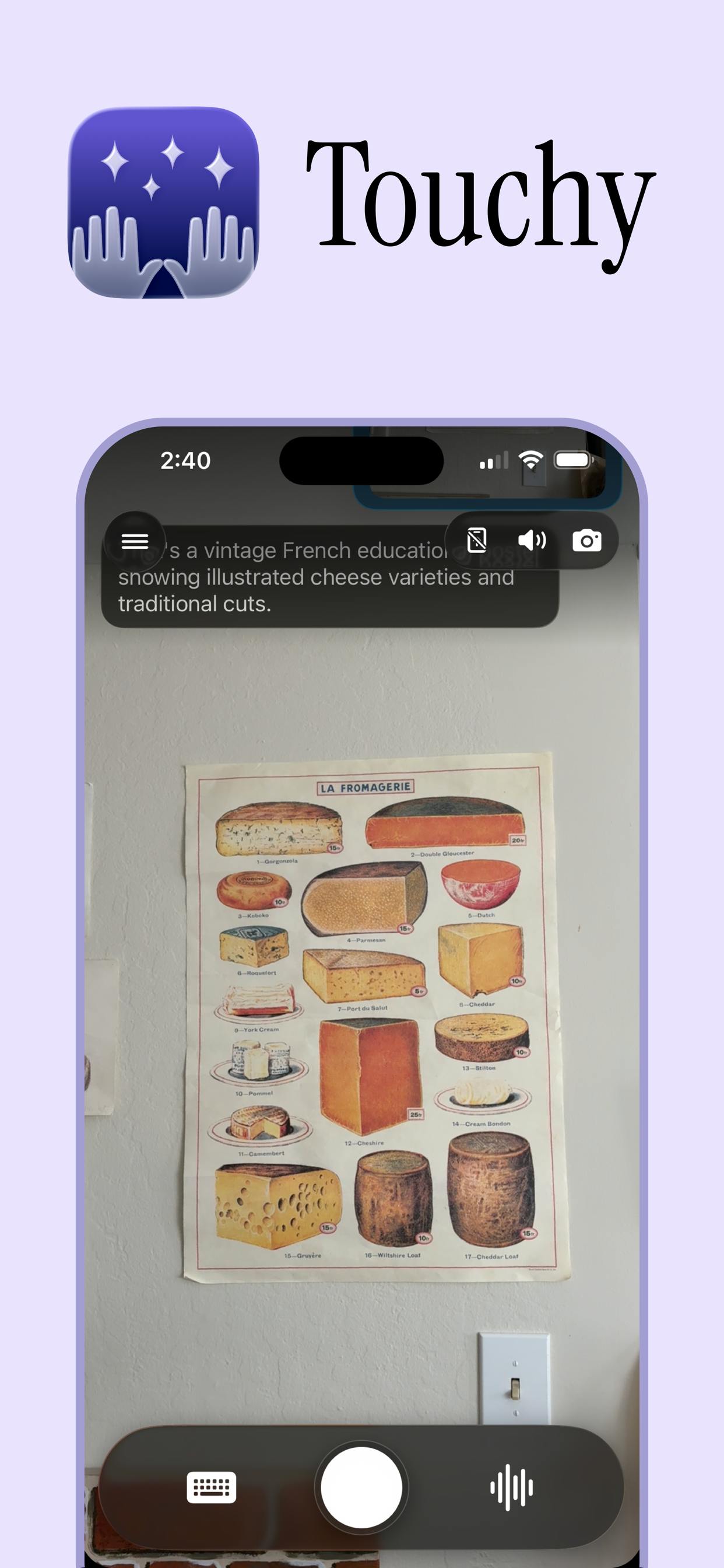
Touchy is an iPhone-native, voice-first AI assistant that can receive visual context through the camera, remember user preferences, and execute tasks across connected applications. The company says the product supports more than 1,000 integrations, including communications, calendar, transportation, and productivity services (App Store; YC launch).
The product addresses a genuine usability gap: general-purpose AI models are increasingly capable, but using them to complete everyday mobile tasks still requires fragmented workflows, app switching, permissions, and manual confirmation. Touchy’s strongest product proposition is not model intelligence alone, but a low-friction interface combining voice, camera context, memory, and cross-application actions.
The strongest investment signal is the founding team. CEO Rohit Agarwal has relevant AI-alignment and machine-learning research experience at Princeton and Google DeepMind. Kevin Wang has substantial data-infrastructure and startup engineering experience, while Andrew Liu has taught and managed technical teams at UC Berkeley. The company is also part of Y Combinator’s S26 batch (YC company profile; Rohit Agarwal; Kevin Wang; Andrew Liu).
However, commercial validation is almost absent. The App Store showed only three ratings at the time of review, while Product Hunt had no product reviews. Downloads, active users, paying subscribers, revenue, retention, conversion, customer acquisition cost, and gross margin have not been disclosed (App Store; Product Hunt reviews). Its September 2 launch ranked thirteenth for the day, which indicates limited early attention—not product-market fit (Product Hunt leaderboard).
Touchy is therefore an interesting product from a capable technical team, but not yet a validated venture investment. The appropriate decision is Watch, pending evidence that consumers use the assistant repeatedly, trust it with sensitive permissions, pay enough to cover inference costs, and retain beyond initial experimentation.
Product Overview
Touchy lets an iPhone user activate an assistant, speak naturally, provide camera context, and request actions across connected services. Representative use cases include interpreting signs or screens, checking a grocery list, creating calendar events, managing email, and coordinating transportation. It can be assigned to compatible iPhone hardware buttons and used in a continuous conversation that accumulates memories and preferences (App Store; official website).
The current product is iPhone-first, requires iOS 18 or later, and is available only in English. Version 1.2 was released shortly after the initial August 25, 2026 App Store release, with responsiveness and onboarding improvements. The App Store lists the app as free with a $14.99 Touchy Plus in-app purchase, although the billing period is not clearly identified in the public listing.
The main customer benefit is reduced interaction cost: users can state an intention rather than open and operate several apps. The manual alternative is Siri, individual app interfaces, shortcuts, or separate AI applications.
Product quality: The interface concept is coherent and well matched to mobile use. Native activation, visual context, memory, and actions form a stronger workflow than a standalone chatbot. However, there is insufficient independent evidence about action reliability, latency, hallucination rates, permission handling, or whether the advertised integrations work consistently.
Founder and Team Assessment
Rohit Agarwal identifies himself as Touchy’s CEO and head of research. His public profile documents a Princeton computer-science PhD, prior research at Google DeepMind, AI-alignment work, and a UC Berkeley EECS degree. His personal academic site reports the Berkeley EECS Citation Award and relevant publications in optimization, mathematical reasoning, and AI alignment (profile; LinkedIn).
Kevin Wang’s profile shows infrastructure experience at SkyPilot and as an early engineer at Eventual, where he worked on distributed processing, inference infrastructure, and multimodal data systems. This is directly relevant to controlling the latency and cost of a multimodal assistant (LinkedIn).
Andrew Liu’s profile shows UC Berkeley computer science, mathematics, and linguistics training, plus experience as a CS61C lecturer and head teaching assistant. The founders state that his previous educational software reached 500,000 students, but independent commercial details were not found (LinkedIn; YC launch).
The company’s public LinkedIn page displayed three associated employees, consistent with the three-founder team, but public employee counts are imperfect. All three profiles indicate current founder roles, supporting—but not conclusively proving—full-time commitment.
Company quality: Technically strong and unusually relevant for this stage, but consumer growth, monetization, trust-and-safety operations, and marketing capability remain unproven.
Founder Assessment: Strong research and engineering capacity, with limited demonstrated consumer distribution and commercial execution.
Market Opportunity
The initial market should be defined narrowly as English-speaking iPhone users willing to pay for a frequently used, permissioned AI assistant, rather than the entire AI or smartphone market.
Because no reliable public count exists for this precise segment, a scenario analysis is more defensible than a top-down TAM claim:
- Potential engaged users: 5–20 million
- Paid conversion: 2%–5%
- Annual gross subscription revenue per payer: $120–$180
- Scenario revenue opportunity: approximately $12 million–$180 million annually
These are analyst assumptions, not verified market figures. The upper end could support a large venture business, while the lower end would not.
Expansion opportunities include Android, desktop, family plans, accessibility use cases, an assistant API, and premium workflow automation. Yet expansion is strategically difficult because the platform owners control operating-system permissions and default assistant placement.
Market timing is favorable for multimodal interfaces, but intensely competitive. RevenueCat’s 2026 dataset found that AI subscription apps generated 41% more revenue per payer but churned 30% faster, while approximately 14,700 subscription apps were launching monthly by January 2026 (RevenueCat). This supports demand but also highlights weak retention and severe distribution pressure.
Traction and Growth Signals
Verified signals are limited:
- App Store release on August 25, 2026 and version 1.2 by September 1.
- Three App Store ratings, averaging 5.0/5—a statistically insignificant sample.
- Product Hunt launch on September 2, ranked #13 that day.
- No Product Hunt reviews.
- Acceptance into Y Combinator S26.
- Three publicly identifiable founders.
Product Hunt attention is treated only as launch interest. There is no disclosed evidence of sustained usage, paid conversion, revenue, organic acquisition, cohort retention, or post-launch growth.
The most important missing metrics are daily and monthly active users, actions completed per active user, action-success rate, free-to-paid conversion, subscriber retention, refund rate, acquisition source, and inference cost per user.
Traction Assessment: Product activity is visible, but commercial traction is unverified.
Competitive Position
Direct and adjacent competitors include Apple’s Siri and Apple Intelligence, Google Gemini, ChatGPT Voice, and other agentic assistant applications. Google already offers Gemini Live with camera and screen sharing on iOS and integrates with Calendar, Maps, Tasks, and Keep (Google). ChatGPT supports voice, memory, images, video, and screen sharing in eligible mobile modes (OpenAI). Apple is developing deeper Siri access to personal context and app actions, supported by operating-system-level integration and privacy infrastructure (Apple).
Touchy’s current differentiation is its combination of native iPhone activation, cross-service actions, persistent memory, and an intentionally low-attention interaction design. However, the underlying models are supplied by third parties: its privacy policy identifies OpenAI, Google Cloud AI, and Anthropic as providers that may process user inputs and personal information (privacy policy).
If the largest platform launched the same feature within six months, why would users continue using Touchy? A credible answer would require materially better cross-platform integrations, superior reliability, accumulated personal memory, or proprietary behavioral data. None has yet been demonstrated.
Defensibility Assessment: Low
Business Model and Economics
Touchy appears to use a free trial or free tier followed by a consumer subscription. The App Store displays a $14.99 in-app purchase, but its duration and usage limits are not publicly clear.
At $14.99 monthly, gross annualized revenue would be approximately $180 per continuously paying subscriber before discounts, refunds, taxes, and platform commissions. Apple offers qualifying small developers a reduced 15% commission, although eligibility and enrollment by Touchy are not verified (Apple Small Business Program).
Economics are a material concern. Voice, multimodal input, memory retrieval, and agentic tool calls can generate substantial model and cloud costs. Touchy itself estimates that a heavily used future assistant could cost $1,200–$2,300 per month at August 2026 frontier-model pricing, far above a consumer subscription, although that estimate assumes an extremely intensive workload (official website). Gross-margin viability therefore depends on routing, caching, on-device inference, usage limits, and declining model prices.
Unicorn Path
Assume a 10× ARR multiple for a high-growth subscription business with strong retention and healthy gross margins. This is an analytical assumption, not a current market valuation.
\[
\$1\,billion \div 10 = \$100\,million\ ARR
\]
At $14.99 per month, $100 million of gross ARR would require approximately 556,000 continuously paying subscribers. After platform fees, discounts, refunds, and partial-year churn, approximately 650,000–800,000 active annual-equivalent subscribers could be required.
That is possible in a global consumer market but unsupported by present evidence. Touchy would need:
- Multi-platform expansion;
- Strong daily or weekly habitual use;
- High action reliability;
- Sustainable inference economics;
- Trust strong enough for email, calendar, contacts, location, camera, and microphone permissions;
- A repeatable acquisition channel beyond launch communities;
- Defensible user memory or workflow integration.
Unicorn Path: Conditional
Valuation Assessment
Y Combinator officially invests $500,000: $125,000 for 7% and $375,000 through an uncapped MFN SAFE (YC deal). Touchy’s YC participation supports the existence of that commitment, but the company’s cap table, additional SAFEs, current fundraising, and post-money valuation are not public.
Valuation Attractiveness: Not Assessable
Assessment requires current ARR, growth, retention, gross margin, burn, runway, outstanding SAFEs, proposed round size, valuation cap, dilution, and liquidation terms.
Key Risks
- No commercial validation: Revenue, subscribers, conversion, and retention are undisclosed.
- Platform competition: Apple can provide deeper default access and lower-friction distribution.
- Weak differentiation: Voice, camera understanding, memory, and integrations are increasingly common.
- Inference economics: Heavy multimodal usage may be incompatible with a $14.99 consumer price.
- Privacy and trust: The app can request access to location, contacts, camera, microphone, calendar, messages, and connected accounts.
- Action reliability: Incorrect email, calendar, purchase, or transportation actions could rapidly destroy trust.
- Consumer AI churn: Industry data suggests AI apps monetize well initially but churn faster.
- iOS and English concentration: Current addressability is limited by platform and language.
- Early pivot risk: The company was initially presented as Tokenless, an AI model-routing product, before becoming Touchy.
- Key-person risk: Execution currently depends on three founders.
Final Assessment
Venture Potential: 61/100
| Category | Score |
|---|---|
| Market Size and Expansion Potential | 17/20 |
| Traction and Growth Evidence | 5/20 |
| Founder and Team | 13/15 |
| Product Strength | 8/10 |
| Distribution Potential | 8/15 |
| Business Model and Economics | 6/10 |
| Defensibility | 4/10 |
| Total | 61/100 |
The strongest factors are team quality, market breadth, and a coherent mobile UX. The weakest are negligible verified traction, uncertain unit economics, platform dependence, and limited defensibility.
Evidence Confidence: 54/100
The product, legal entity, founders, YC participation, App Store activity, basic pricing signal, and privacy policy are verifiable. Feature coverage and integration counts are company claims. Revenue, usage, retention, growth, margins, burn, runway, security controls, valuation, and customer references remain unavailable.
Final Decision: Watch
Touchy is too early for formal due diligence based solely on public evidence. The team is strong enough to merit monitoring, but three App Store ratings and a Product Hunt launch do not establish demand or retention.
Upgrade Conditions
- At least $1 million ARR or compelling month-over-month paid growth;
- More than 70% six-month subscriber retention;
- Verified action-completion and user-confirmed success rates;
- Gross margin above 65%, with declining inference cost per active user;
- Repeatable organic or paid acquisition outside Product Hunt and YC;
- Evidence that users complete valuable tasks several times per week;
- Android or another distribution surface without degrading focus;
- Documented security controls and transparent data-retention practices.
Downgrade Conditions
- Weak paid conversion or rapid subscription churn;
- Usage concentrated in novelty-driven first sessions;
- Model costs scaling faster than revenue;
- Major replication by Apple or another platform;
- Security, privacy, or unauthorized-action incidents;
- Declining release activity or founder disengagement;
- Materially misleading integration or traction claims.
Questions for Further Diligence
- What are current MRR, paid subscribers, and monthly revenue growth?
- How many DAUs and MAUs does Touchy have, excluding launch-week users?
- What are D30, D90, and six-month subscriber retention rates?
- What percentage of installs start a trial, and what percentage convert to paid?
- How many actions does an active user request weekly, and what percentage complete successfully?
- What is the model, cloud, and integration cost per free and paying user?
- What gross margin is achieved at current usage and at projected mature usage?
- Which integrations are native, which depend on third-party automation providers, and which permit write actions?
- How are high-risk actions confirmed, reversed, logged, and audited?
- What are current burn, runway, team compensation, and hiring plans?
- What is the fully diluted cap table, including both YC SAFEs and any additional instruments?
- What financing is currently being raised, at what valuation or SAFE cap, and for what milestones?
Sources
- Touchy on Product Hunt
- September 2 Product Hunt leaderboard
- Official Touchy website
- Touchy App Store listing
- Y Combinator company profile
- Y Combinator launch
- Y Combinator standard deal
- Touchy privacy policy
- Rohit Agarwal profile
- Kevin Wang LinkedIn
- Andrew Liu LinkedIn
- RevenueCat State of Subscription Apps 2026
- Apple Intelligence
- Google Gemini mobile updates
- ChatGPT Voice documentation