
Table of Contents
Cubicle — Venture Investment Report
Prepared: 8 October 2026 | Stage: Early open-source developer tool | Decision: Pass
Snapshot
| Metric | Assessment |
|---|---|
| Product | Local visual office and alert surface for monitoring AI coding and workflow agents |
| Users | Developers and small teams supervising multiple agents |
| Integrations | Paperclip, Claude Code, Codex, Gemini CLI, Copilot examples and generic JSON feeds |
| Product Hunt | #6 daily rank, 120 points and about 100 followers in the launch-week snapshot |
| GitHub | MIT license; 32 stars, 4 forks and 112 commits at research time |
| Distribution | Free npm package; version 0.22.2 published the day before research |
| Revenue and paid usage | No pricing, paid accounts, revenue or retention disclosed |
| Founder | Maker Çağlar Utku Güler; a solo project is presented in public materials |
| Final Decision | Pass |
Executive view
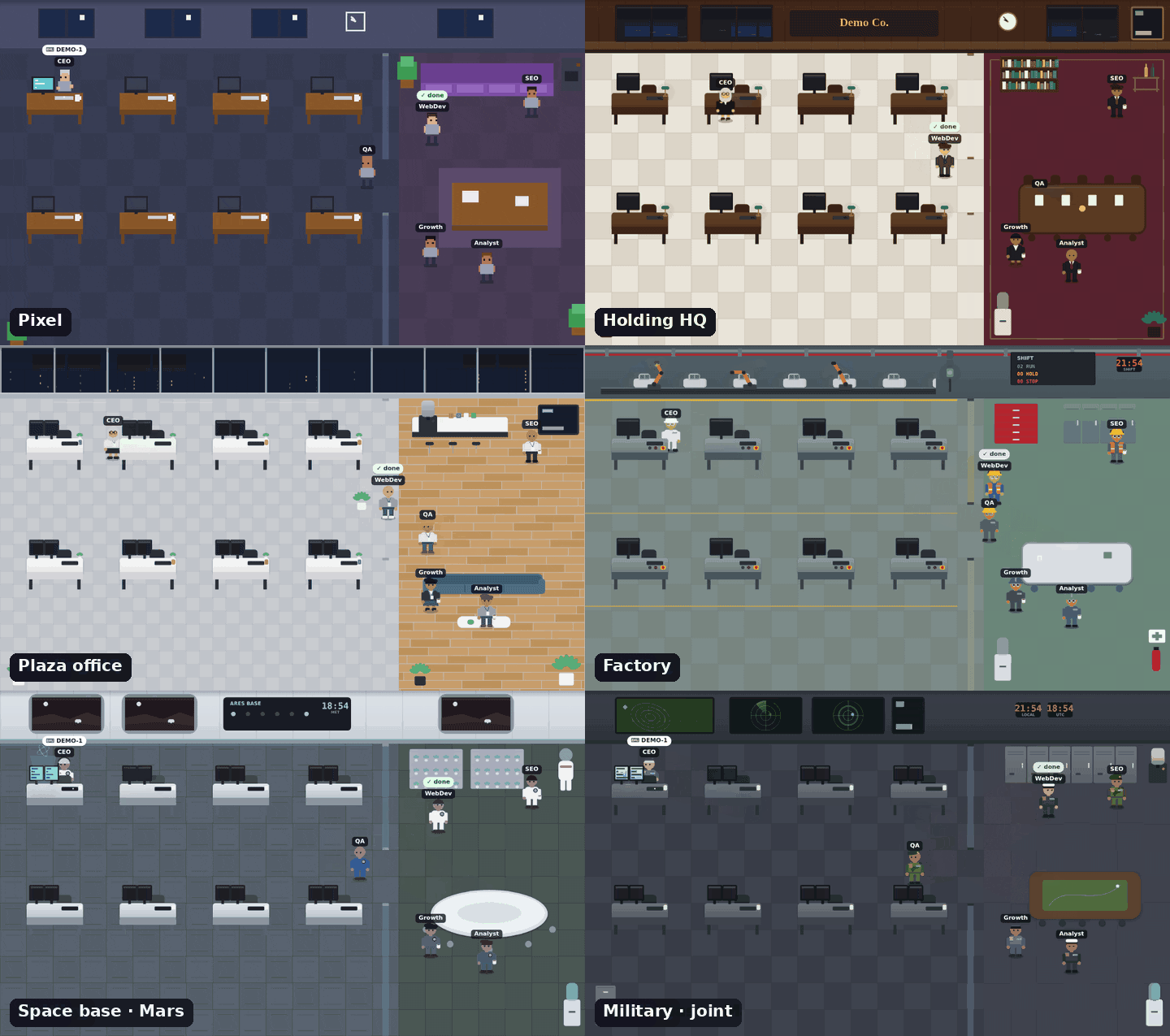
Cubicle gives AI agents a visual office. Running agents appear at desks, agents waiting on user input raise a hand, completed work moves to a lounge and errors are highlighted. A user can monitor Paperclip, Claude Code, Codex, Gemini CLI and other tools through a local web page, a KPI board, phone view and optional Telegram alerts. The idea addresses a growing pain: as developers run more parallel agents, it becomes harder to see which session needs attention without checking terminals and logs one by one.
The product is differentiated by its low-friction setup and approachable display. It is MIT-licensed, requires Node.js, can be started using npx, and can take a small JSON feed from tools without a built-in integration. The repository currently documents useful depth beyond a decorative office: task progress, waits, failures, recent tool steps, replay, cost/budget display where the source provides it, notifications, and redaction options. Its read-only design is a sensible boundary. The display indicates status and asks for attention; it does not prove that an agent’s work is correct.
Early feedback is positive but adoption remains small in the public evidence. The launch reached #6 on Product Hunt with 120 points and about 100 followers. GitHub showed 32 stars and four forks, while the npm package was at version 0.22.2 and had been published the previous day. This suggests a living project and initial interest, but not a commercial user base.
Recommendation: Pass at this stage. Cubicle could become a useful acquisition wedge for a broader agent operations product, but the current evidence describes a free, single-maintainer open-source utility rather than a venture-scale business. Revisit if the maintainer demonstrates sustained adoption, a paid team or enterprise need, and a product path beyond visualization into trusted agent operations.
Product and customer value
Cubicle solves a concrete workflow problem: maintaining awareness across many simultaneous agents. It maps agent states into a shared visual metaphor, surfaces prompts and failures, and can notify a user when intervention is needed. The built-in sources cover several coding-agent CLIs and Paperclip; other tools can publish a small JSON feed. A standalone local server, hosted demo and Paperclip plugin make experimentation relatively easy.
The strongest value is attention management. A developer can leave the office open on a second monitor or phone and see which agent is running, blocked or failed. The KPI board and recent-step display give more context than a basic status dot. Optional Telegram alerts reduce the need to watch the page continuously. For a small team running many agents, one view can lower context switching and shorten time-to-response when a tool pauses.
There is an important product limitation: a running animation or an empty queue does not mean the agent’s output is correct. Cubicle surfaces the runtime state it receives; review still happens in the underlying terminal, issue tracker or code review. The maker has acknowledged this in Product Hunt discussion. That boundary keeps Cubicle safer, but it means the app is an observability and notification layer, not an evaluation, governance or autonomous remediation system.
Market and competition
The likely initial market is individual developers, technical founders and small engineering teams who run multiple coding agents. This audience is growing as coding agents become capable of longer tasks and parallel execution. A second monitor, kiosk or phone notification can make sense for users coordinating several sessions or a fleet of internal agents.
The broader agent operations market is larger but already includes tracing, logs, evaluations, cost monitoring, approval workflows and observability platforms. Cubicle’s distinctive interface could serve as a front door to that information, but customers will compare it with native dashboards and tools that measure correctness, cost and reliability. The office metaphor is memorable; it becomes a business only if it improves response time or productivity enough to justify payment.
A potential expansion path is from a local dashboard to a multi-user team console with role-based access, history, search, integrations, notifications, policy signals and enterprise deployment. That would require substantial product work: secure ingestion, identity, tenant isolation, permissions and reliable uptime. It would also move the tool beyond its current simplicity and compete with broader developer infrastructure products. The company needs evidence that users want that expansion and will pay for it.
Traction and business model
At research time the Product Hunt page showed a #6 daily rank, 120 points and about 100 followers. The GitHub repository showed 32 stars, four forks and 112 commits. The npm profile showed one package, Cubicle, with version 0.22.2 published a day before this report. These are small but useful signs of active development. They do not disclose installs, weekly active users, retention, team usage or revenue.
The current package is free and MIT-licensed, with no public paid tier. Plausible monetization could include a hosted team workspace, managed integrations, secure history and replay, alerting, analytics, enterprise access controls or support. A paid product would need to offer value beyond the local display and retain the open-source tool as a trusted entry point. If the maintainer instead prefers a community project, it may remain useful without becoming a VC opportunity.
The most important commercial test is willingness to pay for team coordination. Ask how many users have installed it, how often they use it, what agent count makes it essential, and whether a team has requested SSO, shared history, audit trails or support. Measure time saved and time-to-intervention, not only downloads or GitHub stars. Until a customer segment and recurring revenue path are shown, the project’s ceiling is uncertain.
Team, product quality and risk
Product Hunt identifies Çağlar Utku Güler as maker, and public posts describe building the project to monitor the maker’s own agents and releasing it as open source. The rapid feature development and integration range show strong product initiative. Public sources reviewed do not establish a company, funding, full-time commitment, commercial intent or a broader team. A solo maintainer can move quickly, but also creates continuity and support risk.
The local-first, read-only approach reduces the blast radius compared with a tool that can approve or execute agent actions. However, Cubicle may display task names, prompts, error text, tool steps, spend and issue details. The repository documents a redaction option, local server binding and token-file practices for Paperclip access; users still need to configure source permissions and shared-screen privacy correctly. An enterprise edition would need a documented security model, access controls and retention choices.
Key risks:
- Weak commercial evidence: Public traction is measured in modest GitHub and Product Hunt signals; installs and active use are unknown.
- No business model: The tool is free and MIT-licensed, with no disclosed willingness to pay or subscription offer.
- Low switching costs: The data feed is intentionally simple, and similar dashboards can be built or bundled by agent platforms.
- Incomplete observability: A status display cannot determine whether the code, output or decisions are correct.
- Platform dependence: Agent CLIs and Paperclip can change hooks, APIs or formats, increasing maintenance burden.
- Founder concentration: A solo maintainer carries product, support and integration continuity risk.
- Sensitive local data: Task names, prompts, tool traces and errors can reveal private work if exposed on a shared or network-accessible screen.
- Scope risk: Enterprise controls and team collaboration could undermine the simple install-and-run product that currently attracts users.
Investment scorecard
| Dimension | Score | Rationale |
|---|---|---|
| Problem relevance | 4/5 | Parallel agents create a real attention and coordination challenge |
| Product experience | 4/5 | Memorable, low-friction and more informative than terminal switching |
| Technical execution | 3/5 | Multi-source support and rapid iteration; maintainability still rests on one maker |
| Traction | 2/5 | Product Hunt and GitHub interest, with installs and active use undisclosed |
| Business model | 1/5 | No paid product, revenue or demonstrated willingness to pay |
| Defensibility | 2/5 | UX and cross-agent integration help; feeds and features are reproducible |
| Team | 2/5 | Strong initiative is visible, but company and full-time team status are unknown |
| Venture readiness | 1/5 | Early open-source utility without validated market or monetization |
| Overall | 2.4/5 | Pass for now; retain as an ecosystem signal and revisit on commercial evidence |
Diligence questions
- How many unique installs, weekly active users and returning users does the project have?
- Which integrations account for recurring use: Paperclip, Claude Code, Codex, Gemini or custom feeds?
- What user behavior or customer outcome improves: time-to-intervention, fewer abandoned sessions or more completed tasks?
- Have teams asked to pay for shared monitoring, history, access controls or support?
- Is the maker interested in building a company, and would the maker commit full time?
- What is the roadmap for multi-user operation, SSO, role-based access and secure deployment?
- How are agent status, prompts, tool calls, errors and costs collected, stored and redacted?
- What happens when an upstream CLI changes its hooks or telemetry format?
- What competitive advantage can Cubicle maintain against native agent dashboards and general observability products?
- What revenue model preserves the MIT community while funding ongoing integration and support work?
Sources
- Product Hunt launch page, maker description and feedback: https://www.producthunt.com/products/cubicle-2
- Official GitHub repository, MIT license, integrations, features and metrics: https://github.com/caglarutkuguler/cubicle
- npm package profile and recent release: https://www.npmjs.com/~caglarutkuguler
- Official live demo: https://caglarutkuguler.github.io/cubicle/
Conclusion: Cubicle is a thoughtful, fast-moving open-source tool for seeing which coding agents need attention. Its local-first UX and broad CLI support are promising, but public evidence does not show a venture-scale business or paid demand. Pass today; reconsider if usage becomes sustained across teams and customers fund a secure, shared agent operations product.