
Table of Contents
GoodSocials Investment Report
Category: AI writing and scheduling of personal-brand LinkedIn posts for founders, consultants, and agencies
Company Stage: Pre-seed / just launched. Stage is not publicly disclosed; this is an analyst inference.
Founder or Founders: Pavel Kucherbaev (GoodSocials, personal site)
Headquarters: Amsterdam, Netherlands, per a secondary source (ChatGate). The founder’s location is corroborated by GrowthMentor.
Funding: Not publicly disclosed
Business Model: Subscription SaaS ($100, $1,000, and $2,000 per month tiers)
Product Hunt Launch Date: September 26, 2026 (Hunted.Space)
Report Date: September 29, 2026
| Investment Metric | Assessment |
|---|---|
| Venture Potential | 37/100 |
| Unicorn Path | Improbable |
| Valuation Attractiveness | Not Assessable |
| Evidence Confidence | 30/100 |
| Final Decision | Pass |
Executive Summary
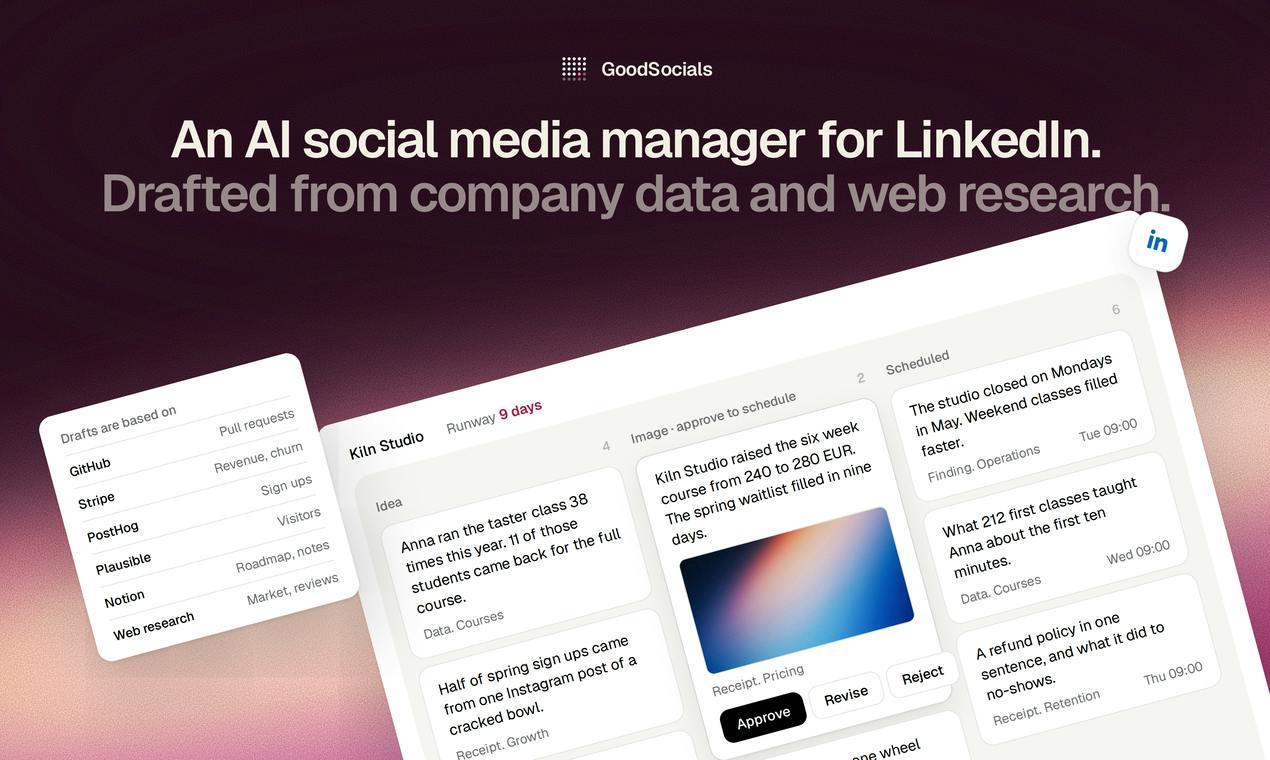
GoodSocials is an AI “social media manager” for LinkedIn. It drafts posts from deep research or from the user’s own data, shows them on a kanban board for approval, and publishes the approved ones on a schedule. The data sources are read-only connections to Stripe, GitHub, PostHog, Plausible, and Notion (docs). The target users are founders, consultants, operators, and agencies who manage personal profiles.
The product has a clear point of view. It refuses engagement-bait formats, writes in the third person, leaves bracketed gaps instead of inventing figures, and runs a quality check that blocks cards containing invented numbers (docs). This is a thoughtful answer to buyers’ growing dislike of “AI slop.”
The strongest positive signal is the founder. Pavel Kucherbaev’s self-reported background, corroborated across several of his own profiles, includes data science management at Atlassian and Booking.com, a PhD in HCI, published research, and a record of shipping several products. His previous product, TimeTuna, was #1 Product of the Day on Product Hunt (kucherbaev.com).
The most important concerns are structural. The product works on a single platform, and the category is crowded with inexpensive, established tools. Supergrow starts at $19 per month, and Taplio is owned by lempire (Taplio ToS). GoodSocials also depends entirely on LinkedIn’s API permissions. The founder appears to be running other products at the same time. Traction is not disclosed.
Decision: Pass. The product is credible and could become a solid bootstrapped business. However, the category’s exit history, the price ceiling, and the platform dependency make a venture-scale outcome unlikely.
Product Overview
Problem. Founders want to post on LinkedIn regularly but don’t have time to write. Generic AI tools produce content that damages credibility. The founder’s own weekly update post took him about an hour to write by hand (Product Hunt).
How it works.
- Setup: the user signs in with LinkedIn and pastes a website URL. The agent writes four themes and three brand principles, and seven draft posts appear on the board (docs).
- Board: cards move through Idea → Draft → Image → Scheduled → Posted. The only actions are approve, revise, and reject.
- Learning: a revise comment rewrites that card and also becomes a lasting rule for future posts.
- Publishing: posts go out at 09:00 local time, one to seven per week, capped at one per day. Images are capped at 200 per month.
Limits. GoodSocials posts only to personal profiles, because LinkedIn restricts company-page permissions. It supports no other networks, offers no replies or analytics dashboards, and requires users to reauthorize LinkedIn every 60 days (docs).
Pricing (website):
| Plan | Price | Scope |
|---|---|---|
| Pro | $100/month | One profile |
| Agency | $1,000/month | Up to 12 profiles |
| Consultancy | $2,000/month | Founder-led setup plus a weekly call |
Every plan has a 14-day free trial. Some sources conflict with the official site: one secondary source cites a 7-day trial (PoweredByAI), and another says the Agency plan covers 10 profiles (ChatGate). This report uses the official site.
What it replaces. Human ghostwriters, which the company frames as costing $3,000 per month; ChatGPT or Claude used by hand; and schedulers like Buffer.
Founder and Team Assessment
Background. The following comes from the founder’s own personal site and GrowthMentor profile, plus the academic record in Google Scholar:
- Data Science Manager at Atlassian (2022–2023) and at Booking.com (2020–2022)
- Postdoctoral researcher at TU Delft
- PhD from the University of Trento
- Antler Amsterdam alumnus
Prior ventures. He co-founded Codesign.io, which he reports reached “more than 10000 users, and dozens of paying ones.” He was CTO of SmartWall, which he says “failed to grow.” His open-source Social-feed plugin has 800+ GitHub stars (founder-reported).
Exits. No exits were found.
Current commitments. He also lists TimeTuna and GoodLads, a Google Ads optimization product, as current ventures (kucherbaev.com). TimeTuna is described as bootstrapped (secondary review). It is not clear whether he works on GoodSocials full-time.
Team. No other team members are visible. The Consultancy tier is sold on the founder’s personal time, which adds key-person risk.
Founder-market fit. He has strong analytical and product skills, and he is his own first user. His commercial record is modest: his prior companies reached users but show little verified revenue.
Founder Assessment: A technically capable, fast-shipping founder with verified-looking experience, but his commercial scaling is unproven and his focus is split across several products.
Market Opportunity
Initial segment. Founders, independent consultants, and small agencies who post on LinkedIn to generate inbound leads, and who have data (Stripe, GitHub, analytics) worth publishing.
Bottom-up estimate (analyst assumption). LinkedIn reports more than 1.3 billion registered members (Espirian, secondary). The relevant group is much smaller.
- Assume 1–3 million English-speaking founders and consultants who post regularly.
- Assume 1–3% would pay $1,200 per year.
- That gives about 10,000–90,000 subscribers, or roughly $12M–$110M ARR, before adding agency tiers.
Willingness to pay. Competitors signal that the market clears well below $100: Supergrow charges $19–$39 per month, and Kleo is reviewed at about $99. GoodSocials’ premium price has not been validated.
Expansion. The founder has said Instagram and X are next (ChatGate, secondary). Agencies and executive-branding teams are the most credible way to raise contract value.
Assessment. The market can support a profitable niche business. The evidence doesn’t show it can support $100M+ ARR for a single LinkedIn-only tool.
Traction and Growth Signals
Launch attention. GoodSocials placed #6 Product of the Day with 135 upvotes and 15 comments (Hunted.Space). A secondary source cites 126 upvotes (ChatGate). The founder hunted the product himself. The launch included a 33% discount code (Product Hunt).
Sustained traction. None is verifiable. No revenue, subscriber count, customer testimonials, reviews, press coverage, or hiring was found. Directory listings only repeat the company’s own copy.
Product activity. The documentation is detailed and the product appears fully built. Integrations with Codex, Claude Code, and Grok are listed as “coming soon” (website).
Key missing metrics:
- Trial-to-paid conversion
- Number of paying profiles
- Churn after months 2–3
- Agency-tier uptake
Traction Assessment: The launch was modest, and the product has no commercial validation.
Competitive Position
Direct competitors.
- Taplio: owned by lempire. It had about 3,000 users when acquired (TheyGotAcquired). It offers post creation, scheduling, and engagement tools (Taplio).
- Supergrow: reports 10,000+ active creators (company-reported). It already offers a kanban board, scheduling, and a Teams plan at $139 per month (Supergrow).
- Kleo and AuthoredUp also compete (AuthoredUp).
Indirect competitors and free alternatives. Buffer includes an AI assistant alongside LinkedIn scheduling (Buffer). General-purpose LLMs with MCP connectors can do this too, and that is exactly how the founder built his first version (Product Hunt).
Differentiation.
- Posts grounded in the user’s own data from Stripe, GitHub, or PostHog
- Anti-slop rules
- A quality gate against invented numbers
- Correction-to-rule learning
These are real product choices, but none is proprietary. The accumulated brand rules create mild switching costs.
Platform dependency. The dependency is severe. The product relies on LinkedIn’s posting permission, which has 60-day expiry and no company-page access (docs).
Six-month test. If Supergrow or Taplio added data-source connectors, or LinkedIn expanded its own AI drafting, why would customers stay? The only answer would be accumulated voice rules and brand trust, which is thin at a 3–5x price premium.
Defensibility Assessment: Low
Business Model and Economics
Revenue model. Flat monthly subscriptions paid through Stripe with no App Store fees. There is no free plan beyond the trial. Pro works out to $1,200 per year, and Agency to $12,000 per year.
Gross margin. Likely favorable for text generation, since 20–30 posts per month is cheap to produce. Deep research and up to 200 generated images per profile per month could raise costs noticeably, and actual margin is not disclosed. Revenue per user is fixed while usage is capped, so growth in usage shouldn’t outpace revenue.
Consultancy tier. This is services revenue built on the founder’s time. It doesn’t scale.
Acquisition. Currently driven by the founder’s own LinkedIn presence and launch platforms. Using the product naturally leads to people talking about it, but every post is written in the third person with no GoodSocials attribution visible, so there is no built-in viral loop.
Churn risk. Likely high. LinkedIn personal-branding tools often suffer from users “falling off the wagon,” and the 60-day reconnect adds friction. This is an analyst assumption.
Unicorn Path
Assumed multiple. 6–10x ARR. This fits SMB and prosumer SaaS that is single-platform with high churn. The category’s known exit, Taplio’s sale to lempire, was reportedly “7 figures” (YouTube), which suggests exits here are modest.
Required ARR. $1B ÷ 6–10x ≈ $100M–$167M.
Customers required:
- At $1,200 per year for Pro: about 83,000–139,000 paying profiles
- At a blended $2,500 per year with agency mix: 40,000–67,000 accounts
- Either figure is several times Supergrow’s reported creator base, at 3–5x its price
Strategic changes required:
- Expand to multiple networks
- Move from individuals to enterprise executive-branding teams
- Achieve durable data-integration lock-in
- Build a distribution channel beyond the founder
- Raise external capital and build a team
Unicorn Path: Improbable
Valuation Assessment
No public information exists on funding, investors, rounds, SAFE terms, or valuation. The founder appears to bootstrap.
Comparables:
- Taplio was acquired by lempire alongside Tweet Hunter; the deal was reportedly seven figures, and Taplio had about 3,000 users (TheyGotAcquired).
- Latka’s Taplio revenue estimates are inconsistent ($420K vs. $600K) and are third-party figures (Latka).
- Supergrow has no disclosed funding.
Valuation Attractiveness: Not Assessable
Assessing it would require MRR, paid profile count, churn, margin after image and research costs, round size and cap, and the founder’s time allocation.
Key Risks
- LinkedIn platform dependency: permission changes, API restrictions, or policy enforcement against automated posting could disable the product.
- Pricing ceiling: established competitors sell overlapping features for $19–$39 per month.
- Easy replication: data connectors and anti-slop rules are simple for incumbents or general LLM agents to copy.
- Split founder focus: TimeTuna and GoodLads are active at the same time, and no team is visible.
- Churn: consistency tools face abandonment, made worse by the 60-day reauthorization.
- Unverified traction: no paying-customer evidence exists.
- Data security: users hand over Stripe and GitHub keys. The keys are encrypted and read-only per the company, but a breach would be damaging.
- Services dependence: the $2,000 tier depends on the founder’s personal time.
- Limited exit market: category acquisitions have been small.
Final Assessment
Venture Potential: 37/100
| Category | Score |
|---|---|
| Market Size and Expansion Potential | 9/20 |
| Traction and Growth Evidence | 2/20 |
| Founder and Team | 8/15 |
| Product Strength | 6/10 |
| Distribution Potential | 5/15 |
| Business Model and Economics | 5/10 |
| Defensibility | 2/10 |
| Total | 37/100 |
The strongest elements are the founder’s analytical background and a well-designed, opinionated product. The weakest are defensibility, traction, and dependence on a single platform.
Evidence Confidence: 30/100
Verified: the founder’s identity, the product’s live status, pricing, detailed product documentation, and the launch results.
Founder-reported: career history and prior user counts.
Estimated: market size and unicorn math.
Unavailable: revenue, customers, retention, funding, legal entity, team size, and time commitment.
Conflicts: minor inconsistencies in secondary sources on upvotes, trial length, and Agency seat count.
Final Decision: Pass
Watch was considered and rejected. Several of the limits are structural, not just gaps in evidence: the company depends on one platform, the category is crowded and commoditized with small historical exits, the product is priced above established tools, and the founder’s own pattern appears to be bootstrapped, multi-product building. Pass does not mean the product is weak. GoodSocials could be a profitable, capital-efficient business. It currently doesn’t fit a venture strategy.
Upgrade Conditions
The company could be reconsidered at Watch or DD if it reaches:
- More than $50K MRR at a $100+ price point, with month-6 logo retention above 60%
- Meaningful agency or team-plan adoption, with 25%+ of revenue from multi-profile accounts
- Successful expansion to X or Instagram without a drop in quality
- Full-time founder commitment plus a technical or GTM co-founder
- Evidence of a distribution loop beyond the founder’s personal network
Downgrade Conditions
- LinkedIn revoking or restricting posting permissions
- Product inactivity or the founder shifting focus to other ventures
- Any data-source key breach
- Evidence that the “authentic” positioning is undermined by factual errors in published posts
Questions for Further Diligence
- How many trials have started since launch, and what share converted to paid?
- What are current MRR and the mix of paid profiles across Pro, Agency, and Consultancy?
- What share of active users connect at least one data source, and do those users retain better?
- What is month-2 and month-3 retention, and how many users drop off at the 60-day LinkedIn reconnect?
- What is the fully loaded cost per profile per month for research, generation, and images?
- How do you justify $100 per month against Supergrow at $39 and Taplio, and what win and loss data do you have?
- What is your LinkedIn API access tier, and what contingency exists if permissions change?
- How is your time split among GoodSocials, TimeTuna, and GoodLads, and which will you prioritize?
- Do you intend to raise outside capital, and on what terms?
- How are Stripe and GitHub keys stored and scoped, and have you had any security review?
- How often does the quality check block posts, and how often do users correct factual errors after publishing?
Sources
- GoodSocials on Product Hunt
- GoodSocials official website and pricing
- GoodSocials documentation
- Hunted.Space launch data (secondary)
- Pavel Kucherbaev personal site and GrowthMentor profile
- TimeTuna review (secondary)
- ChatGate product review (secondary)
- Supergrow pricing
- Taplio and the lempire acquisition (secondary)
- Buffer
- LinkedIn membership numbers (secondary)