
Table of Contents
Rill Browser Investment Report
Category: AI-native macOS browser and developer workflow tool
Company Stage: Not publicly disclosed
Founder or Founders: William (surname not publicly disclosed); profile describes him as a “World Model Researcher”
Headquarters: Not publicly disclosed
Funding: Not publicly disclosed
Business Model: Free browser at launch; future monetization not publicly disclosed
Product Hunt Launch Date: 2026/10/06
Report Date: October 9, 2026
| Investment Metric | Assessment |
|---|---|
| Venture Potential | 43/100 |
| Unicorn Path | Conditional |
| Valuation Attractiveness | Not Assessable |
| Evidence Confidence | 35/100 |
| Final Decision | Watch |
Executive Summary
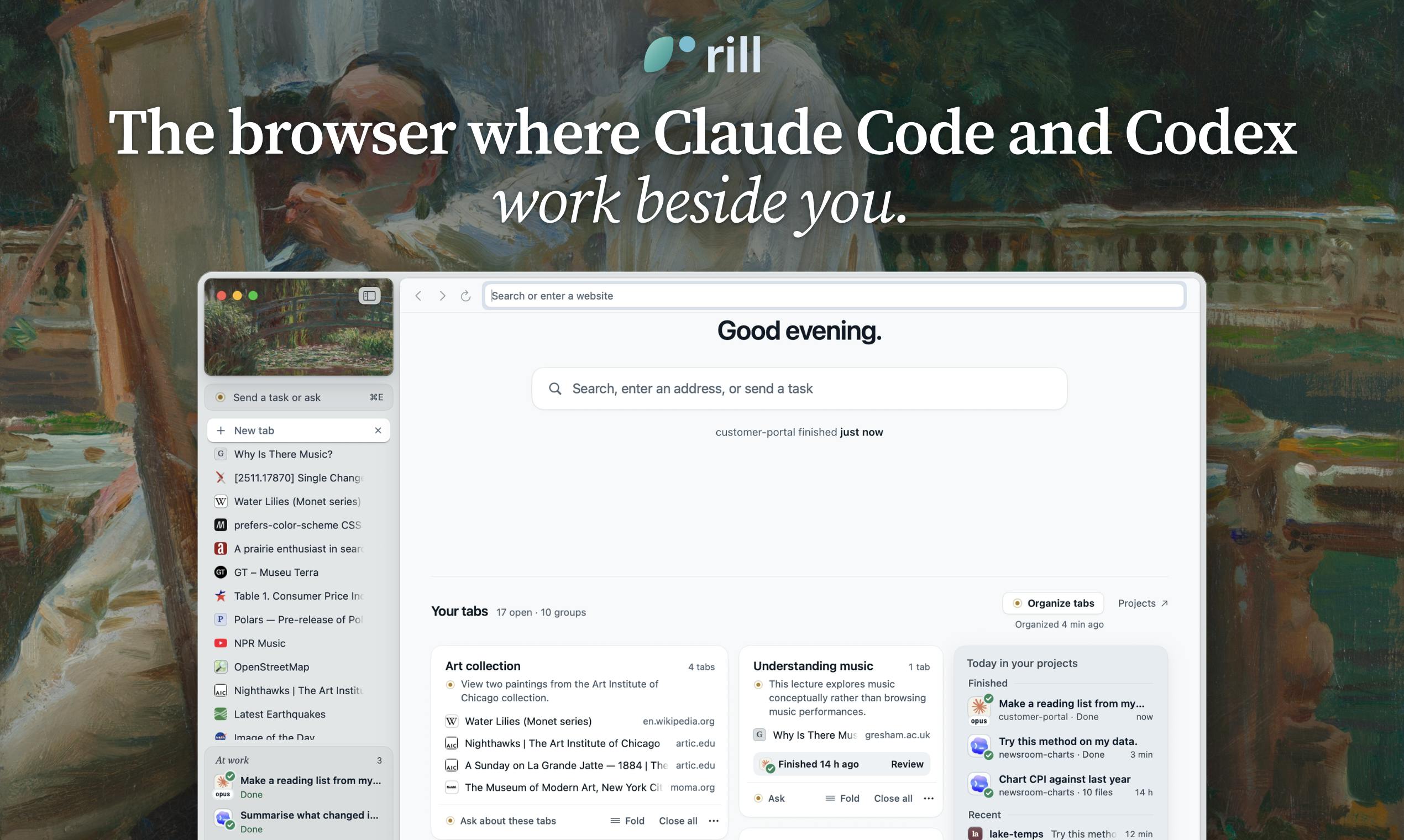
Rill Browser is a free, WebKit-based Mac browser designed to connect ordinary browsing with the coding agents a developer already runs. Its Product Hunt listing says a user can press ⌘E on a page to send its context to Claude Code or Codex, route the task to a project, and let the agent work while the user keeps browsing. It also groups tabs, makes history searchable by day, and collects agent projects in one view. These are product claims and launch materials, not independently verified usage results. Product Hunt listing
The strongest signal is a focused workflow insight: developers often encounter useful references while browsing, then lose context when switching to a terminal or agent workspace. Rill attempts to remove that interruption while building on agent subscriptions users already have. Its maker says the product uses the user’s existing Claude Code or Codex setup rather than charging for model access. Product Hunt listing
The main concern is the gap between launch attention and a repeatable business. On October 9, the Product Hunt page displayed 438 points and a #1 day rank; these indicate launch interest only. No public revenue, active-user, retention, conversion, or customer-reference data was found. The listing says the browser is free, and no paid plan or monetization path is disclosed.
A complete browser is a demanding product to distribute. Users must import browsing data, recreate extensions and habits, and trust a young vendor with a highly sensitive surface. Rill’s current Mac-only, two-agent focus gives it a clear initial wedge but also leaves it exposed to agent vendors and broader AI browsers adding similar context handoff. The public record supports further observation, not an investment or formal diligence decision. Final Decision: Watch.
Product Overview
Rill targets individual developers who use Claude Code or Codex and browse for design references, technical documentation, examples, or product ideas. The maker presents the core workflow as capturing a page in place, selecting the relevant project, and delegating work without copying text or explaining the context again. The listing also describes themed tab organization, searchable browsing history, and an overview of agent projects. Product Hunt listing
The maker describes Rill as a free, WebKit-based native Mac browser that uses existing Claude Code or Codex plans. A user comment on the listing reports that projects appeared after setup; this is a single user report, not a representative onboarding or reliability study. Pricing beyond free access, supported macOS versions, product availability metrics, and a formal roadmap could not be verified from accessible public material. The official website is linked from Product Hunt at rill.love, but detailed pricing and company disclosures were not available during this review.
The customer benefit is reduced context switching and faster delegation from a reference page into a code task. The substitute is a combination of Chrome or Safari, bookmarks or tabs, and manual copy-and-paste into an agent terminal. Rill’s value depends on making the browser switch worthwhile after accounting for extensions, password tools, sync, and reliability.
Founder and Team Assessment
The Product Hunt maker identifies himself as William and says he built Rill to avoid switching contexts while using coding agents. His Product Hunt profile lists “World Model Researcher,” “Harvard College,” “Quant Trading,” and “Foundation Model Training.” These are self-presented profile details; the public material reviewed did not verify his full identity, employment history, exits, company registration, or technical record independently. Maker profile
The launch page presents one maker, with no other team members, hiring, or full-time commitment publicly confirmed. A solo builder can ship a coherent early product, but maintaining a secure browser, cross-agent integrations, support, and a credible distribution channel is a substantial ongoing burden. Founder-market fit is plausible from the stated personal workflow; commercial execution remains unproven.
Founder Assessment: A personally motivated builder with relevant stated interests, but identity, team capacity, and commercial execution are insufficiently verified.
Market Opportunity
The initial segment is Mac-based developers who already run Claude Code or Codex and want to delegate work directly from pages they browse. Their problem is concrete, though its frequency and willingness to pay are unknown. The addressable customer count cannot be responsibly estimated from the available company evidence; the relevant subset is smaller than the broad developer market and depends on adoption of these specific agent workflows.
A threshold model illustrates the scale required, not market size: at an assumed $10 per seat per month, $50 million in annual recurring revenue would require about 417,000 paid seats. Team plans, project governance, and support for additional agents could increase annual contract value and expand the segment, but none is a disclosed commercial offering today. Geographic expansion is technically possible but depends on macOS availability, localization, and agent coverage. The timing is favorable for agent-centric workflows, while browser switching remains a high-friction adoption choice.
Traction and Growth Signals
At the time of review, Product Hunt showed 438 points and a #1 day rank for Rill. The launch page also contained maker replies and early user questions, including discussion of password-manager extensions and whether Rill is a daily or secondary browser. This is useful qualitative feedback, but it is not evidence of sustained use. Product Hunt listing
No reliable public figures were found for downloads, active users, paying customers, revenue, retention, growth, customer references, traffic, or post-launch usage. Product Hunt points and rank should therefore contribute only a small amount to the traction score. The most important missing evidence is repeated weekly usage, agent task completion, paid conversion, and retention after users test their existing browser setup.
Traction Assessment: Strong launch visibility relative to a new product, with commercial traction unverified.
Competitive Position
Direct competition includes AI-first browsers such as Perplexity Comet, which offers page assistance, browsing actions, and broader workflow automation, as well as Mac browsers such as Dia. Product Hunt also places Rill among products such as Arc and SigmaOS. Perplexity Comet Product Hunt alternatives Indirect alternatives are Chrome or Safari paired with Claude Code, Codex, bookmarks, and manual context transfer. Both coding agents already run locally as developer tools, so the user’s current workflow can be assembled without adopting a new browser. OpenAI Codex CLI Claude Code
Rill’s differentiator is the integration of page context, project selection, and background agent work into a single browser shell. If reliable, this is more specific than a generic AI sidebar. The maker says the browser uses WebKit and explains that a full browser gives agents a first-class place in the workflow; that is a product-positioning claim, not evidence of a durable technical moat. Product Hunt listing
If a leading coding-agent platform adds page capture, project routing, and browser handoff, the core Rill feature could be bundled at little incremental cost. Rill could retain users through excellent cross-agent orchestration, dependable context transfer, fast onboarding, and team workflows. No proprietary data, network effects, switching costs, or exclusive distribution are currently evidenced. Browser migration and limited extension compatibility are additional obstacles.
Defensibility Assessment: Low
Business Model and Economics
The only publicly stated price is free. The maker says Rill relies on existing Claude Code or Codex plans, which may limit direct model-inference expense for Rill, but the company has not disclosed hosting, update, support, or other operating costs. No paid tier, subscription price, enterprise contract, advertising plan, or conversion data was found.
Potential monetization could include paid team features, cross-agent orchestration, policy controls, or enterprise deployment. These are analyst hypotheses rather than announced plans. A free consumer browser can attract trial, but a sustainable model must cover ongoing browser maintenance and user support without relying on launch-driven downloads. The company would need to show willingness to pay and repeatable acquisition before gross margin or unit economics could be assessed. Platform compatibility, agent-provider terms, and the cost of supporting new integrations also need diligence.
Unicorn Path
For a software workflow product, assume an illustrative 20× ARR multiple for a high-growth business; this is a scenario, not a current market valuation. A $1 billion valuation at that multiple implies roughly $50 million ARR. At the illustrative $10 monthly seat price above, that means approximately 417,000 paid seats before churn, discounts, payment fees, or support costs. Rill has no disclosed price, paying users, or market share, so this scale is not presently evidenced.
A credible path would require monetization, durable retention, expansion from individual Mac developers to teams, support for multiple agents and operating systems, and an efficient distribution channel. Remaining a free single-user browser would not support this case. Unicorn Path: Conditional
Valuation Assessment
No funding round, investor, valuation, current fundraising status, or financing terms were publicly disclosed in the material reviewed. Revenue and growth are also unknown, so comparable-company multiples cannot responsibly produce an entry-price range. Valuation Attractiveness: Not Assessable.
A responsible assessment requires current ARR and growth, paid-user retention, gross margin, acquisition cost, burn and runway, round size, valuation cap or post-money valuation, cap table, and investor rights. Product Hunt rank and product quality do not substitute for these inputs.
Key Risks
- Browser-switch friction: Users may not leave a mature browser with established extensions, sync, and passwords.
- Feature bundling: Claude Code, Codex, or a scaled browser could add direct page-to-agent handoff.
- Unproven retention: A novel launch workflow may be used occasionally rather than daily.
- Unclear monetization: Free access has no disclosed conversion or revenue mechanism.
- Integration dependence: Core value depends on external agent clients and their local interfaces remaining available and compatible.
- Security and privacy exposure: A browser handles logged-in sessions and browsing history; the public record reviewed did not establish Rill’s security controls or data practices.
- Key-person risk: The public launch materials identify one maker and no operating team.
- Narrow platform and agent coverage: Mac-only distribution and two named coding agents constrain the initial addressable audience.
Final Assessment
Venture Potential: 43/100
| Category | Score |
|---|---|
| Market Size and Expansion Potential | 12/20 |
| Traction and Growth Evidence | 5/20 |
| Founder and Team | 7/15 |
| Product Strength | 7/10 |
| Distribution Potential | 6/15 |
| Business Model and Economics | 3/10 |
| Defensibility | 3/10 |
| Total | 43/100 |
The strongest elements are a clear developer pain point and a product concept that connects browsing to active coding work. The weakest are the lack of commercial evidence, browser migration costs, unclear monetization, and limited defensibility. The score reflects a plausible product wedge, not verified company quality.
Evidence Confidence: 35/100
Verified public evidence is limited to the Product Hunt listing, its launch claims and displayed launch metrics, and the maker’s profile. Product capabilities and the founder’s background are primarily maker-reported. The market calculation is an explicitly labeled analyst scenario. Revenue, usage, retention, team, legal entity, funding, security controls, unit economics, and valuation remain unavailable.
Final Decision: Watch
Watch is appropriate because the workflow is differentiated enough to merit observation, but public evidence does not justify formal diligence or an investment decision. The Conditional unicorn path depends on an unproven transition from a free Mac browser into a paid, broader developer workflow platform.
Upgrade Conditions
- Publish verifiable active-user, paid-conversion, and 90- and 180-day retention data.
- Show a repeatable acquisition channel beyond Product Hunt and a meaningful cohort of weekly active developers.
- Demonstrate paid team demand, with gross margin above 70% and customer-acquisition payback under 12 months.
- Support additional leading coding agents and provide clear security, privacy, and browser-extension documentation.
Downgrade Conditions
- Product updates or agent integrations stop, or upstream changes break the core workflow.
- Users do not retain the browser after importing their everyday work.
- A major agent platform bundles equivalent context handoff with substantially better distribution.
- A material browser security or privacy issue emerges, or the founder stops maintaining the product.
Questions for Further Diligence
- How many weekly and monthly active users do you have, and what share use Rill as their default browser?
- What are 30-, 90-, and 180-day retention by acquisition cohort?
- How many users have completed multiple agent tasks through Rill, and what is task completion success rate?
- What is the free-to-paid plan, and what have users said they would pay for?
- What are the primary acquisition channels and the fully loaded CAC by channel?
- How does Rill transfer page content, cookies, and browsing history to local agents, and what data leaves the device?
- What security review, vulnerability disclosure process, and update cadence do you maintain?
- Which agent integrations are supported today, and how resilient are they to upstream CLI or subscription changes?
- What extension, password-manager, import, and sync gaps most often prevent browser migration?
- Who is on the team, is the founder full-time, and what funding or financing terms are being considered?