
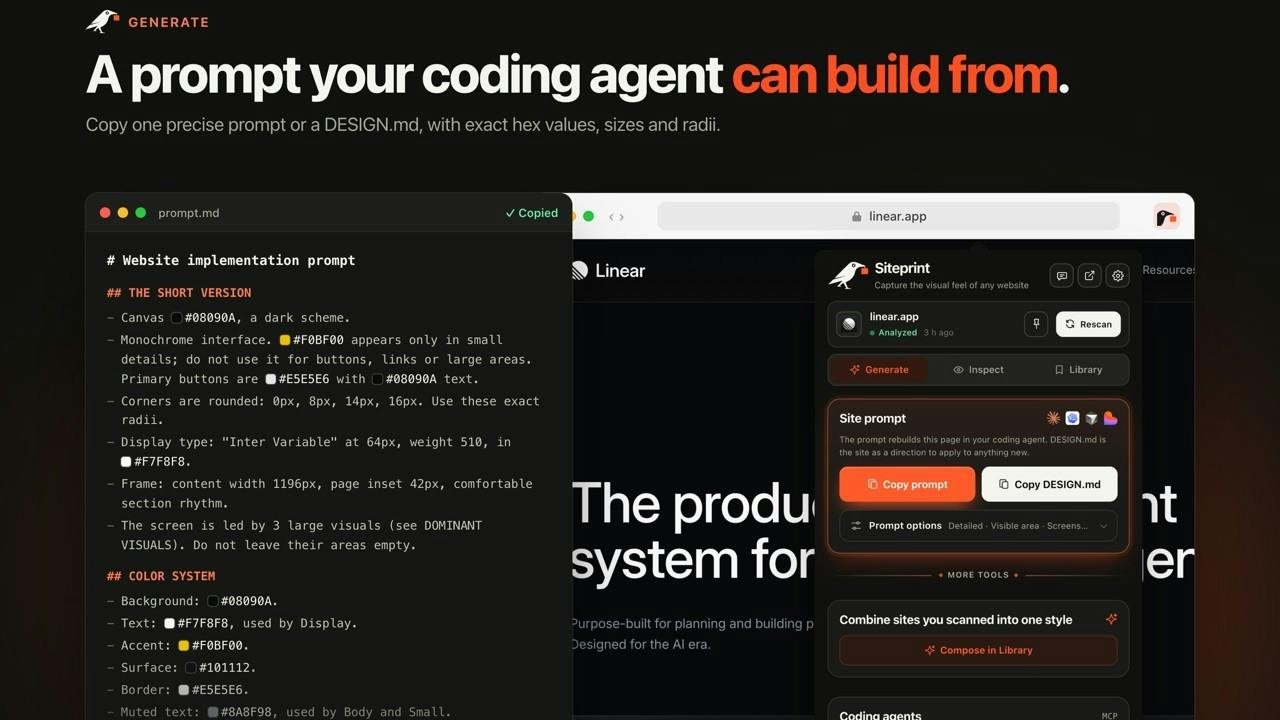
Siteprint — VENTURE INVESTMENT REPORT
Research date: 2026-10-08 | Product Hunt launch: 2026-10-05
SNAPSHOT
Product: Siteprint
Category: Design-to-code workflow / Safari extension
Product Hunt signal: #9 daily rank, 109 points, and 101 followers in the captured product page.
Product: Mac Safari extension that measures a website’s visual design and converts the measurements into AI-ready prompts and design documents.
Availability and pricing: Free Inspect, token export, and Library; Pro is a one-time $9.99 purchase. No account, tracking, or upload is advertised. Requires macOS 14 or later and Safari.
Differentiation: Design values are labeled by visual role and page area rather than presented as an unstructured palette; optional Apple Intelligence analysis runs on supported Macs.
Preliminary decision: PASS.
EXECUTIVE SUMMARY
Siteprint makes website references more actionable for AI-assisted frontend work. From Safari, a user scans a page to capture color values and semantic roles, typography, spacing, corners, buttons and cards, and a section-level layout blueprint. It turns this into a prompt, DESIGN.md, themes, or a scan that a coding agent can read through MCP. The tool does not generate the website itself: it measures the reference and hands its output to Claude Code, Codex, Cursor, or another agent.
This is a clear, focused utility for a real pain point. Developers often ask agents to recreate a visual reference but provide incomplete descriptions, leading the model to guess colors, spacing, type scales, and hierarchy. Siteprint can provide measured inputs and labels such as background, text, accent, and border. The maker also explains limitations openly: images and copy are not reproduced, complex animation is not captured, and results vary with the agent and model. In Product Hunt discussions, the maker said repeated components are only partly detected and that the tool does not yet tell an agent exactly which components to reuse.
The current business is an inexpensive Mac-only product with a one-time $9.99 upgrade and no account. That supports low-friction adoption and aligns with a local, privacy-oriented design, but it implies limited revenue per customer and depends on a narrow Safari-on-Mac audience. Public evidence shows a new Product Hunt launch with modest attention and no verified install, conversion, retention, or revenue data. Recommendation: PASS for venture investment at this stage. The product may be a viable indie utility, but the available business model and traction do not establish a venture-scale opportunity.
PRODUCT AND CUSTOMER
Siteprint offers two levels. Free users can inspect a page’s measurements, export design tokens, and save scans in a local library. Pro adds the complete AI-ready prompt and DESIGN.md, premade themes, Compose for combining two saved site styles, and MCP access so coding agents can read scans directly. The extension is installed from the Mac App Store, enabled in Safari settings, and used on a reference website.
The intended users are frontend developers, designers, founders, and teams using AI coding agents to build or restyle web pages. The most valuable workflow is a creator sees a site whose design language they want to use as inspiration, measures its visual system, and asks an agent to implement a related page within their own project. The tool’s narrow output makes sense because the user’s coding agent remains responsible for implementation and the user keeps control of the codebase.
The creator states that the tool works without Apple Intelligence and that on supported Macs an on-device model can name colors and type styles, describe the visual feel, and answer questions. The official site says scans run on the Mac, with no account, tracking, or uploads. These choices reduce infrastructure costs and privacy concerns, although they also limit cross-device collaboration and centralized analytics.
MARKET AND TIMING
AI coding agents can produce interfaces quickly, but quality still depends on precise direction. Visual reference extraction is a useful bridge between a rendered web page and structured code. The broader design-to-code market includes Figma handoff, browser inspection panels, design token tools, screenshot-to-code products, and AI design generators. As agents improve, the value of exact style inputs may increase because users can delegate implementation while retaining visual intent.
The addressable need is not automatically a large standalone market. Many developers can inspect CSS through browser tools, use a design-system extension, or ask an agent to approximate a screenshot. Some use Figma or an established component library as their source of truth. Siteprint’s strongest opening is a specific Safari-centric group that frequently rebuilds or adapts reference designs with coding agents. A broader product may need Chrome support, reusable component extraction, design-system synchronization, team libraries, or agency workflows, but each would expand scope and competition.
PRODUCT HUNT AND TRACTION
Product Hunt showed the launch as #9 of the day with 109 points and 101 followers. The maker answered questions about visual similarity, dark and light themes, trace accents, and component reuse. The transparency is useful: exact measurements improve visual consistency, but Siteprint does not copy content or imagery, complex animation is outside scope, and the result depends on the downstream agent.
These interactions demonstrate product engagement during launch, not repeat behavior. There are no public install counts, paid conversion rates, active-user numbers, refund rates, or customer references. The company should measure whether users scan multiple reference pages, create several projects, return to the saved library, and use the generated specifications in actual code. Purchase conversion from the free Inspect experience is especially important because the business currently depends on a small one-time payment.
BUSINESS MODEL
The official site advertises free Inspect and Pro for a one-time $9.99 payment. It requires no account and lists no recurring charge. This is a good impulse-purchase price and the local workflow likely keeps variable hosting and AI costs low. Optional Apple Intelligence analysis is available on supported devices, while the product states its basic measuring features work without it.
The trade-off is low lifetime revenue per user. At $9.99 gross before Apple’s distribution fees, taxes, refunds, support, and ongoing maintenance, a venture-scale business would need a large audience or adjacent revenue streams. The maker could add a recurring team or agency plan, design-system libraries, cloud sync, collaboration, or deeper implementation automation, but these require product changes and may conflict with the current no-account and no-upload positioning. No such monetization path was validated in reviewed public materials.
COMPETITIVE POSITION AND DEFENSIBILITY
Siteprint’s best product detail is its treatment of design tokens by role and visual weight. A flat list of hex codes does not tell an agent which color is the main background, a trace accent, a border, or a text color. Siteprint says it captures role, page coverage, type scale, spacing, corners, section structure, and some common interface elements. The output format is tuned for a coding agent rather than a human design audit. Compose adds a lightweight way to blend saved references.
The moat is limited. DOM and CSS inspection are available to browser extensions and developer tools; prompt generation can be copied; and design-to-code companies can bundle comparable measurement. Siteprint’s defensibility would need to come from exceptionally useful agent handoff, integrations, repeated designer workflows, a rich library of saved scans, or team-level adoption. At present, the tool’s focus and ease of use are differentiators but do not create substantial switching costs.
RISKS
- Low revenue ceiling: A one-time $9.99 price creates low lifetime value unless the addressable audience is large.
- Platform constraint: Safari on macOS 14 or later excludes Chrome-first developers, Windows, mobile, and many teams.
- Easily copied features: Website measurements and prompt output can be replicated by incumbent browser extensions or agent tools.
- Incomplete extraction: Repeated component identity, imagery, content, animation, and responsive behavior are not fully captured.
- Downstream variability: The quality of the recreated page depends on the coding agent, model, and user prompting.
- Weak public traction evidence: Product Hunt ranking does not show install conversion, repeat use, or paid demand.
- Platform dependency: Safari and Mac App Store policies and APIs control a core distribution channel.
- Scope expansion tension: Adding cloud libraries or collaboration could raise monetization potential while weakening its privacy-first simplicity.
SCORECARD (1 = weak, 5 = strong)
Problem clarity: 4/5
Product usability: 4/5
Market timing: 4/5
Differentiation: 3/5
Distribution potential: 2/5
Verified traction: 1/5
Monetization: 1/5
Defensibility: 1/5
Venture-scale potential: 1/5
Overall: 2.3/5 — focused indie tool with a weak current venture case.
FINAL DECISION: PASS
Siteprint is a useful and thoughtfully scoped utility for feeding measured visual design into AI coding workflows. The free inspection tier and low one-time price could support an independent software business. The evidence does not show a recurring revenue engine, broad platform reach, sustained user adoption, or a defensible advantage suitable for venture investment. Reassess if it becomes a repeat-use team product, adds validated recurring revenue, or establishes a measurable conversion channel into a larger design-to-code platform.
DILIGENCE QUESTIONS
- How many installs, weekly active users, Pro purchases, refunds, and repeat scans have occurred since launch?
- What share of users convert from free Inspect to the $9.99 Pro unlock?
- How much time does Siteprint save compared with manual browser inspection or existing design-token tools?
- Which user segment scans most often: freelancers, agencies, internal product teams, or founders?
- What does the app capture from websites, and is any page data transmitted off-device?
- How well does token extraction work on responsive pages, dark mode, dynamic content, and authenticated sites?
- What portion of users invoke MCP or use the generated DESIGN.md in a real implementation?
- How will the product support Chrome, cross-device libraries, and team use without losing its privacy proposition?
- Are there plans for recurring agency or team pricing, and what paid workflow would justify it?
- What is the release and support cadence for Safari and macOS compatibility changes?
- How does the maker handle source-site terms, attribution, and users’ rights when measuring reference designs?
- Which existing design inspection or design-to-code tool is most often evaluated as an alternative?
SOURCES
Product Hunt launch and maker discussion: https://www.producthunt.com/products/siteprint
Official product and pricing: https://siteprint.app/