
Table of Contents
- Together Link — Venture Investment Report
Together Link — Venture Investment Report
Category: AI developer infrastructure / coding-agent model routing
Company Stage: Beta product within a Series C private company
Founder or Founders: Vipul Ved Prakash (CEO), Ce Zhang (CTO), Chris Ré, Tri Dao, and Percy Liang are listed as founders
Headquarters: San Francisco, California
Funding: $800 million Series C announced July 2026; reported $8.3 billion valuation
Business Model: Free MIT-licensed Link client; revenue through per-token inference and broader cloud services
Product Hunt Launch Date: 2026/10/09
Report Date: 2026-10-12
| Investment Metric | Assessment |
|---|---|
| Venture Potential | 77/100 |
| Unicorn Path | Achieved at company level; reported $8.3 billion valuation in July 2026 |
| Valuation Attractiveness | High expectations; financial detail insufficient to assess |
| Evidence Confidence | 64/100 |
| Final Decision | Watch |
Executive Summary
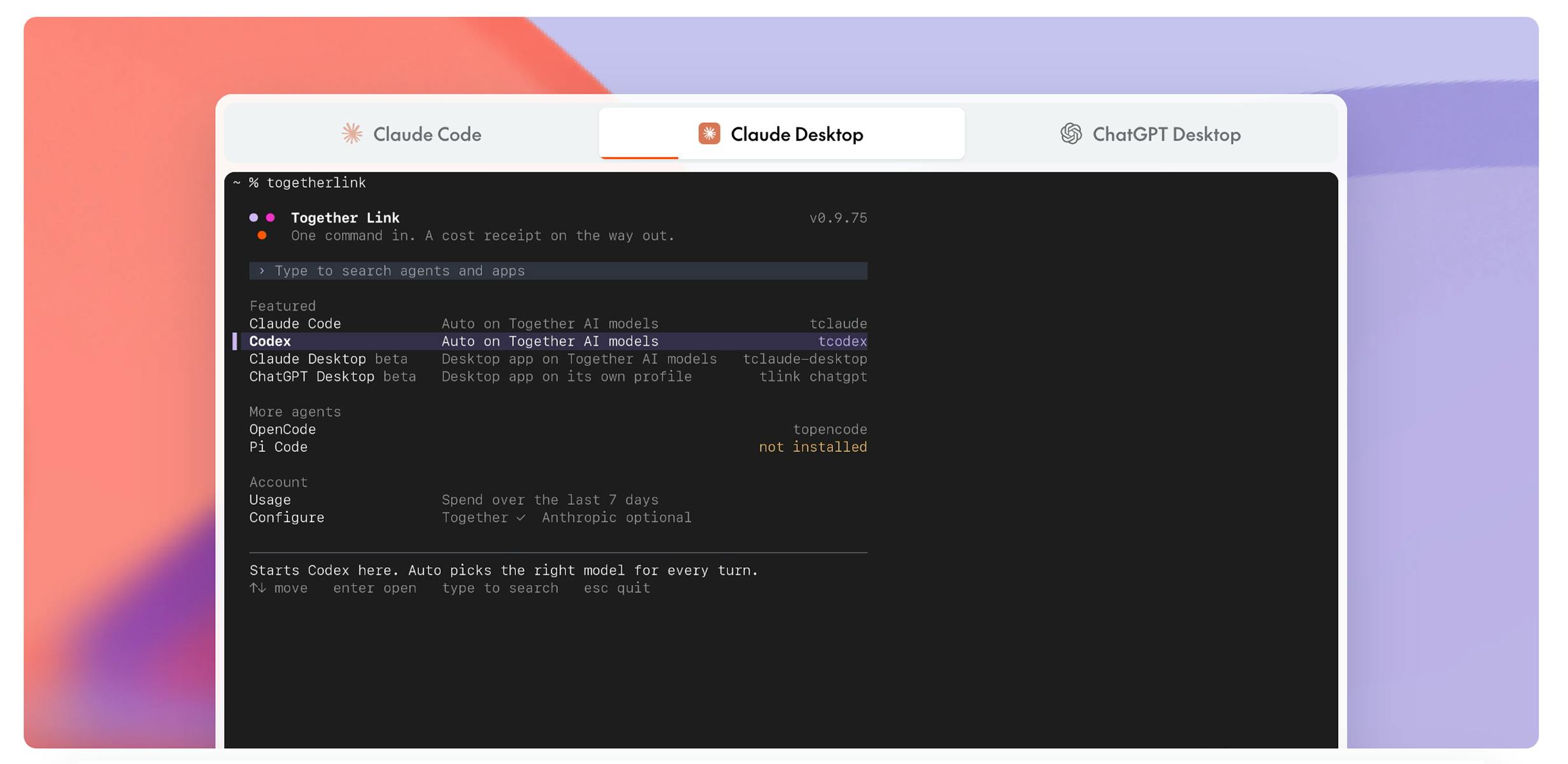
Together Link is a beta utility that connects coding agents developers already use to open models served by Together AI. It supports Claude Code, Claude Desktop, Codex, ChatGPT Desktop, OpenCode, and Pi. A command-line setup configures a separate or temporary profile, routes requests to a chosen model or Together’s router, and reports session costs. The client is free and MIT licensed; users pay per-token model rates.
The product addresses a real cost issue: teams often use expensive frontier models for routine coding tasks. Together claims Link can reduce spend by 50–80% versus using Opus 5.5 for every session. This is a vendor claim, not an independent benchmark; actual savings depend on model quality, retries, and human review. The router chooses once at the beginning of a session, so it may miss later changes in task difficulty.
The investment case is for Together AI, not a separate Link company. Together AI reports thousands of customers and announced an $800 million Series C in July 2026. TechCrunch reported an $8.3 billion valuation and company-claimed annual bookings above $1.15 billion. Bookings are not audited revenue, and Link has no published adoption or revenue metrics. The valuation is demanding for a capital-intensive cloud business.
Final Decision: Watch. Link may route more developer traffic to Together’s inference service, but product use, coding quality, and incremental economics are unverified. See the official product page and launch post.
Product Overview
Together Link is a command-line integration, not a new coding agent. It aims to preserve the user’s existing harness, login, settings, and history while routing calls to Together AI. Users can choose open models such as Kimi K3, GLM 5.3, MiniMax M3, and DeepSeek V4.1 Flash, or use an Auto Router. Together says the router reads the first task in a session and selects a lower-cost model for routine work or a stronger model for harder work. Users can revert to their original setup.
One-command onboarding and session cost receipts can reduce friction and make spending visible. But the client is open source and can be copied; its value depends on Together’s hosted model quality, reliability, and pricing. The beta supports macOS and Linux, requires a Together API key, and has no public service-level commitment or product usage statistics. The linked GitHub repository had about 48 stars and 8 forks at research time, a shallow signal of early interest.
Founder and Team Assessment
Together AI lists Vipul Ved Prakash as Founder and CEO and Ce Zhang as Founder and CTO, alongside Chris Ré, Tri Dao, and Percy Liang. The team combines company-building, research, and systems experience. TechCrunch reports that Ved Prakash previously founded Topsy, acquired by Apple in 2013. Link’s dedicated team and product ownership are not disclosed.
Founder Assessment: Strong company-level credentials; Link-specific staffing and accountability remain unknown.
Market Opportunity
Link targets developers and engineering teams using coding agents at material token volumes. If open models perform adequately on routine work, shifting sessions to cheaper inference can create savings and move usage to Together’s API. Model choice and cost control become more valuable as agents run longer tasks.
The reachable market is smaller than all software developers: users need supported harnesses, confidence in open models, and trust in Together’s reliability, data handling, and latency. Competitors include direct model APIs, OpenRouter, Fireworks, and harness vendors adding their own provider options. Link’s addressable users and market penetration are unknown.
Traction and Growth Signals
Product Hunt showed Link at #4 with 190 points and seven reviews rated 5.0 at research time. The launch is recent, and these signals do not establish retention. Together AI says it serves thousands of customers, including Cognition, Decagon, ElevenLabs, Cursor, and Suno; these are company-level customers and cannot be attributed to Link.
TechCrunch reported Together AI’s claim of annual bookings above $1.15 billion as of its last quarter. This is not audited revenue, ARR, or Link contribution. No Link installs, active users, token volume, repeat use, or verified savings have been disclosed.
Traction Assessment: The parent has scale signals; Link’s own adoption and revenue are unverified.
Competitive Position
OpenRouter provides model aggregation and routing; Fireworks offers usage-priced open-model inference. Developers can also connect directly to Together’s API, while coding harnesses can add providers themselves. Link differentiates through one-command setup, support for multiple agents, reversible configuration, cost receipts, and routing to Together-hosted models.
These features improve onboarding but are reproducible. Defensibility would require better reliability and cost per successful coding task, plus integrations developers keep using. The savings claim must be tested against task completion and rework, not token prices alone.
Defensibility Assessment: Moderate. Together’s inference infrastructure and customers help, but the client is open and providers are relatively easy to switch.
Business Model and Economics
The Link client is free; Together monetizes when users consume its inference. This can make Link a developer acquisition channel and raise model utilization. The broader platform offers serverless and dedicated compute. Yet no Link-specific customer acquisition cost, token share, gross margin, or usage mix is disclosed.
Together must cover GPUs, energy, and hosting while competing on price. Its Series C announcement also describes investor commitments for more than 500 MW of separately capitalized compute. This supports expansion but underscores infrastructure scale and financing needs. Savings for customers do not by themselves establish attractive provider margins.
Unicorn Path
Together AI is already a unicorn: TechCrunch reported an $8.3 billion valuation in its July 2026 Series C. Further upside depends on converting bookings to recognized revenue and sustaining margins while scaling compute. Link could attract developer traffic, but is too new to count as a material growth driver.
Valuation Assessment
The reported $8.3 billion valuation sets a high bar. The reported $1.15 billion annual bookings figure indicates scale but is not revenue and cannot support a clean valuation multiple without definitions, margins, and conversion data. Current share availability, dilution, and terms are unknown.
Valuation Attractiveness: Not Assessable with confidence. Required diligence includes recognized revenue, service-level gross margin, bookings conversion, GPU utilization, financing obligations, and current terms.
Key Risks
- Model quality: Open models may require retries or human correction, reducing savings.
- Router limits: One choice per session may miss changes in task difficulty.
- Competition: Model vendors and other routers can bundle similar features.
- Capital intensity: GPU supply, utilization, energy, and financing affect margins.
- Bookings ambiguity: Company-reported bookings are not revenue or profit.
- Beta adoption: Link has no disclosed usage or retention.
- Provider dependence: Users rely on Together’s models, prices, data policies, and uptime.
- Valuation: The reported $8.3 billion price leaves limited room for execution misses.
Final Assessment
Venture Potential: 77/100
| Category | Score |
|---|---|
| Market Size and Expansion Potential | 17/20 |
| Traction and Growth Evidence | 15/20 |
| Founder and Team | 12/15 |
| Product Strength | 8/10 |
| Distribution Potential | 11/15 |
| Business Model and Economics | 7/10 |
| Defensibility | 7/10 |
| Total | 77/100 |
The company has strong market exposure, experienced founders, customers, and funding. Link’s product evidence is early, while cloud economics and valuation need scrutiny.
Evidence Confidence: 64/100
Official sources document product features, license, founders, and funding. Valuation and bookings rely on reporting of company claims. Audited revenue, margins, Link usage, and task-quality data remain unavailable.
Final Decision: Watch
Watch Together AI and Link. The company has potential in open-model infrastructure, but Link adoption is unproven and the reported valuation is demanding.
Upgrade Conditions
- Publish Link usage, repeat activity, and token volume by cohort.
- Independently verify coding quality and total cost savings.
- Show attractive inference margins and reliable compute access.
- Convert bookings into retained, recognized revenue.
- Offer valuation and terms that compensate for capital and execution risk.
Downgrade Conditions
- Users revert to closed models due to quality or reliability.
- Price competition compresses inference margins.
- Compute commitments create cash-flow pressure.
- Bookings fail to convert into revenue or renewals.
- Link integrations break as agent interfaces change.
Questions for Further Diligence
- How many active Link users and teams use it weekly, and how do they retain?
- What share of installs become paying inference customers?
- What is task success by model and harness versus frontier alternatives?
- How are the 50–80% savings measured, including retries and review?
- What share of Together’s tokens and gross profit comes from Link?
- How are bookings defined and converted to recognized revenue?
- What are gross margins across serverless, dedicated inference, and GPU cloud?
- How are the 500 MW compute commitments financed and matched to demand?
- What retention, training, regional processing, and ZDR controls apply to Link traffic?
- What are current share price, dilution, and investor rights after Series C?
Sources
- Together Link product page and FAQ
- Together AI: Link launch post
- Together Link documentation
- GitHub repository and MIT license
- Product Hunt launch
- Together AI: $800 million Series C
- Together AI founders and leadership
- TechCrunch: Series C, valuation, and bookings
- Together AI inference pricing
- Together AI privacy policy
- OpenRouter models and routing
- Fireworks AI inference pricing
Conclusion: Together Link is a plausible way to acquire inference users for a well-funded open-model cloud. Company scale is visible, but Link adoption, coding quality, and infrastructure margins are not public. Watch for product metrics, revenue conversion, and updated valuation terms.