
Table of Contents
Odyssey-3 — Venture Investment Report
Category: Foundation world model / physical AI
Company Stage: Series B startup; Odyssey-3 research preview
Founder or Founders: Oliver Cameron (CEO) and Jeff Hawke (CTO)
Headquarters: San Francisco, California
Funding: $310 million Series B at a reported $1.45 billion valuation, June 2026
Business Model: Research preview; API access by inquiry; pricing and revenue undisclosed
Product Hunt Launch Date: 2026/10/09
Report Date: 2026-10-12
| Investment Metric | Assessment |
|---|---|
| Venture Potential | 71/100 |
| Unicorn Path | Achieved; reported $1.45 billion valuation |
| Valuation Attractiveness | High potential, but financial evidence insufficient to assess |
| Evidence Confidence | 59/100 |
| Final Decision | Watch |
Executive Summary
Odyssey-3 is a learned world model that generates interactive environments and predicts how they change as a user or agent acts. Odyssey targets simulation, synthetic data, robotics, autonomous driving, and agent training. Its research preview is public; physical-AI developers seeking API access must contact the company. Pricing, revenue, customer count, and production service commitments are not disclosed.
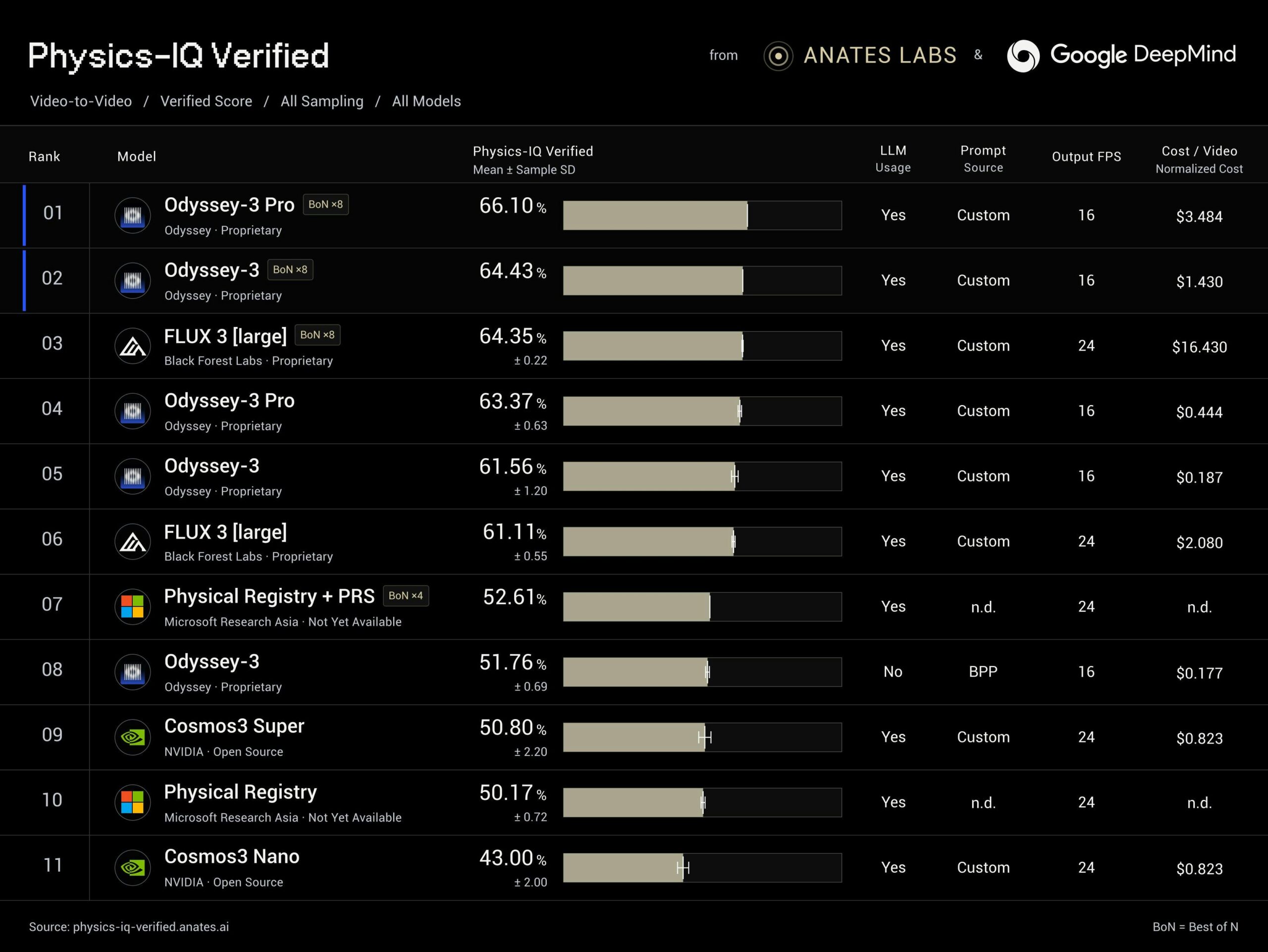
The technical case is promising. Odyssey reports a 66.1 score for Odyssey-3 Pro on Physics-IQ Verified video-to-video using best-of-eight sampling, and first-place results in three WorldMark categories. The current Physics-IQ leaderboard ranks Odyssey-3 Pro second behind FLUX 3 in the verified video-to-video track, with normalized cost of $0.267 per video. Benchmark configurations differ, and selected video quality does not prove reliable interactive behavior or physical control. Odyssey’s robot and driving examples also use separately trained policies or action decoders.
Odyssey has experienced autonomy founders, a strong investor group, and a $310 million Series B at a reported $1.45 billion valuation. AWS is to become its preferred cloud provider, with model work on Trainium. However, the valuation precedes public revenue or quantified customer deployments. World models remain compute-intensive, and the path from video simulation to safe physical applications is unproven.
Final Decision: Watch. Track paid pilots, model performance in single-sample use, and sim-to-real reliability before investing at the reported valuation. The spreadsheet’s Product Hunt date is 2026/10/09; Odyssey announced the model on October 8. See the official launch post and Product Hunt page.
Product Overview
Odyssey-3 predicts object motion and interactions over time, then generates environments users can navigate. The preview supports first- and third-person movement and independent camera control. Developers can adapt the foundation to a robot or vehicle by training action decoders or policies on paired observations and actions.
Odyssey reports robot-arm tasks after tens of hours of demonstrations, Flexion humanoid policies, and a car-driving policy trained on 20 hours of driving data in India. These are company-reported experiments, not evidence of certified safety or repeatable customer deployments.
Potential uses include agent training, synthetic data, interactive media, and physical-system simulation. Odyssey’s broader portfolio includes Explorer for 3D scene generation, Agora for multi-agent simulation, and Starchild for multimodal interaction. Public API pricing and service terms are unavailable.
Founder and Team Assessment
Odyssey was founded by Oliver Cameron and Jeff Hawke, whose team says it spent roughly a decade building driverless-car systems. TechCrunch reports Cameron led Voyage and later held a product role at Cruise, while Hawke worked at Wayve. Their backgrounds fit the problem; product-level staffing and commercial execution remain unclear.
Founder Assessment: Strong technical relevance and founder-market fit; deployment performance at Odyssey’s scale is not yet proven.
Market Opportunity
Possible buyers include robotics and autonomous-vehicle developers, industrial simulation teams, game studios, and AI labs that need interactive environments or synthetic data. Commercialization could use paid API access, enterprise licensing, or cloud consumption, but these are inferred paths; Odyssey has not published terms or pipeline data.
The opportunity depends on whether simulation reduces real data collection and testing costs. Visual quality is insufficient if a model does not reproduce the physical variables that matter to a machine. Each use case needs validation against its sensors, controls, safety targets, and edge cases. Public evidence does not support a bottom-up market estimate.
Traction and Growth Signals
Product Hunt showed Odyssey 3 at #5 with 161 points at research time. This indicates launch attention, not recurring use. Odyssey’s preview and related products show continuing research activity. The Series B and AWS/Trainium collaboration provide resources for development.
No public metrics were found for preview users, API customers, paid pilots, revenue, usage, or deployment success. Company demonstrations are research signals, not quantified commercial traction.
Traction Assessment: Strong funding and research activity; product adoption and revenue remain unverified.
Competitive Position
Google DeepMind’s Genie 3 generates real-time interactive worlds at 20–24 frames per second and 720p. NVIDIA Cosmos 3 is an open physical-AI model family for simulation, synthetic data, and action generation, backed by NVIDIA’s developer ecosystem. Odyssey combines interactive generation with physics-focused evaluation and policies adapted to physical systems.
Odyssey’s launch post highlighted a 66.1 Physics-IQ Verified score using best-of-eight sampling. The current verified leaderboard places Odyssey-3 Pro second behind FLUX 3; its page separates sampling modes and normalized costs. Odyssey also reports leading WorldMark results, but those are company evaluations in specific categories. Neither establishes reliable control in a customer’s real environment.
Defensibility Assessment: Moderate. A durable physical-prediction advantage could compound, but major labs and NVIDIA have strong models, compute, and distribution. Odyssey has not disclosed exclusive data access or validated deployment loops.
Business Model and Economics
Odyssey provides a research preview and directs API users to contact the company. The likely business is paid model access for simulation and policy training, possibly paired with cloud consumption; pricing and revenue are not public.
Training and serving interactive video worlds require substantial compute. Gross margin depends on GPU utilization, inference speed, quality, and generations needed per useful simulation. Public benchmark costs do not disclose Odyssey’s internal costs or customer willingness to pay. Strategic cloud work and the Series B improve resources but do not prove unit economics.
Unicorn Path
Odyssey has already reached unicorn status through its reported $1.45 billion Series B valuation. Further value depends on converting research and partner work into repeat paid workloads. Robotics, autonomy, and simulation can support large contracts, but validation cycles are long. Near-term proof should include paid pilots and measurable reductions in real-world data or testing cost.
Valuation Assessment
The reported valuation is substantial for a company with no public revenue or paid deployment metrics. The $310 million raise and strategic investors provide resources, but do not support a revenue multiple or return estimate. Future dilution and financing terms are unknown.
Valuation Attractiveness: Not Assessable with confidence. Diligence needs revenue, customer cohorts, API pricing, cost per useful simulation, burn, and runway.
Key Risks
- Sim-to-real gap: Benchmark scores may not transfer to safe physical control.
- Evaluation limits: Best-of-eight results may differ from single-sample use.
- Commercial uncertainty: Customers, prices, and revenue are undisclosed.
- Compute intensity: Training and low-latency inference may constrain margins.
- Competition: Google DeepMind, NVIDIA, and other labs have strong resources.
- Long sales cycles: Robotics and auto buyers require extensive validation.
- Data access: Sensor and action data may be costly or rights constrained.
- Valuation: The $1.45 billion reported price sets a high evidence bar.
Final Assessment
Venture Potential: 71/100
| Category | Score |
|---|---|
| Market Size and Expansion Potential | 18/20 |
| Traction and Growth Evidence | 9/20 |
| Founder and Team | 14/15 |
| Product Strength | 9/10 |
| Distribution Potential | 10/15 |
| Business Model and Economics | 5/10 |
| Defensibility | 6/10 |
| Total | 71/100 |
The team and technical direction are compelling. Product usage, commercial deployment, and unit economics are not established.
Evidence Confidence: 59/100
Funding, leadership, and preview availability are documented. Several model and benchmark claims come from Odyssey. Revenue, customer adoption, reliability, and model costs remain unknown.
Final Decision: Watch
Watch Odyssey-3. Reassess when API terms, paid deployments, and physical-system validation are available. Benchmark results alone do not support the reported valuation.
Upgrade Conditions
- Publish API pricing, usage, reliability, and customer references.
- Show repeat paid pilots or deployments.
- Validate single-sample performance and safe task completion.
- Demonstrate sim-to-real transfer across hardware and environments.
- Show cost per useful simulation and sustainable margins.
Downgrade Conditions
- Pilots fail to generalize beyond controlled demonstrations.
- Useful quality requires excessive sampling or compute.
- API access remains limited without commercial terms.
- Competitors deliver comparable results at lower cost.
- Funding needs or dilution rise before commercial validation.
Questions for Further Diligence
- What are Odyssey-3’s single-sample quality and latency in interactive use?
- How does best-of-eight Physics-IQ performance compare with single-generation results?
- Which customers pay for API or enterprise access, and what is in production?
- What task success and safety results exist across robot platforms?
- How much real-world data is needed to adapt the model to a new body?
- What does a useful simulation cost at target resolution and frame rate?
- What are the rights and privacy terms for training data?
- What are API availability, service commitments, and deployment options?
- What are revenue, burn, runway, and compute commitments after Series B?
- How will Odyssey defend its position against Genie 3 and Cosmos 3?
Sources
- Odyssey-3 official launch and benchmarks
- Odyssey 3 Product Hunt launch
- Odyssey Series B announcement
- Odyssey company and team
- Physics-IQ Verified leaderboard and normalized costs
- Physics-IQ Verified research paper
- WorldMark benchmark paper
- Google DeepMind: Genie 3
- NVIDIA: Cosmos 3
- TechCrunch: Series B and valuation
Conclusion: Odyssey-3 combines a serious world-model program with promising early demonstrations and strong financing. Its launch benchmark framing has already shifted on the public leaderboard; commercial access, revenue, and deployment reliability remain unknown. Watch until paid deployments and sim-to-real evidence support the valuation.