
Table of Contents
Skilldocs Investment Report
Category: Collaborative Markdown editor / AI-agent skill management / developer tools
Company Stage: Experimental or pre-commercial product; standalone company formation not verified
Founder or Founders: Rajiv Ayyangar
Headquarters: San Francisco Bay Area, California, United States
Funding: Not publicly disclosed; no Skilldocs-specific financing was found
Business Model: Not publicly disclosed
Product Hunt Launch Date: August 13, 2026
Report Date: August 16, 2026
| Investment Metric | Assessment |
|---|---|
| Venture Potential | 51/100 |
| Unicorn Path | Conditional |
| Valuation Attractiveness | Not Assessable |
| Evidence Confidence | 46/100 |
| Final Decision | Watch |
Executive Summary
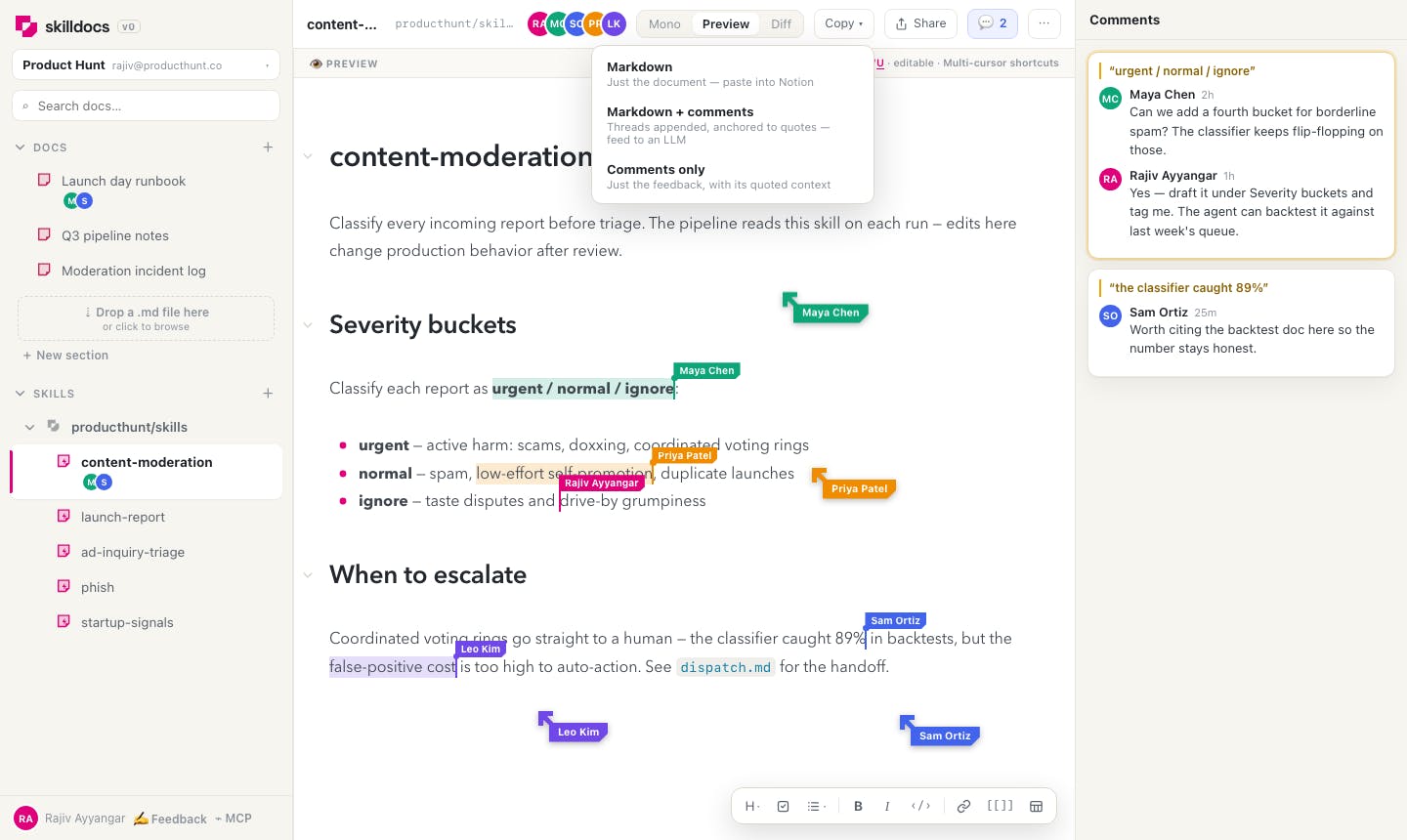
Skilldocs is a real-time collaborative editor for the Markdown files used to instruct AI agents. It combines live rendering, multiple cursors, inline comments, version history, GitHub imports, and an MCP integration that lets agents push files into Skilldocs and retrieve edits, comments, and diffs (Skilldocs tour).
The product serves teams creating Agent Skills—portable folders containing a SKILL.md file, instructions, scripts, and reference materials. This format was originally developed by Anthropic and subsequently released as an open standard supported by multiple agent products (Agent Skills; Anthropic). Skilldocs’ thesis is that these files will become important enough to require a purpose-built collaboration and governance layer.
The strongest positive signal is founder quality. Rajiv Ayyangar is CEO of Product Hunt and previously co-founded Tandem, a Y Combinator-backed virtual-office startup that raised a reported $7.5 million seed round led by Andreessen Horowitz. He also has product and data experience at Dropbox, Yahoo, and other technology companies (LinkedIn; TechCrunch). This is substantially stronger founder experience than is typical for an experimental Product Hunt launch.
The central investment concern is that Skilldocs does not yet appear to be a standalone company. Ayyangar remains Product Hunt’s CEO, no dedicated Skilldocs team or legal entity was identified, and pricing, revenue, customers, retention, funding, security policies, and business terms are not publicly disclosed. The current product may be an internal tool or founder-led experiment rather than a full-time venture.
Final Decision: Watch. Skilldocs is a thoughtful product in an emerging category, but the present evidence supports product quality more than company quality. An upgrade to DD requires full-time commitment, a defined commercial model, retained team usage, and expansion from editing into the broader lifecycle of evaluating, governing, and deploying agent skills.
Product Overview
Agent skills are generally stored as plain Markdown and related files in a repository. Teams can review them through pull requests, edit them in an IDE, or copy them into general-purpose document tools. Each option has limitations: IDE and Git workflows are less accessible to non-engineers, while Google Docs or Notion can alter formatting and separate the document from its source-controlled version.
Skilldocs attempts to bridge those workflows. Its editor renders Markdown in place while revealing syntax around the cursor. It supports Mermaid diagrams, multi-cursor editing, heading folds, real-time presence, comments anchored to selected text, follow mode, and automatic conflict resolution through a CRDT-based document model (product tour).
The agent workflow is the most differentiated component. Its MCP server provides tools for an agent to:
- Push a local skill into Skilldocs.
- Read the document and comment threads.
- Compare the collaborative version with the original baseline.
- Reply to or resolve comments.
- Pull the revised text back into a local file.
Skilldocs can also connect to a GitHub repository and display Markdown skills alongside documents imported from local machines. Past versions are preserved as read-only snapshots that can be restored (Skilldocs).
Current support is documented for Claude Code, Claude Desktop, Cursor, and other clients capable of connecting to an HTTP or local MCP server. No native mobile or desktop application was identified.
Public pricing, free-plan limits, paid plans, enterprise features, or billing terms were not found. The website includes authentication and workspace functionality, but a search result also described the instance as being “for the Product Hunt team.” Whether public users can create durable production workspaces under commercial terms was not independently verified.
The product’s primary benefit is allowing technical and non-technical employees to review agent instructions without losing Markdown fidelity or disconnecting the conversation from the agent’s working file.
Founder and Team Assessment
Rajiv Ayyangar identifies himself as Skilldocs’ builder in his launch posts and Product Hunt maker profile. His current primary role is CEO of Product Hunt, a position he has held since 2023 (LinkedIn; Product Hunt profile).
Ayyangar previously co-founded and led Tandem from 2018 through 2022. Tandem developed a virtual office for distributed teams, participated in Y Combinator, and raised a reported $7.5 million seed round at a valuation above $30 million (TechCrunch). Ayyangar later wrote that Tandem’s original venture-backed company would otherwise have been closed and that the team transferred the product into a separate LLC to avoid stranding customers (founder account). This was not a conventional venture exit, but it demonstrates fundraising, product development, and operating experience.
His earlier roles include an entrepreneur-in-residence position at Dropbox and product or data work at Yahoo, Aviate, and other companies. He studied engineering at Princeton (LinkedIn).
No other Skilldocs employees, co-founders, contractors, open positions, or advisors were reliably identified. Full-time commitment is therefore the decisive team concern. Skilldocs would require dedicated engineering, security, sales, and customer-success resources to become an enterprise product.
There is also a potential distribution interpretation issue: Skilldocs launched on Product Hunt while its founder is Product Hunt’s CEO. This does not imply manipulation, but Product Hunt exposure should not be treated as independent validation of organic demand.
Founder Assessment: Highly credible product founder, but full-time commitment and the existence of a dedicated company are not verified.
Market Opportunity
The initial customer segment is narrowly defined as software and AI teams creating reusable Agent Skills for Claude Code, Cursor, enterprise agents, or cross-platform agent systems. The likely users are developers, prompt or context engineers, operations specialists, and domain experts collaborating on procedural instructions.
A bottom-up scenario requires assumptions because Skilldocs does not disclose pricing or customer data:
- Potential initial organizations: 20,000–100,000
- Potential annual contract value: $600–$6,000
- Indicative initial addressable revenue: $12 million–$600 million annually
These figures are analyst assumptions, not verified market statistics. The lower ACV reflects a small-team collaborative editor; the upper end assumes team administration, repository connections, version history, and higher usage.
The narrow editing market may support a useful SaaS business but is not clearly venture-scale. A larger opportunity emerges if Skilldocs expands into an agent-skill lifecycle platform encompassing:
- Skill testing and evaluation.
- Success-rate comparisons between versions.
- Approval and deployment workflows.
- Security scanning for malicious instructions or scripts.
- Enterprise access controls and audit logs.
- Cross-agent compatibility testing.
- A private or public skill registry.
- Usage telemetry and rollback.
- API-based distribution to agent platforms.
Market timing is favorable because Agent Skills became an open standard in late 2025, and Anthropic has stated that skills can include executable code and should be audited before installation (Agent Skills specification; Anthropic security discussion). That creates potential demand for collaboration and governance, but it is too early to know whether SKILL.md becomes a durable category or simply another repository-managed file.
Traction and Growth Signals
Skilldocs launched on Product Hunt on August 13, 2026 and ranked seventh for the day, with Product Hunt snapshots showing approximately 200 votes or points (daily leaderboard; listing). This indicates launch interest, not product-market fit.
The public website contains a functioning product tour and documents a relatively complete collaboration workflow, including real-time editing, comments, GitHub import, MCP access, and version history. This supports product execution beyond a landing-page concept.
However, no reliable public evidence was found for:
- Registered or active users.
- Number of workspaces or connected repositories.
- Paying customers or revenue.
- Free-to-paid conversion.
- User retention.
- Number of documents edited.
- MCP package downloads.
- Customer testimonials or case studies.
- A regular public changelog.
- A dedicated team or hiring activity.
The Product Hunt comments raise an important product requirement: teams need to know whether an edited skill causes an agent to perform better, not merely whether the prose appears clearer. Skilldocs currently documents version history but does not publicly demonstrate evaluation results attached to each version.
Traction Assessment: Visible product execution and launch interest, but no commercially meaningful traction has been verified.
Competitive Position
Direct competitors include HackMD, GitBook, GitHub, and other collaborative Markdown or technical-documentation tools. HackMD already offers real-time collaboration, inline comments, GitHub integration, version history, and a free plan; its Prime plan costs $5 per seat per month (HackMD pricing).
GitBook provides collaborative documentation, Git-based synchronization, an AI writing agent, and integrations with GitHub, Slack, and Linear. It has also published guidance around structuring products for agents through skill.md files (GitBook pricing; GitBook skill.md). Mintlify similarly positions itself as a knowledge platform for both humans and agents (Mintlify).
Indirect and free alternatives include:
- GitHub pull requests and code review.
- VS Code Live Share.
- Google Docs or Notion combined with copy-and-paste.
- Obsidian and Git synchronization.
- Open-source CodiMD.
- Editing directly with Claude Code or Cursor.
Skilldocs’ differentiation is its agent-review loop: comments, diffs, and updated Markdown are structured so the originating agent can participate in the review and write the approved version back to disk. This is more specific than generic Markdown collaboration.
Switching costs are currently low because the underlying files remain portable Markdown. That is beneficial to customers but weakens lock-in. Proprietary data and network effects are not evident. Defensibility could improve if Skilldocs accumulates evaluation histories, governance policies, performance benchmarks, and deployment records.
If GitHub, Anthropic, or GitBook launched equivalent collaborative skill review within six months, why would customers remain? Today, the answer is not strong enough. Skilldocs would need superior evaluation, cross-agent portability, review ergonomics, and enterprise governance—not just a better editor.
Defensibility Assessment: Low
Business Model and Economics
No public revenue model exists. A plausible model would be freemium team SaaS with per-seat pricing, repository limits, enterprise governance, and usage-based evaluations, but this is an analyst scenario rather than a company-announced plan.
At a hypothetical $10–$20 per user per month, a five-person team would generate $600–$1,200 in annual recurring revenue. Enterprise plans might reach $10,000–$50,000 annually if they included SSO, audit logs, private deployment, security scanning, evaluation infrastructure, and support.
The collaborative editor should have attractive software gross-margin potential. Costs include database and CRDT synchronization, document storage, GitHub integration, MCP hosting, authentication, and customer support. If Skilldocs adds repeated agent evaluations, model inference and sandbox execution could become significant variable expenses.
Security requirements are material. The official setup flow states that API tokens can be valid for one year and may enter the user’s clipboard and shell history (Skilldocs). Skills can include executable code, and private repositories may contain sensitive procedures. No public privacy policy, security page, SOC 2 report, data-processing agreement, or subprocessor list was found.
Unicorn Path
An 8× forward-ARR multiple is assumed for a fast-growing developer-tools SaaS company. This implies:
\[
\$1\text{ billion} \div 8 = \$125\text{ million required ARR}
\]
With pricing unavailable, illustrative requirements are:
- At $120 per paid seat annually: approximately 1.04 million paid seats.
- At $6,000 team ACV: approximately 20,800 organizations.
- At $25,000 enterprise ACV: approximately 5,000 organizations.
- At $100,000 enterprise ACV: approximately 1,250 organizations.
A collaborative editor for SKILL.md files alone is unlikely to sustain these numbers. Skilldocs would need to become the system of record for skill creation, testing, security, approval, deployment, telemetry, and rollback across multiple agent platforms. It would also need a committed team, enterprise distribution, a defensible dataset, and substantial expansion revenue.
Unicorn Path: Conditional
Valuation Assessment
No Skilldocs-specific funding, investors, valuation, SAFE cap, legal entity, or fundraising process was identified. Tandem’s previous financing is not Skilldocs funding and should not be used to infer the current product’s value.
Revenue, retention, gross margin, burn, and runway are also unknown. A responsible valuation range therefore cannot be produced.
Valuation Attractiveness: Not Assessable
Required information includes corporate ownership, founder commitment, IP ownership, current ARR, growth, paid conversion, retention, gross margin, cash needs, cap table, proposed round size, SAFE or preferred terms, and post-money valuation.
Key Risks
- Not demonstrably a standalone company: Skilldocs may be an internal tool or side project.
- Founder commitment: Ayyangar remains CEO of Product Hunt.
- No verified commercial traction: Revenue, customers, usage, and retention are unavailable.
- Feature-level market: Collaborative skill editing may be absorbed by GitHub, Anthropic, GitBook, or IDE vendors.
- Narrow initial market: Teams may prefer ordinary repository review for plain Markdown files.
- Missing evaluation layer: Editing quality does not establish improved agent performance.
- Low switching costs: Customers retain portable Markdown and Git repositories.
- Security exposure: Private instructions, repository data, scripts, and long-lived API tokens require stronger controls.
- Unclear monetization: No pricing or enterprise packaging has been announced.
- Distribution conflict: Product Hunt launch visibility is less informative because its CEO built the product.
Final Assessment
Venture Potential: 51/100
| Category | Score |
|---|---|
| Market Size and Expansion Potential | 14/20 |
| Traction and Growth Evidence | 5/20 |
| Founder and Team | 11/15 |
| Product Strength | 8/10 |
| Distribution Potential | 6/15 |
| Business Model and Economics | 3/10 |
| Defensibility | 4/10 |
| Total | 51/100 |
Product quality and founder experience are the strongest elements. The weakest are lack of a committed company, commercial evidence, pricing, defensibility, and a demonstrated path beyond collaborative editing.
Evidence Confidence: 46/100
Founder identity, background, product functionality, launch date, and Agent Skills’ open-standard status are publicly supported. Product performance is company-reported. Market size, pricing potential, and customer economics are analyst assumptions. Team size, legal entity, funding, revenue, retention, security posture, valuation, and fundraising status remain unknown.
Final Decision: Watch
Skilldocs is too early for formal DD, but its product concept warrants monitoring. The strongest venture case depends on evolving from “Figma for Markdown” into a cross-platform control plane for agent knowledge and skills.
Upgrade Conditions
- Formation of a dedicated company with full-time founder commitment.
- Public pricing and at least $500,000–$1 million in verified ARR.
- Fifty or more retained paying organizations.
- Greater than 70% six-month team retention.
- Skill evaluation and version-performance measurement.
- Enterprise security, SSO, audit logs, and repository-access controls.
- Repeatable acquisition outside Product Hunt.
- Evidence of cross-platform deployment and defensible skill telemetry.
Downgrade Conditions
- No meaningful development after the launch.
- Continued operation as a founder side project.
- Low repeat usage after initial document imports.
- Anthropic, GitHub, or GitBook releasing equivalent workflows.
- Users remaining unwilling to pay above generic editor pricing.
- Material repository-access, token, or privacy incidents.
- Agent Skills failing to achieve broad cross-platform adoption.
Questions for Further Diligence
- Is Skilldocs a Product Hunt product, an independent company, or a personal project?
- Who owns the code and intellectual property?
- Will the founder work full-time on Skilldocs?
- How many weekly active teams, documents, and connected repositories exist?
- What are 30-, 90-, and 180-day team retention rates?
- Are there paying customers, and what are current MRR and ACV?
- What pricing and enterprise packaging are planned?
- How will Skilldocs measure whether one skill version performs better than another?
- What security controls protect repositories, skill code, and MCP credentials?
- What is the competitive response to GitHub or Anthropic adding collaborative skill review?
- What are the intended funding amount, valuation, cap table, burn, and runway?
- Does the roadmap include evaluation, deployment, governance, and telemetry?