
Table of Contents
Kudos 3.0 — Investment Assessment
Category: Consumer fintech / AI smart wallet
Stage: Growth-stage private company; founded 2021, 3.0 launched October 2026
Founders: Tikue Anazodo (CEO/co-founder) and Ahmad Ismail (co-founder)
HQ: Woodland Hills, California (SEC filing)
Funding: $7M seed and $10.2M Series A announced through 2024; later Form D amendments need reconciliation
Business Model: Merchant commissions, card-issuer referrals, Premium subscriptions, and Lifetime memberships
Product Hunt Launch Date: 2026/10/12 (spreadsheet display value)
Report Date: 2026/10/15
| Metric | Assessment |
|---|---|
| Venture Potential | 69 / 100 |
| Unicorn Path | Conditional |
| Valuation Attractiveness | Not assessable |
| Evidence Confidence | 58 / 100 |
| Final Decision | DD |
Executive Summary
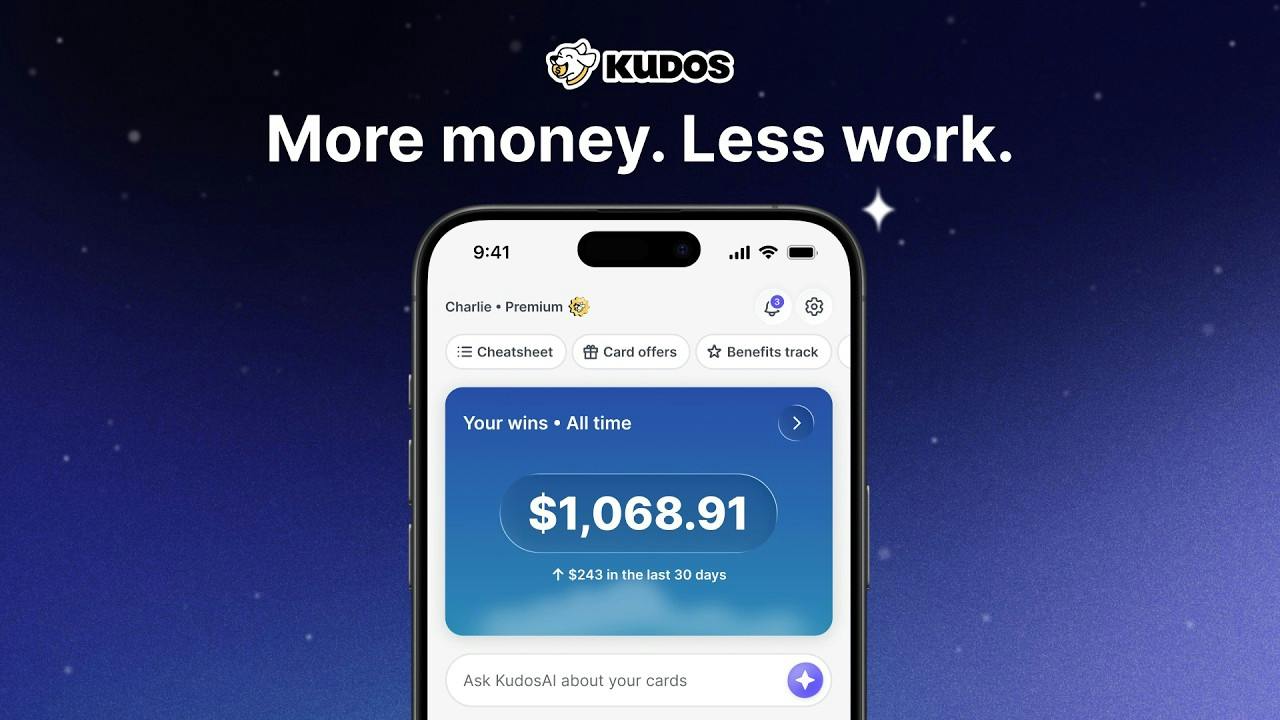
Kudos 3.0 expands Kudos from card-rewards optimization into a consumer “money agent.” It recommends the best card, surfaces issuer offers, negotiates bills, and helps cancel subscriptions. A ranked home screen highlights a user’s next financial action, while Kudos AI answers questions using linked financial data. The company says it will not move money or cancel subscriptions without user approval.
Kudos has more scale signals than a typical Product Hunt launch. Its website claims 500,000+ members and 10,000+ reviews at 4.8 stars. In 2024, the CEO told TechCrunch Kudos had 200,000 registered users and over $200 million in annualized checkout GMV, while saying revenue was still early. These figures indicate reach and commerce volume, not current active users, ARR, or margin. Product Hunt showed #8 and 119 points for 3.0 in the reviewed snapshot.
Revenue comes from merchant commissions, card-application referrals, Premium memberships, and Lifetime purchases. Users keep the savings from bill negotiation, so the feature must be funded through subscription and partner economics. Combining commerce revenue with consumer subscriptions is attractive, but issuer referrals can create perceived conflicts in card rankings. Automated calls also raise cost, consent, and outcome-measurement questions.
The preliminary decision is DD. The company has a sizable claimed user base, relevant payments experience, and multiple monetization paths. Verify active-member retention, paid conversion, net contribution per user, data-linking coverage, and savings methodology before investing. Members, GMV, and advertised savings alone do not establish product-market fit.
Product Overview
Users connect cards and, for Premium features, transaction accounts through Plaid; optional credit-profile data can come through Spinwheel. Kudos recommends cards across a stated two million stores, tracks benefits, autofills card details, activates eligible offers, and provides spending insights. Version 3.0 adds a ranked dashboard, AI Q&A, bill-negotiation calls, and subscription cancellation. The strongest loop is connect accounts → receive a timely recommendation → use a card or approve an action → measure money saved.
The bundle reduces manual work but depends on accurate issuer data, reliable account connections, and user trust. The company says users approve cancellations and receive bill-call transcripts.
Founder and Team Assessment
Tikue Anazodo and Ahmad Ismail founded Kudos after working at Google and Affirm. TechCrunch reports Anazodo led product work at Google Pay and launched BNPL at Affirm. Their consumer-payments background fits the product. TechCrunch reported 14 employees in 2024, versus 11 in 2022; current staffing and capacity for compliance, support, and call operations are not public.
Market Opportunity
The first market is U.S. consumers with multiple rewards cards, recurring household bills, and enough spend to benefit from optimization. An illustrative, unsourced bottom-up case is 5 million reachable multi-card consumers at $40 of annual net revenue each from Premium, issuer referrals, and merchant commissions: $200 million of potential annual revenue before rewards, service, and acquisition costs. This assumes linked accounts and recurring use; it is not a sourced market-size estimate.
Expansion into subscriptions, travel, and bill management could increase engagement. Each new action also raises expectations for accurate data, explicit consent, dependable execution, and dispute resolution.
Traction and Growth Signals
The company currently claims 500,000+ members, 4.8 stars, and 10,000+ reviews; it does not define the active-member period or review sources. In 2024, its CEO reported 200,000 registered users and $200 million in annualized checkout GMV, but described revenue as early. No current ARR, paid conversion, churn, CAC, or gross margin is public.
Product Hunt displayed 119 points and an #8 day rank for Kudos 3.0; the product page showed 5.0 across 14 reviews. Maker comments described early savings tests and said roughly half of negotiation calls get a discount. Kudos support pages publish different annual savings averages—$1,074 on one page and $441 in another guide. Reconcile their samples, time periods, and whether they are net of fees. The stated member growth is encouraging, but there is no public cohort bridge from registrations to retained, monetized accounts.
Competitive Position
Direct alternatives include CardPointers and MaxRewards for card choice and offers, plus Rocket Money for subscription tracking and bill negotiation. Cashback and shopping extensions such as Honey and Rakuten compete for the same purchase flow. Kudos’s potential advantage is one wallet combining multi-card recommendations, merchant-funded rewards, financial insights, and AI-executed household actions.
This breadth increases partner and data dependencies. CardPointers markets recommendations and issuer-offer activation; Rocket Money offers subscription and bill services. If the largest bank, card network, or personal-finance platform adds rewards recommendations and bill negotiation in its own app, why will consumers keep Kudos connected to every account? The answer must be measured cross-issuer coverage, provable savings, and repeat usage beyond features offered by individual banks.
Business Model and Economics
Kudos says it earns merchant commissions, card-application commissions, and Premium or Lifetime fees. Core card recommendations, autofill, and wallet features are free; Premium adds extended transaction history, AI insights, automatic offers, bill negotiation, and cancellation. Its help center says free members receive 80% of Boost commissions and Premium users receive 100%, a 1.25x rate. Current exact Premium pricing is shown at checkout, not in the public help page reviewed.
Margins depend on purchase volume, partner take rates, rewards paid out, Premium conversion, and support or call costs. Lifetime memberships bring cash forward but create long-term feature obligations. Obtain net revenue after cashback, contribution margin per user, negotiation cost/success, paid retention, and acquisition cost by channel. Confirm whether phone-agent actions scale without human escalation.
Unicorn Path
At a hypothetical 10x ARR multiple, a $1 billion enterprise value requires $100 million ARR. At an illustrative $100 annual net revenue per active-member equivalent, Kudos would need one million such members; at $40, it would need 2.5 million. These are scenarios, not forecasts, and the claimed 500,000+ members may include inactive or free accounts.
A venture-scale path requires more active linked users, recurring Premium use, and partner income while controlling reward and service costs. New financial actions may improve retention, but also add trust and execution risk.
Valuation Assessment
The last clearly announced priced round located was a $10.2M Series A in 2024, following a $7M seed. TechCrunch said the Series A valuation exceeded twice the seed valuation but did not publish either valuation. A later SEC Form D amendment reports $20.377M sold in the offering; reconcile this with the publicly announced $17.2M cumulative total. Current valuation, terms, and verified ARR are unavailable, so attractiveness is not assessable.
Key Risks
- Recommendation trust: Issuer referral commissions may affect perceived card rankings.
- Sensitive data: Transaction, credit, AI-query, and call data require strong controls.
- Savings claims: Public annual averages differ and need consistent methodology.
- Service cost: Long negotiation calls and retries may erase value.
- Data coverage: Plaid and issuer feeds can be incomplete or delayed.
- Conversion: A large free base may not become paying members.
- Lifetime plans: One-time fees create continuing feature obligations.
- Competition: Banks and finance apps can bundle similar features.
- Consent and compliance: Referrals, profiling, and automated calls require ongoing review.
- Unclear performance: Current users, revenue, churn, and margins are undisclosed.
Final Assessment
| Dimension | Score | Rationale |
|---|---|---|
| Market | 16 / 20 | Broad consumer need; account-linking and repeat use are hurdles. |
| Traction | 14 / 20 | Member and historical GMV claims are substantial; current revenue unknown. |
| Team | 12 / 15 | Relevant payments experience; current operating capacity unknown. |
| Product | 8 / 10 | Useful wallet with broader automation; new actions need proof. |
| Distribution | 10 / 15 | Web, mobile, and partner channels; CAC unknown. |
| Business economics | 5 / 10 | Multiple income streams; reward and call costs unclear. |
| Defensibility | 4 / 10 | Cross-card data helps; features are replicable. |
| Total Venture Potential | 69 / 100 | Attractive platform if retention and unit economics hold. |
Evidence confidence: 58 / 100. Features, revenue streams, historical funding, and 2024 user/GMV statements have sources. Current active users, ARR, paid conversion, retention, margins, and savings methodology are not public. Final Decision: DD. Upgrade toward Invest if cohorts show sustained account links, repeat actions, attractive contribution after rewards and calls, and independently checkable savings. Downgrade to Watch or Pass if member totals are mostly inactive, referral incentives impair trust, or call costs exceed recurring revenue.
Diligence Questions
- How many claimed members are monthly active, have linked accounts, and remain after 90/180 days?
- What are Premium conversion, ARPU, churn, Lifetime share, and net revenue retention?
- Reconcile the $200M annualized GMV claim to current volume and company revenue.
- What are gross partner commissions, rewards paid, and net contribution per active member?
- What are call success, duration, escalation, and fully loaded negotiation costs?
- Reconcile the $441 and $1,074 annual savings claims by sample and net methodology.
- How are card rankings governed when Kudos earns issuer referral commissions?
- What financial data reaches Plaid, Spinwheel, AI, and call vendors, and for how long?
- Reconcile the SEC Form D amendment with public round totals, and provide runway.
- Which 3.0 workflows drive multi-feature use and retained revenue?