
Table of Contents
Agnost AI Investment Report
Category: AI-agent product analytics, observability, evaluation, and optimization
Company Stage: Pre-seed / accelerator-stage
Founder or Founders: Shubham Palriwala and Parth Ajmera
Headquarters: San Francisco, California, United States
Funding: Entrepreneurs First backing and a founder-reported $250,000 raise; accepted into Y Combinator S26. YC’s standard investment is $500,000, but Agnost AI’s total funding and receipt of all funds are not independently confirmed (YC profile, YC standard deal, founder profile)
Business Model: Usage-limited SaaS subscriptions plus custom enterprise contracts; potentially model-training and optimization revenue
Product Hunt Launch Date: August 25, 2026 (Product Hunt awards)
Report Date: August 28, 2026
| Investment Metric | Assessment |
|---|---|
| Venture Potential | 68/100 |
| Unicorn Path | Conditional |
| Valuation Attractiveness | Not Assessable |
| Evidence Confidence | 58/100 |
| Final Decision | DD |
Executive Summary
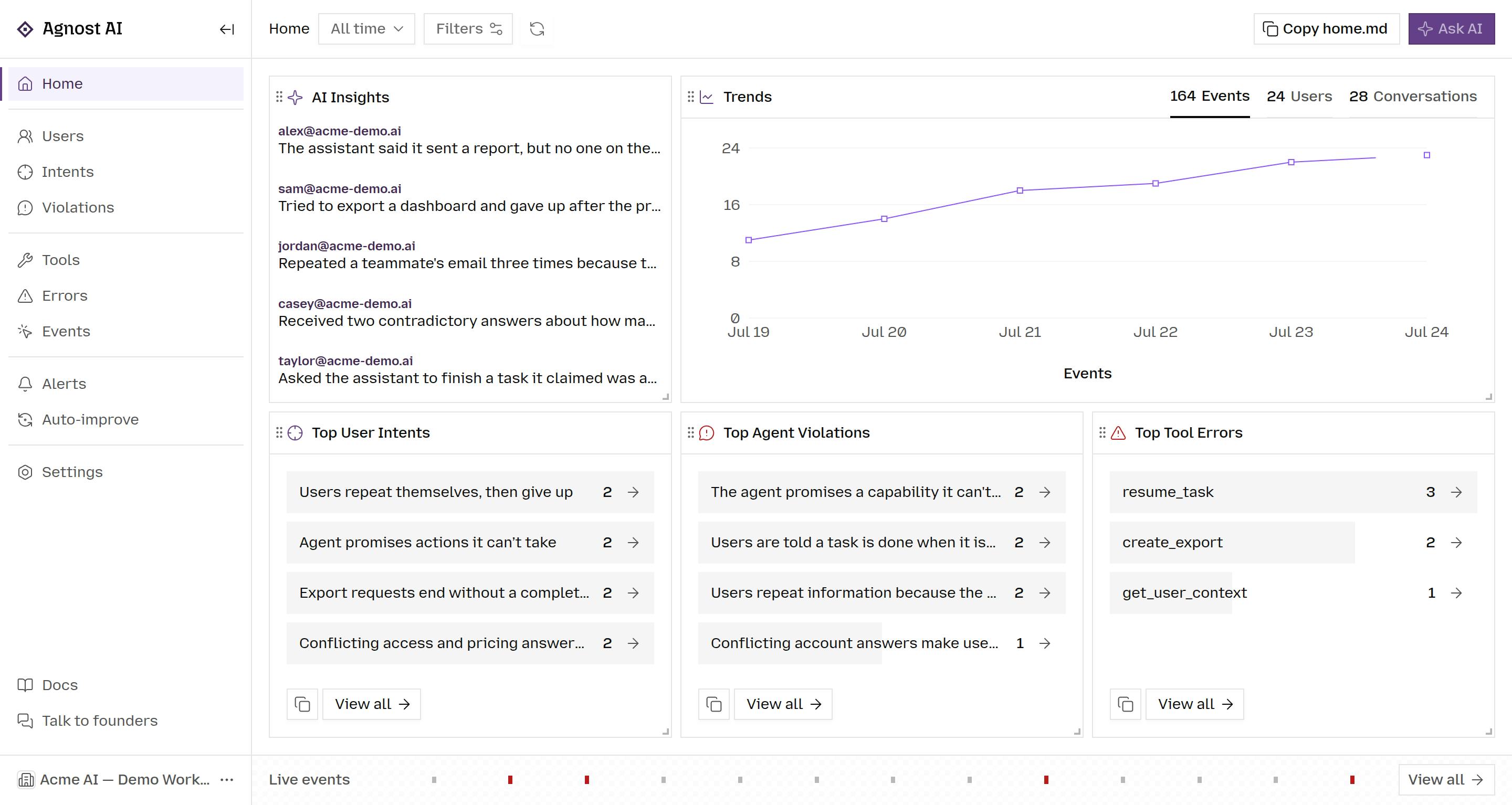
Agnost AI analyzes production conversations and traces from chat and voice agents to identify failures that ordinary infrastructure monitoring may miss: user frustration, repeated requests, hallucinated commitments, policy violations, feature requests, and potential churn. It connects through SDKs or OpenTelemetry and links detected patterns to the underlying conversations and tool calls (official website, documentation).
The product addresses a credible problem. Conventional observability can show that an API call succeeded without establishing that the user’s task was completed. Agnost AI’s emphasis on conversation-level intent and behavioral failure discovery is therefore useful and differentiated from purely technical tracing. The public demo, documented integrations, transparent pricing, and active releases support a positive product-quality assessment.
The strongest investment signals are the founders’ technical backgrounds, acceptance into Y Combinator S26, and the company-reported ingestion of more than one million messages or events per day. YC also reports that the company is working with teams at Google, Exa, and Corgi, although the commercial status, contract size, and duration of these relationships are undisclosed (YC launch, YC company profile).
The principal concern is that usage is not the same as commercial traction. Agnost AI has not publicly disclosed ARR, paying-customer count, retention, gross margin, or customer acquisition economics. Its market is also crowded: LangSmith, Langfuse, Arize, Braintrust, Helicone, PostHog, and large observability vendors can add overlapping analytics and automated remediation.
The appropriate decision is DD, not Invest. The product and team justify direct diligence, but an investment decision requires verification of revenue quality, customer retention, infrastructure costs, data-security controls, financing terms, and whether Agnost AI’s recent expansion into workload-specific model training is repeatable rather than services-heavy.
Product Overview
Agnost AI’s initial customer is a product or engineering team operating a customer-facing AI agent with enough production traffic that manual review of conversations is impractical. The product ingests conversations, events, model generations, tool calls, handoffs, and guardrail results, then organizes them into intents and violations with supporting evidence (documentation).
Core benefits include automatic clustering of recurring issues, detection of frustration and silent failures, identification of feature requests, and generation of suggested fixes or evaluations. Integration is available through SDKs and OpenTelemetry. The product is web-based; no relevant mobile-app distribution was found.
Published pricing is:
- Free: 1,000 events per month and seven-day retention.
- Starter: $49 per month, 10,000 events and 30-day retention.
- Pro: $499 per month, one million events and 90-day retention.
- Enterprise: Custom pricing, volume and retention, VPC deployment, audit logs, SLAs, and custom workflows (official website).
The current website says customers should pseudonymize identifiers and redact secrets or sensitive fields before ingestion; it does not claim automatic PII redaction. That candor is positive, but it also highlights implementation and compliance friction for enterprises handling sensitive conversations.
Agnost AI has recently introduced a broader proposition: using customer traces to build workload-specific models. In one company-reported test covering 780 held-out traces, it claimed higher task success and materially lower cost and latency than a frontier model. This is an encouraging technical experiment, not independent proof of general performance or repeatable commercial demand (YC company profile).
Product Quality Assessment: Strong early product design and credible technical architecture, but accuracy, false-positive rates, and production ROI have not been independently validated.
Founder and Team Assessment
CEO Shubham Palriwala describes prior experience as Formbricks’ first engineer, an engineering intern at Cisco, an OWASP maintainer, and a contributor or mentee in open-source programs including Bitcoin Core and the Linux Foundation ecosystem (LinkedIn).
Co-founder Parth Ajmera studied computer science at IIT Madras and reports engineering experience at Microsoft and Infurnia, including Spark infrastructure, graphics, and GPU-related work (LinkedIn). Both profiles indicate full-time involvement since 2025 and current locations in San Francisco.
The founders appear technically complementary and have prior experience with data infrastructure, developer products, and production engineering. Public evidence of enterprise sales leadership, scaled hiring, or previous exits is limited. The publicly visible core team appears to consist primarily of the two founders; exact employee count is not reliably disclosed. This creates execution and key-person risk across product, security, sales, and support.
Founder Assessment: Strong technical founder-market fit and evidence of rapid execution; enterprise sales capability and organizational scaling remain unproven.
Market Opportunity
The narrow initial segment is software companies operating production chat or voice agents with sufficient conversation volume and commercial exposure to justify dedicated quality analytics. Willingness to pay should be highest where agent failures cause churn, support expense, compliance exposure, or failed transactions.
Reliable public data on the number of such teams is unavailable. An illustrative—not verified—bottom-up scenario is:
- 5,000–20,000 production-agent teams globally;
- $6,000–$30,000 annual revenue per customer, ranging from the published Pro tier to enterprise contracts;
- implied initial addressable revenue of approximately $30 million–$600 million annually.
The lower end would not independently support a unicorn. The upper end could support a venture-scale company but requires successful enterprise penetration. Adjacent expansion into evaluations, automated remediation, model routing, specialist-model training, compliance monitoring, and broader customer-intelligence analytics could enlarge the opportunity.
Market timing is favorable: Dynatrace agreed to acquire AI-observability company Arize for $915 million and described AI observability as a rapidly growing category, although Dynatrace’s forecast should be treated as an interested-party estimate rather than neutral market evidence (Dynatrace announcement).
Traction and Growth Signals
Agnost AI reports processing more than one million messages or events daily and working with multiple companies. Its YC profile names teams at Google, Exa, and Corgi; these references are meaningful but do not establish that all are paying enterprise customers (YC profile, YC launch).
The July 2026 Hacker News launch received 85 points and 52 comments, indicating developer interest and substantive engagement rather than merely directory exposure (Hacker News). The Product Hunt launch ranked third for its launch day, but this is launch attention rather than evidence of retention or revenue (Product Hunt awards).
The company’s GitHub organization contains three public repositories, with recent updates but negligible public stars and forks. This confirms ongoing development but does not yet indicate open-source-led distribution (GitHub).
No reliable public information was found for ARR, MRR, paying customers, customer concentration, cohort retention, conversion, net revenue retention, or sustained website growth.
Traction Assessment: Credible early product usage and launch momentum, but commercially unverified.
Competitive Position
Direct competitors include LangSmith, Langfuse, Arize, Braintrust, Helicone, and other LLM-observability and evaluation platforms. Indirect alternatives include PostHog or Mixpanel augmented with custom event pipelines, data warehouses, manual transcript review, and in-house LLM classification.
Agnost AI differentiates through product-oriented conversation analysis rather than only trace inspection: it attempts to discover unknown behavioral failures and user needs. However, LangSmith already markets automated issue clustering, diagnosis, fixes, and evaluation creation, demonstrating that this functionality can be bundled by a larger platform (LangSmith pricing and features). Langfuse offers low-cost tracing, evaluations, metrics, and enterprise security, with plans beginning at $29 per month (Langfuse pricing).
If a large platform launched equivalent conversation clustering within six months, customers might retain Agnost AI only if it consistently delivers better detection accuracy, faster time-to-fix, proprietary customer-specific models, or measurable business outcomes. None of these advantages is yet independently established. OpenTelemetry support lowers adoption friction but also lowers switching costs.
Defensibility Assessment: Low–Medium
Business Model and Economics
At published prices, annualized self-service contract values are $588 for Starter and $5,988 for Pro. Enterprise ACV is not disclosed. Expansion can occur through rising event volumes, longer retention, security requirements, and custom optimization workflows.
The model has attractive software characteristics but non-trivial variable costs. Every additional conversation requires storage, embeddings or classification, and potentially LLM inference. Gross margin depends on how frequently Agnost AI invokes expensive models versus smaller classifiers and clustering systems. The founders state that they use embeddings, smaller classifiers, and LLM fallbacks to control processing costs, but endpoint-level economics are unavailable (Hacker News).
The specialist-model initiative could create higher-value contracts and stronger lock-in, but custom training, evaluation, and deployment may introduce services costs. Diligence must determine whether revenue scales faster than inference, storage, and founder-support expense.
Unicorn Path
Assume a mature, high-growth infrastructure SaaS multiple of 10× ARR. This is an analytical assumption, not a current market valuation. A $1 billion valuation would therefore require approximately:
$1 billion ÷ 10 = $100 million ARR.
At the $499 monthly Pro price, Agnost AI would need roughly 16,700 equivalent Pro customers. That is unlikely for a specialized developer tool. A more credible route would be 2,000 enterprise customers at $50,000 ACV, or 1,000 at $100,000 ACV.
Reaching that scale requires enterprise-grade security, demonstrable ROI, high retention, international distribution, broader integrations, and movement from analytics into evaluation, automated remediation, and model optimization. Proprietary learning from each customer must remain customer-specific unless contractual permissions allow cross-customer improvements, limiting conventional data-network effects.
The Arize transaction confirms strategic value in AI observability, but Agnost AI must become a broader agent-quality platform rather than remain a $49–$499 analytics dashboard.
Unicorn Path: Conditional
Valuation Assessment
Known backers include Entrepreneurs First and Y Combinator. A founder profile reports $250,000 raised through EF. YC’s standard terms provide $500,000 through two SAFEs, but Agnost AI’s complete financing history, cap table, SAFE conversion status, and current round terms are not public (YC deal).
No reliable valuation, SAFE cap, ARR, burn, runway, or secondary transaction was found. The $915 million Arize acquisition is strategically relevant but cannot establish an Agnost AI valuation without Arize’s revenue and growth data.
Valuation Attractiveness: Not Assessable
Assessment requires current ARR, growth, gross margin, retention, cash balance, burn, cap table, SAFE terms, proposed round size, post-money valuation, and liquidation preferences.
Key Risks
- Commercial validation: No verified revenue, paying-customer, retention, or expansion data.
- Competitive bundling: LangSmith, Langfuse, Arize/Dynatrace, and major observability vendors can replicate core features.
- Weak switching costs: OpenTelemetry and standard trace formats simplify migration.
- Data security: Production conversations may contain PII, confidential data, or regulated information; customers are expected to perform some redaction.
- Gross-margin uncertainty: High-volume classification, storage, and model training may create material variable costs.
- Positioning risk: Expansion from analytics into specialist-model training could improve economics or dilute focus.
- Customer-reference ambiguity: Named organizations are not confirmed as paying, retained enterprise accounts.
- Team concentration: A two-founder core creates product, sales, support, and key-person dependency.
Final Assessment
Venture Potential: 68/100
| Category | Score |
|---|---|
| Market Size and Expansion Potential | 16/20 |
| Traction and Growth Evidence | 10/20 |
| Founder and Team | 13/15 |
| Product Strength | 8/10 |
| Distribution Potential | 10/15 |
| Business Model and Economics | 6/10 |
| Defensibility | 5/10 |
| Total | 68/100 |
The strongest elements are founder technical quality, a genuine production problem, and potential expansion into a broader agent-quality platform. The weakest are unverified commercial traction, uncertain unit economics, and limited demonstrated defensibility.
Evidence Confidence: 58/100
Founder identities, backgrounds, product functionality, pricing, YC participation, public documentation, and development activity are reasonably verifiable. Message volume, customer relationships, performance benchmarks, and funding amounts are primarily company- or founder-reported. Revenue, retention, margins, customer concentration, burn, runway, legal entity, and valuation remain unavailable.
Final Decision: DD
Agnost AI is strong enough to justify founder meetings, customer calls, technical review, and financial diligence. It is not ready for an Invest decision because valuation, revenue quality, retention, margins, security posture, and financing terms are unknown.
Upgrade Conditions
- Verified annualized revenue above $1 million with diversified paying customers.
- Strong six- and twelve-month logo retention and positive expansion.
- Gross margin above 70% after inference, storage, and support costs.
- Reference calls confirming measurable reductions in churn, failures, or engineering time.
- Repeatable acquisition beyond YC, founder networks, and launch platforms.
- Independent validation of detection accuracy and specialist-model results.
- Enterprise security controls, including verified SOC 2 progress and robust PII handling.
Downgrade Conditions
- Usage concentrated in free, trial, or non-paying design partners.
- High churn after initial diagnostic value is exhausted.
- Material feature parity from LangSmith, Langfuse, or Dynatrace/Arize.
- Custom-model work proves services-intensive or low-margin.
- Security incidents or misleading customer and performance claims.
- Founder disengagement or declining product-development activity.
Questions for Further Diligence
- What are current ARR, MRR, and monthly growth, separated by subscription and services revenue?
- How many paying customers use Starter, Pro, and Enterprise, and which named organizations are paying?
- What are 30-, 90-, 180-day, and customer-level retention rates?
- How much of the reported one-million-event daily volume comes from the largest three customers?
- What are gross margins by plan after inference, embeddings, storage, and support?
- What measurable ROI have customers achieved, and can three customers provide references?
- What are free-to-paid conversion, sales-cycle length, CAC, and primary acquisition channels?
- How accurate are intent and violation detections, and how are false positives measured?
- What data is retained, where is it hosted, and what SOC 2, DPA, deletion, and PII controls are operational?
- Is specialist-model training a standardized product, a managed service, or a future roadmap item?
- What are current burn, runway, team structure, and twelve-month hiring plan?
- What are the cap table, outstanding SAFEs, current valuation cap, round size, and proposed terms?
Sources
- Product Hunt: Agnost AI
- Official website and pricing
- Official documentation
- Y Combinator company profile
- Y Combinator launch
- YC standard investment terms
- Agnost AI GitHub organization
- Hacker News launch discussion
- Shubham Palriwala profile
- Parth Ajmera profile
- LangSmith pricing and features
- Langfuse pricing
- Dynatrace–Arize acquisition announcement