
Table of Contents
Sider Code Investment Report
Category: AI browser agent, website customization, consumer productivity software
Company Stage: Growth-stage product by usage; financing stage not publicly disclosed
Founder or Founders: Joel Liu
Headquarters: Boston/Medford, Massachusetts, United States
Funding: Not publicly disclosed; founder describes Sider as bootstrapped
Business Model: Freemium consumer subscription, usage-based AI credits, team subscriptions
Product Hunt Launch Date: September 1, 2026
Report Date: September 4, 2026
| Investment Metric | Assessment |
|---|---|
| Venture Potential | 74/100 |
| Unicorn Path | Conditional |
| Valuation Attractiveness | Not Assessable |
| Evidence Confidence | 62/100 |
| Final Decision | DD |
Executive Summary
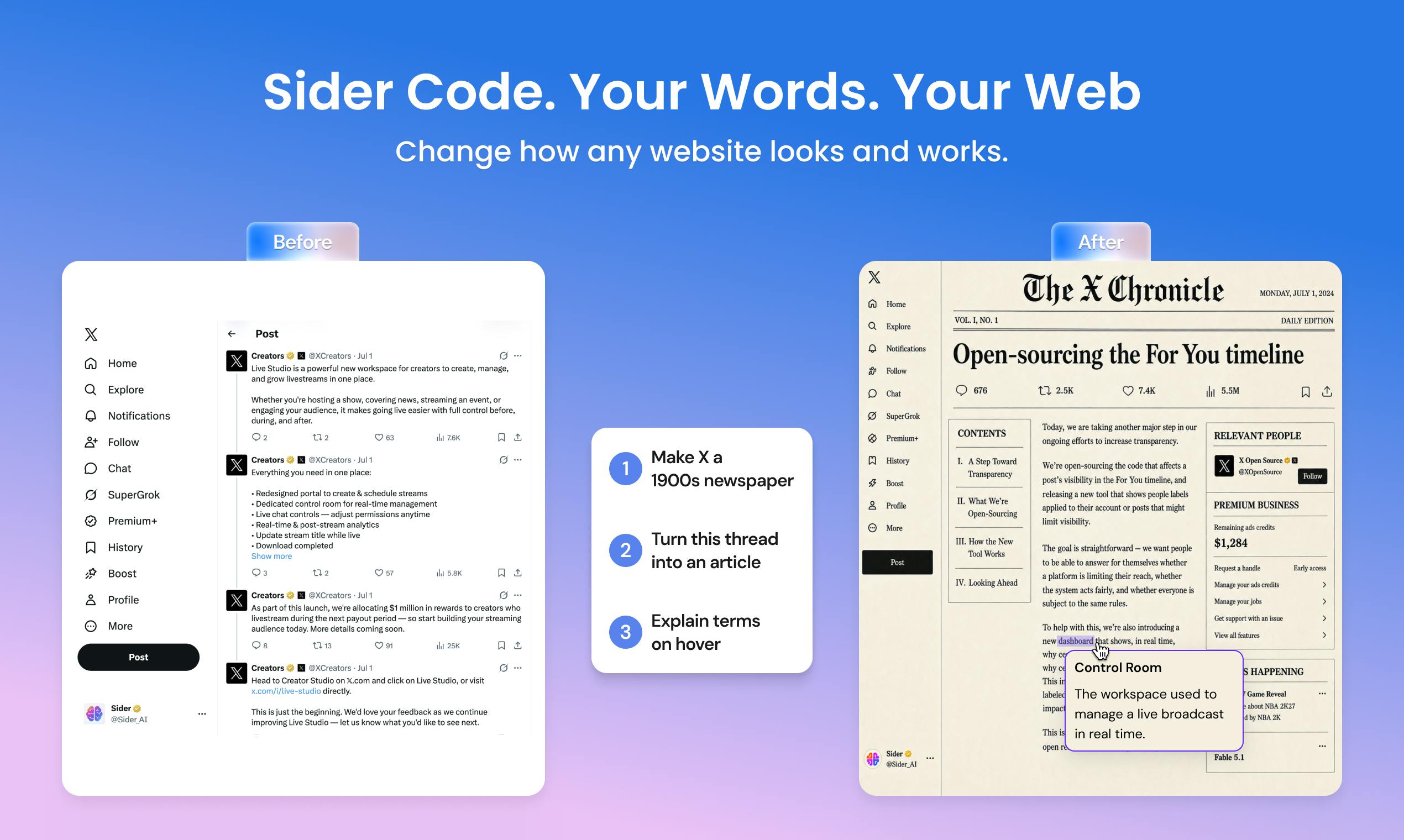
Sider Code is an AI browser feature that lets users modify existing websites through natural-language instructions. It can hide page elements, restructure information, add actions, summarize content, and preserve modifications across subsequent visits. Examples include removing YouTube Shorts, turning an X thread into an article, summarizing Reddit comments, or adding dark mode to Google Docs (official product page).
The feature belongs to Sider, a broader multi-model AI assistant available as a Chrome and Edge extension and through desktop and mobile applications. Sider combines models from several third-party providers with web summarization, writing, translation, document analysis, image tools, and browser automation. Sider Code therefore launches into an existing distribution base rather than starting as a standalone product.
The strongest positive signal is distribution. Sider’s website reports more than 10 million active users and over 100,000 five-star ratings. The Chrome Web Store independently shows a 4.9/5 rating from approximately 114,000 reviewers, while its listing says more than six million users actively use the Chrome and Edge extensions each week (Chrome Web Store, Sider Code). The difference between six million weekly extension users and ten million users across all platforms is plausible, but the latter is company-reported.
The principal concerns are weak product-level defensibility and financial opacity. Sider Code’s core capability can potentially be replicated by browser vendors, AI assistants, and existing userscript tools. Revenue, paid conversion, retention, gross margin, customer concentration, burn, and valuation are not publicly disclosed. Dependence on third-party models creates both cost and platform risk.
The investment conclusion is DD. Sider’s installed base, strong extension ratings, continuous product activity, and bootstrapped history justify a founder meeting and access to financial data. An investment recommendation cannot be made without verifying whether the large free-user base converts into durable, high-margin subscription revenue at an acceptable valuation.
Product Overview
Most websites provide the same layout and workflow to every visitor. Users who want different functionality generally need browser extensions, ad blockers, CSS tools, or custom JavaScript userscripts.
Sider Code reduces that technical barrier. The user enters a plain-English instruction, after which the agent interprets the current page, generates and applies the required code, and saves the customization for future visits. It can:
- Hide unwanted elements or content formats.
- Change layouts and visual presentation.
- Extract and reorganize page information.
- Add summarization and explanatory features.
- Create site-specific actions.
- Preserve and enable or disable saved changes.
The feature is delivered inside the existing Sider browser extension. Sider is also available for Edge, Safari, macOS, Windows, iOS, and Android, although Sider Code’s deepest functionality is browser-dependent (Chrome Web Store).
Sider Code was offered free during its Product Hunt launch, and its current product page continues to describe it as free. Standalone post-launch pricing is unclear. The broader Sider application offers Basic, Professional, and Ultra subscriptions. Apple lists monthly prices of $9.99, $19.99, and $39.99, with corresponding annual prices of $99.99, $199.99, and $299.99 (App Store).
The principal customer benefit is personalization without coding. It replaces manual browser development, individual single-purpose extensions, userscripts, copying information into chatbots, and tolerating inefficient website interfaces.
Product Quality: Strong concept and convenient workflow, although reliability across frequently changing third-party websites remains unverified.
Founder and Team Assessment
Joel Liu is CEO of Vidline Inc., the legal operator of Sider. His LinkedIn profile lists him as CEO since June 2021 and previously as a co-founder of web-research and bookmarking product Diigo from 2013 to 2021 (Joel Liu). That background provides relevant browser-product and information-management experience.
Liu has publicly characterized Sider as a fully bootstrapped startup. No reliable primary evidence of institutional funding, prior financing rounds, or outside investors was found. Bootstrapping a product to millions of users would be a strong capital-efficiency signal, but profitability and cumulative founder capital are not verified.
LinkedIn classifies Sider as having 51–200 employees while displaying only approximately 13 associated profiles. Neither figure establishes actual full-time headcount. The Chrome Web Store identifies Vidline Inc. as the developer and provides a Boston address and D-U-N-S number, supporting the legal-entity and operating-location information (Chrome Web Store, LinkedIn).
The team demonstrates strong consumer-product execution through cross-platform development, frequent extension updates, multilingual support, and integration of multiple AI providers. Enterprise sales and governance capabilities are less established publicly.
Founder Assessment: Strong browser-product experience and apparent capital efficiency, but team depth and enterprise commercial capability remain insufficiently verified.
Market Opportunity
The initial customer segment is individual knowledge workers, researchers, students, marketers, and other frequent browser users who pay for AI assistance embedded directly in web workflows.
A bottom-up installed-base scenario is more useful than a broad “AI productivity” market estimate:
- 10 million active users claimed across Sider’s products;
- 2%–5% paid conversion as an analyst assumption;
- $120–$240 annual gross revenue per paying user;
- Implied annual subscription revenue of approximately $24 million–$120 million.
These figures are scenarios, not reported Sider results. Actual conversion, discounts, credit purchases, and subscription mix are unknown.
The team market offers higher potential annual contract values through centralized billing, usage administration, shared knowledge, security controls, and employee provisioning. Adjacent opportunities include browser automation, reusable customization templates, enterprise workflow agents, marketplaces for user-created modifications, and deployment inside managed corporate browsers.
The realistic market is large enough for venture-scale revenue. However, Sider must demonstrate that customers will pay for a browser-layer aggregator even as underlying model providers and browser companies bundle similar capabilities.
Traction and Growth Signals
Sider has materially stronger distribution evidence than Sider Code alone:
- The Chrome Web Store reports a 4.9/5 score from approximately 114,000 ratings and says the product has more than six million weekly users across Chrome and Edge (Chrome Web Store).
- Sider reports more than 10 million active users across platforms and more than 100,000 five-star ratings (Sider Code).
- The extension was updated on September 3, 2026, two days after the Sider Code launch, indicating continued product activity.
- Sider reports being selected as a Chrome “Favorite of the Year” in 2025 and an Editor’s Pick in 2026. The Chrome listing currently marks the extension as “Featured.”
- The company has introduced team subscriptions, indicating an effort to expand beyond individual consumers (Sider LinkedIn).
Sider Code ranked fifth on Product Hunt on September 1, 2026 (Product Hunt leaderboard). Third-party snapshots showed its vote count rising during the launch period, so the final leaderboard rank is more reliable than inconsistent archived vote totals.
No reliable public data was found for Sider Code’s active users, saved customizations, repeat usage, or conversion impact. Sider’s revenue and paid-user count are also undisclosed. A third-party database estimates $7.2 million of 2024 revenue, but no underlying company filing or founder confirmation supports that estimate; it is therefore not used as verified traction.
Traction Assessment: Strong large-scale usage evidence, but revenue quality and Sider Code adoption remain unverified.
Competitive Position
Direct competitors include AI browser assistants such as HARPA AI, Monica, MaxAI, and Merlin. These products combine browser context with summarization, writing, search, automation, and access to external AI models.
Sider Code also competes with:
- Arc Boosts, which supports per-site visual and functional customization.
- Tampermonkey, a free userscript manager for modifying website functionality.
- Ad blockers and readability extensions.
- Manual CSS and JavaScript.
- AI-enabled browsers and general-purpose agents capable of interacting with webpages.
Sider’s immediate advantage is combining a substantial installed base with natural-language code generation, content understanding, persistence, and broader AI-assistant functionality. It does not require users to find, inspect, or maintain scripts manually.
Switching costs are currently low. Saved customizations create some user-specific workflow lock-in, but there is no verified network effect or proprietary foundation model. A marketplace for shared and rated website modifications could improve defensibility, but no such scaled marketplace was verified.
If the largest browser platform launched the same capability within six months, customers would remain only if Sider offered a materially better library of workflows, cross-browser compatibility, model choice, and user-community content. That advantage has not yet been proven.
Defensibility Assessment: Low-Medium
Business Model and Economics
Sider monetizes through subscriptions and credit limits. Apple’s published in-app purchases imply annual consumer contract values of approximately $100–$300. Sider also launched team plans with centralized account and usage management, but public enterprise pricing is unavailable.
Gross-margin potential is lower than for conventional software because Sider purchases access to multiple third-party models. Variable costs include text and multimodal inference, image generation, search, document processing, storage, and customer support. Heavy users may be unprofitable unless credit allowances and model routing are carefully managed.
The company’s payment FAQ states that newer plans use fixed monthly credit pools rather than unlimited access, suggesting an effort to control usage costs (payment FAQ). Investors should verify contribution margin by plan and whether price increases or credit reductions have affected retention.
Browser distribution avoids mobile app-store commissions for direct web subscriptions, although purchases through Apple incur platform fees. Organic Chrome discovery may support efficient acquisition, but Sider’s paid-marketing expenditure is unknown.
Unicorn Path
A 6× ARR multiple is assumed for a growing AI application dependent on third-party models, with moderate switching costs and meaningful competitive pressure. A higher multiple would require strong retention, efficient model costs, and differentiated enterprise workflows.
Required ARR = $1 billion ÷ 6 = approximately $167 million.
Possible subscriber requirements are:
- At $120 annual revenue per payer: approximately 1.39 million paying users.
- At $200 annual revenue per payer: approximately 835,000 paying users.
- At $300 annual revenue per payer: approximately 557,000 paying users.
Against the company-reported 10 million active users, this implies roughly 6%–14% paid penetration before considering discounts and payment fees. That is demanding for a consumer browser extension.
A more credible route combines consumer subscriptions with team and enterprise contracts. Sider would need stronger administrative controls, security documentation, shared workflows, auditability, and durable browser automation rather than primarily aggregating third-party models.
Unicorn Path: Conditional
Valuation Assessment
Sider has not publicly disclosed institutional funding, investors, financing terms, a SAFE cap, or a valuation. The founder’s statement that Sider is bootstrapped suggests no conventional venture round, but it does not establish ownership or financing obligations.
No verified revenue or growth rate is available. Consequently, public or private software multiples cannot be applied responsibly.
Valuation Attractiveness: Not Assessable
Required information includes ARR, year-over-year growth, gross margin by plan, net and gross retention, paid-user count, CAC, burn, cash balance, cap table, current round size, valuation, liquidation preferences, and founder liquidity.
Key Risks
- Commercial opacity: Revenue, paid conversion, retention, and profitability are undisclosed.
- Platform replication: Browser vendors or large AI assistants could bundle natural-language website modification.
- Low switching costs: Consumers can move between numerous AI extensions with limited workflow disruption.
- Third-party model dependency: Pricing, rate limits, or policy changes from model providers could impair margins or functionality.
- Browser-policy dependency: Extension-store permission or policy changes could restrict access to page content.
- Privacy and security exposure: The extension handles website content and personally identifiable information; saved chats and files may be stored on U.S.-based Amazon infrastructure (privacy policy).
- Generated-code reliability: Website changes could break after site updates or create unintended page behavior.
- Enterprise-readiness gap: Public terms dated March 2023 describe personal, non-commercial use despite the later introduction of team plans, indicating documentation and governance need updating (terms).
- Feature sprawl: Sider’s broad set of chat, image, video, document, and browser tools may weaken product focus.
- Margin pressure: Heavy multimodel usage could increase inference costs faster than subscription revenue.
Final Assessment
Venture Potential: 74/100
| Category | Score |
|---|---|
| Market Size and Expansion Potential | 17/20 |
| Traction and Growth Evidence | 16/20 |
| Founder and Team | 10/15 |
| Product Strength | 8/10 |
| Distribution Potential | 14/15 |
| Business Model and Economics | 5/10 |
| Defensibility | 4/10 |
| Total | 74/100 |
Sider’s installed base and browser distribution are the strongest elements. The weakest are financial transparency, third-party model dependency, low switching costs, and limited evidence that Sider Code itself has sustained usage.
Evidence Confidence: 62/100
The legal entity, founder identity, product availability, app pricing, extension ratings, update activity, and major features are verified through primary sources. The 10-million-user figure, bootstrapped status, and awards are company-reported. Revenue, retention, paid conversion, margin, team size, funding, and valuation remain unavailable.
Final Decision: DD
The product and existing distribution are strong enough to justify formal due diligence. Sider should not receive an “Invest” decision without verified financials, cohort retention, unit economics, financing terms, and evidence that Sider Code increases engagement or conversion.
Upgrade Conditions
- Verified ARR above $10 million with sustained annual growth above 50%.
- At least 70% twelve-month paid-user retention.
- Gross margin above 65% after model and infrastructure costs.
- Evidence that Sider Code materially improves conversion or retention.
- A growing team-plan business with referenceable customers.
- A defensible marketplace or library of reusable website modifications.
- Updated enterprise terms, security documentation, and privacy controls.
- Attractive financing terms supported by verified operating metrics.
Downgrade Conditions
- Declining extension users or deterioration in Chrome Web Store ratings.
- Sider Code showing low repeat usage after initial experimentation.
- Major browsers launching equivalent native functionality.
- Model costs producing weak or negative contribution margins.
- Loss of Chrome Web Store access or material permission restrictions.
- Security incidents involving website content, conversations, or generated scripts.
- Misleading usage, revenue, funding, or privacy representations.
Questions for Further Diligence
- What are current ARR, MRR, and revenue growth over the last 12 months?
- How many of the six million weekly extension users and ten million cross-platform users are paying?
- What are 30-, 90-, 180-day, and twelve-month retention by subscription tier?
- How many users have created a Sider Code customization, and what percentage reuse one weekly?
- Has Sider Code increased free-to-paid conversion or reduced churn?
- What are gross margin and contribution margin by plan after model-inference costs?
- What are CAC and payback periods for Chrome discovery, affiliates, paid search, and other channels?
- What percentage of revenue comes from consumers, teams, and credit add-ons?
- What protections prevent generated code from accessing or transmitting sensitive page data?
- What is the actual full-time team structure, and how dependent is the company on Joel Liu?
- What is the fully diluted cap table, including any founder loans, SAFEs, or employee options?
- Is the company raising capital, and if so, at what valuation and on what terms?