
Table of Contents
Pluto Investment Report
Category: AI recruiting / talent discovery — voice-agent career representation and candidate-matching network
Company Stage: Pre-seed, Y Combinator Summer 2026 batch; publicly operating since at least March 2026
Founder or Founders: Sahil Seth, founder and CEO (ex-Bain; previously built and shut down a voice-AI startup that reached roughly $100K ARR pace with staffing-agency partnerships); Sahil Gandhi, founding talent engineer (ex-Scale AI) x
Headquarters: New York City x
Funding: Y Combinator standard investment (S26); no other round publicly disclosed linkedin
Business Model: Free for professionals; company-side monetization not publicly disclosed (platform makes warm introductions between candidates and hiring companies) linkedin
Product Hunt Launch Date: August 27, 2026 launly
Report Date: August 30, 2026
| Investment Metric | Assessment |
|---|---|
| Venture Potential | 65/100 |
| Unicorn Path | Conditional |
| Valuation Attractiveness | Not Assessable |
| Evidence Confidence | 52/100 |
| Final Decision | DD |
Executive Summary
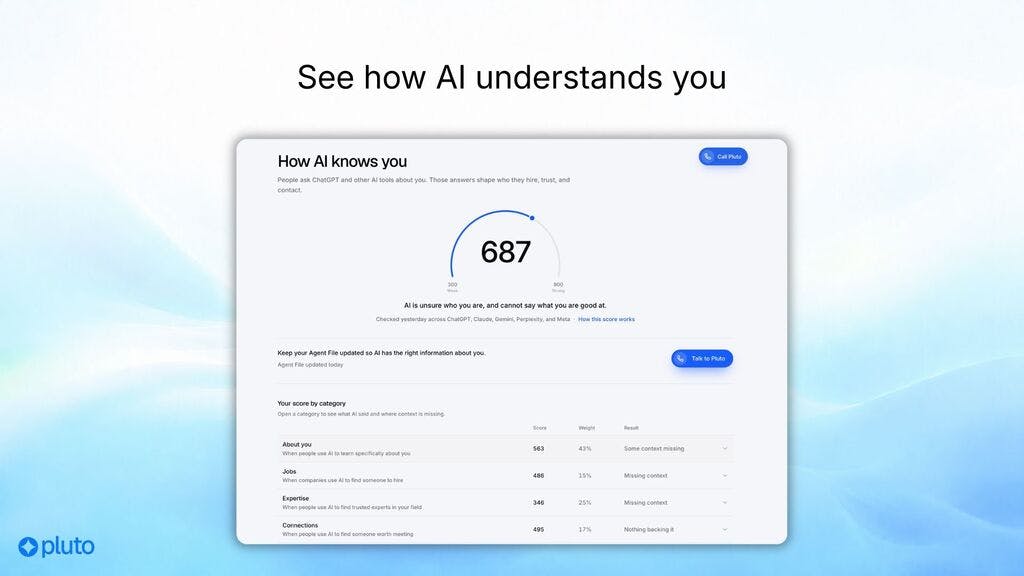
Pluto is an AI voice agent that represents a professional’s career. A person calls Pluto, talks for about ten minutes, and the agent extracts a structured narrative — strengths, aspirations, working style — into a “living profile” that stays current, can be discovered by hiring companies and other AI agents, and remains anonymous until the person chooses to be seen. Companies use Pluto to search the network and receive warm introductions with confirmed mutual interest. linkedin
The thesis is sharp: as companies increasingly use AI agents to hire (Mercor reached a $10 billion valuation in October 2025 and reportedly $20 billion in August 2026), candidates need their own agent-side representation — a “source of truth” for the agent internet that static LinkedIn profiles and resumes cannot provide. talentpluto
The strongest positive signal is distribution invention combined with specific, dated traction claims: 15,000+ professionals in June, 18,000+ in July, and 25,000+ on the current website, with 100+ companies using Pluto to meet candidates — all founder-reported, but specific, consistent, and growing ~67% over ten weeks. Named customer testimonials from staff at Warp and Rho lend partial corroboration. talentpluto
The most important concern is that nothing commercial is verified: no revenue, pricing, retention, or placement data exists publicly, and the growth engine itself — outbound cold calls and texts to professionals — carries US telemarketing-compliance exposure. Defensibility against LinkedIn’s network effects and Mercor’s capital is unproven. linkedin
The decision is DD: a large market with proven venture outcomes, a differentiated product, a capable and unusually distribution-savvy founder, and credible-but-unverified traction — exactly the profile where formal diligence, not conviction, is the right next step.
Product Overview
Problem: Static profiles reduce professionals to titles and keywords. Recruiters and, increasingly, AI hiring agents screen on surface signals, missing what people are actually great at, want next, and how they work. Passive candidates have no mechanism to stay discoverable without actively job-hunting or enduring recruiter spam. linkedin
How it works: A professional talks to Pluto by phone for about ten minutes. The voice agent asks follow-up questions, builds a structured career narrative, and converts it into a living profile that updates as the person does. The user controls visibility separately for people, companies, and AI agents, and stays anonymous until opting in. On the demand side, companies describe a role; Pluto searches its network and the broader market, assesses fit on both sides, and makes warm introductions with confirmed interest. linkedin
Core features: Voice-native onboarding; dynamic profile maintenance; granular privacy and visibility controls; agent-readable representation; company-side search and warm-intro workflow. talentpluto
Target users: Initially GTM professionals at startups — the published customer stories are founding SDRs, account executives, growth leads, and heads of sales at companies like Warp and Rho — expanding toward all knowledge workers. talentpluto
Pricing: Free for individuals; company-side pricing is not publicly disclosed. talentpluto
Platforms: Phone (a dedicated number) and web. Replaces: static LinkedIn profiles, resumes, and cold-outbound recruiting. talentpluto
Founder and Team Assessment
Sahil Seth is independently verifiable through YC, LinkedIn, and X: ex-Bain consultant, built “Mentr” (mentorship marketplace) in college, then a voice-AI startup that he reports reached roughly $100K ARR pace with partnerships with billion-dollar staffing agencies before he deliberately killed it to pursue the larger representation thesis; he has raised venture capital before and entered YC in the S26 batch. The founding engineer, Sahil Gandhi, is ex-Scale AI. linkedin
The founder’s voice-AI-obsession-meets-staffaging background is strong founder-market fit, and his distribution instincts are unusually developed: the product itself onboards supply through outbound calls, the founder’s LinkedIn content (15,000+ followers) drives demand, and the team runs community events. Caveats: no prior exits; the team appears to be roughly two to a handful of people; all prior-startup performance claims are founder-reported; and the company’s identity is tightly coupled to the founder’s personal brand. linkedin
Founder Assessment: Rare combination of domain obsession and distribution capability, but commercial execution at marketplace scale is untested and the team is very small.
Market Opportunity
The initial segment is narrow: GTM and startup professionals in the US who are passively open to opportunities, matched with venture-backed startups hiring for those roles. Willingness to pay sits on the company side — recruiting is a proven, enormous spend category, and the AI-hiring segment has produced the fastest value creation in recruiting tech history: Mercor went from a $250 million valuation to $10 billion within two years, with reported revenue around $70 million+ at its Series B stage, and reportedly reached $20 billion in August 2026. ConverzAI raised $16 million for AI voice recruiting on the company side. forbes
Bottom-up (analyst assumptions): if Pluto’s demand side is company subscriptions of $10–30K/year, capturing 3,000–5,000 startup customers implies $30–150M ARR — a venture-scale outcome within reach of the US startup hiring market alone. Alternatively, placement fees of $15–30K per senior hire would require several thousand annual placements. Expansion paths: verticals beyond GTM (engineering, finance, ops), geographic expansion, and the longer-term “agent source-of-truth” layer — licensing verified career context to the many AI hiring agents candidates will otherwise have to onboard with individually. talentpluto
Timing is favorable: companies are demonstrably adopting AI agents to hire, and candidate-side representation is an acknowledged emerging gap. linkedin
Traction and Growth Signals
Company-reported, dated, and internally consistent: 15,000+ professionals had talked to Pluto by late June 2026, 18,000+ by mid-July, and the website now claims 25,000+, alongside 100+ companies using Pluto to meet candidates — roughly 67% supply growth in ten weeks if accurate. Named testimonials from individuals at Warp and Rho partially corroborate real usage. talentpluto
Launch attention was solid: #7 Product of the Day with 104 votes and 25 substantive comments, plus 157 followers; commenters included professionals testing the product and a user at Optiver who reported the AI mischaracterizing her — a candid quality signal the founder publicly addressed. A third-party analysis of YC S26 distribution strategies highlighted Pluto’s outbound-call mechanism as its most interesting growth decision. launly
Missing metrics: everything financial and retention-related. No revenue, paying-customer count, pricing, placement volume, candidate NRR, or profile-update retention is public. All user counts are founder-reported and unverified.
Traction Assessment: Specific, consistent, and growing claims with named references, but commercially unverified.
Competitive Position
| Competitor | Position | Notes |
|---|---|---|
| Incumbent profile layer | 1B+ users, network effects, building AI hiring features; profiles remain static and spam-prone producthunt | |
| Mercor | AI hiring marketplace | $10B→$20B trajectory; candidate-side data at massive scale cnbc |
| ConverzAI, Apriora, similar | Company-side AI voice recruiters | $16M+ rounds; screen candidates but do not represent them startupintros |
| Teal, Eightfold, Personal.ai, Humantic | Career tools / talent AI | Adjacent; none own voice-native candidate representation launly |
| Free alternative | Maintaining a LinkedIn profile | Zero-cost incumbent behavior |
Differentiation: voice-native deep narratives, anonymous-until-seen privacy design, two-sided warm-intro workflow, and an explicit “built for agents” architecture. Potential advantages: proprietary conversational career data and two-sided network effects if liquidity builds. But switching costs for candidates are low, the network is still small, and the platform question is severe — if LinkedIn or Mercor shipped candidate-side agent profiles tomorrow, Pluto’s residual advantages would be focus, voice UX, and privacy design. A partial, not decisive, answer. talentpluto
Defensibility Assessment: Low-to-Medium
Business Model and Economics
The revenue model is not publicly disclosed. The plausible structures are company subscriptions, per-introduction fees, or placement fees — each with different economics. Cost structure: each professional onboarding consumes roughly ten minutes of voice AI (moderate inference cost per user, plus telephony), meaning supply acquisition costs are real but the product itself is the acquisition mechanism. Demand-side economics are unknown. Marketplace risks are classic: liquidity across verticals (current testimonials concentrate in GTM roles), chicken-and-egg between supply depth and company demand, and disintermediation once introductions are made. AI accuracy is a unit-economics-adjacent risk: misrepresenting a candidate’s story imposes real costs on trust. Nothing about margins, conversion, or churn can be assessed publicly. producthunt
Unicorn Path
Assume an 8–12x ARR multiple for an AI-talent marketplace (Mercor has commanded far higher on growth, but a sober planning range is warranted). A $1 billion valuation requires roughly $85–125M revenue. At an assumed $15–30K average company contract, that implies 3,000–7,000 paying companies — single-digit penetration of the US startup and scale-up market; at placement-fee economics, several thousand annual placements. Strategic requirements: winning the candidate-representation layer as agent-mediated hiring becomes standard, expanding beyond GTM into multiple verticals, converting 25K supply-side profiles into a dense, queryable network, and likely raising significant growth capital. This is achievable only if the agent-hiring paradigm matures on the current trajectory and Pluto out-executes incumbents — a real but conditional path.
Unicorn Path: Conditional
Valuation Assessment
Valuation Attractiveness: Not Assessable. The only disclosed financing is YC’s standard investment. No revenue, pricing, retention, SAFE terms, or valuation exists publicly. The adjacent comparable — Mercor’s rapid re-rating — illustrates both the upside narrative and the danger of pricing on category hype rather than verified fundamentals. Assessment would require: ARR and growth, paying-company count and ACV, placement volumes, retention on both sides, burn, and the terms of any post-YC round. linkedin
Key Risks
- Unverified traction — all user and company counts are founder-reported with no independent audit
- Undisclosed monetization — no public pricing or revenue model; marketplace liquidity unproven
- Platform replication — LinkedIn’s network effects and Mercor’s $20B-scale resources could absorb candidate-agent representation forbes
- Compliance exposure — growth relies on outbound calls and texts to individuals, with US telemarketing-law risk linkedin
- Data privacy — sensitive career narratives and voice recordings require rigorous consent, retention, and sharing controls talentpluto
- AI accuracy — misrepresenting a person’s story (a documented early user experience) damages the core trust proposition producthunt
- Key-person risk — a two-to-few-person team where the founder’s personal brand is the primary channel
- Fragmentation — candidates must onboard with multiple AI hiring agents; no integrations exist yet producthunt
- Vertical concentration — early traction skews to GTM roles; depth per vertical is unproven
Final Assessment
Venture Potential: 65/100
| Category | Score |
|---|---|
| Market Size and Expansion Potential | 15/20 |
| Traction and Growth Evidence | 11/20 |
| Founder and Team | 11/15 |
| Product Strength | 7/10 |
| Distribution Potential | 12/15 |
| Business Model and Economics | 4/10 |
| Defensibility | 5/10 |
| Total | 65/100 |
Strongest: distribution invention (the product acquires its own supply), a founder with authentic domain obsession, and a market with the fastest-proven venture outcomes in recruiting. Weakest: zero disclosed economics, low current defensibility, and compliance exposure at the heart of the growth engine.
Evidence Confidence: 52/100
Verified: founder identity and background, team, YC S26 backing, headquarters, product mechanics, launch results, and named testimonial individuals. Company-reported: 15K→18K→25K professional counts, 100+ companies, prior-startup ARR, and staffing-agency partnerships. Unavailable: revenue, pricing, retention, placement data, cap table, and burn. The consistent, dated nature of the claims raises credibility above typical launch-stage startups, but no independent verification exists.
Final Decision: DD
Pluto meets the DD bar: a large market with proven venture-scale outcomes, meaningful product differentiation, a capable founder with demonstrated distribution ability, traction claims specific and consistent enough to warrant verification, and a conditional-but-credible venture path. Every critical unknown — revenue model, paying customers, retention, compliance posture, and terms — is resolvable through a founder meeting and data review, which is precisely what DD exists to do. This is not an invest recommendation: the claims remain unverified and the valuation is unknown.
Upgrade Conditions
- Verified revenue: disclosed ARR with a working company-side pricing model
- Conversion evidence: introductions-to-interviews-to-hires funnel data
- Retention: professionals updating their stories and companies renewing
- Compliance clarity: documented TCPA-safe consent flows for outbound calls
- A seed round priced on verified traction rather than category narrative
- Demonstrated expansion beyond GTM into at least two additional verticals
Downgrade Conditions
- Inability to substantiate the 25K user and 100+ company claims
- Monetization stalling: companies unwilling to pay for introductions
- LinkedIn or Mercor launching candidate-side agent representation
- Regulatory action or complaints over outbound calling practices
- AI-accuracy failures producing public misrepresentation incidents
- Founder deprioritizing the company post-YC
Questions for Further Diligence
- What is current ARR, and what is the pricing model — subscription, per-intro, or placement fee?
- How many of the 100+ companies are paying, and at what ACV?
- What is the verified professional count, and how many completed onboarding versus abandoned mid-call?
- How many introductions have been made, and what share converted to interviews and hires?
- What is retention — do professionals return to update their stories, and at what frequency?
- What is the cost per onboarded professional (voice minutes, telephony, outreach)?
- How is TCPA consent captured for outbound calls and texts?
- What are data retention, sharing, and deletion policies for voice recordings and career narratives?
- How is AI accuracy validated before a profile is shown to companies?
- What is team size today, and what is the hiring plan post-YC?
- Did investors from the prior startup roll into Pluto’s cap table?
- How would Pluto respond if LinkedIn shipped agent-native candidate profiles, or Mercor opened its candidate side to representation?
Sources
- Product Hunt — Pluto producthunt
- Pluto — official website talentpluto
- Launly — launch metrics and analysis launly
- Sahil Seth — YC announcement post linkedin
- Sahil Seth — founder background post linkedin
- Sahil Seth — X profile x
- Sahil Seth — building for AI agents post linkedin
- Hank Couture — YC funding confirmation linkedin
- YC S26 distribution analysis (secondary) linkedin
- CNBC — Mercor $10B valuation cnbc
- Forbes — Mercor $20B talks forbes
- ConverzAI — Series A announcement prnewswire