
Table of Contents
Soup CLI Investment Report
Category: Open-source LLM fine-tuning and post-training infrastructure
Company Stage: Pre-commercial / early open-source adoption
Founder or Founders: Alpamys Makazhan (Co-Founder/CTO); Rafik Mamedov (Co-Founder/CEO), based on indexed professional profiles
Headquarters: Almaty/Astana, Kazakhstan; corporate entity reportedly incorporated in Delaware
Funding: Not publicly disclosed
Business Model: Free Apache-2.0 software; donations currently accepted; future commercial model not publicly disclosed
Product Hunt Launch Date: August 9, 2026
Report Date: August 12, 2026
| Investment Metric | Assessment |
|---|---|
| Venture Potential | 58/100 |
| Unicorn Path | Conditional |
| Valuation Attractiveness | Not Assessable |
| Evidence Confidence | 55/100 |
| Final Decision | Watch |
Executive Summary
Soup CLI is an open-source command-line system for fine-tuning, evaluating, exporting, and serving open-source language models. It aims to replace fragmented fine-tuning configurations and infrastructure work with a single YAML configuration and command. Its headline capability is layer streaming, which keeps frozen model weights in system RAM or NVMe storage and transfers one decoder layer at a time to the GPU, reportedly allowing an 8-billion-parameter model to be fine-tuned on a laptop GPU with 4 GB of VRAM (GitHub; official website).
The product is technically ambitious and unusually transparent about benchmarks, failed experiments, correctness defects, and remaining limitations. The repository had 648 stars, 81 forks, and active development as of August 12, 2026, while PyPI tracking reported approximately 83,000 cumulative downloads, including roughly 11,800 over the preceding 30 days. PyPI downloads include CI and automated traffic and therefore are not equivalent to unique or active users (GitHub API; PePy).
The strongest positive investment signal is the combination of technical differentiation and visible developer adoption. Soup addresses a material problem for machine-learning engineers: post-training stacks are complex, hardware-intensive, and distributed across tools for data preparation, training, evaluation, export, and deployment. Commercial activity around OpenPipe, Together AI, and Predibase indicates that organizations will pay to simplify model customization and production deployment.
The principal concern is that Soup is currently a free tool, not a validated company. No recurring revenue, paying customers, enterprise deployments, retention, gross margin, or commercial pricing is public. The project also competes against much larger open-source ecosystems—including Unsloth, LLaMA Factory, and Axolotl—and its code contributions are overwhelmingly concentrated in one maintainer.
The decision is Watch. Soup has stronger product and technical-founder signals than the typical Product Hunt launch, but it has not established a commercial wedge or repeatable enterprise demand. Formal diligence would become appropriate after the company launches a paid product and verifies design partners, retention, and willingness to pay.
Product Overview
Soup targets developers and machine-learning teams that need to fine-tune open-source models but do not want to manually integrate training frameworks, configuration files, data tooling, evaluation pipelines, quantization, and deployment systems.
The workflow begins with installation through PyPI. Users initialize a project, point Soup at training data and a base model, and run training from one YAML file. The tool supports supervised fine-tuning and preference methods such as DPO, KTO, ORPO, and SimPO, alongside data inspection, evaluations, model merging, GGUF and ONNX export, and OpenAI-compatible serving (PyPI).
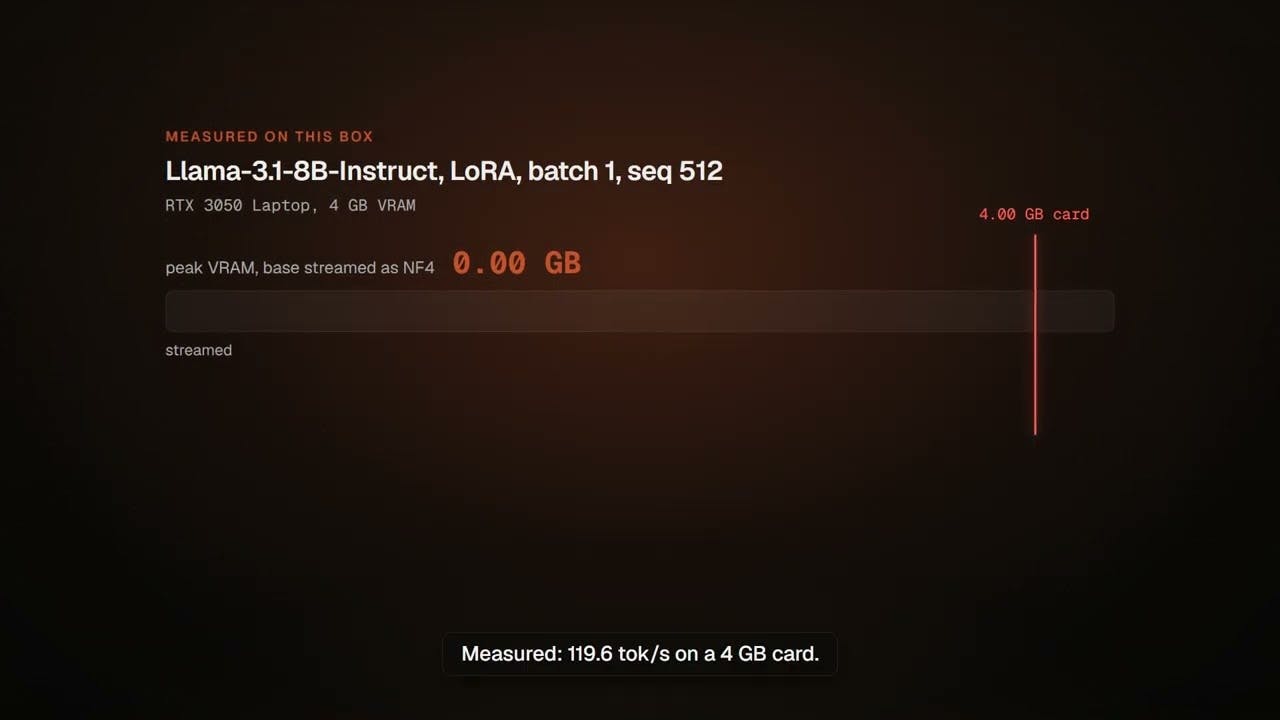
Its most distinctive feature is beta-stage layer streaming. Instead of loading the frozen base model entirely into GPU memory, Soup stores it in RAM or NVMe and copies layers into VRAM sequentially. The project reports a 3.32 GB peak when fine-tuning Llama 3.1 8B on an RTX 3050 laptop. The current documentation appropriately qualifies the throughput figure: it was measured before a later correctness repair and has not been re-measured on the original laptop (v0.73.0 release).
The product is available for Python 3.10–3.12, primarily for CUDA GPUs, with Apple MLX and multiple serving or export integrations. It is licensed under Apache-2.0 and works offline without account creation or vendor lock-in (official documentation).
Pricing is currently free. The project accepts one-time donations through Stripe under MePlay, Inc., but donations are not a venture-scale revenue model. The existing alternative is a combination of Hugging Face Transformers and TRL, PEFT, Axolotl, LLaMA Factory, Unsloth, DeepSpeed, vLLM, and custom scripts.
Founder and Team Assessment
Alpamys Makazhan is publicly identified as Soup’s primary developer and Co-Founder/CTO. His GitHub profile lists Astana, Kazakhstan and shows 97 public repositories. His indexed LinkedIn profile describes software-development experience and identifies him as a Soup co-founder.
Rafik Mamedov’s indexed LinkedIn profile identifies him as CEO of MePlay, Inc. and describes responsibility for positioning, go-to-market, and fundraising. However, detailed employment history, prior exits, and current full-time commitments could not be independently verified.
The official site identifies Soup as a project of MePlay, Inc., described as a Delaware corporation. A government incorporation record, capitalization table, and registered headquarters were not located, so the exact corporate relationship should be verified during diligence (official website).
The repository shows 14 public contributors, but Makazhan accounts for 712 contributions, versus 10 for the next-largest contributor (GitHub contributors). This demonstrates high founder output but substantial key-person risk. There are no verified employees, open positions, or established enterprise-sales and customer-success teams.
Founder Assessment: Strong technical execution and unusually rigorous public documentation, but organizational depth and commercial capability remain unproven.
Market Opportunity
The initial customer is an AI startup, applied-ML team, research group, or independent developer that wants to customize an open-source model while reducing GPU-memory requirements and infrastructure complexity.
Willingness to pay exists in the broader market. OpenPipe raised a $6.7 million seed round for a managed fine-tuning platform and monetizes training and inference (OpenPipe announcement). Together AI raised $305 million while offering infrastructure spanning training, fine-tuning, and inference (Together AI). Rubrik’s acquisition of Predibase further demonstrates strategic demand for production-grade model customization, although transaction terms were not officially disclosed (Rubrik).
Soup’s narrow initial segment—developers fine-tuning open models on constrained hardware—is unlikely by itself to support $100 million of revenue. The larger opportunity is an open-source-to-enterprise conversion model covering managed training, private deployments, evaluation governance, collaboration, security, model registries, and support.
An illustrative bottom-up scenario, not a company forecast, is:
- 2,000 commercial teams × $25,000 annual contract value = $50 million ARR.
- 4,000 commercial teams × $25,000 = $100 million ARR.
- Alternatively, 1,000 enterprises × $100,000 = $100 million ARR.
These customer counts and contract values are analyst assumptions. Soup currently has no verified paid contracts showing that this pricing is achievable.
Traction and Growth Signals
The strongest traction is observable in public developer channels. The repository was created in February 2026 and had reached 648 stars and 81 forks by August 12, with code pushed as recently as August 11 (GitHub API). PyPI lists version 0.73.0, uploaded on August 9 through trusted publishing with supply-chain attestations (PyPI).
PePy reports approximately 83,300 cumulative downloads and 11,800 over 30 days, but explicitly includes CI traffic. Downloads therefore overstate identifiable developer adoption and provide no evidence of production usage, retention, or commercial conversion (PePy).
A secondary Product Hunt tracker ranked Soup #6 for its launch day; another tracker recorded approximately 96 votes (Launly; NODUS). This indicates launch interest only.
The v0.73.0 release provides a mixed but valuable quality signal. Testing on borrowed H100 hardware reproduced the low-memory result, but also exposed silent gradient errors and several non-functional backends. The project disclosed and repaired many of these issues. Transparency is positive; the volume and severity of defects show that Soup remains alpha-stage infrastructure (release notes).
Revenue, paying customers, active installations, production workloads, retention, customer references, and commercial pipeline are not publicly disclosed.
Traction Assessment: Meaningful open-source interest and rapid development, but commercial traction is unverified.
Competitive Position
Direct open-source competitors include LLaMA Factory, Axolotl, Unsloth, Hugging Face TRL, and custom PyTorch/PEFT workflows. Indirect competitors include managed platforms such as OpenPipe, Together AI, cloud providers, and internal ML-platform teams.
Soup’s 648 GitHub stars are modest relative to Axolotl’s approximately 12,300 and Unsloth’s approximately 70,300 as of the report date (Axolotl API; Unsloth API). Soup must therefore overcome substantial ecosystem and brand disadvantages.
Differentiation rests on the all-in-one workflow, low-VRAM layer streaming, offline operation, automatic configuration, and evaluation gates. However, Apache licensing permits competitors and cloud platforms to adopt similar functionality. Switching costs are currently low, and Soup has no proprietary customer dataset or network effect.
If Hugging Face or Unsloth shipped comparable layer streaming within six months, users would remain only if Soup delivered superior reliability, workflow coverage, migration tooling, and vendor-neutral governance. That preference has not yet been demonstrated.
Defensibility Assessment: Low to Medium
Business Model and Economics
There is no commercial pricing page or recurring paid plan. The current model consists of free software and voluntary donations. Revenue, if any, is not publicly disclosed.
A credible business model could combine managed training, enterprise support, private-cloud deployment, governance features, team collaboration, and hosted inference. Pure software support could have high gross margins, whereas hosted GPU training and inference would introduce substantial variable costs and potentially lower margins.
The company must determine whether Soup is a developer-acquisition channel for a commercial platform or permanently free infrastructure. Monetizing too aggressively could weaken adoption; monetizing too late could allow larger platforms to capture commercial workloads.
Critical unknowns include cloud cost per training job, support burden, enterprise sales cycle, paid conversion, gross margin, expansion revenue, and whether users prefer local hardware precisely because they do not want to pay a managed provider.
Unicorn Path
An optimistic 10× ARR multiple is assumed for a rapidly growing, high-margin AI developer platform. At that multiple:
Required ARR = $1 billion ÷ 10 = $100 million.
At an assumed $25,000 annual contract value, Soup would need approximately 4,000 commercial customers. At $100,000 per enterprise, it would require approximately 1,000 customers.
The current free CLI cannot produce this result. Soup would need to build a paid enterprise control plane, managed training and deployment, security and compliance capabilities, reliable multi-user workflows, and repeatable global distribution. It would also need a larger engineering and sales organization and production reliability materially above its present alpha stage.
The opportunity is real, but the required transformation from open-source tool to enterprise platform is substantial.
Unicorn Path: Conditional
Valuation Assessment
No reliable public funding round, investor, SAFE cap, post-money valuation, acquisition offer, or active fundraising terms were found. Revenue and growth are also undisclosed.
Valuation Attractiveness: Not Assessable
Assessment would require current ARR, revenue pipeline, design-partner contracts, gross margin, burn, runway, round size, valuation cap, ownership structure, liquidation preferences, and the relationship between Soup’s intellectual property and MePlay, Inc.
Key Risks
- No validated monetization: The project is free and has no disclosed recurring revenue.
- Strong incumbents: Larger open-source projects have substantially greater adoption.
- Reliability risk: Recent releases disclosed silent correctness and backend failures.
- Key-person concentration: Most code contributions come from one developer.
- Low switching costs: Users can migrate to adjacent open-source frameworks.
- Commoditization: Layer streaming and workflow automation can be replicated.
- Open-source conversion risk: Downloads and stars may not convert into paid enterprise demand.
- Infrastructure economics: A hosted product would incur GPU and support costs absent from the current local model.
- Organizational ambiguity: Team size, legal structure, IP assignment, and founder commitments require verification.
Final Assessment
Venture Potential: 58/100
| Category | Score |
|---|---|
| Market Size and Expansion Potential | 16/20 |
| Traction and Growth Evidence | 8/20 |
| Founder and Team | 10/15 |
| Product Strength | 9/10 |
| Distribution Potential | 7/15 |
| Business Model and Economics | 3/10 |
| Defensibility | 5/10 |
| Total | 58/100 |
The strongest elements are technical product depth, rapid iteration, and a commercially relevant developer problem. The weakest are monetization, verified customer adoption, organizational depth, and defensibility against larger ecosystems.
Evidence Confidence: 55/100
The source code, release activity, license, repository metrics, package releases, benchmark disclosures, and current free model are verifiable. Founder roles and corporate structure are supported principally by company materials and indexed profiles.
Revenue, customer count, retention, team employment status, funding, cap table, gross margin, burn, runway, and valuation are unavailable. Download statistics include automated traffic and cannot establish active usage.
Final Decision: Watch
Soup is a promising open-source infrastructure project but not yet a sufficiently demonstrated venture company. The conditional unicorn path depends on launching and validating an enterprise platform that does not currently exist publicly.
Upgrade Conditions
- Launch a clearly priced commercial product.
- Secure at least 10–20 paying design partners with verifiable production use.
- Demonstrate at least $50,000 in MRR or equivalent contracted ARR.
- Show six-month customer retention above 80%.
- Verify gross margin above 70% for the intended commercial model.
- Establish multiple active core maintainers.
- Provide independent benchmark reproduction and production customer references.
- Demonstrate acquisition beyond Product Hunt and founder-led developer promotion.
Downgrade Conditions
- PyPI and GitHub activity decline materially after launch.
- Critical correctness defects continue to reach production releases.
- Unsloth, Hugging Face, or Axolotl replicates the low-VRAM advantage.
- Users adopt Soup for experiments but not repeated or production workloads.
- The founders do not commit full-time or fail to clarify IP ownership.
- Hosted GPU costs make commercial gross margins unattractive.
Questions for Further Diligence
- How many identifiable monthly active developers and production organizations use Soup?
- What proportion of PyPI downloads excludes CI, mirrors, and automated dependency installation?
- Are there paying customers, donations, MRR, or contracted design partners?
- What commercial product and pricing model does MePlay intend to launch?
- What are 30-, 90-, and 180-day retention rates for active projects?
- How many users run repeated training jobs rather than a single evaluation?
- Which Soup features are used in production, and which remain experimental?
- What are expected GPU and support costs for a hosted or enterprise offering?
- What are the founders’ full-time commitments, equity ownership, and responsibilities?
- Is all Soup intellectual property formally assigned to MePlay, Inc.?
- What are the current burn, runway, fundraising target, valuation, and round terms?
- Why will enterprises pay Soup rather than use Unsloth, Axolotl, Hugging Face, or a cloud provider?