
Table of Contents
Papaya Investment Report
Category: Consumer relationship-wellness / intimacy tracking app
Company Stage: Very early-stage; commercial status not publicly disclosed
Founder or Founders: Petros Tepoyan
Headquarters: Not publicly disclosed
Funding: No reliable public funding information found
Business Model: Freemium consumer subscription
Product Hunt Launch Date: August 9, 2026
Report Date: August 12, 2026
| Investment Metric | Assessment |
|---|---|
| Venture Potential | 43/100 |
| Unicorn Path | Improbable |
| Valuation Attractiveness | Not Assessable |
| Evidence Confidence | 44/100 |
| Final Decision | Watch |
Executive Summary
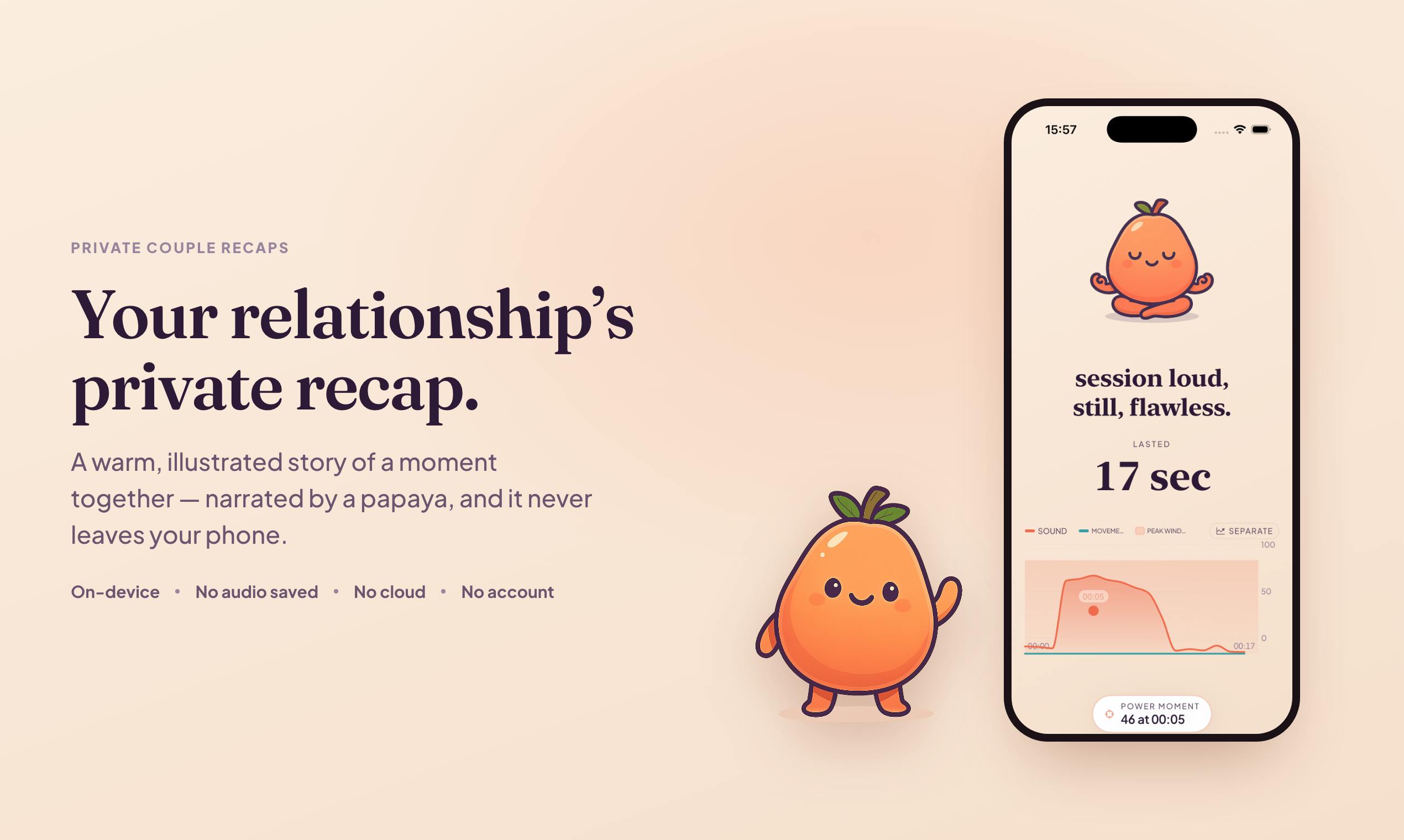
Papaya is an iPhone application for adult couples that measures sound and motion intensity during an intimate encounter and produces a short illustrated recap. Its principal differentiation is privacy: processing occurs on-device, raw audio is reportedly discarded immediately, and normal usage requires neither an account nor cloud storage (official website; privacy policy).
The product demonstrates thoughtful technical execution for a sensitive use case. It includes optional Apple Watch context, encrypted device-to-device sharing, localization into 22 languages, and a freemium subscription model. The current App Store listing shows version 1.4, one rating, and a “Data Not Collected” privacy label (App Store).
The strongest investment signal is product differentiation. On-device architecture addresses a credible objection to intimacy applications: users may be unwilling to upload highly sensitive information to a third-party server. This could support trust and favorable word of mouth within a narrow audience.
The central concern is not product quality but venture scalability. No revenue, subscriber count, retention, download volume, conversion rate, or repeat-usage data are public. Moreover, the specific “intimate-session recap” proposition may be novelty-driven and episodic rather than habit-forming. Distribution is constrained by the sensitive subject matter, iPhone-only availability, and dependence on Apple.
The final decision is Watch. Papaya is sufficiently distinctive to monitor, but current evidence does not justify formal due diligence. It must first demonstrate repeat use, paid retention, efficient organic acquisition, and a credible expansion from a novelty feature into a broader relationship-wellness platform.
Product Overview
Papaya targets adult couples who want a playful record of intimate moments without uploading sensitive recordings or relationship data. A user places an iPhone nearby and starts a session. The application reduces microphone input to sound-intensity measurements, combines that with motion data, and generates an illustrated summary containing rhythm, peaks, duration, and a narrative title (official website).
The default product does not save raw audio. According to the privacy policy, original audio frames are processed in memory and immediately discarded, while saved summaries contain aggregated metrics such as duration, peak intensity, motion, rhythm, silence share, and per-second intensity (privacy policy). These assertions are company-reported and have not been independently audited.
Additional features include optional read-only Apple Health and Apple Watch context, QR-based partner pairing, encrypted sharing through AirDrop or Messages, local history, trends, and recap styles. The official site acknowledges that the current version does not yet have an in-app Face ID lock, which is a meaningful omission given the sensitivity of locally stored summaries (official website).
The free plan provides several initial recaps followed by one recap per week. The App Store lists monthly Pro pricing at $4.99 and annual pricing at $44.99, while the website states $39.99 annually. The App Store figure is used as the current storefront price, but the discrepancy should be clarified (App Store; official website).
Papaya requires iOS 17 or later and supports iPhone, iPad, Apple Watch, compatible Macs, and Apple Vision; there is no Android version. It replaces informal memory, journaling, or no tracking at all rather than a clearly established paid workflow.
Founder and Team Assessment
The App Store identifies Petros Tepoyan as the individual seller and copyright holder. His indexed professional profile describes him as a senior iOS engineer and lists experience at Alfa-Bank and education at the American University of Armenia (LinkedIn). This background is relevant to building an Apple-native, privacy-oriented application.
Tepoyan’s public GitHub profile contains 38 repositories and shows experience across mobile and software projects. Papaya’s application code is not public, so its encryption implementation and claim that health-data access is read-only cannot be independently reviewed through GitHub.
No co-founders, employees, advisors, prior exits, hiring activity, or institutional company structure were verified. Full-time commitment is also unknown; the indexed professional profile appears to list outside employment. Commercial, growth-marketing, clinical, and consumer-subscription expertise remain unproven.
Founder Assessment: Relevant iOS execution capability is visible, but full-time commitment, team depth, and commercial capability remain unverified.
Market Opportunity
The initial segment is narrow: privacy-conscious, iPhone-owning adult couples who are comfortable placing a phone nearby during intimacy and willing to pay for repeated illustrated recaps. The customer problem is real but discretionary; the alternative is typically doing nothing rather than paying for another product.
The wider couples-app category can support meaningful consumer businesses. Paired reports eight million downloads, while its App Store listing shows approximately 205,000 ratings and subscription prices materially above Papaya’s (Paired App Store). Paired also reported 5,000 paying subscribers shortly after launch and $4.6 million in cumulative funding in 2021, demonstrating investor and consumer interest in relationship applications (Paired funding announcement).
An illustrative—not verified—bottom-up scenario shows Papaya’s present scale limitation:
- 100,000 annual subscribers × $44.99 = approximately $4.5 million gross annual billings.
- 1 million annual subscribers × $44.99 = approximately $45 million gross annual billings.
Reaching one million paying couples would already require substantial global consumer distribution. Adjacent expansion into communication prompts, relationship journaling, sexual wellness, date planning, or expert-led relationship content could increase addressable revenue, but would place Papaya in more direct competition with established apps such as Paired, Agapé, and Lovewick.
Traction and Growth Signals
Papaya launched on Product Hunt on August 9, 2026. A secondary launch tracker reports 94 votes, two comments, and a #6 daily position (Launly). These figures indicate launch-day curiosity, not product-market fit.
The App Store shows only one rating, although the product has already reached version 1.4 and supports 22 languages (App Store). Version activity and localization demonstrate shipping capacity, but they do not establish demand.
No reliable information was found for downloads, registered users, active couples, paid subscribers, MRR, conversion, renewal, cohort retention, session frequency, acquisition cost, or organic referral rate. There are also no independently verified customer case studies or sustained community discussions.
Traction Assessment: Active product development is visible, but commercial traction is almost entirely unverified.
Competitive Position
Direct competitors include relationship applications such as Paired, Agapé, Lovewick, and other couple-journaling or intimacy products. Indirect alternatives include Apple Notes, private photo journals, Health data, paper journals, and simply discussing the experience without recording it.
Papaya’s privacy architecture and humorous recap format provide clear differentiation. Its $4.99 monthly price is also below Paired’s currently listed $14.99 monthly tier (Papaya App Store; Paired App Store).
However, switching costs are low. The product has no verified network effect, proprietary dataset, exclusive content library, or distribution advantage. Its decision not to collect cloud data strengthens privacy but simultaneously limits personalization, cross-device continuity, experimentation, and data-driven defensibility.
If Apple, Paired, or another major relationship platform launched an on-device intimacy recap within six months, customers would continue using Papaya only if its brand, recap quality, accumulated local history, and partner experience were substantially better. No public evidence yet establishes such loyalty.
Defensibility Assessment: Low
Business Model and Economics
Papaya uses a freemium subscription model. Pro unlocks unlimited sessions, history, trends, themed styles, personalized insights, and recovery context. Annual consumer revenue per payer is therefore approximately $45 before taxes, discounts, refunds, and Apple’s commission.
Apple states that standard subscription proceeds are 70% during a subscriber’s first year and 85% afterward; qualifying Small Business Program members receive 85% from the outset (Apple subscription economics). Papaya’s enrollment status is unknown.
Because processing is primarily on-device and the company reports no analytics or session-data cloud, infrastructure and AI-inference costs may be low. This is economically favorable, although payment fees, customer support, localization, product development, and any Russia-specific subscription-verification server remain.
The harder issue is retention. Papaya must prove that intimate recaps create recurring value after the novelty wears off. Its no-account architecture may also make lifecycle marketing, churn analysis, attribution, and re-engagement more difficult. Gross margin, conversion, renewal, acquisition cost, and refund rates are not publicly disclosed.
Unicorn Path
A 5× net-revenue multiple is assumed. This is an analyst assumption reflecting an unproven consumer subscription business with platform dependency and unknown retention—not a verified market multiple.
At 5× revenue, a $1 billion valuation requires approximately:
$1 billion ÷ 5 = $200 million in annual net revenue.
Assuming a blended 20% deduction for Apple commissions and other storefront effects, a $44.99 annual subscriber would produce roughly $36 in net annual revenue before operating costs. Papaya would therefore require approximately:
$200 million ÷ $36 = 5.6 million annual subscribers.
Even under a more optimistic 8× multiple, it would need approximately $125 million in net revenue, or about 3.5 million annual subscribers at the same assumed net revenue per subscriber.
That scale appears unrealistic for the current single-purpose proposition. A credible route would require Android expansion, broader relationship-wellness features, materially higher lifetime value, repeatable international distribution, strong annual retention, and potentially a portfolio or platform spanning intimacy, communication, and relationship health.
Unicorn Path: Improbable
Valuation Assessment
No reliable public information was found regarding funding, investors, a financing round, SAFE cap, post-money valuation, secondary transaction, or current fundraising process. Revenue and growth are also undisclosed.
Valuation Attractiveness: Not Assessable
A responsible valuation assessment requires current MRR or ARR, subscriber growth, annual renewal, cohort retention, gross margin, acquisition cost, founder commitment, burn, runway, legal structure, cap table, round size, valuation cap, and investor rights. Product quality and Product Hunt performance alone cannot support a valuation range.
Key Risks
- Unproven recurring demand: The recap may be interesting once but insufficiently valuable for subscription renewal.
- No verified commercial traction: Revenue, subscribers, usage, and retention are unknown.
- Narrow initial use case: The addressable paying segment may be substantially smaller than the broader couples-app market.
- Weak defensibility: Features can be replicated, while switching costs and network effects are minimal.
- Distribution constraints: Sexual subject matter may restrict advertising, partnerships, app-store merchandising, and social sharing.
- Apple dependency: Papaya is iPhone-only and relies on App Store approval and subscription economics.
- Privacy and security execution: Claims are not independently audited, and the current absence of an app lock exposes locally stored recaps to anyone with device access.
- Key-person and commitment risk: Only one developer is verified, and full-time commitment is unknown.
- Limited product analytics: A no-analytics architecture may impede retention measurement and product optimization.
- Pricing inconsistency: The website and App Store show different annual prices.
Final Assessment
Venture Potential: 43/100
| Category | Score |
|---|---|
| Market Size and Expansion Potential | 11/20 |
| Traction and Growth Evidence | 3/20 |
| Founder and Team | 8/15 |
| Product Strength | 8/10 |
| Distribution Potential | 5/15 |
| Business Model and Economics | 5/10 |
| Defensibility | 3/10 |
| Total | 43/100 |
The strongest element is a differentiated, technically coherent privacy-first product. The weakest elements are commercial validation, distribution, and defensibility.
Evidence Confidence: 44/100
The product, developer identity, pricing, platform availability, update activity, and published privacy policy are verified through primary sources. Product Hunt performance comes partly from a secondary tracker. Architecture and encryption assertions are company-reported and unaudited.
Revenue, subscriber count, retention, conversion, funding, legal entity, team size, gross margin, burn, runway, and valuation remain unavailable.
Final Decision: Watch
Papaya is too early for formal due diligence. The product is distinctive, but its current market appears niche, its unicorn path is improbable, and nearly all commercial metrics are unknown. Monitoring is justified because strong retention or an effective expansion into broader relationship wellness could materially improve the venture case.
Upgrade Conditions
- At least 10,000 paying subscribers with sustained non-launch growth.
- Verified six-month annual-plan retention above 70%.
- Evidence that couples complete multiple sessions per month after the first 90 days.
- Repeatable organic or partner-referral acquisition outside Product Hunt.
- Android launch or evidence that iOS alone supports efficient scale.
- Independent privacy and security review, plus Face ID app locking.
- A credible broader relationship-wellness roadmap without weakening privacy differentiation.
Downgrade Conditions
- Rapid decline in session frequency after initial use.
- Weak trial-to-paid conversion or high first-renewal churn.
- App Store removal, repeated review rejection, or restricted discoverability.
- A major couples platform replicating the feature successfully.
- Material inconsistency between privacy claims and observed data flows.
- Founder disengagement or discontinued product updates.
Questions for Further Diligence
- What are current downloads, monthly active couples, paid subscribers, MRR, and monthly growth?
- What percentage of users complete a first session, a second session, and five sessions?
- What are 30-, 90-, and 180-day user and subscriber retention?
- What are trial-to-paid conversion and annual-plan renewal rates?
- How frequently do retained couples use Papaya each month?
- Which acquisition channels generate users, and what are CAC and referral rates by channel?
- What is net revenue per subscriber after Apple fees, taxes, refunds, and discounts?
- Is the founder working full-time, and who covers product, security, design, and growth?
- Has the on-device processing and encryption architecture received an independent audit?
- What are the legal entity, cap table, burn rate, runway, and existing founder investment?
- Is Papaya currently fundraising, and what are the round size, valuation cap, and proposed terms?
- What expansion can increase lifetime value without turning Papaya into an undifferentiated couples app?