
Table of Contents
Supernova Investment Report
Category: AI-native data integration and business intelligence
Company Stage: Seed / product reinvention
Founder or Founders: Luke Zapart, Ryan Buick, and Will Pride; Kate Zapart is also publicly active in the launch
Headquarters: San Francisco, California, United States
Funding: $4.2 million round announced in January 2022, led by Sequoia with Abstract Ventures, SV Angel, and angels
Business Model: Usage-based data infrastructure and AI-token markup
Product Hunt Launch Date: 2026/08/21
Report Date: August 26, 2026
| Investment Metric | Assessment |
|---|---|
| Venture Potential | 81/100 |
| Unicorn Path | Plausible but unproven |
| Valuation Attractiveness | Not Assessable |
| Evidence Confidence | 83/100 |
| Final Decision | DD |
Executive Summary
Supernova, formerly Canvas, connects company data from Stripe, HubSpot, PostgreSQL, Salesforce, NetSuite, advertising platforms, and more than 30 other sources into an encrypted Apache Iceberg lake. Teams can query and model that data in Supernova or expose governed, read-only access to Claude and Codex through MCP. The product bundles connectors, storage, catalog, SQL execution, models, dashboards, Git history, CLI, API, and AI assistance.
Frontier models can analyze data, but direct production connections are slow, rate-limited, fragmented, and hard to govern. Supernova prepares data with permissions, typed schemas, history, and fast queries, priced transparently without seat or feature fees.
Three former Flexport colleagues experienced the “data request gap,” raised $4.2 million from Sequoia and data-industry operators, and have built since 2020. Canvas was Product Hunt’s number-one product in 2023; the Supernova relaunch ranked number two with more than 330 points. A public MIT-licensed repository exposes meaningful architecture and 370 commits, although it had only four stars when reviewed.
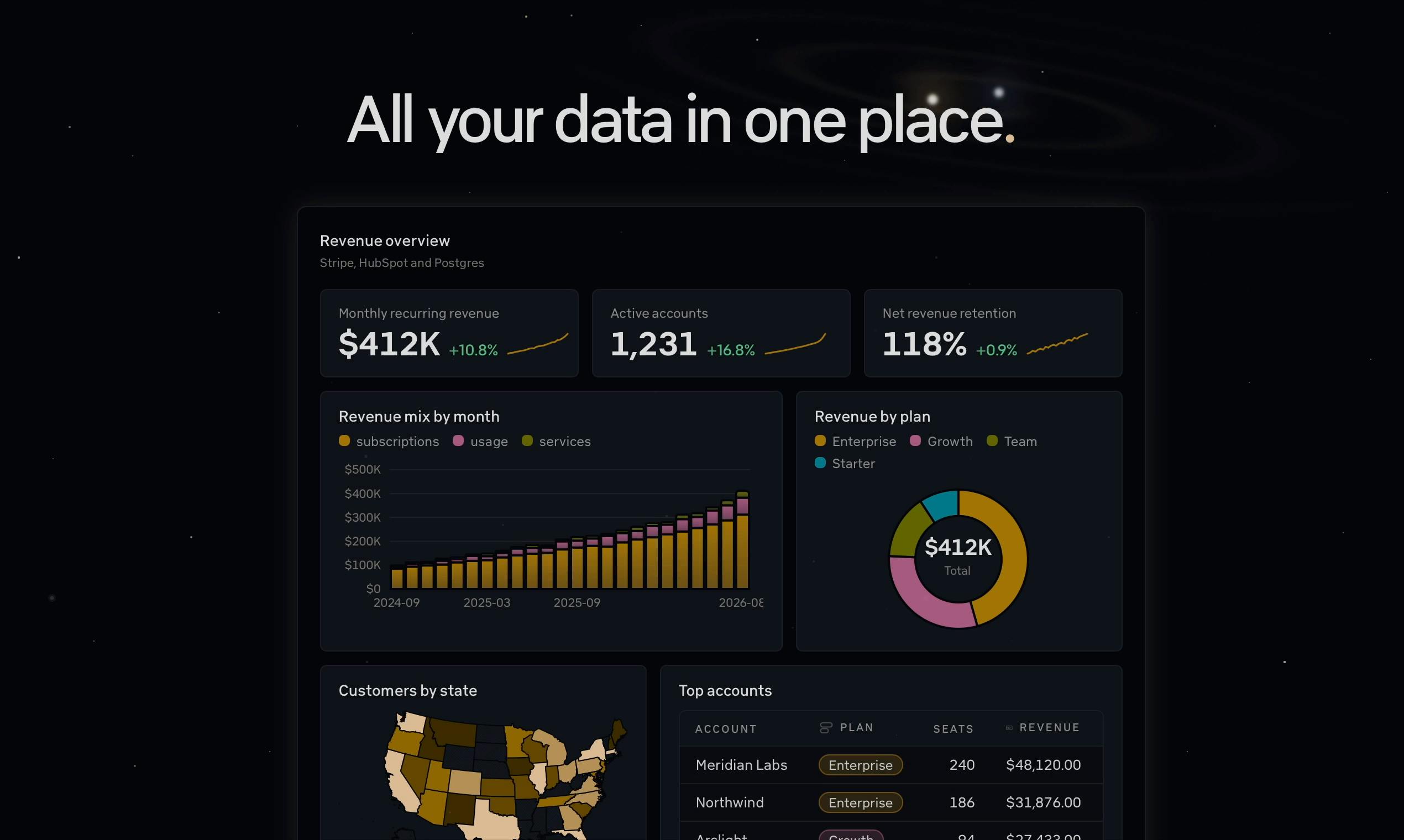
Commercial evidence is the missing piece. The official home page displays $412,000 MRR, 1,231 active accounts, and 118% net revenue retention inside a product demonstration; these appear to be illustrative sample-company data and must not be treated as Supernova’s metrics. Actual ARR, customer count, retention, gross margin, and growth are not disclosed. AI-generated financial answers also create correctness and governance risk.
Final decision: DD. Founder-market fit, product depth, open architecture, and a timely MCP distribution wedge justify diligence. Investment depends on verified revenue quality, retention, data accuracy, security, infrastructure margins, and financing terms.
Product Overview
Supernova replaces a patchwork of extract/load tools, warehouses, BI interfaces, and direct AI connections. FTL connectors discover schemas and synchronize source data. Titan manages encrypted Iceberg tables; Neutron is a memory-bounded Rust query engine; TypeSQL catches schema errors; Particle creates analyses and dashboards with AI.
Claude, Codex, and compatible clients connect through OAuth-secured MCP. Agents inspect metadata, run bounded read-only SQL, and author repository assets according to table permissions. Models, dashboards, themes, and SQL packages live in Git for review and reproducibility.
Pricing is $0.15 per GB-hour compute, $0.05 per GB-month storage, $0.10 per GB egress, $0.40 per million reads, $5 per million writes/list operations, and 1.5 times pass-through for AI tokens. Seats and Claude/Codex access are free; displayed cost comparisons are explicitly illustrative.
Open Iceberg storage and zero-copy connections reduce lock-in. The MIT repository exposes meaningful application and data-plane architecture, though local operation still needs team-managed services.
Founder and Team Assessment
Luke Zapart, Ryan Buick, and Will Pride founded Canvas in 2020 after working at Flexport. TechCrunch identified Zapart as CEO, Pride as CTO, and Buick leading sales and marketing. They personally observed business teams waiting on data teams and reverting to CSV, providing direct problem experience across product, engineering, and GTM.
The 2022 investor group included Sequoia, Abstract Ventures, SV Angel, and operators from leading data and software companies—valuable for design partnerships, hiring, and introductions. Kate Zapart joined the 2026 launch, but her formal role is unclear.
A six-year journey demonstrates resilience but raises a question: was the shift from collaborative spreadsheets to an integrated AI data stack successful evolution or a response to weak growth? Current headcount, roles, retention, and ownership are unavailable.
Founder Assessment: Strong founder-market fit and network; organizational strength and pivot evidence require verification.
Market Opportunity
Supernova participates in data integration, cloud analytics, BI, and AI-agent infrastructure—each a large enterprise category. The initial customer is a startup or mid-market company that needs data answers but cannot staff a complete data team. MCP can expand usage from analysts to every Claude or Codex user with appropriate permissions.
An illustrative bottom-up scenario assumes 100,000 target organizations, 5% penetration, and $20,000 annual average spend, producing $100 million ARR. Larger customers, more connectors, automation, and agent workloads can increase spend. These are scenario assumptions, not company guidance.
Model capability is improving faster than companies can govern data, but warehouse, ETL, BI, and AI vendors are converging. Supernova must prove simpler, cheaper enterprise reliability.
Market Assessment: Very large and strategically important, with intense platform convergence.
Traction and Growth Signals
The 2026 launch ranked second with more than 330 points, about 1,300 followers, and three historical reviews. Canvas ranked first in 2023 with 482 points. A Duro Labs review described joining Zendesk, HubSpot, and database data. These support interest, not current PMF.
TechCrunch reported six employees, a handful of paying customers, and design partners in 2022; this is stale. Founders now claim 80–90% customer cost reductions, rapid million-row queries, and custom connectors within 24 hours. These need invoice, benchmark, and reference validation.
GitHub showed 370 commits but four stars and no forks. No reliable current data was found for ARR, logos, active accounts, sync volume, retention, expansion, or support load. Website dashboard numbers appear demonstrative.
Traction Assessment: Long product history and credible anecdotes; commercial scale unverified.
Competitive Position
Competitors span Fivetran, Airbyte, Meltano, Snowflake, Databricks, BigQuery, MotherDuck, ClickHouse, dbt, Hex, Sigma, ThoughtSpot, Metabase, Omni, Seek AI, Equals, Rows, and direct SaaS MCP connectors. Large platforms have established security, connectors, procurement relationships, and ecosystems. Startups can assemble lower-cost open-source components.
Supernova differentiates through one integrated lake-to-agent experience, open Iceberg storage, Git-based analytics, TypeSQL, a Rust engine, transparent usage pricing, broad startup connectors, and governed MCP. Its architecture may lower operational work and make analysis reproducible.
Defensibility can arise from connector reliability, schema history, cost-efficient execution, accumulated models, permissions, and workflow trust. Models and MCP alone are not moats. If a warehouse or ETL incumbent ships equivalent agent access, customers may prefer the existing vendor unless Supernova maintains superior cost and simplicity.
Defensibility Assessment: Medium
Business Model and Economics
Usage pricing aligns revenue with data volume and compute rather than headcount. This reduces adoption friction and lets all employees use the product, but very small customers may generate limited revenue. AI tokens carry a 50% markup. There are no premium plans, so expansion must come from workloads and data rather than feature gates.
Costs include source API operations, object storage, egress, query compute, connector maintenance, AI tokens, support, compliance, and sales. The company says pricing is tuned so every customer is profitable, but blended gross margin is undisclosed. Extremely low customer bills can challenge support economics.
Key diligence metrics are annualized revenue, gross margin by workload, expansion, connector support cost, customer acquisition, payback, usage concentration, and sensitivity to cloud prices.
Unicorn Path
At a 10x ARR multiple, a $1 billion valuation requires about $100 million ARR. That could mean 5,000 customers at $20,000 annual spend or 1,000 at $100,000. The usage model can expand naturally, but low-cost positioning requires significant volume.
Supernova must become the governed data layer for AI agents, not merely an inexpensive startup BI tool. It needs enterprise security, high reliability, expanding data volumes, strong retention, and distribution through AI clients while avoiding disintermediation.
Unicorn Path: Plausible but unproven
Valuation Assessment
The $4.2 million 2022 financing and lead investor are verified. No later round, current price, revenue, burn, runway, cap table, or terms were reliably found.
Valuation Attractiveness: Not Assessable
Required inputs include ARR, growth, retention, gross margin, cash, burn, runway, capitalization, proposed round size and price, liquidation preferences, and pro-rata rights.
Key Risks
- Actual commercial metrics are not public.
- Product evolution may reflect weak historical PMF.
- Warehouses and ETL/BI incumbents can bundle MCP and AI.
- AI may return plausible but incorrect financial analyses.
- Sensitive business data creates security and compliance exposure.
- Connector maintenance and rate limits create ongoing operational cost.
- Low usage prices may not support high-touch customers.
- Open architecture reduces lock-in and facilitates competition.
- Claude and Codex distribution depends on external platforms.
- Current financing needs and valuation are unknown.
Final Assessment
Venture Potential: 81/100
| Category | Score |
|---|---|
| Market Size and Expansion Potential | 19/20 |
| Traction and Growth Evidence | 14/20 |
| Founder and Team | 14/15 |
| Product Strength | 9/10 |
| Distribution Potential | 11/15 |
| Business Model and Economics | 7/10 |
| Defensibility | 7/10 |
| Total | 81/100 |
Evidence Confidence: 83/100
Architecture, pricing, founders, funding, repository, and launch history are supported. Current revenue, retention, margins, and customer scale are missing; demo metrics were excluded.
Final Decision: DD
Supernova offers a coherent, technically deep answer to governed AI analysis. Proceed to diligence because the team and market are strong, but require proof that the new platform has durable commercial momentum.
Upgrade Conditions
- Verified ARR above $3 million with rapid growth.
- Net revenue retention above 110% and low logo churn.
- Gross margin above 70% after connector and support costs.
- Reference customers relying on MCP for recurring decisions.
- Accuracy controls and audit trails accepted for financial analysis.
- Enterprise security and favorable financing terms.
Downgrade Conditions
- Demo adoption does not convert to sustained workloads.
- The pivot reset revenue or customer retention.
- Incumbents erase the cost or integration advantage.
- Security reviews block sensitive data access.
- Support costs overwhelm low usage revenue.
Questions for Further Diligence
- What are current ARR, growth, logo count, and average annual spend?
- How much prior Canvas revenue and usage migrated to Supernova?
- What are gross and net retention by customer cohort?
- What is gross margin after cloud, connector, and support costs?
- How often do AI answers contain material numerical or methodological errors?
- What verification and lineage appear with every answer?
- Which competitors win or lose most often, and why?
- How many customers use MCP weekly versus dashboards alone?
- What security certifications, audit logs, and tenant-isolation controls exist?
- How concentrated are revenue, data volume, and connector workload?
- What are current team, burn, runway, and hiring plans?
- What are cap table, round size, valuation, and investor rights?