
Table of Contents
Wizstar Investment Report
Category: AI avatars and generative-video software
Company Stage: Early commercial / undisclosed
Founder or Founders: Not publicly verified; Product Hunt launch representative uses the name Starry Li
Headquarters: Not publicly disclosed
Funding: No reliable public financing announcement found
Business Model: Freemium, credit-based and subscription video generation with enterprise offerings
Product Hunt Launch Date: 2026/08/21
Report Date: August 26, 2026
| Investment Metric | Assessment |
|---|---|
| Venture Potential | 58/100 |
| Unicorn Path | Unproven |
| Valuation Attractiveness | Not Assessable |
| Evidence Confidence | 61/100 |
| Final Decision | Pass |
Executive Summary
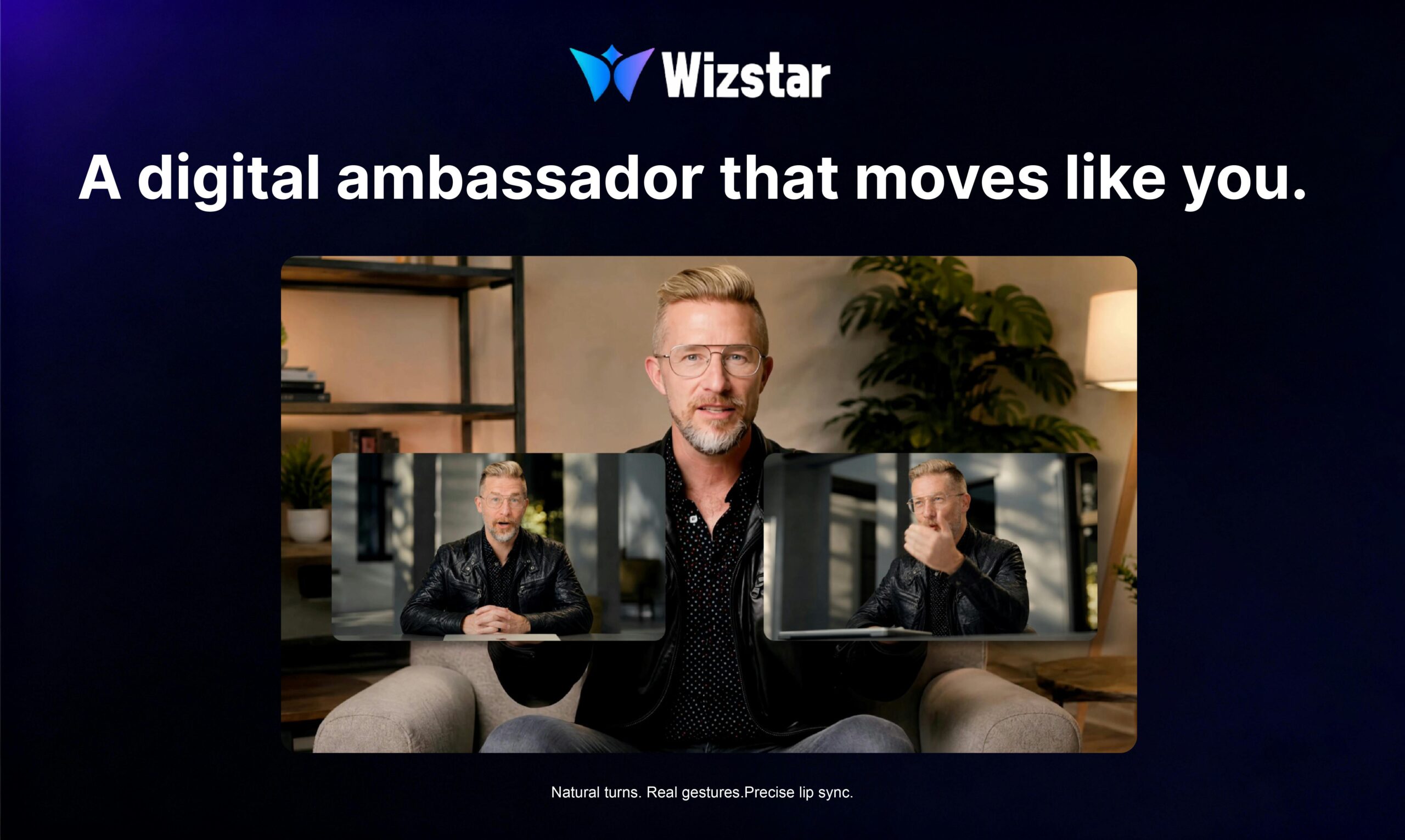
Wizstar is an AI content platform centered on reusable digital avatars that can speak, gesture, turn their heads, interact with objects, and preserve lip synchronization during difficult poses or facial occlusion. A user supplies a photo or video, voice sample, and script; Wizstar generates marketing, product-demo, training, localization, live-streaming, or social video without repeated filming.
The product addresses a real production problem. Talking-head avatar tools often look stiff, fail during head turns, or require re-recording when a script changes. Wizstar describes a two-stage process that separates audio, mouth movement, and head pose before reconstructing facial texture and expressions. It also offers general text/image-to-video using external models such as Seedance, Kling, and MiniMax.
Launch execution was strong: Wizstar ranked number one on Product Hunt with roughly 319–323 points, 771 followers, and active discussion. Hunter Chris Messina described using a Wizstar avatar for a founder video and praised its movement quality. However, Product Hunt attention and a friendly launch testimonial are not PMF. No verified revenue, active-user, retention, customer, founder, team, funding, or model-economics data were found.
The market is large but fiercely competitive, with established avatar and video platforms. Wizstar partly depends on third-party models, while identity, voice, and live-avatar features create consent and abuse risk.
Final decision: Pass. Visual quality merits monitoring, but opacity, weak commercial evidence, limited defensibility, dependency, and safety exposure make investment unsuitable. Reconsider after verified enterprise adoption, retention, margins, provenance controls, and team disclosure.
Product Overview
Product Hunt positions “digital ambassadors” for founders, creators, marketers, sales, and training. The avatar supports difficult viewing angles, facial occlusion, body gestures, source videos up to five minutes or 200 MB, customized clothing, multiple languages, and localized presenters.
Wizstar describes AI Avatar Turbo for speed and cost efficiency from a single image/video, and AI Avatar for consistent, reusable, longer output. The official site also offers image generation, text-to-video, product ads, translation, interactive avatars, and live streaming. Breadth supports a suite but risks weakening focus.
The technical explanation separates speech, mouth movement, and head pose, drives a 3D face, then reconstructs texture and expression. No paper, benchmark, patent, or controlled comparison validates quality, latency, identity preservation, or failure rate.
Free credits lead to memberships. The pricing page did not yield reliable plan details. A company release says MiniMax H3 is free and Seedance 2.5 costs $0.99 or comes with membership and 30 seconds of credits. Avatar price, commercial rights, watermarks, overages, and API terms remain unverified.
Founder and Team Assessment
The Product Hunt maker, Starry Li, says she runs marketing; Chris Messina hunted the launch. Public materials did not identify legal founders, executives, headquarters, engineering leadership, ownership, or team size, nor a reliable corporate profile or financing disclosure for this exact product.
The team shows skill in packaging, launch marketing, multi-model integration, localization, and demonstrations. Detailed launch responses support customer engagement. Heavy reliance on company press releases and sparse corporate disclosure reduce underwriteability.
Investors must establish where research occurs, which technology is proprietary, and whether the company controls all models, voices, likenesses, and training rights. Entity transparency affects data transfers, export restrictions, IP, and enforcement.
Founder Assessment: Execution is visible; founders, credentials, ownership, and governance are not.
Market Opportunity
AI video serves advertising, localization, learning, internal communications, sales enablement, creator content, and customer service. Avatar software can replace repeated studio production and make one presenter available across languages and channels.
A bottom-up scenario could assume 500,000 creators and small teams paying $300 annually, producing $150 million ARR. An enterprise route with 10,000 organizations at $15,000 annual value also produces $150 million ARR. These are scenario assumptions, not Wizstar forecasts.
The opportunity expands through API usage, live avatars, performance marketing, and localized content. Yet model prices fall rapidly, novelty fades, and generic production becomes interchangeable. Value will accrue to platforms with trusted identity, repeatable workflows, brand controls, distribution, and measurable conversion lift—not merely visually impressive generation.
Market Assessment: Large and growing, but rapidly commoditizing.
Traction and Growth Signals
Product Hunt recorded approximately 319–323 points, number-one daily rank, 771 followers, and around 31 comments in third-party launch tracking. The discussion included praise for lip synchronization and a positive hunter demonstration. These are marketing signals only.
A May 2026 YouTube walkthrough of creating marketing video from an Amazon link had fewer than 1,000 views when indexed. July and August company press releases describe enterprise workflows, more than 75 localization languages, Seedance 2.5, MiniMax H3, live streaming, and interactive avatars. Press releases validate what the company claims to offer, not adoption or customer outcomes.
No independent review base, named enterprise case study, user cohort, revenue figure, paid conversion, generated-video volume, retention, API usage, or traffic history was reliably found. The product is broad enough that engagement must be separated by avatar, general video, translation, and live-stream use cases.
Traction Assessment: Excellent launch visibility; insufficient independent or commercial evidence.
Competitive Position
Direct avatar competitors include HeyGen, Synthesia, Captions, Tavus, D-ID, Hour One, Colossyan, DeepBrain AI, and Elai. Generative-video competition includes Runway, OpenAI Sora, Google Veo, Kling, Seedance, MiniMax, Pika, Luma, Higgsfield, and aggregators. Adobe, Canva, TikTok, and CapCut control powerful creative distribution.
Wizstar differentiates on expressive whole-body movement, robust lip sync during occlusion and head turns, long reusable avatars, localization, and a unified suite. Its founder-ambassador positioning is clearer than a generic video generator.
Defensibility is currently low. Third-party models can improve underneath every competitor, and the website explicitly promotes integrations of external engines. Visual features are copied quickly. A moat would require proprietary avatar training, exclusive data, identity authorization, low-cost inference, workflow integration, enterprise controls, or demonstrably superior retention.
If an incumbent matched motion quality, customers could switch based on price, credits, language coverage, or distribution. No switching-cost evidence is public.
Defensibility Assessment: Low
Business Model and Economics
Wizstar uses free credits, memberships, and transactional access, with enterprise products also promoted. Revenue can scale with generation volume, API calls, seats, and live-stream usage. Exact current packaging is unclear.
Video inference is expensive and model-dependent. Gross margin depends on generation success rate, retries, resolution, duration, priority queues, model licensing, voice synthesis, storage, and support. Subscription credits can produce healthy breakage, but power users may be unprofitable. Reliance on Seedance, Kling, or MiniMax exposes Wizstar to supplier price and access changes.
Diligence needs revenue by product, paid conversion, credit utilization, inference cost per successful minute, refund/retry rates, gross margin, churn, and acquisition payback.
Unicorn Path
At an illustrative 8x ARR multiple, a $1 billion valuation requires about $125 million ARR. That could mean roughly 417,000 users paying $300 annually or 8,333 enterprise customers paying $15,000. Achieving this requires strong repeat use, international brand trust, defensible avatar quality, and safe enterprise deployment.
Without verified users or revenue, the path is theoretical. The more likely outcome today is a competitive creator tool with volatile margins unless Wizstar owns a distinctive model or enterprise workflow.
Unicorn Path: Unproven
Valuation Assessment
No verified financing amount, valuation, legal entity, cap table, cash position, or current round terms were found. Unattributed secondary claims were excluded.
Valuation Attractiveness: Not Assessable
Required inputs include legal entity, founders, capitalization, prior funding, revenue, growth, gross margin, burn, runway, proposed round, valuation, option pool, liquidation terms, and intellectual-property ownership.
Key Risks
- Founders, entity, funding, and governance are opaque.
- No verified revenue, retention, or customer evidence.
- Avatar and video markets are crowded and fast commoditizing.
- Dependence on third-party models threatens cost and access.
- Deepfake, impersonation, fraud, and election misuse create liability.
- Voice and likeness consent must be continuously enforced.
- Training-data and generated-content rights may be contested.
- Video inference and retries may compress gross margin.
- Broad product scope can weaken focus.
- Product Hunt popularity may not translate into retained demand.
Final Assessment
Venture Potential: 58/100
| Category | Score |
|---|---|
| Market Size and Expansion Potential | 18/20 |
| Traction and Growth Evidence | 8/20 |
| Founder and Team | 5/15 |
| Product Strength | 8/10 |
| Distribution Potential | 9/15 |
| Business Model and Economics | 5/10 |
| Defensibility | 5/10 |
| Total | 58/100 |
Evidence Confidence: 61/100
Product features, launch performance, public offers, and company claims are visible. Founder identity, entity, funding, adoption, revenue, economics, and technical ownership remain uncertain. Press releases were treated as company statements.
Final Decision: Pass
Wizstar may be a strong creative product, but investability is not established. Corporate transparency, retained paid usage, proprietary advantage, margins, and safety controls must improve before diligence.
Upgrade Conditions
- Verified ARR above $2 million with strong paid retention.
- Named enterprise customers using avatars repeatedly.
- Gross margin above 65% after inference and retries.
- Independent quality benchmarks against leading avatar vendors.
- Robust likeness consent, watermarking, detection, and audit logs.
- Full founder, entity, IP, and financing disclosure.
Downgrade Conditions
- Launch users fail to retain or convert.
- Core quality depends entirely on third-party models.
- Abuse or consent failures cause platform restrictions.
- Generation costs rise faster than revenue.
- Major creative suites bundle equivalent avatars.
Questions for Further Diligence
- Who are the legal founders, executives, and beneficial owners?
- What entity owns the code, models, domain, and customer contracts?
- What are current revenue, growth, paid users, and cohort retention?
- Which avatar components are proprietary versus third-party models?
- What is inference cost per successful minute by product and resolution?
- How many generations fail, retry, or receive refunds?
- Which enterprises use Wizstar repeatedly, and for what workflows?
- How are voice and likeness ownership verified and revoked?
- What watermarking, provenance, moderation, and abuse-response systems exist?
- What licenses govern model output and commercial use?
- What are funding history, burn, runway, and hiring plans?
- What round terms and valuation are currently proposed?
Sources
- Product Hunt: Wizstar
- Wizstar official website
- Wizstar official pricing page
- Wizstar AI video generator page
- PR Newswire: Wizstar Product Hunt launch
- PR Newswire: enterprise AI avatar offering
- PR Newswire APAC: Seedance 2.5 and MiniMax H3 release
- YouTube walkthrough: Amazon-link marketing video
- Hunted.Space launch history