
Table of Contents
Descent Investment Report
Category: Consumer Travel / Flight Price Tracking
Stage: Bootstrapped / Pre-Seed
Founder: Pietro Messineo
Launch Date: March 25, 2026
Business Model: Freemium iOS subscription
Report Date: August 11, 2026
| Investment Metric | Assessment |
|---|---|
| Venture Potential | 46/100 |
| Unicorn Path | Improbable under the current model |
| Valuation Attractiveness | Not assessable — no financing valuation disclosed |
| Evidence Confidence | 67/100 |
| Final Decision | WATCH |
Executive Summary
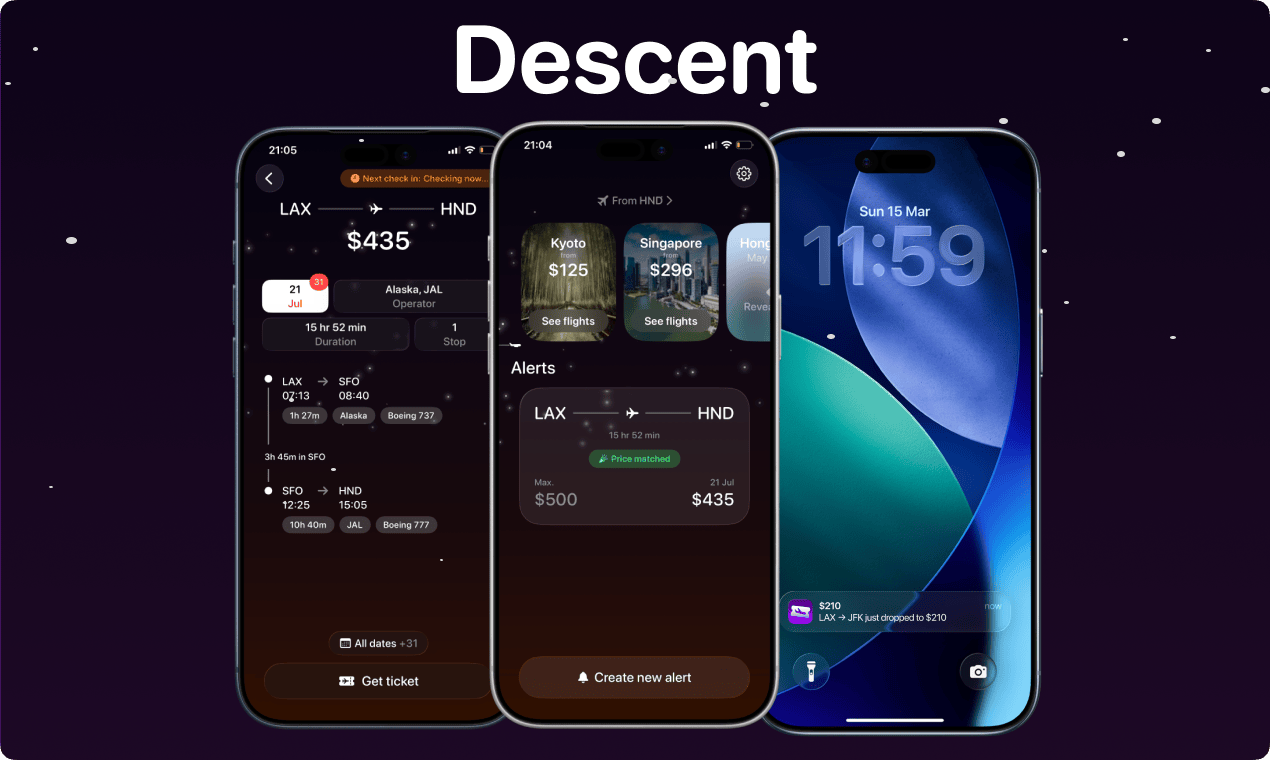
Descent is an iOS flight-price tracking app that lets travelers set a maximum budget for a route and receive a notification when a qualifying fare appears. Users can filter by travel dates, cabin class, number of stops, passenger count, and currency.
Its most distinctive feature is Descent Copilot, which converts natural-language requests—such as “Direct flights from London to Barcelona in July under €80”—into structured flight alerts. Copilot is powered by Apple Intelligence and processes the request on-device. The app also provides destination discovery, flexible-date calendars, nearby-airport search, and direct links to booking providers.
Descent launched on Product Hunt on March 25, 2026, receiving approximately 150 upvotes and finishing within the day’s top ten products. It currently has a 4.7 rating from 15 App Store ratings, indicating positive but still very limited early adoption.Product Hunt launch data App Store
The product is polished, solves a recognizable consumer problem, and is built by an experienced iOS developer with a history of launching apps that reached hundreds of thousands or millions of downloads. However, Descent currently looks more like a promising bootstrapped consumer app than a venture-scale travel company.
The primary investment concern is defensibility. Google Flights, Skyscanner, Hopper, Kayak, Going, and other established travel platforms already provide free or paid fare alerts. Descent improves the experience through budget-based alerts, natural-language input, and native iOS design, but these features are replicable.
The appropriate decision is WATCH. Descent could become a profitable subscription product or a strategic acquisition target, but there is not yet enough evidence of distribution, paid conversion, retention, or differentiated travel data to support a traditional venture investment.
Product Overview
Descent was created to eliminate the need for travelers to repeatedly check flight-search platforms while waiting for prices to fall.
A user creates an alert by selecting:
- Origin and destination
- Travel dates or flexible date ranges
- Maximum acceptable price
- Economy or business class
- Direct flights or permitted stops
- Passenger count
- Preferred currency
Descent then monitors available fares and sends a push notification when it identifies a flight below the user’s budget.
The app covers more than 7,000 airports and supports at least 11 currencies. Its Explore section helps users discover inexpensive destinations from a selected home airport, while the calendar displays prices across multiple dates.
The free plan includes two flight alerts. Descent First Class, the premium subscription, adds unlimited alerts, instant searches, a complete flight calendar, and additional customization.
Current US App Store pricing is:
- Weekly: $1.99
- Monthly: $3.99
- Annual: $34.99
The product is ad-free and available on iPhone and iPad, with compatibility for Apple Silicon Macs. Descent Copilot requires an Apple Intelligence-compatible device, such as an iPhone 15 Pro or later.App Store
Founder Assessment
Descent was built by Pietro Messineo, a solo iOS developer and founder of 6AM Swift.
Messineo reports more than 13 years of iOS development experience and over 50 apps shipped. His portfolio includes:
- Wallpapers Central, with more than two million downloads
- Launchify, with more than 600,000 downloads
- EmojiHub, with more than 50,000 downloads
- Social Widgets, reportedly acquired after reaching 200,000 downloads
- NutrixAI, an AI meal-tracking app that was also acquired
His background is a meaningful positive signal. Descent is not his first consumer application, and he has demonstrated an ability to identify App Store trends, build native products quickly, and generate meaningful download volume.
However, his website also lists a current Engineering Manager role at Kape Technologies. This suggests Descent may be operated as an independent side business rather than a full-time venture-backed company. That is not necessarily a weakness for a profitable indie app, but it limits the speed and organizational scale required for a venture outcome.Pietro Messineo
Founder assessment: Strong product execution, but unclear venture commitment.
Market Opportunity
Descent operates within the large global online travel market. Mobile travel search and booking are established consumer behaviors, and fluctuating airline prices create a recurring reason for travelers to use monitoring tools.
The immediate market consists of:
- Price-sensitive leisure travelers
- Travelers with flexible destinations or dates
- Frequent international travelers
- Users planning premium-cabin trips
- Consumers who currently monitor Google Flights manually
The underlying market is large, but Descent’s actual addressable revenue is much smaller than total flight-booking volume. The app currently monetizes subscriptions rather than directly capturing the full value of flight transactions.
The annual subscription price of $34.99 creates a relatively low average revenue per customer. Even with strong margins, Descent would require a very large paying-user base to become a major company.
Potential expansion paths include:
- Affiliate revenue from completed bookings
- Hotels, trains, rental cars, and travel insurance
- Premium deal curation and price predictions
- Family or group travel planning
- Subscription bundles for frequent travelers
- B2B tools for travel agents or corporate travel teams
These expansions could increase revenue per user, but they would also place Descent in more direct competition with large online travel agencies.
Traction
Descent’s Product Hunt launch generated approximately 150 upvotes and placed the app within the day’s top ten products. This is a positive awareness signal but not evidence of product-market fit.
The App Store currently shows:
- 4.7 out of 5 rating
- 15 total ratings
- Version 1.1.2
- Continued product updates, including flexible dates, interactive airport maps, nearby-airport search, and localization improvements
The founder also recruited early beta testers through Reddit before the public launch. That post generated limited engagement, but it demonstrated direct user support and active product iteration.Reddit
The critical missing metrics are:
- Total downloads
- Monthly active users
- Number of active alerts
- Free-to-paid conversion
- Monthly and annual recurring revenue
- Subscription renewal rate
- 30-day and 90-day retention
- Customer acquisition cost
- Flight-search or data-provider cost per user
- Percentage of alerts that result in bookings
Traction assessment: Early and positive, but commercially unverified.
Competitive Position
Descent enters a highly competitive market.
Google Flights already allows users to track prices and receive alerts. Skyscanner provides email and push-notification price alerts, while Hopper combines fare monitoring with price predictions and booking services. Kayak, Going, and other travel platforms provide overlapping functionality.
Descent’s current advantages are:
- Users can define an explicit maximum budget
- Natural-language alert creation
- A polished native iOS experience
- On-device processing for Copilot requests
- Support for flexible dates and nearby airports
- No advertising or sponsored search results
- A simple, transparent subscription model
These are valuable product advantages, but they do not yet represent a durable moat. Google, Skyscanner, or Hopper could add budget-threshold alerts and natural-language input without changing their core infrastructure.
Descent will need to build defensibility through one or more of the following:
- Superior proprietary fare data
- More accurate and faster deal detection
- Personalized price predictions
- A large base of high-intent travelers
- Exclusive airline or booking partnerships
- A trusted consumer travel brand
- Booking data that improves recommendations
- A broader travel-planning workflow
At present, Descent’s moat is primarily product design and execution speed.
Defensibility assessment: Low.
Business Model and Economics
Descent uses a freemium subscription model. The free tier provides two alerts, while the premium plan offers unlimited tracking and advanced search features.
At $34.99 per year, the product is affordable for consumers but has limited revenue per account. Apple’s platform fee, taxes, refunds, infrastructure costs, and flight-data expenses will reduce net revenue.
The most important economic question is the cost of monitoring fares. Unlike Copilot’s on-device natural-language processing, flight-price monitoring necessarily depends on external fare data and background infrastructure. If Descent pays for flight-search API requests, heavy users could create meaningful variable costs.
The company may eventually supplement subscriptions with affiliate commissions when users click through and complete bookings. That could improve revenue per user, although flight affiliate economics are typically less attractive than hotel commissions.
A sustainable model requires:
- Strong annual subscription conversion
- High renewal rates
- Controlled flight-data costs
- Low-cost organic acquisition
- Additional booking or affiliate revenue
- Expansion beyond occasional travel use
Unicorn Path
Assuming a long-term valuation multiple of 5x–10x revenue, a $1 billion valuation would likely require approximately $100M–$200M in annual revenue.
At the current $34.99 annual subscription price, that would require roughly:
“`text
$100M revenue: approximately 2.9 million annual subscribers
$200M revenue: approximately 5.7 million annual subscribers
“`
These figures are before considering App Store fees, taxes, discounts, churn, and variable data costs. The required number of paying users could therefore be substantially higher.
A credible unicorn path would require Descent to evolve beyond a standalone fare-alert subscription. It would need to become a broader travel platform that captures booking, affiliate, insurance, hotel, or financial-protection revenue.
Necessary conditions include:
- Millions of active users
- Strong organic or viral distribution
- High paid-conversion and annual renewal rates
- Proprietary travel or pricing intelligence
- Meaningful booking revenue
- Expansion beyond Apple devices
- A full-time team and external growth capital
- Defensibility against Google and major travel platforms
Unicorn Path: Improbable under the current model
Descent may become a successful independent business without becoming a unicorn. A profitable consumer app or a small strategic acquisition is currently a more credible outcome.
Valuation Assessment
No external funding round, company valuation, revenue figure, or institutional investor has been publicly disclosed.
As a result, a precise valuation range would create false confidence.
Valuation Attractiveness: Not assessable
A future valuation should be based on:
- Annual recurring revenue
- Subscription growth
- Paid conversion
- Renewal and retention
- Net revenue after App Store fees
- Flight-data and infrastructure costs
- Organic versus paid acquisition
- Affiliate and booking revenue
- Founder commitment and hiring plans
For an acquisition-focused valuation, an investor should also consider the strategic value of Descent’s user base, technology, App Store presence, and travel-intent data.
Key Risks
- Feature commoditization: Fare alerts are already available from larger platforms.
- Weak switching costs: Users can maintain alerts across several free services.
- Low customer frequency: Many consumers book flights only a few times per year.
- Platform dependency: Distribution and billing depend heavily on Apple.
- Data dependency: Flight availability and pricing depend on external providers.
- Limited monetization: The current annual subscription price caps revenue per user.
- Solo-founder capacity: Product, support, marketing, and partnerships depend on one developer.
- Unverified commercial traction: Downloads, revenue, conversion, and retention are unknown.
Final Assessment
Venture Potential: 46/100
Descent is a well-designed consumer product built by an experienced iOS developer. The problem is real, the app is actively maintained, and the founder has demonstrated previous success in mobile product development.
However, the existing product is not yet a strong venture investment. The category is crowded, the core feature is replicable, subscription revenue per user is low, and commercial traction remains undisclosed.
Evidence Confidence: 67/100
Product features, pricing, founder identity, App Store ratings, and launch performance are publicly verifiable. Confidence is limited by the absence of operating and financial data.
Final Decision: WATCH
Descent should be monitored as a potentially profitable independent app rather than treated as an immediate venture opportunity.
An upgrade to ENGAGE would require evidence of:
- At least $20K–$50K MRR
- Strong annual subscription renewal
- Meaningful organic download growth
- Sustainable flight-data costs
- Affiliate or booking revenue
- A strategy beyond iOS fare alerts
- Full-time founder commitment
Until those conditions are demonstrated, Descent is best viewed as a promising product with acquisition potential, not a probable unicorn.