
Table of Contents
Keet Investment Report
Category: AI-generated consumer education
Company Stage: Early-stage; newly launched iOS learning product
Founder or Founders: Zack Ashen and Tommy Tsai ycombinator
Headquarters: New York City, according to Y Combinator ycombinator
Funding: Y Combinator affiliation is verified; capital raised and financing terms are not publicly disclosed ycombinator
Business Model: Two free generated courses, followed by purchased course-generation credits; credit prices are not published trykeet
Product Hunt Launch Date: September 22, 2026, according to a secondary launch account; the Product Hunt page itself shows only “launched this week” chatgate
Report Date: September 25, 2026
| Investment Metric | Assessment |
|---|---|
| Venture Potential | 43/100 |
| Unicorn Path | Conditional |
| Valuation Attractiveness | Not Assessable |
| Evidence Confidence | 37/100 |
| Final Decision | Watch |
Executive Summary
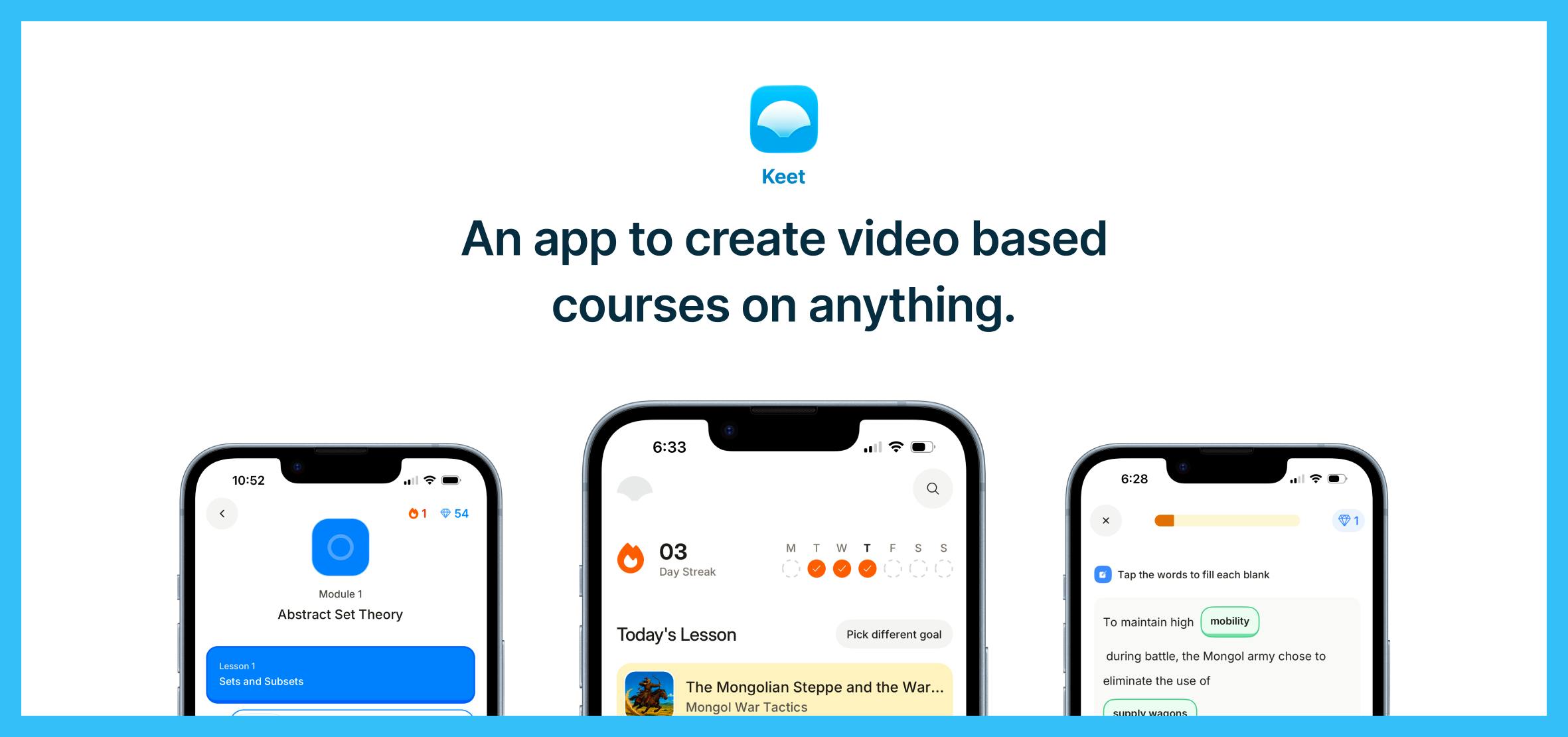
Keet is an iOS app that generates a structured course on a subject chosen by the learner. Its company describes short explainer videos, lessons, quizzes, and games, with controls for depth, complexity, and narration style. It targets people who want more guidance than a collection of YouTube videos or an AI chat provides, particularly when exploring niche interests. trykeet
The strongest positive signal is execution, not commercial traction. Keet has a live product site and App Store listing, two identifiable founders, and a relatively specific approach to sequencing and presenting AI-generated lessons. Y Combinator lists the company as active with a two-person team. ycombinator
The central concern is that public evidence stops close to launch. Product Hunt displayed 102 points and a #12 daily rank when checked, while the indexed US App Store listing showed four ratings. Neither establishes repeat learning, paid conversion, educational outcomes, or sustainable acquisition. Revenue, retention, generation costs, and fundraising terms are not publicly disclosed. trykeet
Keet also faces an unusually demanding consumer-learning test: users must both want a course and continue taking it after the novelty of generating one wears off. Its current differentiation could improve that experience, but no public evidence yet shows that it creates a durable advantage over free content or larger learning platforms.
Decision: Watch. The product warrants post-launch observation, but the present record does not justify formal investment diligence. Its product promise, company execution, venture potential, and investment price are separate questions; only the first two have meaningful public support.
Product Overview
Keet addresses a recognizable problem: self-directed learners can find explanations easily but must assemble their own curriculum and check whether they understand it. A user chooses a topic and course preferences; Keet presents a roadmap of modules and lessons with videos and assessments. The founders say their video workflows use Manim for mathematical visualizations and Remotion for other animated explanations. These are company-reported implementation details, not an independent assessment of lesson accuracy. trykeet
The initial customer is an English-speaking, iPhone-using adult who repeatedly explores topics outside formal study. The immediate alternative is a self-assembled mix of YouTube, books, web search, and AI chat. Keet’s potential benefit is less time spent planning and a more coherent path through unfamiliar material. The official site offers two free courses and says additional generations require credits, but publishes no credit price. It advertises iOS, not Android or a web learning app. trykeet
Founder and Team Assessment
Y Combinator identifies Zack Ashen as CEO and Tommy Tsai as CPO, describes both as Cornell computer-science graduates, and lists two team members. Their public profiles show Ashen’s software-engineering internships at PayPal and other firms and Tsai’s product internships at Microsoft and Intapp. These profiles support relevant technical and product capability, but they do not establish education-sector expertise, commercial leadership, previous exits, or current full-time commitment. ycombinator
A material context point is the pivot. Y Combinator’s earlier Keet launch described APIs for connecting developers to websites, whereas its current profile describes a course-generating app. The change is not inherently negative, but investors should ask what was learned from the first market and how long the education product has been tested. A two-person team also creates key-person and content-quality-review risk. ycombinator
Founder Assessment: Credible technical and product-building background; education-market expertise and commercial execution remain unproven.
Market Opportunity
The narrow starting segment is adults willing to pay for personalized, self-paced courses on subjects they pursue for interest rather than credentials. Keet’s own examples include mathematics, physics, history, and engineering; those examples demonstrate breadth of possible content, not the size of a paying market. trykeet
A useful bottom-up scenario, not a market-size estimate, is 1 million paying learners spending $120 annually: $120 million in consumer spend before platform fees. Neither the number of reachable paying learners nor $120 annual spend is verified for Keet. At 100,000 such learners, the same assumptions yield $12 million. The gap illustrates why willingness to pay, repeat course creation, and acquisition cost matter more than a broad “education market” label.
Expansion into exam preparation, professional development, team training, or institutional learning could increase revenue per customer. Each would require additional proof—such as dependable subject accuracy, measurable outcomes, administrative controls, or sales capability. Consumer learning can cross borders, but language quality, curricula, and payment behavior would need validation market by market. Keet has not publicly demonstrated those expansions. trykeet
Traction and Growth Signals
Product Hunt showed 102 points, 80 followers, and a #12 daily rank when checked. Its maker discussion describes the new app, while an indexed US App Store result showed a 5.0 rating from just four ratings. These are small, early attention and availability signals—not evidence of product-market fit or a reliable satisfaction measure. producthunt
The founders discussed a TestFlight beta in an August 2026 Launch HN post. That post offered three free generations and proposed a future subscription with credits; the current official site instead says two free courses followed by credit purchases. The likely explanation is a changed launch offer, but the current website is the better source for today’s stated terms. The founders also acknowledged slow course generation and early personalization in the beta post. trykeet
No reliable public figures were found for active or paying users, revenue, growth, course completion, renewal, conversion, downloads, or sustained post-launch acquisition. Traction Assessment: A launched product with modest attention, but commercially unverified.
Competitive Position
Keet competes directly for learning time with established course and learning apps, indirectly with AI course-generation tools, and most sharply on price with free YouTube and AI-assisted self-study. Coursebox, for example, already markets prompt-to-course generation with videos and quizzes, although its authoring-oriented customer and workflow differ from Keet’s learner-first app. Canva also offers an AI course-creation tool for educators. coursebox
Keet’s present distinction is the combination of an on-demand curriculum, short generated videos, and interactive reinforcement in a consumer app. There is no verified proprietary content library, exclusive distribution, learning-outcome dataset, or meaningful switching cost. The founders describe a learner prerequisite map as a future ambition, not a current moat. trykeet
If a large learning or AI platform launched equivalent courses within six months, customers would need a reason to stay—demonstrably better teaching, trusted accuracy, and a learning record that improves personalization over time. None is yet publicly established. Defensibility Assessment: Low.
Business Model and Economics
The current site describes free introductory generations and paid credits, without a published price or verified paid-customer count. The founders previously proposed a subscription that grants credits; investors should verify whether that plan still applies. Annual revenue per customer, renewal behavior, discounts, and expansion revenue are therefore unknown. No enterprise, affiliate, or transaction revenue is publicly substantiated. trykeet
Course creation entails AI work, video rendering, storage, and delivery. The founders reported using rendering presets to make production less expensive, but disclosed no per-course cost or gross margin. A critical test is whether repeat usage produces enough paid credit revenue to cover generation and support costs—not merely whether existing courses can be replayed cheaply. news.ycombinator
Distribution through iOS also affects unit economics. Apple advertises a 15% commission for qualifying developers in its Small Business Program and a standard 30% commission for larger eligible in-app digital sales; Keet’s eligibility and actual fee mix are unknown. Customer acquisition cost, free-to-paid conversion, repeat course purchases, subscription renewal if introduced, and seasonal churn all require measurement. developer.apple
Unicorn Path
For a consumer app without verified revenue or exceptional retention, assume an illustrative 8× annual net revenue at scale. This is an underwriting assumption, not Keet’s valuation or an observed comparable-company multiple. A $1 billion valuation would then require roughly $125 million in annual revenue.
At a hypothetical $120 in annual consumer spending per payer, and assuming a 30% platform deduction for illustration, Keet would retain about $84 before AI generation, infrastructure, support, and other costs. Reaching $125 million would require roughly 1.5 million paying learners at that spend level. A lower realized price, discounts, churn, or weaker margins would raise the required scale; direct-payment and fee mixes could change it. Keet has disclosed neither its price nor evidence that this acquisition and retention scale is reachable. Apple’s published program terms also mean one fee assumption will not fit every stage or sale. trykeet
A more credible route might require moving beyond individual curiosity courses into recurring, high-value learning: proven outcomes, broader platforms and languages, or institutional contracts with materially higher annual spend. Those are strategic possibilities, not announced businesses. Unicorn Path: Conditional.
Valuation Assessment
Y Combinator identifies Keet as a Summer 2024 company, but the public sources reviewed do not disclose an investment amount, other investors, a subsequent round, a SAFE cap, post-money valuation, or current fundraising status. Keet’s revenue and retention are also undisclosed. Its earlier developer-API positioning makes old financing descriptions especially unsuitable as proxies for the current education business. ycombinator
Duolingo provides evidence that a consumer learning platform can achieve substantial scale—it reported approximately 12.2 million paid subscribers at year-end 2025—but its established scale does not supply a responsible financing multiple for this unvalidated product. Coursebox is a relevant product competitor, not a disclosed transaction comparable here. coursebox
Valuation Attractiveness: Not Assessable. A price judgment requires current ARR or net revenue, growth, cohorts, gross margin and generation costs, burn and runway, cap table, proposed round size and valuation or SAFE cap, ownership, and liquidation terms. No price range can responsibly be inferred from Product Hunt performance.
Key Risks
- Learners may generate a course once but not finish it or return; completion and retention are undisclosed. trykeet
- Willingness to purchase further generations after the free allowance is unverified, while credit pricing remains unpublished. trykeet
- Incorrect explanations or weak assessments could undermine trust; the founders say reinforcement quality still needs improvement. news.ycombinator
- Slow generation may depress activation, as acknowledged in the beta launch discussion. news.ycombinator
- AI, rendering, and delivery costs may rise with usage faster than net receipts; per-course economics are unavailable. news.ycombinator
- Free self-study and competing AI course generators create low switching costs and replication risk. coursebox
- An iOS-only public offering narrows reach and leaves distribution and payment economics partly platform-dependent. trykeet
- A two-person team must simultaneously improve pedagogy, reliability, growth, and commercial operations. ycombinator
Final Assessment
Venture Potential: 43/100
| Category | Score |
|---|---|
| Market Size and Expansion Potential | 13/20 |
| Traction and Growth Evidence | 2/20 |
| Founder and Team | 9/15 |
| Product Strength | 7/10 |
| Distribution Potential | 6/15 |
| Business Model and Economics | 4/10 |
| Defensibility | 2/10 |
| Total | 43/100 |
The strongest elements are a coherent product and identifiable builders. The weakest are absent commercial traction, untested repeat distribution, and no demonstrated moat. The score reflects the evidence available today, not a finding that the product cannot improve.
Evidence Confidence: 37/100
Verified public evidence covers the live site, the App Store listing, named founders, Y Combinator profile, and launch-page activity. Product mechanics and roadmap are largely company-reported. The bottom-up market and unicorn calculations above are explicitly hypothetical. Paying customers, revenue, retention, margins, acquisition costs, funding terms, and valuation remain unavailable; four App Store ratings do not fill those gaps. ycombinator
Final Decision: Watch
Keet is a plausible learning product, but a venture case requires repeat use and profitable monetization at a scale its public record does not yet demonstrate. The conditional unicorn route, low present defensibility, and unassessable price make “Invest” inappropriate; the absence of verified commercial traction makes “DD” premature.
Upgrade Conditions
- Disclose at least six months of cohorts showing course starts, completion, 30-, 90-, and 180-day return rates, and repeat generation.
- Demonstrate sustained paid conversion and meaningful recurring or repeat-purchase revenue beyond launch-driven acquisition.
- Show positive contribution margin per paying learner after generation, delivery, platform fees, and acquisition.
- Validate a differentiated outcome through learner comparisons, credible educational review, or contracts with repeat-paying organizations.
- Provide founder commitment, cap table, financial statements, and actual financing terms for diligence.
Downgrade Conditions
- Course completion or repeat purchase proves persistently weak; cost per generation cannot be covered by realized revenue.
- Major platforms replicate the experience without Keet showing better outcomes or retention.
- Product activity stalls, the founders leave, or material accuracy, privacy, or security problems emerge.
Questions for Further Diligence
- What are current MRR, recognized credit revenue, monthly growth, paying learners, and active learners?
- What share of new users finish a first lesson and course, and what are 30-, 90-, and 180-day retention by acquisition cohort?
- What percentage converts after the two free courses, and how often do payers purchase or generate another course?
- What are current credit prices, discounts, refunds, and realized annual revenue per paying learner?
- What is the fully loaded generation and delivery cost per course, by video type and course length?
- What gross margin remains after AI, rendering, cloud, App Store fees, and customer support?
- Which channels produce retained paying learners, and what are channel-level acquisition costs and payback periods?
- How are lesson accuracy, source rights, assessment quality, and measurable learning outcomes tested?
- What did the company learn from its developer-API business, and when did both founders commit full-time to education?
- What are current burn, runway, team responsibilities, and the next product and platform milestones?
- What financing has closed, who owns the company, and what are the proposed round valuation, terms, and investor rights?
Sources
- Keet on Product Hunt. producthunt
- Keet official website and pricing FAQ. trykeet
- Y Combinator company profile. ycombinator
- Keet US App Store listing. apps.apple
- Founders’ Launch HN discussion. news.ycombinator
- Zack Ashen and Tommy Tsai public profiles. linkedin
- Apple Small Business Program and Duolingo 2025 filing. developer.apple