
Table of Contents
DocsAlot CLI Investment Report
Category: Developer Tools / AI-Readable Documentation
Company Stage: Pre-Seed / Early Commercial
Founder or Founders: Faizan Khan
Headquarters: Montreal, Canada
Funding: No verified financing amount publicly disclosed; founder reports participation in Alchemist Accelerator W37
Business Model: SaaS subscriptions with free tooling and custom enterprise plans
Product Hunt Launch Date: August 9, 2026
Report Date: August 12, 2026
| Investment Metric | Assessment |
|---|---|
| Venture Potential | 62/100 |
| Unicorn Path | Conditional |
| Valuation Attractiveness | Not Assessable |
| Evidence Confidence | 68/100 |
| Final Decision | Watch |
Executive Summary
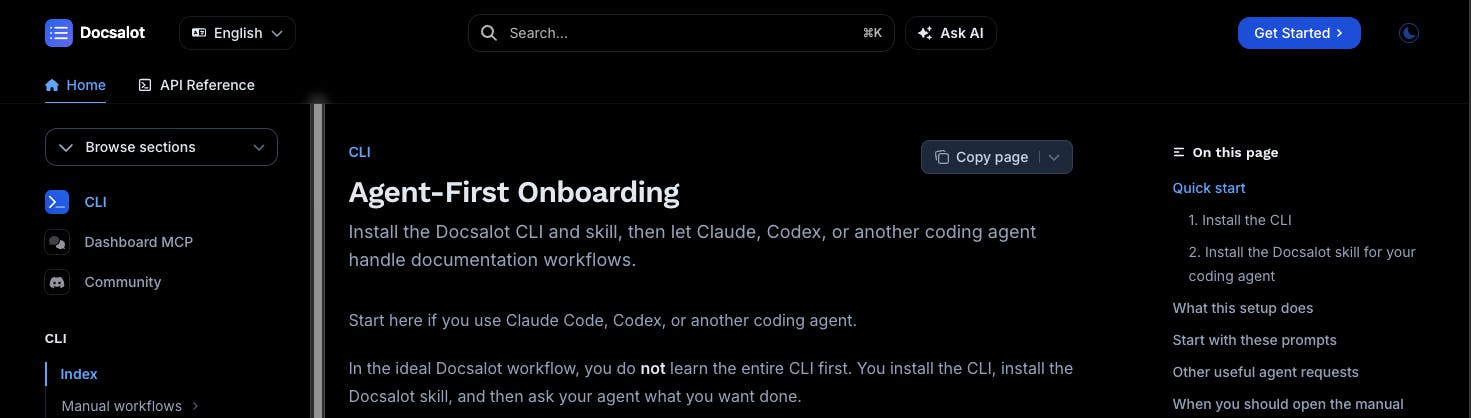
DocsAlot is a documentation platform designed to make product and developer documentation usable by both people and AI agents. DocsAlot CLI extends the platform into the terminal, allowing coding agents such as Claude Code, Codex, and Cursor to create, preview, update, and publish documentation through natural-language instructions.
The product addresses a growing problem in software development. Coding agents increasingly rely on documentation when generating integrations, answering technical questions, and modifying code. Conventional documentation may be readable by developers while remaining difficult for agents to retrieve, navigate, or interpret correctly. DocsAlot attempts to become the source-of-truth and publishing layer for this new “agent-readable” documentation category.
The strongest investment signal is the company’s focused positioning. DocsAlot combines hosted documentation, AI-readable files, a CLI, an agent skill, hosted Model Context Protocol tools, documentation benchmarks, and AI visibility audits. This is more differentiated than a simple AI writing assistant.
The company also shows strong product velocity and technical credibility. Its CLI is distributed through npm, supports interactive and token-based authentication, works in CI environments, and covers the documentation lifecycle from local initialization to publishing. The company has also created a public benchmark covering more than 240 documentation sites, which could become an effective lead-generation and category-creation asset.DocsAlot CLI documentation Benchmark
However, commercial evidence remains limited. Following DocsAlot’s original Product Hunt launch in July 2026, the founder reported 34 signups over two days, approximately 30 created help centers, and no paying customers at that point. Revenue, retention, paid conversion, gross margin, active sites, and enterprise adoption have not been disclosed.Founder’s Reddit post
The final decision is Watch. DocsAlot has a credible product, founder, market thesis, and potential wedge, but it needs evidence of paid adoption and durable retention before formal due diligence is warranted.
Product Overview
DocsAlot CLI gives developers and coding agents a programmatic interface to DocsAlot’s hosted documentation platform.
The CLI supports:
- Creating local documentation projects
- Creating hosted DocsAlot projects
- Pulling existing documentation into local files
- Pushing updates as new versions
- Previewing changes locally
- Publishing approved versions
- Browser-based authentication
- API token authentication for CI pipelines
- JSON output for agents and scripts
- Installing a bundled DocsAlot skill for coding agents
A developer can manually use the CLI, but the primary workflow is agent-driven. The user gives Claude Code, Codex, Cursor, or another coding agent an objective in natural language. The agent reads DocsAlot’s instructions, initializes or updates the documentation, runs a preview, and publishes after human approval.npm CLI documentation
The CLI is part of a broader platform that publishes several documentation surfaces from the same source:
- Hosted documentation sites
- API references
llms.txtskill.md- Hosted MCP search and retrieval tools
- AI help-center widgets
- Documentation visibility audits
- Benchmark reports
This broader platform is strategically important. A standalone CLI would have limited monetization and weak defensibility. A system of record connecting source code, product knowledge, hosted documentation, AI retrieval, and documentation-quality measurement has a more credible venture-scale opportunity.
Pricing
DocsAlot offers three plans:
| Plan | Price | Main Use Case |
|---|---|---|
| Startup | $39 per month | One public documentation site with hosted MCP |
| Team | $99 per month | Production documentation, private docs, custom domains and higher capacity |
| Enterprise | Custom | Migration, SSO, audits, analytics and custom integrations |
Both paid plans include hosted documentation, AI-readable exports, and collaboration without per-seat charges. The Team plan includes 250 AI messages per month and five languages. Enterprise adds services such as documentation migration, SDK maintenance, automated drift checks, security controls, and AI visibility audits.DocsAlot pricing
Founder and Team Assessment
DocsAlot was founded by Faizan Khan. His public professional profile identifies previous experience at Plotly and SafetyWing, a McGill University background, and participation in Alchemist Accelerator’s W37 cohort. These details are primarily founder-reported through LinkedIn rather than independently documented through financing announcements.LinkedIn search profile
The founder demonstrates credible domain engagement. He has published technical articles covering agent-friendly CLIs, MCP, llms.txt, AI-readable documentation, and documentation benchmarks. He also publicly shared launch conversion data, including that the first Product Hunt campaign had not immediately produced paying customers. That transparency is a positive founder signal.DocsAlot blog Reddit
The broader team size is not publicly disclosed. This creates key-person risk across engineering, sales, customer onboarding, documentation services, and support. Enterprise customers will also require confidence in security, uptime, data handling, and long-term product support.
Founder Assessment: Strong technical founder-market fit and category insight, but team depth and commercial execution remain unverified.
Market Opportunity
DocsAlot’s initial market consists of developer-tool companies, API-first startups, SaaS companies, and software teams whose customers use coding agents during onboarding and integration.
The immediate buyer is likely one of the following:
- Developer experience leader
- Product engineering leader
- Technical writer
- Head of documentation
- Support or customer success leader
- Founder of an API-first startup
The market is commercially validated but highly competitive. Mintlify announced a $45 million Series B at a $500 million valuation, while Fern raised a $9 million Series A for its SDK and API documentation platform. Established competitors include GitBook, ReadMe, Docusaurus, Document360, Redocly, and multiple open-source frameworks.Mintlify Fern
DocsAlot’s current pricing creates the following simplified revenue requirements:
“`text
100,000 Team customers × $1,188 annual subscription
= $118.8 million ARR
“`
That customer count is unrealistic for a small documentation platform. The more credible opportunity is moving toward enterprise contracts with higher annual contract values.
For example:
“`text
5,000 enterprise customers × $20,000 ACV
= $100 million ARR
“`
Reaching that level would require DocsAlot to become more than a documentation host. It would need to own AI onboarding analytics, documentation governance, automated drift detection, agent evaluation, and enterprise developer experience.
Traction and Growth Signals
DocsAlot’s original platform launched on Product Hunt on July 5, 2026 and ranked second for the day. The founder reported:
- 638 visitors and 997 pageviews on launch day
- 15 signups on launch day
- 1,196 visitors and 34 signups across two days
- Approximately 30 of 34 signups created help centers
- No paying customers from the launch at the time of the report
This represents a visitor-to-signup conversion rate of approximately 2.8% across the two reported days. The help-center creation rate among signups was strong, but the sample is small and the data is founder-reported.Reddit
DocsAlot CLI subsequently launched on August 9, 2026 and received approximately 120 Product Hunt votes, finishing around fifth for the day according to secondary launch trackers. The CLI documentation states that it is currently used by “at least 20 agents,” although it does not define whether that means 20 installations, active agents, customers, or internal test instances.Product Hunt CLI documentation
Additional positive signals include an actively published blog, a working npm package, a public documentation benchmark, free audit tools, and a third-party technical review. The benchmark has expanded beyond 240 documentation sites, creating a useful proprietary research and distribution asset.Benchmark Independent technical review
Critical missing metrics include:
- ARR and MRR
- Paying customers
- Active documentation sites
- Trial-to-paid conversion
- Customer retention
- Net revenue retention
- MCP request volume
- CLI weekly active usage
- Customer acquisition cost
- Gross margin
- Enterprise pipeline
Traction Assessment: Meaningful product engagement, but paid commercial traction remains unverified.
Competitive Position
DocsAlot competes directly with Mintlify, GitBook, ReadMe, Fern, Document360, and Redocly. It also competes with Docusaurus, MkDocs, custom documentation stacks, and internal GitHub-based workflows.
Its current differentiation includes:
- Documentation designed for both humans and agents
- Hosted MCP retrieval
llms.txtandskill.mdgeneration- CLI and CI workflows designed for coding agents
- AI visibility audits
- Public documentation benchmarks
- Automated documentation maintenance
- Integrated hosted docs and help centers
The public benchmark is a promising distribution wedge. It allows DocsAlot to audit potential customers, generate free value, identify documentation weaknesses, and create outbound sales opportunities. Over time, anonymized benchmark and usage data could help DocsAlot understand which documentation structures produce successful agent outcomes.
However, the moat remains limited. Mintlify, GitBook, ReadMe, and Fern can add agent skills, MCP servers, AI-readability audits, and CLI-based publishing. Coding-agent providers could also make documentation generation and updating a native feature.
DocsAlot will remain defensible only if it becomes the measurement and governance layer for agent onboarding—not merely another place to host documentation.
Defensibility Assessment: Medium-Low
Business Model and Economics
The $39 and $99 monthly plans create accessible entry points but relatively low annual contract values. DocsAlot will need substantial customer volume or successful enterprise expansion to support venture economics.
The core hosting product should have attractive software margins. However, costs may increase through:
- AI help-center messages
- Documentation generation
- Agent evaluation
- Benchmark crawls
- MCP traffic
- Search infrastructure
- Multilingual generation
- Enterprise migration services
- Human documentation and SDK audits
The Enterprise plan includes labor-intensive services such as migration and SDK maintenance. These may improve early revenue but could reduce gross margin if they are not highly automated or separately priced.
The strongest long-term model would combine subscription revenue with usage-based pricing for MCP requests, AI messages, benchmark evaluations, and automated documentation maintenance.
Unicorn Path
Assuming an 8x–10x ARR multiple, DocsAlot would need approximately:
“`text
$100 million ARR at a 10x multiple
$125 million ARR at an 8x multiple
“`
At the current Team price of $1,188 per year, this would require approximately 84,000–105,000 customers.
A more credible route would require enterprise ACVs of $15,000–$50,000 and several thousand customers. DocsAlot would need to expand into:
- Enterprise documentation governance
- Automated documentation drift detection
- AI-agent onboarding analytics
- Agent task-success evaluation
- SDK and API lifecycle management
- Usage-based MCP infrastructure
- Security and compliance controls
- Deep integrations with engineering and support systems
Unicorn Path: Conditional
A billion-dollar outcome is possible only if DocsAlot develops from a small documentation SaaS into an enterprise agent-readiness and developer-experience platform.
Valuation Assessment
No verified funding amount, valuation, SAFE cap, revenue, or round terms are publicly available.
Valuation Attractiveness: Not Assessable
A valuation assessment requires current ARR, growth, retention, gross margin, burn, runway, financing history, round size, valuation cap, and investor ownership.
Key Risks
- Commercial traction remains unverified.
- Mintlify, GitBook, ReadMe, and Fern can replicate AI-readable features.
- Existing pricing produces low ACV.
- Agent-documentation standards may change rapidly.
- Enterprise services could reduce gross margin.
- The company appears highly dependent on one founder.
- Product Hunt distribution has not yet demonstrated paid conversion.
- Benchmarks may generate attention without creating recurring revenue.
- AI agents may increasingly generate documentation without a dedicated platform.
Final Assessment
Venture Potential: 62/100
| Category | Score |
|---|---|
| Market Size and Expansion Potential | 17/20 |
| Traction and Growth Evidence | 9/20 |
| Founder and Team | 11/15 |
| Product Strength | 9/10 |
| Distribution Potential | 8/15 |
| Business Model and Economics | 5/10 |
| Defensibility | 3/10 |
| Total | 62/100 |
DocsAlot has a strong product thesis, credible founder-market fit, and a timely position at the intersection of developer tools and AI agents. Its main weaknesses are limited paid traction, low current ACV, concentrated founder risk, and intense competition.
Evidence Confidence: 68/100
The founder, product, pricing, CLI, npm package, benchmark, and launch conversion data are publicly visible. Funding, revenue, retention, team size, gross margin, burn, runway, customer references, and valuation remain unavailable.
Final Decision: Watch
DocsAlot merits continued monitoring but does not yet justify formal due diligence. The company needs to demonstrate that developers will pay for agent-readable documentation and remain customers after initial setup.
Upgrade Conditions
- At least $500,000–$1 million ARR
- More than 100 paying Team or Enterprise customers
- Six-month gross retention above 80%
- Verified enterprise references
- Gross margin above 70%
- Meaningful weekly CLI or MCP usage
- Enterprise ACV above $10,000
- Repeatable acquisition beyond Product Hunt
Downgrade Conditions
- Continued lack of paid conversion
- Low ongoing usage after documentation setup
- Major competitors commoditize agent-readable documentation
- Enterprise services dominate revenue and reduce margins
- Product development slows materially
- Benchmark traffic fails to produce commercial pipeline
Questions for Further Diligence
- What are current MRR and monthly revenue growth?
- How many paying Startup, Team, and Enterprise customers exist?
- How many documentation sites are active each week?
- What percentage of trials convert to paid subscriptions?
- What are six-month customer and revenue retention?
- How frequently do customers use the CLI after initial setup?
- What are gross margins by plan?
- How much revenue comes from services rather than software?
- Which acquisition channels have produced paying customers?
- What capital has been raised, including accelerator investment?
- What are the current financing terms and valuation expectations?
- What proprietary data or workflow will prevent competitors from replicating the platform?