
Table of Contents
Omniwork Investment Report
Category: Creative AI / Multi-Agent Workflow Software
Company Stage: Pre-Seed / Early Commercial Launch
Founder or Founders: Not publicly disclosed
Headquarters: Not independently verified; one secondary profile lists Singapore
Funding: No verified external funding found
Business Model: Freemium, usage-limited SaaS subscription
Product Hunt Launch Date: August 10, 2026
Report Date: August 12, 2026
| Investment Metric | Assessment |
|---|---|
| Venture Potential | 55/100 |
| Unicorn Path | Conditional |
| Valuation Attractiveness | Not Assessable |
| Evidence Confidence | 48/100 |
| Final Decision | Watch |
Executive Summary
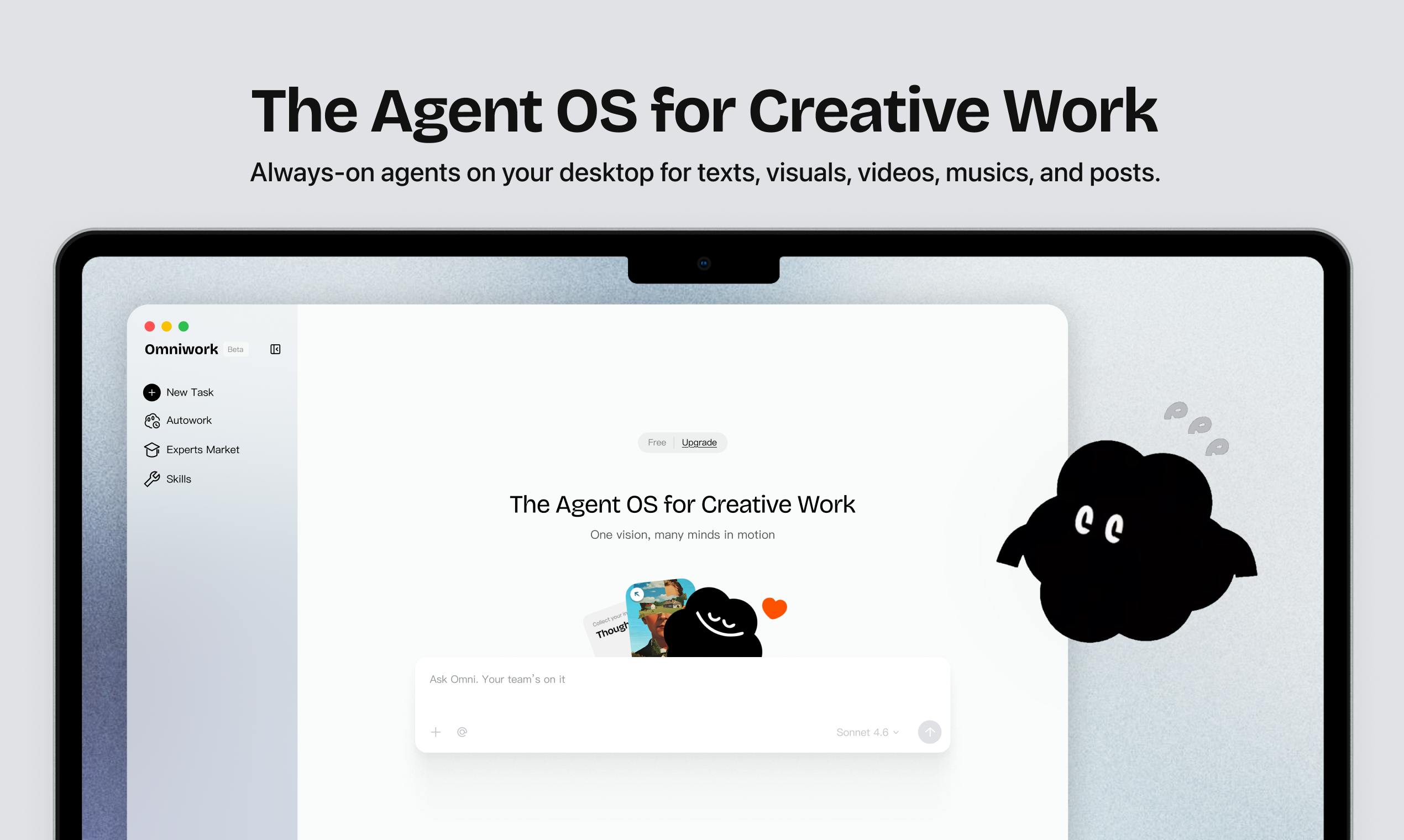
Omniwork is a desktop workspace that uses specialized AI agents to complete creative tasks across writing, images, video, music, social media, trend monitoring, and marketing. Rather than asking users to manage separate AI applications, Omniwork presents itself as a “Creative Agent OS” that can coordinate multiple agents from an initial goal through production and delivery.
The product addresses a real problem. Content creators and marketing teams increasingly use multiple AI tools, but transferring context, brand standards, files, and feedback between those tools creates workflow fragmentation. Omniwork attempts to become the orchestration and memory layer across that process.
Its August 2026 launch finished first on Product Hunt with approximately 400 votes, demonstrating strong launch-day interest but not product-market fit. The company’s website also states that Omniwork is trusted by more than 10,000 teams, but no methodology, customer list, active-user definition, or independent verification is provided. That claim should therefore be treated as company-reported and unverified.Product Hunt Launch ranking Omniwork
The investment opportunity is potentially meaningful because the creative software market supports large outcomes, as demonstrated by Adobe and Canva. Canva now reports $4 billion in annual recurring revenue and 265 million monthly active users while expanding into what it also calls a “Creative Operating System.” This validates the size of the opportunity but creates a major competitive threat for Omniwork.CNBC
Omniwork should remain on a watchlist, but public evidence is not sufficient to begin formal due diligence. The company must verify its team, customer usage, revenue, retention, model costs, and differentiation before it can be evaluated as a venture investment.
Product Overview
Omniwork combines autonomous agents, workflow orchestration, persistent memory, and a desktop companion in one creative workspace.
According to the company, users can provide a creative objective and allow Omniwork to select and coordinate agents to research, create, revise, and deliver the final output. Available agent roles include video editor, music producer, voice actor, growth marketing expert, content analyst, game creator, trend monitor, and social account monitor.Omniwork
Its primary features are:
- More than 100 specialized AI agents
- Multi-agent workflow orchestration
- Persistent memory across agents and projects
- Custom workflows
- Team collaboration
- Social trend and account monitoring
- Image, video, music, and written content generation
- A desktop companion that reports task progress
- Planned marketplace for creator-built agents
The persistent memory and orchestration layer are strategically more important than the number of agents. A library of agent templates is relatively easy to reproduce; workflow data, user preferences, and project history could create higher switching costs if users rely on Omniwork every day.
Pricing
Omniwork currently offers three plans:
| Plan | Price | Primary Offering |
|---|---|---|
| Starter | Free | 100+ agents and five Deep tasks per month |
| Pro | $69 per month | Automated workflows, integrations and collaboration |
| Ultimate | $1,999 per year | Custom AI training, SSO, security and dedicated support |
The pricing page contains a minor inconsistency: the Pro description references approximately 90 Deep tasks per month, while the feature list states more than 30 Deep tasks. This should be clarified before unit economics can be evaluated.Omniwork pricing
The product appears to offer a native Mac download. Availability for Windows was not reliably verified.
Founder and Team Assessment
Omniwork’s founders and executive team are not clearly identified on its official website or Product Hunt profile. No reliable founder biographies, previous companies, fundraising announcements, or investor profiles were located.
One LinkedIn result associates a person identified as “Hao Z.” with an Omniwork CPO role. However, the LinkedIn company page uses the omniwork.io domain and describes an older French intervention-management business, not the omniwork.ai creative product. It should not be treated as a verified company profile.LinkedIn
A secondary startup profile lists Omniwork’s location as Singapore but does not identify the founders or disclose capital raised. The location may be correct, but it remains unverified through a primary source.Startup88
The absence of transparent team information is a material diligence issue. A venture investor needs to know who built the product, whether they are working full-time, what relevant AI or creative-software experience they possess, and whether the company has the technical resources to operate a complex multi-agent platform.
Founder Assessment: Insufficient public evidence to evaluate founder-market fit or execution capability.
Market Opportunity
Omniwork’s initial market consists of professional creators, social media teams, small marketing agencies, e-commerce brands, and internal content teams that already pay for multiple AI and creative applications.
Its immediate value proposition is tool consolidation. At $69 per month, Omniwork could be economically attractive if it replaces several writing, image, video, research, and automation subscriptions. The Ultimate plan’s $1,999 annual price targets organizations that require security, support, and custom training.
The broader opportunity is large and commercially validated. Canva has expanded from simplified design into end-to-end creative workflows and generative AI. Adobe is similarly integrating image, video, audio, partner models, and professional editing into Firefly and Creative Cloud. Adobe’s partnership with Runway demonstrates that established creative platforms are moving toward unified multi-model workflows.CNBC Adobe
A simplified bottom-up scenario illustrates the initial opportunity:
“`text
100,000 Pro customers × $828 annual subscription
= $82.8 million ARR
“`
Alternatively:
“`text
25,000 Ultimate customers × $1,999 annually
= approximately $50 million ARR
“`
These figures are not estimates of current demand. They demonstrate the scale required under existing pricing. The market can support venture-scale revenue, but Omniwork would need substantial global distribution and strong retention.
Traction and Growth Signals
Omniwork finished first in its Product Hunt launch cohort with approximately 400 votes. The launch indicates effective positioning and early interest in creative agents.Launch ranking
The company says it spent approximately one year building the product and claims to serve more than 10,000 teams. However, public evidence does not establish whether these are registered workspaces, active teams, free users, beta testers, or paying customers.
Social content about Omniwork has appeared across Instagram and TikTok, including a TikTok demonstration with significant engagement. This suggests influencer-based distribution may be part of its launch strategy, but it does not establish organic retention or commercial conversion.
The following metrics remain unavailable:
- ARR and MRR
- Paying customer count
- Active team count
- Free-to-paid conversion
- Cohort retention
- Deep-task consumption
- Revenue growth
- Customer acquisition cost
- Customer concentration
- Gross margin
- Enterprise contracts
- Burn and runway
Traction Assessment: Strong launch-day visibility, but commercially unverified.
Competitive Position
Omniwork competes across several overlapping categories.
Direct competitors include multi-agent and workflow platforms such as MindPal, Phygital+, Scade, and Modelize. Creative workflow competitors include Canva, Adobe Firefly, Runway, Magnific, Visla, and Narrato. Users can also assemble an alternative stack using ChatGPT or Claude, Canva, Runway, Midjourney, Zapier, and social-media management tools.Product Hunt alternatives
Omniwork’s differentiation is the combination of:
- Creative specialization
- Agent orchestration
- Persistent cross-project memory
- An always-available desktop interface
- Goal-to-delivery automation
- A planned marketplace for expert-created agents
The largest strategic risk is bundling. Canva describes its expanding platform as a Creative Operating System and already has 265 million monthly active users. Adobe can distribute AI workflows through established professional products and has partnered with model providers such as Runway, Google, OpenAI, ElevenLabs, and Black Forest Labs.
If Canva or Adobe launched equivalent agent orchestration, customers might remain with those platforms because their assets, editing workflows, brand systems, and teams are already there.
Omniwork’s most credible defense would be superior automation across competing creative applications rather than attempting to replace every application. Its planned expert-agent marketplace could eventually create network effects, but the marketplace is not yet presented as a fully operating ecosystem.
Defensibility Assessment: Low to Medium
Business Model and Economics
Omniwork’s freemium model provides an accessible acquisition funnel, while the $69 monthly Pro plan creates a meaningful prosumer price point. The Ultimate plan has an implied annual contract value of $1,999, which remains low for a true enterprise product despite including SSO and dedicated support.
The key economic uncertainty is the cost of Deep tasks. Video, image, music, research, and multi-agent workflows can generate substantial model and infrastructure expenses. Gross margin will depend on:
- Model-provider pricing
- Number of agents invoked per workflow
- Video and image generation volume
- Storage and processing costs
- Failed or repeated generations
- Customer support requirements
- Actual task consumption by paid users
The planned expert marketplace could add commission revenue and improve retention. However, it could also create quality-control, intellectual-property, and revenue-sharing complexity.
The model could become attractive if Omniwork maintains more than 70% gross margin and converts users to annual team plans. It could be structurally weaker if $69 subscribers consume large volumes of expensive generative media.
Unicorn Path
A reasonable long-term multiple for a high-growth creative SaaS platform would be approximately 8x–10x ARR. That implies:
“`text
Required ARR at 10x: $100 million
Required ARR at 8x: $125 million
“`
At the current Pro price of $828 per year, Omniwork would require approximately 121,000–151,000 continuously paying Pro customers.
At the Ultimate price of $1,999 per year, it would require approximately 50,000–63,000 customers. A more credible enterprise strategy would raise ACV to $10,000–$50,000 through governance, brand systems, collaboration, security, and high-volume automation.
A unicorn outcome would require:
- Verified retention among professional teams
- Enterprise rather than primarily individual adoption
- Higher ACV and expansion revenue
- Sustainable generative-media economics
- Cross-platform and third-party creative integrations
- Proprietary workflow or preference data
- A functioning expert-agent marketplace
- Distribution beyond Product Hunt and paid influencer campaigns
Unicorn Path: Conditional
The market supports billion-dollar companies, but Omniwork has not yet demonstrated the commercial traction or defensibility required for that outcome.
Valuation Assessment
No reliable public information was found regarding funding, investors, revenue, SAFE terms, or current valuation.
Valuation Attractiveness: Not Assessable
A responsible valuation would require current ARR, growth, gross margin, retention, paid conversion, burn, runway, round size, valuation cap, and liquidation terms. Product Hunt performance and the company-reported 10,000-team claim are insufficient to establish a valuation.
Key Risks
- Unverified founder and team identity
- No verified revenue, retention, or active-customer data
- Direct competition from Canva, Adobe, and Runway
- Potentially high generative-media costs
- Low switching costs if workflows remain simple
- Product breadth may reduce output quality
- Dependence on third-party foundation models
- Unverified “10,000+ teams” marketing claim
- Planned marketplace has not yet demonstrated network effects
- Security and privacy requirements for persistent creative memory
Final Assessment
Venture Potential: 55/100
| Category | Score |
|---|---|
| Market Size and Expansion Potential | 18/20 |
| Traction and Growth Evidence | 8/20 |
| Founder and Team | 4/15 |
| Product Strength | 8/10 |
| Distribution Potential | 7/15 |
| Business Model and Economics | 6/10 |
| Defensibility | 4/10 |
| Total | 55/100 |
Omniwork has a strong product concept, credible pricing, and a large addressable market. Its weaknesses are limited company transparency, unverified commercial traction, uncertain unit economics, and powerful incumbent competition.
Evidence Confidence: 48/100
Product capabilities, pricing, launch ranking, and website claims are publicly visible. Founder identity, corporate ownership, funding, revenue, retention, customer activity, gross margin, and valuation remain unavailable or unverified.
Final Decision: Watch
Omniwork is too early and insufficiently transparent for formal due diligence. It should be monitored because the product is ambitious and the market is large, but the current evidence does not establish a venture-grade company.
Upgrade Conditions
- Verified founders and full-time team
- At least $1 million ARR
- More than 70% six-month paid retention
- Gross margin above 70%
- Verified enterprise customers
- Clear organic acquisition channels
- Evidence that workflow memory creates retention
- Enterprise ACV above the current $1,999 plan
Downgrade Conditions
- The 10,000-team claim cannot be substantiated
- Low paid conversion or rapid churn
- Deep-task costs produce weak gross margins
- Product development becomes inactive
- Canva or Adobe replicates the core workflow
- Material privacy or intellectual-property concerns emerge
Questions for Further Diligence
- Who founded Omniwork, and who currently works full-time on it?
- What does “10,000+ teams” mean: registered, active, or paying?
- What are current MRR, growth, and paid customer count?
- What are 30-day, 90-day, and six-month retention rates?
- What is the average model and infrastructure cost per Deep task?
- What is gross margin by subscription tier?
- Which acquisition channels generated the first 10,000 teams?
- Which third-party models and creative applications does Omniwork use?
- How is customer content stored, and is it used for model training?
- What is the current fundraising valuation and round structure?
- How will the expert marketplace manage quality and intellectual property?
- Why will users choose Omniwork if Canva or Adobe offers similar orchestration?