
Table of Contents
Toone Investment Report
Category: Local-first AI-agent workflow and automation software
Company Stage: Early access / private beta
Founder or Founders: Matheus Paranhos; no additional founders publicly verified
Headquarters: Not publicly disclosed; founder’s public GitHub profile lists Portugal
Funding: No reliable public funding information found
Business Model: Not publicly disclosed; bring-your-own-model-provider software, with access currently invitation-based
Product Hunt Launch Date: March 25, 2026
Report Date: September 22, 2026
| Investment Metric | Assessment |
|---|---|
| Venture Potential | 55/100 |
| Unicorn Path | Conditional |
| Valuation Attractiveness | Not Assessable |
| Evidence Confidence | 49/100 |
| Final Decision | Watch |
Executive Summary
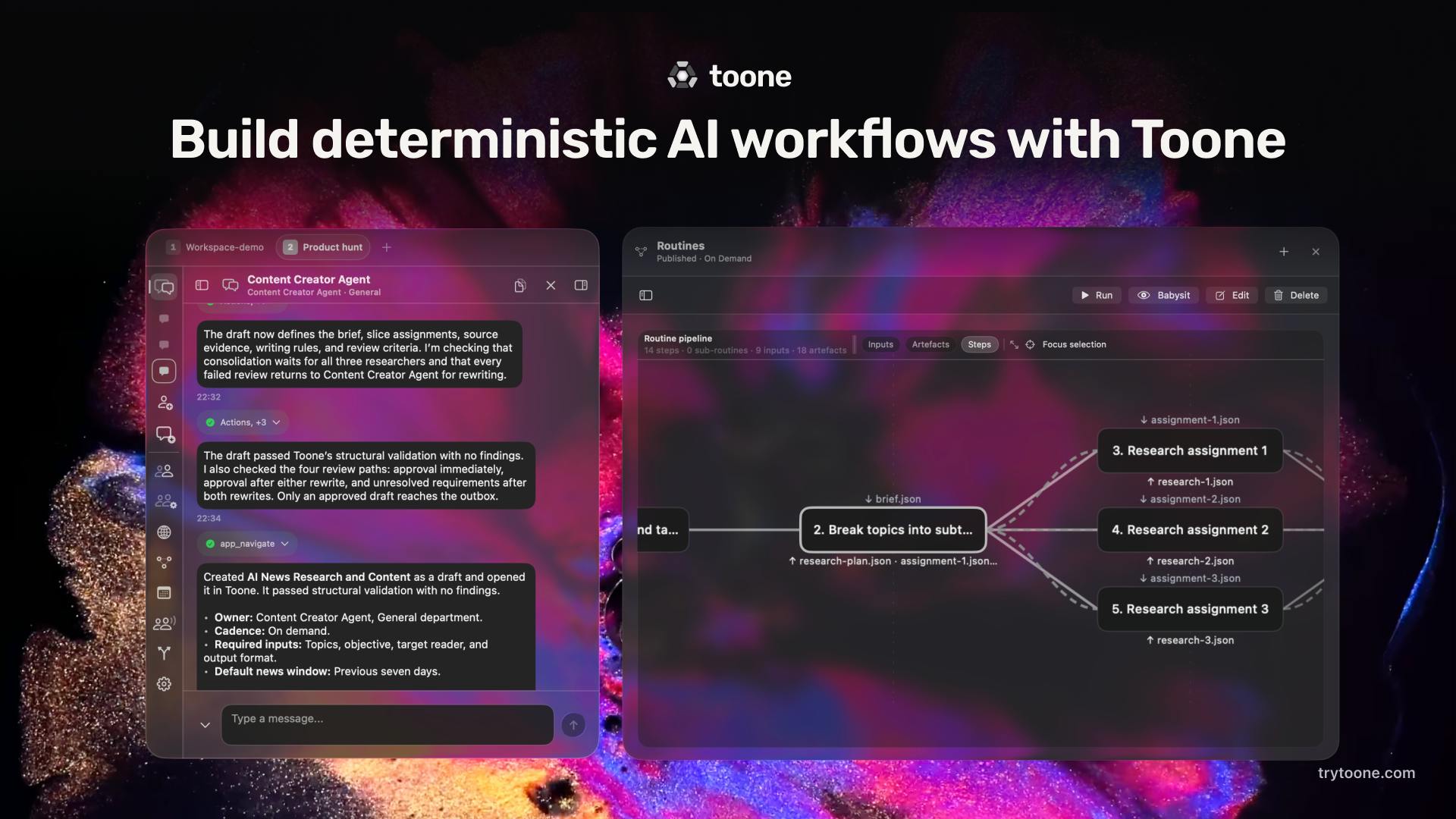
Toone is a native macOS workspace for creating and operating teams of specialized AI agents. Users define agents, give them roles and permissions, organize them into projects, and convert recurring work into natural-language routines. Toone emphasizes observable execution: users can inspect individual steps, pause a run, correct a failure, edit the routine and resume it rather than restarting the workflow (official website, release history).
The initial target customer appears to be a technically capable professional or small business already paying for OpenAI or Anthropic access but seeking a more structured way to manage recurring agent work. The product runs on the user’s Mac, stores project context locally and sends model requests directly to the selected AI provider, according to Toone’s privacy policy (privacy policy). This local-first architecture is a credible product differentiator for privacy-conscious users.
The strongest positive signal is product execution. Toone’s public repository shows an actively maintained project, while the private desktop application reached version 1.0.76 by September 18, 2026. Recent releases added pause-and-resume controls, failure recovery, editable in-progress routines and better multi-agent thread handling (GitHub releases). That demonstrates shipping velocity and attention to real agent-orchestration failure modes.
The central concern is commercial validation. Pricing is not publicly disclosed, public registration and installer distribution are closed, and no verified revenue, paying-customer count, retention, active usage or independent customer references are available. The company reports two deployments, but one is associated with an organization in which the founder is involved, weakening its value as independent validation (showcases, founder profile).
Toone could become a meaningful vertical operating layer for local and governed agents, but its current macOS-only, invitation-based footprint and dependence on model-provider platforms constrain distribution. The final decision is Watch until paid demand, sustained retention, team usage and a scalable monetization model are verified.
Product Overview
Toone addresses the gap between conversational AI and repeatable operational workflows. General-purpose AI chats can help with individual tasks, but project context, approvals, role separation and failure recovery are often assembled manually. Toone packages those functions into a persistent desktop workspace.
Its core product elements include:
- Specialized agents with defined responsibilities;
- Projects containing agents, routines, tools, files and accumulated context;
- Natural-language creation of recurring workflows;
- Step-level inspection and debugging;
- Pause, resume, cancel and mid-run editing controls;
- Approval points for sensitive actions;
- Voice interaction, meeting recording, speaker labeling and next-action extraction;
- An Explore catalog for reusable routines and bundles (product site, user guide).
The product requires macOS 14 or later, an OpenAI or Anthropic account, and an online Mac while routines execute. The desktop application is currently available in English and access is distributed in small invitation batches (early-access page). The public GitHub repository contains the website and product documentation; the desktop application itself is proprietary and maintained separately (GitHub repository).
Pricing is not publicly disclosed. Toone states that users bring their own OpenAI or Anthropic subscription and that it does not sell a separate model plan, but that does not establish whether Toone access is currently or eventually paid (official FAQ). Consequently, willingness to pay and the product’s revenue model remain unverified.
Product Quality Assessment: Promising architecture and unusually thoughtful workflow-recovery controls, but independent testing, reliability benchmarks and broad availability are missing.
Founder and Team Assessment
The publicly identifiable maker is Matheus Paranhos. His LinkedIn profile describes him as founder of Hexagonal.io and a senior software engineer focused on agentic AI, with more than six years of software-engineering experience (LinkedIn). His GitHub account identifies him with Hexagonal.io and places him in Portugal (GitHub profile).
Hexagonal.io presents itself as a software-development business offering web, mobile, backend and AI-automation services, as well as proprietary products available for licensing or partnership (Hexagonal.io). Toone’s company page states that the product is published by Hexagonal.io, but it does not identify a separate legal entity, employee count, executive team or board (Toone company page).
The public Toone repository has one visible contributor, Paranhos’s mattwebhub account, with 176 recorded contributions at the time reviewed. The repository had 14 stars and no forks, although these figures concern the public website rather than the proprietary application (GitHub API, contributors). No current job openings or verifiable hiring program were found.
Paranhos appears technically capable and closely involved in implementation. Commercial leadership, enterprise sales experience, previous exits and ability to recruit a broader team are not publicly verified. Hexagonal.io’s continuing services positioning also creates a question about whether Toone is the founder’s exclusive full-time focus.
Founder Assessment: Strong hands-on technical execution, but team depth, commercial capability and exclusive commitment remain unproven.
Market Opportunity
The narrow initial segment is macOS-based professionals and small teams that already use advanced AI tools and want repeatable, inspectable multi-agent workflows. Likely use cases include research, product development, software engineering, content operations and internal reporting.
Customer willingness to pay is not established. Adjacent products show that professional AI workflow software can support meaningful subscription pricing: Lindy lists plans from $29.99 to $199.99 per user per month, while Relevance AI targets companies through an enterprise AI-workforce offering (Lindy pricing, Relevance AI). These are market references, not evidence that Toone can charge comparable prices.
A bottom-up scenario illustrates the challenge. At an assumed—not actual—price of $20 per user per month, 100,000 paying users would generate approximately $24 million ARR; 500,000 would generate $120 million ARR. The first outcome could support a substantial software company, while the second would require mass-market distribution far beyond an invitation-only macOS application.
More credible expansion opportunities include Windows and web access, multi-user team administration, enterprise governance, paid routine templates, deployment infrastructure and APIs. Geographical reach is potentially global because the product connects to broadly available model providers, although its English-only application currently limits accessibility.
The market can support venture-scale revenue, but Toone has not demonstrated that its particular desktop-centric product can capture it.
Traction and Growth Signals
Toone launched on Product Hunt on March 25, 2026. Product Hunt’s indexed page reports 106 votes and five comments, while its daily leaderboard placed Toone ninth (Product Hunt, daily leaderboard). This is evidence of early interest only.
More substantive product signals include:
- Version 1.0.76 released on September 18, 2026;
- 76 numbered releases visible in the release history;
- Continued public repository activity through September 22, 2026;
- A live invitation, authentication and download system;
- Published documentation, privacy disclosures and reusable routines (releases, repository data).
Toone reports a Truleaf deployment with three organizations, 21 departments and 107 production routines, plus a micoo design-partner deployment with one organization, seven departments and 38 production routines as of July 2026 (showcases). These numbers are company-reported and do not establish paid contracts. Truleaf is also listed in Paranhos’s professional profile, making it a founder-affiliated deployment rather than a fully independent reference.
Revenue, registrations, invitations issued, weekly active users, paying users, workflow volume, retention and customer outcomes are not publicly disclosed.
Traction Assessment: Strong product activity but commercially unverified.
Competitive Position
Direct competitors include agent-workforce platforms such as Lindy and Relevance AI, plus workflow automation software such as n8n. Lindy combines scheduled routines, persistent context, approvals and integrations; Relevance AI offers enterprise controls, evaluations and more than 2,000 integrations; n8n offers hosted and self-hosted workflow automation with execution history and enterprise administration (Lindy, Relevance AI, n8n).
Indirect competition is increasingly significant. Anthropic’s Claude Code supports local project context, multiple agent sessions, scheduled routines and an Agent SDK across desktop, terminal and web surfaces (Anthropic documentation). OpenAI provides workflow agents and an Agents SDK, reducing the technical difficulty of creating similar orchestration products (OpenAI).
Toone differentiates through its local-first project structure, natural-language routines, specialist-agent organization and human-readable recovery process. However, the application relies on OpenAI and Anthropic access, so its suppliers are also potential competitors.
If either model provider launched equivalent local projects, multi-agent routines and visual recovery controls within six months, customers would remain only if Toone offered superior cross-provider portability, domain-specific routines, organizational memory or governance. Those advantages are plausible but not yet demonstrated at scale.
Defensibility Assessment: Low to Medium
Business Model and Economics
No paid Toone plan, enterprise contract or usage price is publicly listed. The likely future models are per-user subscriptions, team workspace fees, enterprise licensing or paid routine/template distribution, but these are analyst possibilities rather than announced plans.
The bring-your-own-provider architecture may reduce Toone’s direct inference burden because requests travel from the user’s device to the chosen provider. Users, however, must pay both the provider and any future Toone fee, potentially constraining willingness to pay. Local execution also reduces Toone’s cloud costs but requires the customer’s Mac to remain online.
Potential variable costs include account services, encrypted relay infrastructure, software distribution, support and payment processing. Gross margin, customer-acquisition cost, support cost and renewal behavior are unknown. A desktop application sold directly could avoid App Store commissions, but the distribution and payment mechanism has not been disclosed.
Enterprise monetization would require centralized administration, deployment controls, auditability, service commitments and independently verified security. Public materials describe permissions and local data handling, but no security certification or third-party audit was found.
Unicorn Path
An illustrative 8× ARR multiple is appropriate for scenario analysis because Toone would be a subscription-software company but currently lacks verified growth, margins or enterprise traction.
Required ARR = $1 billion ÷ 8 = approximately $125 million.
At an assumed $240 annual subscription, Toone would require approximately 520,000 paying users. At an assumed $12,000 annual team contract, it would require approximately 10,400 customers. Both prices are analytical assumptions because Toone has not published pricing.
A blended path could combine individual subscriptions, team contracts and enterprise licensing. Reaching that scale would require:
- Public self-service distribution;
- Windows, web or cloud expansion;
- Verified team collaboration and administration;
- Repeatable acquisition beyond launch communities;
- Strong paid retention;
- Enterprise security and governance;
- A larger engineering and commercial organization;
- Proprietary workflow data, templates or integrations that increase switching costs.
The current product can seed such a platform, but the existing invitation-only macOS model is insufficient by itself.
Unicorn Path: Conditional
Valuation Assessment
No reliable financing announcement, investor, round size, SAFE cap, valuation or acquisition offer was found. Revenue and current fundraising status are also not publicly disclosed.
Valuation Attractiveness: Not Assessable
Assessment would require current ARR, growth, retention, gross margin, cash burn, runway, cap table, financing target, valuation, option pool, liquidation preferences and founder ownership.
Key Risks
- No verified monetization or commercial traction.
- Platform competition from OpenAI and Anthropic.
- macOS-only distribution and invitation-gated access.
- Single-founder and key-person concentration.
- Unverified demand outside founder-affiliated deployments.
- Low switching costs unless routines and project context become deeply embedded.
- Unclear willingness to pay on top of model-provider subscriptions.
- Security exposure from agents accessing files, tools and sensitive workflows.
- Service-business distraction through Hexagonal.io.
- Limited enterprise readiness and no verified compliance certifications.
Final Assessment
Venture Potential: 55/100
| Category | Score |
|---|---|
| Market Size and Expansion Potential | 16/20 |
| Traction and Growth Evidence | 7/20 |
| Founder and Team | 9/15 |
| Product Strength | 8/10 |
| Distribution Potential | 7/15 |
| Business Model and Economics | 4/10 |
| Defensibility | 4/10 |
| Total | 55/100 |
Product execution and market relevance are the strongest elements. Commercial traction, monetization, distribution and defensibility are the weakest.
Evidence Confidence: 49/100
The product architecture, release activity, founder identity, access conditions and reported deployment structure are documented. Deployment metrics are company-reported, while founder background is supported mainly by self-reported professional profiles. Revenue, retention, customer count, funding, team size, margins and valuation remain unavailable.
Final Decision: Watch
Toone is too early for formal due diligence. Its product has credible technical substance, but there is insufficient evidence of an independent, scalable company rather than a technically sophisticated founder-led product.
Upgrade Conditions
- Publish pricing and demonstrate at least 500 paying users or meaningful contracted team revenue.
- Show more than 70% six-month paid-customer retention.
- Produce three or more independent, referenceable business customers.
- Demonstrate repeatable acquisition outside Product Hunt and founder networks.
- Launch team administration and a non-macOS access path.
- Verify strong gross margins and limited support burden.
- Establish a full-time team and clear corporate structure.
- Demonstrate durable cross-provider workflow portability.
Downgrade Conditions
- Public access remains closed without measurable adoption.
- Product releases materially slow or stop.
- Early users fail to convert to paid plans.
- Model providers replicate the core workflow experience.
- Founder attention shifts primarily to services or another project.
- Material security, permission or privacy incidents occur.
- Reported deployments or adoption claims prove misleading.
Questions for Further Diligence
- How many invitations, activated accounts, WAUs and paying users does Toone have?
- What are 30-, 90- and 180-day retention by cohort?
- What percentage of activated users run a routine weekly?
- Are Truleaf and micoo paying customers, design partners or internal deployments?
- What pricing model is planned, and what willingness-to-pay tests have been conducted?
- What are average workflow frequency, completion rate and human-intervention rate?
- What is the planned Windows, web or cloud roadmap?
- What are current monthly burn, runway and founder cash investment?
- Is Matheus Paranhos working full-time on Toone, and who else maintains the proprietary app?
- What legal entity owns the product and intellectual property?
- What are the cap table, financing target, valuation and proposed round terms?
- How will Toone remain differentiated if model providers bundle equivalent routines and agent orchestration?