
Table of Contents
Unsloth Desktop Investment Report
Category: Open-source AI infrastructure / local model training and inference
Company Stage: Early-stage, YC-backed; precise financing stage not publicly verified
Founder or Founders: Daniel Han and Michael Han
Headquarters: San Francisco, California, United States
Funding: Amount not reliably verified. Third-party databases report approximately $500,000–$540,000, while YC, M12 and Lightspeed publicly identify Unsloth as a portfolio company.
Business Model: Open-source distribution with contact-sales Pro and Enterprise plans
Product Hunt Launch Date: August 12, 2026
Report Date: August 15, 2026
| Investment Metric | Assessment |
|---|---|
| Venture Potential | 78/100 |
| Unicorn Path | Conditional |
| Valuation Attractiveness | Not Assessable |
| Evidence Confidence | 64/100 |
| Final Decision | DD |
Executive Summary
Unsloth Desktop is a free, open-source application for running, fine-tuning and deploying AI models on local hardware. It supports macOS, Windows and Linux, spanning language, diffusion, image, video and audio models. Its purpose is to make workflows that normally require command-line tools, notebooks and hardware-specific configuration accessible through a desktop interface (official documentation).
The product is built on an unusually strong open-source foundation. The main GitHub repository had approximately 71,500 stars and 6,400 forks as of the report date, with code pushed on August 15, 2026. The company’s Hugging Face organization hosts approximately 1,446 models and 37 collections. These signals establish meaningful developer awareness and distribution, although they do not establish paid adoption.
The strongest investment signal is Unsloth’s position in the workflow before and around model deployment: optimization, fine-tuning, quantization, local inference and model distribution. The company is not starting from a single desktop launch; Desktop extends an established developer brand and makes its technical stack accessible to less specialized users.
The central concern is commercialization. Desktop is free, while prices for Unsloth Pro and Enterprise are not published. Revenue, customer count, retention, conversion, contract value and gross margin are all not publicly disclosed. Unsloth must show that open-source popularity converts into durable enterprise contracts rather than primarily supporting a free developer community.
The appropriate decision is DD. Product and distribution evidence justify formal diligence, but an investment decision cannot be made without commercial metrics, current financing terms and validation of the company’s benchmark claims.
Product Overview
Local AI workflows remain fragmented. Users often combine tools such as llama.cpp, Ollama, notebooks, model repositories and separate interfaces for inference, fine-tuning and media generation. Hardware compatibility and memory constraints create additional friction.
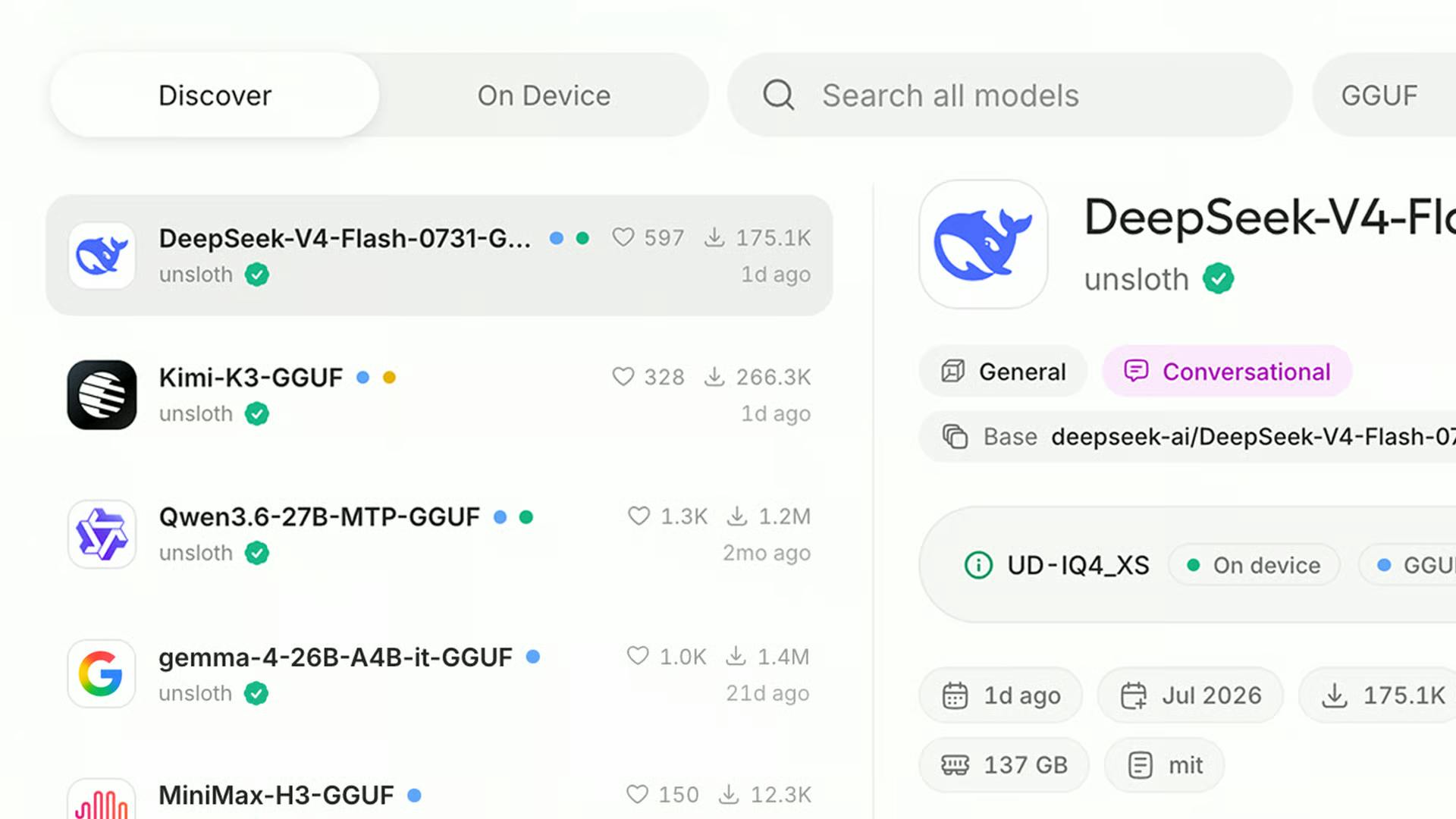
Unsloth Desktop packages these workflows into a Tauri-based application. Users can select and download models, chat locally, fine-tune models without code, generate images or video, connect local models to coding agents, expose an OpenAI-compatible API and deploy remote access through Cloudflare HTTPS (Desktop documentation).
The product serves individual AI developers, researchers, technical enthusiasts and smaller teams that want local control, privacy or reduced dependence on hosted inference. It supports CPU environments and NVIDIA, AMD, Intel and Apple hardware, although the documentation cautions that older hardware may not be well supported.
Desktop is free and Apache-2.0 licensed through the GitHub repository. The broader company offers:
- Free: Open-source, single-GPU model support.
- Pro: Multi-GPU support and additional performance features; price available only through sales contact.
- Enterprise: Multi-node and full-training capabilities, customer support and additional optimization; price not published.
These tiers and their company-reported performance claims are shown on the official pricing page.
Product quality appears high for a beta, particularly in breadth, operating-system support and time-to-first-use. However, early community testing identified opaque error handling, failed video-generation workflows, incomplete advanced controls and performance inconsistencies. The founders responded rapidly and reported implementing several requested fixes in subsequent releases (Reddit launch discussion).
Product Quality Assessment: Technically ambitious and differentiated, but still beta-quality across a broad hardware and model matrix.
Founder and Team Assessment
Unsloth identifies two brothers as its founding team: Daniel Han, focused on software, data and algorithms, and Michael Han, focused on design, product and engineering (official team page). Public product activity demonstrates substantial technical capability: custom training optimizations, frequent model support, cross-platform packaging and direct engagement with technical users.
The company is backed by Y Combinator, and Unsloth also appears in the portfolios of M12 and Lightspeed. Public job listings indicate hiring for technical positions, but current headcount and organizational structure are not reliably disclosed.
No verified previous founder exits were found. Commercial leadership, enterprise sales experience and the division of responsibilities beyond the two founders remain unclear. The visible pace of founder-led product support is positive, but it also creates key-person and execution risks if the team remains small.
Founder Assessment: Strong technical founder-market fit and execution; enterprise commercialization and organizational scalability remain unproven.
Market Opportunity
The initial commercial segment is AI-development organizations that fine-tune or run open models and need to reduce GPU memory, training time or infrastructure complexity. Likely buyers include AI startups, research teams, model-development consultancies and enterprise machine-learning groups.
A defensible market calculation cannot be produced from verified customer and pricing data. An illustrative bottom-up scenario is:
- 10,000–50,000 addressable AI-development organizations
- $20,000–$100,000 annual contract value
- Implied annual revenue pool: $200 million–$5 billion
These are analyst assumptions, not verified Unsloth pricing or customer counts. The wide range reflects uncertainty over whether Unsloth becomes a departmental tool or mission-critical enterprise infrastructure.
Expansion opportunities include managed training, enterprise deployment, model optimization APIs, support contracts, governance and private model registries. International reach is structurally possible because the product is open-source and distributed online.
Market timing is favorable: open-weight models are improving, organizations are seeking alternatives to exclusively hosted APIs, and hardware cost makes training efficiency economically relevant. The market is large enough for venture outcomes, but willingness to pay for Unsloth rather than free underlying frameworks requires validation.
Traction and Growth Signals
Verified or directly observable signals include:
- Approximately 71,500 GitHub stars, 6,400 forks and 1,178 open issues, with active code updates as of August 15, 2026 (GitHub).
- Approximately 1,446 public models and 37 model collections on Hugging Face.
- The latest GitHub release was published August 14, 2026, indicating rapid post-launch iteration (releases).
- The launch announcement generated substantial engagement in the LocalLLaMA community, including more than 1,200 Reddit points and hundreds of comments at observation time (Reddit).
- Unsloth Desktop ranked approximately fifth on Product Hunt’s August 12 leaderboard. Product Hunt pages show some inconsistent fourth/fifth-place references, so this should be treated only as launch attention (Product Hunt).
YC states that Unsloth has more than 10 million monthly model downloads, but this is a company-reported ecosystem metric, not an independently audited count and not necessarily attributable to Desktop (YC profile).
Revenue, paid customers, Desktop active installations, paid conversion, retention and enterprise references are not publicly disclosed.
Traction Assessment: Strong open-source and developer adoption, but commercially unverified.
Competitive Position
Direct competitors include LM Studio, Ollama, Jan, Open WebUI and model-training interfaces. Indirect alternatives include Hugging Face libraries, llama.cpp, PyTorch, Axolotl, cloud notebooks and managed platforms from major cloud providers. Advanced users can assemble a free stack from these components.
Unsloth’s differentiation is the combination of training optimization and an integrated local interface. Its model catalog, quantization work, fine-tuning workflows and existing developer brand are stronger advantages than the desktop UI alone.
Switching costs are currently moderate to low. Models and common APIs are portable, while much of the stack depends on external projects such as llama.cpp, PyTorch and Hugging Face. The Apache license also permits competitors to reuse available code.
If a major platform launched equivalent desktop functionality, customers might remain because of Unsloth’s optimization kernels, rapid support for new models and established model-distribution ecosystem. That answer is credible but incomplete: sustained advantage requires proprietary enterprise tooling, superior performance or deep workflow integration.
Defensibility Assessment: Medium
Business Model and Economics
Desktop is currently free. Monetization appears to come from Pro and Enterprise versions offering multi-GPU, multi-node, full-training and support capabilities (pricing). No public prices mean annual contract value cannot be verified.
Potential gross margins could resemble infrastructure software, but GPU-related support, benchmarking, compatibility engineering and customer-specific deployments may introduce substantial service costs. Local execution limits Unsloth’s direct inference expense, which is favorable, but managed training or hosted services would reintroduce cloud-compute exposure.
The central economic question is whether free distribution produces qualified enterprise leads at low acquisition cost. Required diligence includes conversion from GitHub or Desktop users, sales-cycle duration, support hours per account, renewal rates and the division between software and services revenue.
Unicorn Path
A mature AI infrastructure software company with strong growth and recurring revenue might command approximately 8–12× ARR. Using a 10× midpoint:
Required ARR = $1 billion ÷ 10 = approximately $100 million
Illustrative paths include:
- 5,000 enterprise customers at $20,000 ARR
- 2,000 customers at $50,000 ARR
- 1,000 larger customers at $100,000 ARR
None of these contract values are verified Unsloth pricing. The calculation only shows the commercial scale required.
Reaching $100 million ARR would require more than Desktop adoption. Unsloth would need repeatable enterprise sales, team-level administration, security and compliance controls, support commitments, stable multi-node infrastructure and high renewal rates. API, managed-training or deployment revenue could improve expansion, but could also reduce gross margins.
Unicorn Path: Conditional
Valuation Assessment
YC, M12 and Lightspeed backing is publicly visible. Third-party databases report approximately $500,000–$540,000 of funding, but the figures conflict and no sufficiently detailed primary financing announcement was found. Current fundraising status, valuation, SAFE cap and ownership are not public.
Valuation Attractiveness: Not Assessable
Assessment requires current ARR, growth, gross margin, retention, burn, runway, round size, post-money valuation, cap table, liquidation preferences and investor ownership. Product quality or GitHub popularity alone cannot support a responsible valuation range.
Key Risks
- Commercial conversion: Strong open-source usage may not convert into paid contracts.
- Unverified retention: Desktop adoption and repeat usage are unknown.
- Competitive replication: Major local-AI and cloud platforms can bundle similar interfaces.
- Broad compatibility burden: Supporting multiple operating systems, hardware vendors and model types may strain a small team.
- Benchmark credibility: Several performance claims are company-reported and need reproducible third-party validation.
- Low switching costs: Users can migrate models and workflows to other open tools.
- Founder concentration: Product development and community support appear highly founder-dependent.
- Security risk: Local code execution, file access and remote tunnels require robust sandboxing and permission controls.
- Open-source monetization risk: A permissive license can facilitate adoption while weakening proprietary capture.
Final Assessment
Venture Potential: 78/100
| Category | Score |
|---|---|
| Market Size and Expansion Potential | 17/20 |
| Traction and Growth Evidence | 14/20 |
| Founder and Team | 12/15 |
| Product Strength | 9/10 |
| Distribution Potential | 13/15 |
| Business Model and Economics | 6/10 |
| Defensibility | 7/10 |
| Total | 78/100 |
The strongest elements are technical execution, open-source distribution and community credibility. The weakest are unverified monetization, absent retention data and uncertain enterprise economics.
Evidence Confidence: 64/100
Founder identities, product availability, licensing, repository activity, pricing structure and ecosystem activity are verifiable. Download and performance figures are primarily company-reported. Revenue, customer count, retention, margins, burn, runway, current valuation and financing terms remain unavailable.
Final Decision: DD
Unsloth is sufficiently differentiated and established in the developer ecosystem to justify founder meetings and formal diligence. However, Invest would be inappropriate because current valuation, revenue, retention, unit economics and round terms are unknown.
Upgrade Conditions
- Verified recurring revenue above $1 million with sustained growth.
- Evidence of at least 70% six-month paid-customer retention.
- Multiple referenceable enterprise deployments.
- Gross margin above 70%, excluding non-recurring services.
- Repeatable open-source-to-paid conversion.
- Independently reproducible performance benchmarks.
- Enterprise-grade security, administration and compliance controls.
Downgrade Conditions
- Minimal conversion from the free ecosystem to paid plans.
- High customer-support or deployment costs.
- Material benchmark discrepancies.
- Declining repository or release activity.
- Major competitor replication without differentiated enterprise features.
- Security incidents involving code execution or remote access.
- Founder disengagement or inability to build commercial leadership.
Questions for Further Diligence
- What are current ARR, monthly revenue growth and the split between software and services?
- How many Pro and Enterprise customers are paying today, and at what median ACV?
- What are 30-, 90- and 180-day retention for Desktop and paid customers?
- What percentage of paid pipeline originates from GitHub, Hugging Face or Desktop?
- What are gross margin and support cost per enterprise customer?
- Which benchmark claims have been independently reproduced?
- How many active Desktop installations exist, and how is activity measured without telemetry?
- What security audits cover sandboxed execution, file permissions and remote tunnels?
- What is the current team structure, and who owns enterprise sales?
- What are burn rate, cash runway and planned hiring?
- What is the fully diluted cap table and total capital raised?
- What valuation, round size and investor terms are currently being offered?