
Table of Contents
BearDrive Investment Report
Category: AI-agent collaboration infrastructure / file synchronization
Company Stage: Seed-stage parent company; BearDrive is in free public beta
Founder or Founders: Snow Lee and Liam Hwang
Headquarters: San Francisco Bay Area, United States
Funding: Runbear reports closing a seed round and receiving $500,000 of non-dilutive TIPS funding; total funding and round terms are not reliably disclosed
Business Model: Open-source software plus a planned paid, managed team service
Product Hunt Launch Date: August 12, 2026
Report Date: August 15, 2026
| Investment Metric | Assessment |
|---|---|
| Venture Potential | 70/100 |
| Unicorn Path | Conditional |
| Valuation Attractiveness | Not Assessable |
| Evidence Confidence | 62/100 |
| Final Decision | DD |
Executive Summary
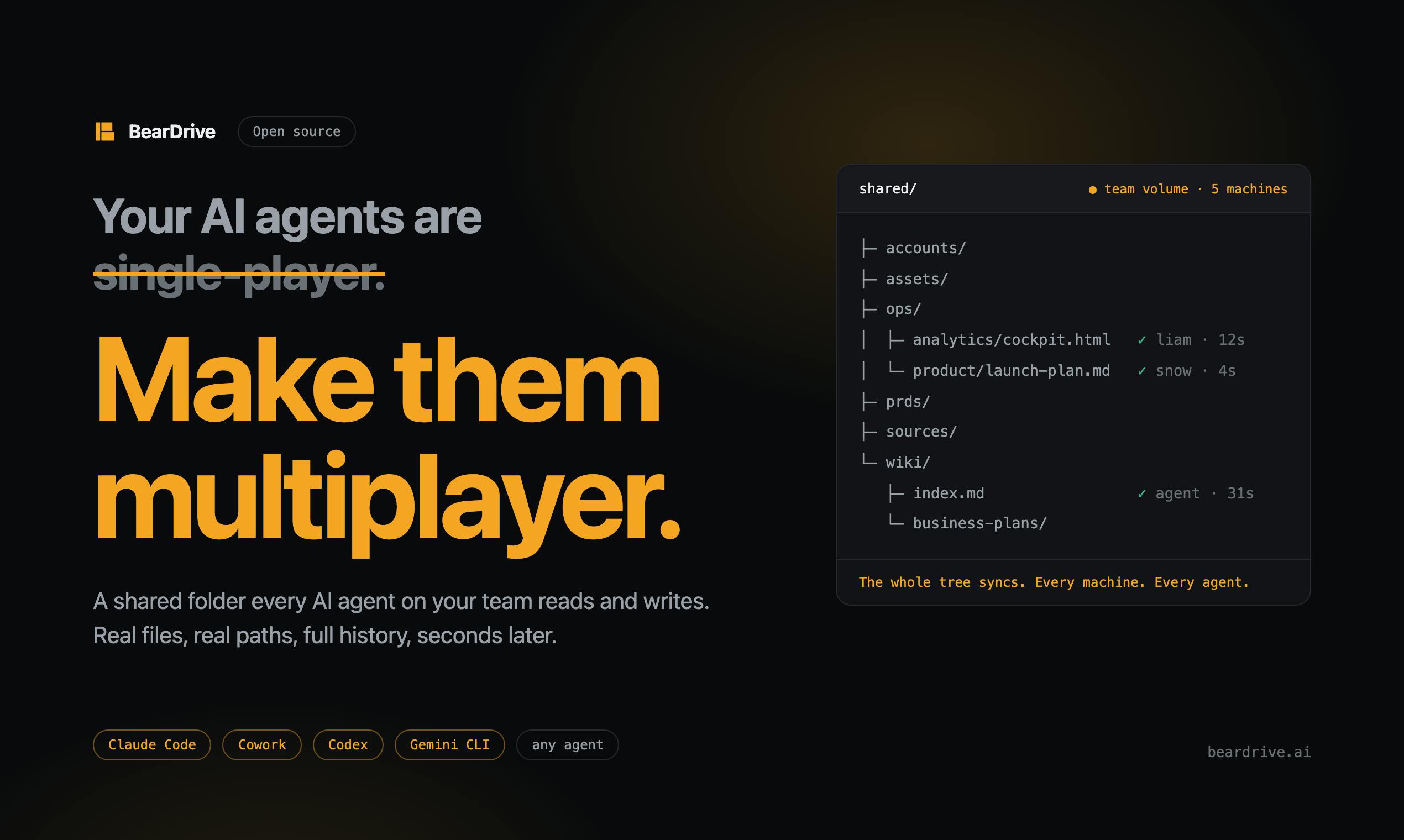
BearDrive is an open-source shared-folder system designed for teams using local AI agents such as Claude Code, Codex, Gemini CLI, Cowork and Hermes. It keeps files synchronized across agents, people and devices while preserving versions, authorship and agent-session provenance. Teams can use Runbear’s managed cloud service or deploy the complete server on their own infrastructure (official website; GitHub).
The product addresses an emerging but legitimate problem: AI agents increasingly generate reports, presentations, research and structured data as local files, but team sharing remains dependent on Slack attachments, cloud-drive uploads or Git workflows. BearDrive attempts to create a shared file and context layer that works without requiring every agent vendor to support a proprietary integration.
The strongest investment signal is company quality. BearDrive is built by Runbear, whose founders have previously worked together on multiple startups. CEO Snow Lee and CTO Liam Hwang both co-founded 42 Company and Ultra Caption; the former was acquired by Buzzvil and the latter by Kakao, according to their professional profiles (Snow Lee; Liam Hwang). Runbear also reported reaching $400,000 ARR at the end of 2025 after approximately sixfold annual revenue growth, although this is a founder-reported figure for Runbear’s broader AI-agent business—not BearDrive revenue (founder retrospective).
The principal concern is that BearDrive itself has almost no verified commercial validation. Its managed service is free during beta, paid pricing is undecided, and the GitHub repository had only 39 stars as of the report date. BearDrive customer count, active teams, synchronized files, retention and willingness to pay are not publicly disclosed.
The decision is DD, based primarily on the founders’ prior execution and Runbear’s reported commercial foundation. Due diligence must determine whether BearDrive is a focused expansion of Runbear’s strategy or another pivot, and whether early users treat shared agent files as an essential system of record rather than a convenient free utility.
Product Overview
AI-agent users frequently produce files locally and then distribute them through Slack, email, Google Drive or manual uploads. This creates duplicate “final” versions, weak provenance and fragmented context between different agents and team members.
BearDrive turns a local folder into a synchronized project. A command-line daemon scans for changes and exchanges them with a central “hub.” The system uses append-only journals, content-addressed storage and deterministic conflict resolution. Files remain available offline, and losing versions from concurrent edits are preserved rather than silently discarded (technical documentation).
Core functions include:
- Cross-device and cross-user folder synchronization.
- Hooks for Claude Code, Codex, Gemini CLI and Hermes.
- File version history and authorship by user, agent and device.
- Private team links and revocable public sharing.
- Agent-read tracking and document-staleness analysis.
- Selective synchronization through ignore rules.
- Export and import between managed and self-hosted hubs.
- Storage support for S3, Google Cloud Storage, R2, MinIO and local disks.
The managed product is free during beta, with unlimited projects, teammates and history. Future managed plans will be priced per team, but no price or beta-end date has been determined. Self-hosting is free under the AGPL-3.0 license (pricing).
The product currently supports macOS and Linux; Windows support is not listed in the repository. Its primary benefit is that files created by one agent become immediately available at a real local path to other agents. It replaces manual attachment sharing, cloud-drive uploads and, for non-code artifacts, some Git-based collaboration.
Product quality appears strong for an early beta. The public repository documents conflict handling, permissions, authentication, credential scanning and sandboxing of shared HTML. Nevertheless, security audits, production reliability statistics and large-scale synchronization benchmarks are not public.
Founder and Team Assessment
Snow Lee is Runbear’s co-founder and CEO. His public profile identifies prior roles as chief architect and chief product officer at Buzzvil, as well as two previous founder exits. These claims are primarily based on founder-maintained professional profiles rather than acquisition filings, but the histories are consistent across the founders’ profiles.
Liam Hwang is co-founder and CTO. He previously served as an engineering manager and DevOps team lead at Buzzvil and was a co-founder of the same two earlier companies. His background is directly relevant to BearDrive’s distributed synchronization, infrastructure and developer-tooling requirements (profile; Runbear biography).
The founders demonstrate both technical and commercial experience. Runbear was founded in 2023 and participated in Techstars in 2024. Public founder updates describe multiple product iterations, 200-plus paying Runbear companies and a period in which enterprise sales were paused because implementation work resembled consulting (company retrospective). These figures are company-reported and do not establish current customer retention.
Current team size is not reliably disclosed. The founders appear actively committed, and GitHub activity continued through August 14, 2026. Key-person risk remains material because much of BearDrive’s visible development and product narrative is founder-led.
Founder Assessment: Strong technical and repeat-founder credentials, but strategic focus and repeatable commercialization require verification.
Market Opportunity
The initial customer segment is small and midsized software, research and professional-services teams where several employees use file-producing AI agents daily. The immediate problem is not generic cloud storage; it is maintaining shared context and provenance across independently running agents.
No reliable count of such teams exists. An illustrative bottom-up scenario is:
- 50,000–250,000 AI-intensive teams
- $1,200–$6,000 annual managed-service spend
- Implied annual addressable revenue: $60 million–$1.5 billion
These are analyst assumptions, not BearDrive pricing or verified market statistics. The range is anchored loosely to Runbear’s current Team and Business pricing of $79 and $319 per month, while acknowledging that BearDrive may have different economics (Runbear pricing).
The initial segment alone may support a meaningful software company but is unlikely to produce a unicorn without expansion. Larger opportunities include enterprise agent governance, fine-grained access controls, compliance, audit trails, knowledge lifecycle management, agent identity and managed storage. Geographic expansion is structurally straightforward because the product is agent- and cloud-provider-neutral.
Market timing is favorable if local and coding agents become standard workplace tools. The risk is that shared context moves into agent-platform-native workspaces rather than independent synchronized folders.
Traction and Growth Signals
BearDrive ranked sixth on Product Hunt’s August 12, 2026 daily leaderboard (Product Hunt leaderboard). This demonstrates launch interest but not product-market fit.
More substantive evidence includes:
- A working, documented open-source product with an active release history.
- GitHub repository created June 12, 2026 and updated August 14, 2026.
- 39 GitHub stars, zero forks and nine open issues as of August 15, 2026 (GitHub API).
- Version 0.15.0 released August 11 for macOS and Linux (releases).
- Runbear’s founder-reported $400,000 ARR at year-end 2025, up sixfold during the year; none is publicly attributed to BearDrive.
- Runbear’s earlier company-reported milestone of more than 200 paying companies, although the company subsequently paused some enterprise sales and changed product direction.
The GitHub star and release-download counts indicate very early adoption. Managed-service registrations, active installations, weekly synchronized projects and post-launch retention are unknown.
Traction Assessment: Parent-company commercialization is encouraging, but BearDrive-specific traction is commercially unverified.
Competitive Position
Direct and adjacent alternatives include Dropbox, Google Drive, Box, Syncthing, Resilio Sync, Obsidian Sync, Git/Git LFS and agent-memory or knowledge-base products. Manual alternatives include Slack attachments, shared repositories and cloud-storage links. Anthropic, OpenAI, Google and Microsoft could integrate shared files and team memory into their agent platforms.
BearDrive’s differentiation is its combination of real local files, agent-neutral hooks, offline synchronization, version provenance, agent-read telemetry and full self-hosting. AGPL licensing limits the ability of cloud vendors to offer a closed hosted copy without releasing modifications.
Switching costs are initially low because customers retain their files and can export full history. This is good for trust and adoption but weakens commercial lock-in. Defensibility could improve if BearDrive becomes the cross-vendor identity, permission and audit layer for enterprise agents.
If a major platform released equivalent functionality, customers might retain BearDrive for cross-platform compatibility, self-hosting and data control. However, customers standardized on one agent ecosystem could prefer the bundled product.
Defensibility Assessment: Medium-Low
Business Model and Economics
BearDrive plans to monetize managed hosting per team while keeping the complete self-hosted core free. Pricing has not been finalized. Current beta users provide no revenue.
Potential variable costs include object storage, bandwidth, backups, metadata databases, authentication, support and security operations. BearDrive does not itself incur material model-inference costs, which should make its economics more favorable than usage-heavy AI applications. However, permanent version retention and unlimited beta storage may become expensive for teams generating large media files.
A managed storage product could sustain strong gross margins if quotas and egress are priced correctly. Enterprise expansion could add SSO, compliance, audit retention, support and policy-management revenue. The company must verify that free self-hosting generates managed-service leads rather than substituting for paid adoption.
Unicorn Path
A high-growth infrastructure SaaS company might receive approximately 8–12× ARR. Using a 10× midpoint:
Required ARR = $1 billion ÷ 10 = approximately $100 million
Illustrative customer requirements are:
- At $3,000 annual revenue per team: approximately 33,000 paying teams.
- At $15,000 enterprise ACV: approximately 6,700 customers.
- At $50,000 enterprise ACV: approximately 2,000 customers.
BearDrive has not published pricing, so these are scenarios rather than forecasts. A $100 million ARR outcome would require enterprise governance, security certifications, cross-platform agent support, repeatable bottom-up distribution and expansion beyond file synchronization into an agent collaboration control plane.
Storage and egress must remain a minority of revenue, likely requiring quotas or usage pricing. The current free, self-hostable product alone does not present a direct unicorn path.
Unicorn Path: Conditional
Valuation Assessment
Runbear reports closing a seed round during 2025 and publicly announced $500,000 in non-dilutive TIPS support. Third-party databases report total financing ranging from approximately $820,000 to $1.47 million and identify investors including Techstars, Kakao Ventures, Bass Investment and A2G Capital. Because the figures conflict and complete primary financing documents were not found, no total funding figure is treated as verified.
The most recent valuation, round size, SAFE cap, investor ownership and current fundraising status are not publicly disclosed. Runbear’s reported $400,000 ARR is historical, unaudited and not attributable to BearDrive.
Valuation Attractiveness: Not Assessable
Assessment requires current ARR, revenue composition, growth, gross margin, retention, burn, runway, cap table and current round terms.
Key Risks
- No BearDrive monetization: The managed beta is free and future pricing is unresolved.
- Strategic-focus risk: Runbear has repeatedly repositioned its product, and BearDrive may become another experiment rather than the core company.
- Weak early distribution: Forty GitHub stars and minimal release downloads do not yet indicate organic developer adoption.
- Platform replication: Major agent providers can bundle shared workspaces and context.
- Limited lock-in: Open formats, self-hosting and exportability reduce switching costs.
- Security exposure: Synchronizing agent-readable files can expose credentials, sensitive documents or malicious content.
- Storage economics: Permanent version history and large generated files could create unfavorable storage and egress costs.
- Enterprise readiness: Independent security audits, uptime metrics and compliance coverage specific to BearDrive are unavailable.
- Parent-company traction uncertainty: Runbear’s revenue and customer metrics are founder-reported and may relate to earlier product versions.
Final Assessment
Venture Potential: 70/100
| Category | Score |
|---|---|
| Market Size and Expansion Potential | 16/20 |
| Traction and Growth Evidence | 10/20 |
| Founder and Team | 14/15 |
| Product Strength | 8/10 |
| Distribution Potential | 10/15 |
| Business Model and Economics | 6/10 |
| Defensibility | 6/10 |
| Total | 70/100 |
The founders and product architecture are the strongest elements. BearDrive-specific commercialization, distribution and defensibility are the weakest.
Evidence Confidence: 62/100
Product functionality, pricing status, license, repository activity and founder identities are verifiable. Revenue, customer and growth figures are company-reported. Funding databases conflict, while retention, margins, burn, runway, BearDrive active usage and valuation remain unavailable.
Final Decision: DD
Formal diligence is justified by the experienced founding team, existing Runbear revenue claims and a credible emerging problem. Investment should not proceed until BearDrive’s strategic role, early retention, willingness to pay and current financing terms are verified.
Upgrade Conditions
- At least 100 paying BearDrive teams after pricing launches.
- More than 70% six-month team retention.
- Verified weekly usage across multiple users and agents per account.
- Managed-service gross margin above 75%.
- Referenceable enterprise deployments.
- Repeatable acquisition beyond Product Hunt and founder-led outreach.
- Independent security review and documented reliability targets.
Downgrade Conditions
- Failure to convert beta teams into paid plans.
- Another major strategic pivot within twelve months.
- Storage and support costs materially exceeding plan revenue.
- Agent vendors bundling adequate cross-user file synchronization.
- Security incidents involving synchronized credentials or public links.
- Declining repository and release activity.
Questions for Further Diligence
- How many BearDrive teams are registered, weekly active and retained after 30 and 90 days?
- How many users, agents, projects and synchronized files does the median active team have?
- What proportion of Runbear’s current ARR is recurring, and what is current ARR after the BearDrive launch?
- What pricing has been tested with beta teams, and what percentage expressed willingness to pay?
- What are Runbear’s gross margin, burn rate and runway?
- What are expected storage, bandwidth and support costs per active BearDrive team?
- Is BearDrive the company’s primary product or a complementary product to Runbear’s Slack agents?
- What are Runbear’s current customer and revenue retention rates?
- What independent penetration tests or security audits cover BearDrive?
- What is the fully diluted cap table and total capital raised?
- What valuation, round size and financing terms are currently proposed?
- Which product capabilities would remain differentiated if Anthropic, OpenAI or Google launched shared agent folders?