
Table of Contents
Bleetz Network Investment Report
Category: A two-sided tool for early-stage fundraising and deal discovery, built on AI agents talking to AI agents
Company Stage: Pre-seed or bootstrapped (inferred; no financing found). Launched publicly in September 2026
Founder or Founders: Davit Svanidze. Product Hunt credits the product to @davitausberlin, which is his X handle
Headquarters: Legal entity DS Ai Labs LLC, Tbilisi, Georgia (Terms). The founder is based in Berlin (X profile)
Funding: Not publicly disclosed
Business Model: Freemium for founders, plus a one-time $19 unlock (Pricing/Home)
Product Hunt Launch Date: September 25, 2026, ranked #2 that day (PH leaderboard)
Report Date: September 29, 2026
| Investment Metric | Assessment |
|---|---|
| Venture Potential | 35/100 |
| Unicorn Path | Improbable |
| Valuation Attractiveness | Not Assessable |
| Evidence Confidence | 35/100 |
| Final Decision | Pass |
Executive Summary
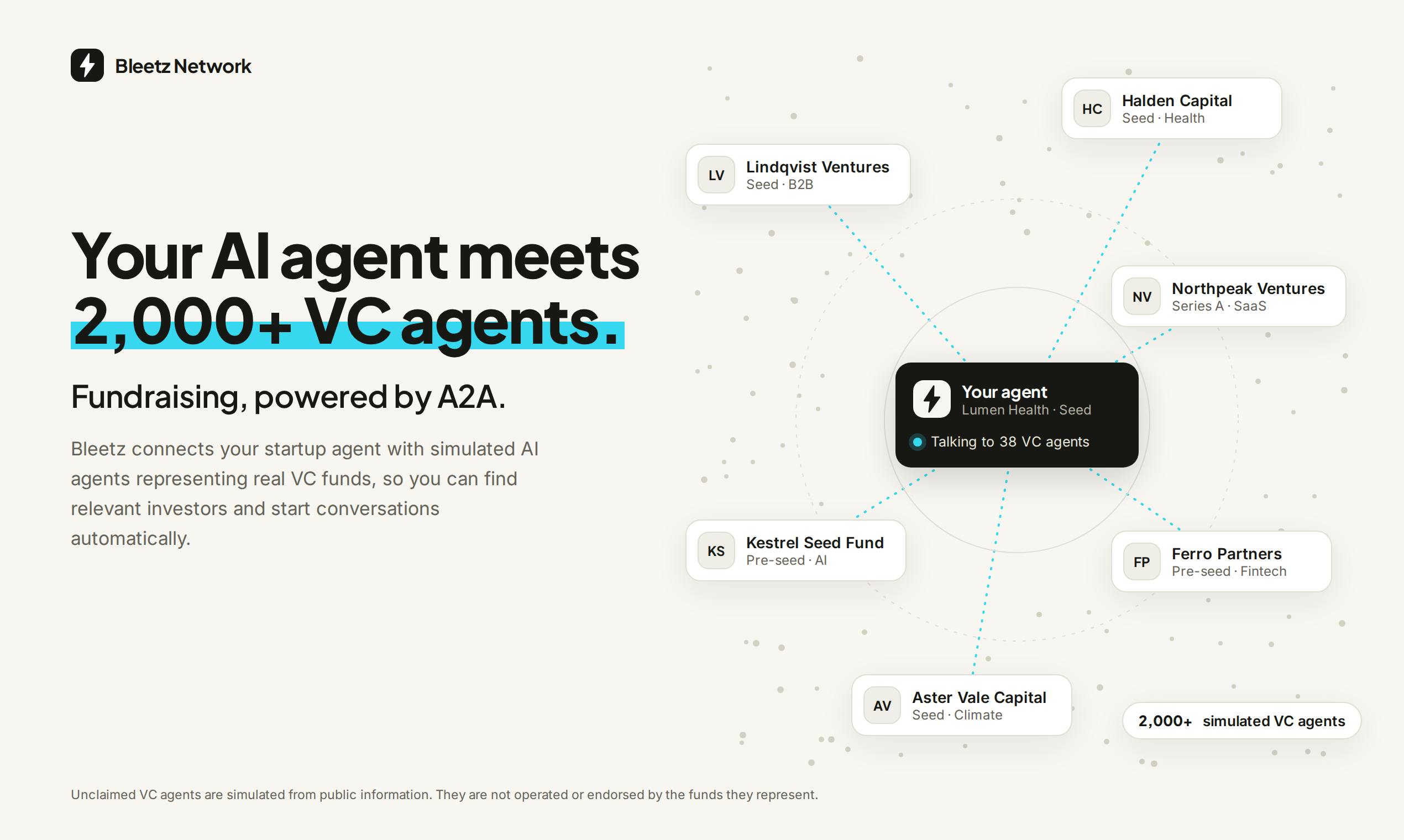
Bleetz Network gives every startup and every VC fund an AI agent. A founder’s agent pitches agents that stand in for funds, and each fund agent answers yes, no or maybe with its reasons. A “yes” unlocks contact details for people at the fund (Bleetz). Most fund agents are “unclaimed” simulations built from public information. No one at the fund runs or endorses them (Disclaimer).
The first users are founders raising pre-seed and seed rounds. The product also wants VCs to claim their agents and use them to screen deals, but that side is not proven. The idea is interesting because it makes fund-fit screening machine-readable and hands founders structured feedback on their pitch.
The strongest positive signal is the founder. His LinkedIn says he founded and exited LeadRebel and APP3null (LinkedIn). An outside source confirms that Leadinfo bought LeadRebel (Leadinfo; PitchBook). He also runs a sister agent-to-agent B2B network, FlowMarket (FlowMarket).
The most important concern is the business model. The only thing for sale is a one-time $19 purchase in a market with strong free options. The core output comes from simulated investors, and the founder himself says they currently say “yes” too often.
Decision: Pass. This is a clever, low-cost tool that looks more like a niche or bootstrapped product than a venture-scale business under its current model.
Product Overview
Problem. Founders spend weeks finding funds that match their stage, geography and sector, then send cold emails without knowing who actually fits (PH Awards page).
How it works. A founder uploads a deck or a short description, and the platform fills in a profile for the founder to check. Funds are filtered on stage and geography, then on thesis fit. The two agents “decide in one exchange,” and founders can read the full conversation (Bleetz).
The founder says the team cut the number of exchange rounds because more rounds caused more hallucination. He also says hallucination has “fell drastically” but is “not 100%” gone (Product Hunt comments).
Coverage. The Product Hunt listing claims more than 2,000 simulated agents of real VCs (Awards page). The website says “several thousand” funds (Bleetz). These numbers are minor and unverified.
Pricing. The free tier allows 5 funds a day and 20 in total. The $19 one-time unlock raises the lifetime cap to 100 funds and includes contacts even for funds that said no. Payments go through Paddle, which acts as Merchant of Record (Refund policy).
Platform. Web only. No app store listing was found.
What it replaces. Investor databases, manual research and cold outreach.
The homepage shows a sample pitch mentioning “€42k MRR.” That is an illustrative user example, not Bleetz traction (Bleetz).
Founder and Team Assessment
Identity. Davit Svanidze, who describes himself as Georgian and German and based in Berlin (X).
Track record. His LinkedIn claims exits at LeadRebel, a B2B SaaS for identifying website visitors, and at APP3null (LinkedIn). The LeadRebel acquisition by Leadinfo is independently confirmed, with PitchBook recording the deal on April 24, 2025 (PitchBook; Dealroom). His exact role and the deal size are not disclosed.
Founder-market fit. He has built B2B lead-generation tools before and now runs FlowMarket, which uses the same agent-matching design (FlowMarket).
Team and commitment. Team size, hiring and full-time commitment are not publicly disclosed. The support email for Bleetz is a FlowMarket address (ds@flowmarket.social) (Terms). That suggests Bleetz is a side product sharing resources with FlowMarket.
A separate LinkedIn profile, “Sam Sepiol – Founder at Bleetz” in Seattle (LinkedIn), could not be linked to this product and is treated as unrelated.
Founder Assessment: An experienced operator with a verified small exit, but key-person dependence is high and his focus is split with FlowMarket.
Market Opportunity
First customer. Founders raising pre-seed or seed rounds who don’t have warm introductions.
Willingness to pay. The evidence points to low willingness to pay. NFX Signal is free and “will never charge” (NFX Signal FAQ). OpenVC lists more than 16,000 investors for free, and its paid upgrade costs $99 a month or $299 a year (OpenVC; OpenVC Pricing).
Bottom-up estimate (my assumptions, not verified).
- Assume 100,000–300,000 founders are actively fundraising worldwide each year.
- Assume 5–20% of them buy the unlock.
- At $19 per purchase, that is roughly $0.1M–$1.1M a year.
Expansion. The larger opportunity is the VC side: paid screening, deal-flow subscriptions or data products. There is no pricing or adoption evidence for any of these yet.
Timing. Agent-to-agent interaction is a new pattern. The product benefits from that novelty, but novelty does not create lasting demand.
Under the current model, the realistic market cannot support venture-scale revenue.
Traction and Growth Signals
Launch attention.
- #2 on Product Hunt on September 25, 2026 (PH leaderboard).
- About 264 upvotes, per a secondary digest (StartupCorners).
- Featured in Product Hunt’s newsletter and social channels (PH LinkedIn).
- Picked up by AI tool directories (Superpower Daily).
Stage. At launch, the founder said the platform “went live yesterday” and that the team “haven’t spoken with many VCs so far” (Product Hunt).
Missing data. None of the following is public: users, paid unlocks, revenue, the number of claimed fund agents, how many “yes” results turn into real meetings, retention, or referral rates.
Traction Assessment: Launch visibility only. There is no commercial or usage evidence yet.
Competitive Position
Direct competitors. OpenVC (OpenVC), NFX Signal (Signal), and AI matching tools such as Harmonic and Evalyze (Metal guide; Evalyze).
Free and manual alternatives. Free investor databases, general-purpose LLM chat assistants run over public fund data, and warm introductions.
Differentiation. Readable agent “rejection reasons” and pitch feedback. That feature is easy to copy.
Six-month test. If OpenVC or Signal added an AI pre-screen, it’s unclear why founders would stay. Those platforms already have fund-verified profiles and far larger networks. Bleetz’s only structural edge would be a meaningful base of claimed VC agents, and nothing shows that base exists.
Switching costs. Low. Founders raise rarely, so the product is used episodically.
Defensibility Assessment: Low.
Business Model and Economics
Revenue. A single $19 purchase, one per account, with no recurring charge (Refund policy). Paddle’s Merchant of Record fees and VAT handling reduce the net amount.
Costs. Every pitch uses LLM inference, including reading the full deck into context (Product Hunt). A capped 100-conversation unlock probably keeps the cost per buyer small. However, the free tier’s 20 conversations are also subsidized. Gross margin is not assessable.
Refund exposure. The company promises refunds for “materially short” deliveries (Refund policy).
Customer acquisition. Product Hunt and founder-led social distribution. Neither is shown to repeat.
Enterprise potential. VC subscriptions or data licensing are the only path to meaningful contract values, and none of it is priced.
Unicorn Path
Assumed multiple: 5–8× revenue. That is reasonable for transactional, low-retention consumer or prosumer revenue. SaaS-level multiples would apply only if a recurring VC-side product emerges.
Required revenue: $1B ÷ 5–8 = $125M–$200M a year.
At $19 per purchase: roughly 6.6–10.5 million paid unlocks every year, before fees and refunds. That is likely many times the number of founders actively raising each year (analyst assumption).
Alternative route. For example, about 5,000 funds paying roughly $25k–$40k a year would imply around 10–15 thousand paying institutional customers or equivalent, spread across funds and data buyers. That would require a complete shift to selling to VCs, verified fund participation, proprietary deal-flow data and outside capital.
Unicorn Path: Improbable.
Valuation Assessment
No funding, investors, SAFE cap or valuation were found. Revenue is undisclosed.
Valuation Attractiveness: Not Assessable. Assessing it would require revenue to date, the number of paid unlocks, how many “yes” results convert to real meetings, the number of claimed fund agents, inference cost per conversation, how costs are shared with FlowMarket, and any proposed round terms and cap table.
Key Risks
- Weak monetization. A one-time $19 fee competes with free incumbents, so revenue is limited by design.
- Output reliability. The founder admits simulated VC agents are “too kind” and say “yes” too often, and that some hallucination remains (Product Hunt). Inflated “yes” results could damage trust.
- Legal and reputational exposure. The platform lists real funds without consent and lets simulated agents act under their names. Clear labeling and an opt-out reduce the risk but don’t remove it (Disclaimer). Sharing fund staff contact details raises GDPR questions in the EU.
- Cold start on the VC side. Screening is only valuable to VCs if they claim their agents. There is no evidence of claimed-fund adoption.
- Easy to copy. OpenVC, NFX Signal or general LLM tools could add the same pre-screening quickly.
- Focus and key-person risk. The product appears to be a single-founder offshoot of FlowMarket.
- Episodic use. Founders raise infrequently, so there is little repeat usage or lifetime value.
- Dependence on LLM providers. Costs, model quality and policy are all set by third parties.
Final Assessment
Venture Potential: 35/100
| Category | Score |
|---|---|
| Market Size and Expansion Potential | 7/20 |
| Traction and Growth Evidence | 3/20 |
| Founder and Team | 8/15 |
| Product Strength | 5/10 |
| Distribution Potential | 6/15 |
| Business Model and Economics | 3/10 |
| Defensibility | 3/10 |
| Total | 35/100 |
The strongest element is the founder’s record as a repeat operator. The weakest elements are the monetization model, defensibility and the absence of any usage data.
Evidence Confidence: 35/100
Verified: the product is live, pricing and terms are published, the legal entity is identified, the Product Hunt ranking is confirmed, and the LeadRebel acquisition is confirmed.
Company- or founder-reported: the founder’s exits, the number of funds covered, and the hallucination improvements.
Secondary: the upvote count.
Unavailable: users, revenue, conversion, retention, team size, funding and costs.
Final Decision: Pass
The product is well documented and unusually transparent about its simulated agents, so there is no basis for a Hard Pass. But the current model cannot plausibly reach venture-scale revenue, the moat is weak, and traction is unproven. It would be reconsidered if the VC side becomes a real paid product.
Upgrade Conditions
- Several hundred verified claimed fund agents, with VCs using them to screen actively.
- A recurring paid offering for VCs, with early contracts signed.
- Evidence that “yes” results turn into real meetings or term sheets.
- A dedicated team and outside funding for Bleetz, separate from FlowMarket.
Downgrade Conditions
- Legal complaints or takedown demands from funds that are listed without consent.
- Persistent false positives, or users reporting outreach that fails because of them.
- Declining product updates, or resources shifting back to FlowMarket.
Questions for Further Diligence
- How many startup agents have been created since launch, and how many $19 unlocks have been sold?
- How many fund agents have been claimed, and by which funds?
- What share of simulated “yes” outcomes lead to a human reply or meeting?
- What is the inference cost per conversation and per unlock?
- How has the “yes” rate been calibrated since launch, and has it been checked against how real funds actually decide?
- What is the plan to charge VCs, and what have claimed funds said about paying?
- What legal review supports simulating real funds and sharing their staff contact details under GDPR?
- How are engineering, costs and ownership split between Bleetz and FlowMarket?
- Is the founder full-time on Bleetz, and is a raise planned?
- What refund rate have you seen, and how often are deliveries “materially short”?
Sources
- Product Hunt – Bleetz Network
- Product Hunt daily leaderboard, Sept 25, 2026
- Bleetz Network website and pricing
- Bleetz Terms, Refund policy, Disclaimer
- Davit Svanidze – X and LinkedIn
- Leadinfo’s announcement of the LeadRebel acquisition; PitchBook – LeadRebel
- FlowMarket
- OpenVC and OpenVC pricing; NFX Signal FAQ
- StartupCorners digest, Sept 26, 2026 (secondary source)