
Table of Contents
NobodyWho Investment Report
Category: On-device AI inference infrastructure
Company Stage: Pre-seed
Founder or Founders: Cecilie Waagner Falkenstrøm and Asbjørn Olling
Headquarters: Copenhagen, Denmark
Funding: €2 million pre-seed round announced in December 2025, backed by PSV Tech, The Footprint Firm, and Norrsken Evolve
Business Model: Free open-source inference engine with reported paid fine-tuning and potential enterprise support
Product Hunt Launch Date: 2026/08/20
Report Date: August 26, 2026
| Investment Metric | Assessment |
|---|---|
| Venture Potential | 79/100 |
| Unicorn Path | Conditional |
| Valuation Attractiveness | Not Assessable |
| Evidence Confidence | 82/100 |
| Final Decision | DD |
Executive Summary
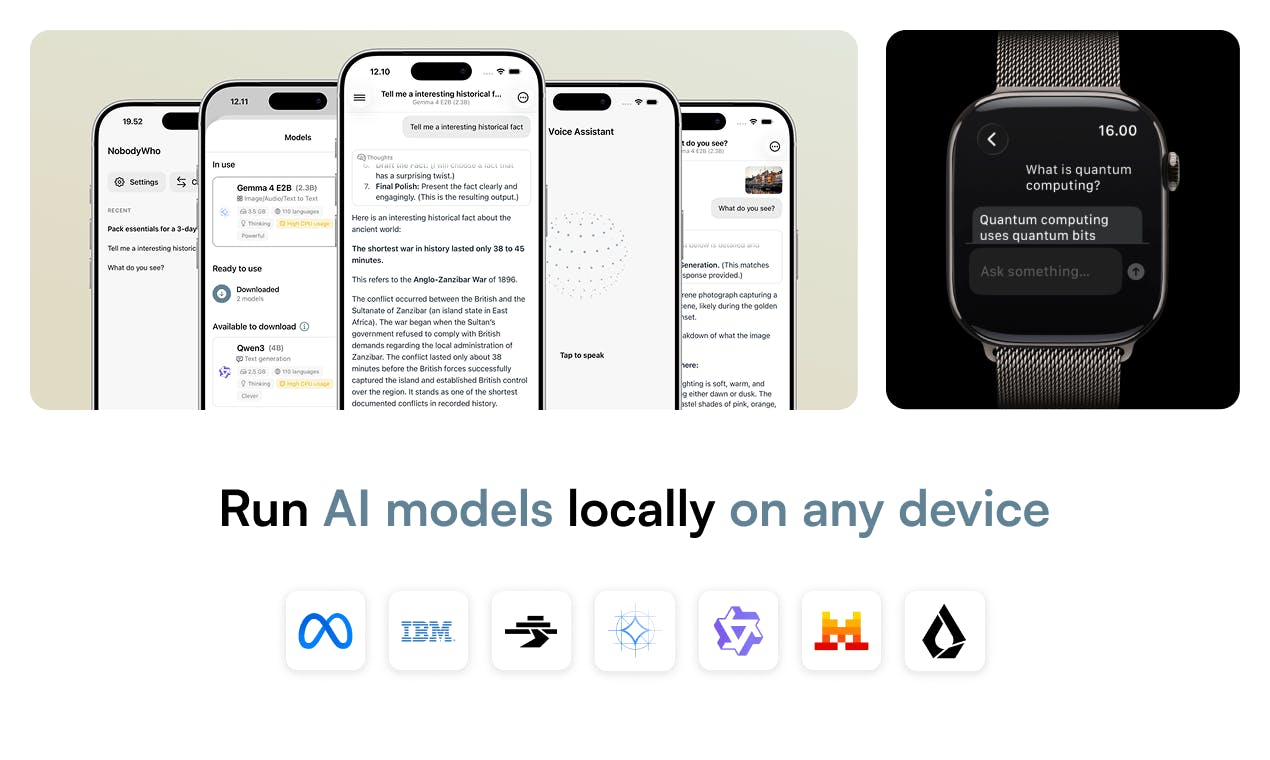
NobodyWho is an open-source inference engine for running language, vision, speech-recognition, and speech-generation models fully on end-user devices. Built on llama.cpp with a Rust core, it provides native integrations for Kotlin, Swift, Flutter, React Native, Python, and Godot. Developers can download GGUF models from Hugging Face, use GPU acceleration through Metal or Vulkan, and add type-safe tool calling whose grammar is generated from function signatures.
The investment thesis is that local AI becomes an important infrastructure layer as applications demand privacy, offline operation, predictable cost, low latency, and European data sovereignty. NobodyWho removes considerable integration work across mobile and desktop frameworks. The product is free for commercial use under EUPL 1.2, and a secondary database reports paid fine-tuning as the current revenue model.
Public evidence is substantial for a pre-seed company: approximately 1,040 GitHub stars, 75 forks, nearly 2,000 commits, active releases, a six-person Hugging Face organization, platform packages, and €2 million of funding. Funding coverage reported more than 5,000 developers by December 2025. Product Hunt added 106 points and 91 followers, but that launch attention is not PMF.
The principal concern is business-model capture. llama.cpp supplies the core engine, models are open, and device/platform vendors provide native runtimes. A permissive free library can achieve adoption without producing durable revenue. Performance varies sharply by device, quantization, model size, context, and structured-output constraints. The company must show production applications, developer retention, enterprise willingness to pay, and a differentiated optimization layer.
Final decision: DD. The team, financing, technical execution, and open-source adoption warrant diligence. Investment should require verified production usage, revenue, commercial pipeline, performance advantages, licensing clarity, and financing terms.
Product Overview
NobodyWho wraps local inference in consistent APIs instead of making teams integrate llama.cpp separately for every platform. The documentation covers streaming chat, structured output, tool calling, embeddings, RAG, speech-to-text, and text-to-speech, distributed through Maven, Swift Package Manager, npm, pub.dev, PyPI, and Godot Asset Library.
The engine works offline without API keys; model weights stay on device, reducing data transfer and cloud fees. The launch adds multimodal input, Hugging Face downloads, Metal/Vulkan acceleration, and context shifting.
Performance is device-specific. The maker reported 27 tokens per second for a one-billion-parameter Granite model on iPhone 15 Pro. He also disclosed grammar constraints raising Qwen3 0.6B time-to-first-token from about 20 to 240 milliseconds, with a smaller effect at four billion parameters. Standardized benchmarks for loading, memory, battery, thermals, quality, and context are still needed.
The project began as a Godot engine in 2023, was rewritten in Rust in 2024, then added Android, iOS, Python, Flutter, React Native, Swift, Kotlin, and speech support—credible continuity beyond launch week.
Founder and Team Assessment
Cecilie Waagner Falkenstrøm is co-founder and CEO and has worked with language-model art since 2016. Asbjørn Olling is co-founder and an active technical contributor. Product Hunt maker Pierre’s role and ownership were not verified.
The team demonstrates persistence across a multi-year rewrite, cross-platform packages, documentation, community work, and fundraising. Public sources describe a small team; Hugging Face lists six members.
Missing information includes founder ownership, prior company-building outcomes, commercial leadership, exact headcount, contributor employment, hiring plan, and key-person dependencies.
Founder Assessment: Strong mission and technical delivery, with commercial scaling ability still unproven.
Market Opportunity
The initial market includes mobile, desktop, game, and embedded application developers who need private or offline AI. Regulated companies, European enterprises, consumer apps with sensitive data, and products serving unreliable connectivity are natural segments. The engine can also serve voice interfaces, assistants, games, field tools, and edge devices.
An illustrative bottom-up case assumes 25,000 organizations adopting local AI and 10% buying enterprise optimization, support, or fine-tuning at €40,000 annual contract value. That yields €100 million ARR. A broader model-runtime and fleet-management platform could expand beyond services, but these are analytical scenarios, not company forecasts.
On-device hardware is improving, open small models are advancing, and cloud inference cost and privacy concerns support timing. Countervailing forces are native Apple, Google, Microsoft, Qualcomm, and model-vendor runtimes that may make local inference a bundled commodity.
Market Assessment: Large strategic trend with uncertain independent software capture.
Traction and Growth Signals
GitHub showed about 1,040 stars, 75 forks, 1,963 commits, 13 issues, and 10 pull requests, with August 2026 updates. This is meaningful open-source interest, not production proof.
Funding coverage reported more than 5,000 developers and an engaged Discord by December 2025. Current active developers, package downloads, production apps, and cohorts are undisclosed. Product Hunt added 106 points and 91 followers. Technical comments challenged latency, memory, context, and quantization; candid maker responses supported developer trust. Anecdotal Reddit experience included easy Godot setup and an Android crash.
No public evidence established revenue, paying customers, contract size, retention, or end users reached.
Traction Assessment: Strong pre-seed open-source adoption; commercial traction unverified.
Competitive Position
Direct alternatives include llama.cpp, MLX, ExecuTorch, ONNX Runtime, MLC LLM, Google AI Edge, Apple Core ML and MLX, Qualcomm AI tools, MediaPipe, Ollama, and framework-specific packages. Cloud inference from OpenAI, Anthropic, Google, Mistral, and Groq is often easier and more capable. Hugging Face and model vendors reduce distribution friction.
NobodyWho differentiates through one Rust-based layer exposed consistently across six application frameworks, type-safe tool calling, multimodality, speech, model download, and application-oriented documentation. Godot support provides a useful early wedge; mobile cross-platform support broadens it.
Defensibility may develop through performance tuning, compatibility data, enterprise deployment, and community contributions. Today, reliance on llama.cpp and open models limits control, while platform vendors optimize their own hardware. Cross-platform consistency and neutrality may retain developers, but production cohorts must prove it.
Defensibility Assessment: Medium
Business Model and Economics
The library is free for individuals and companies under EUPL 1.2. Dealroom reports paid fine-tuning services, but the official site does not publish prices or commercial packages. Plausible extensions include enterprise support, custom optimization, security-certified distributions, fleet model management, analytics, evaluation, and private model deployment; these should not be counted as current revenue without proof.
On-device inference shifts compute cost to customer hardware, supporting high software gross margin. Company costs include engineers, model/device testing, package maintenance, support, fine-tuning compute, and compatibility work. Services can generate early revenue but are labor-intensive and may cap multiples.
Required evidence includes revenue mix, project margin, recurring support contracts, conversion from open source, sales cycle, customer concentration, and the boundary between free and paid value.
Unicorn Path
At a 10x ARR multiple, a €1 billion valuation requires about €100 million ARR. One route is 2,500 enterprise customers paying €40,000 annually. A higher-value platform could reach the target with 500 customers at €200,000, but that requires fleet management, governance, optimization, and support beyond the present library.
The company must turn open-source mindshare into recurring software revenue, become a trusted cross-platform standard, demonstrate superior performance, and avoid being absorbed by native runtimes.
Unicorn Path: Conditional
Valuation Assessment
The €2 million pre-seed round and named investors are publicly supported. Current valuation, ownership, revenue, burn, runway, and new-round terms are not public. Secondary enterprise-value estimates are not reliable enough for underwriting.
Valuation Attractiveness: Not Assessable
Required inputs are ARR, services versus recurring revenue, customer pipeline, burn, runway, cap table, option pool, round size, price, liquidation preferences, and pro-rata rights.
Key Risks
- Free adoption may not convert to recurring revenue.
- Native device runtimes can commoditize the integration layer.
- Dependence on llama.cpp and third-party models limits control.
- Performance and quality vary across devices and quantization.
- Cross-platform maintenance creates substantial engineering load.
- Model files can strain storage, memory, battery, and download flows.
- Services-heavy fine-tuning may not scale like software.
- Open-source license obligations may deter some commercial users.
- Privacy claims require secure model, prompt, and tool handling.
- Commercial metrics and valuation remain undisclosed.
Final Assessment
Venture Potential: 79/100
| Category | Score |
|---|---|
| Market Size and Expansion Potential | 18/20 |
| Traction and Growth Evidence | 16/20 |
| Founder and Team | 12/15 |
| Product Strength | 9/10 |
| Distribution Potential | 11/15 |
| Business Model and Economics | 6/10 |
| Defensibility | 7/10 |
| Total | 79/100 |
Evidence Confidence: 82/100
Funding, founders, headquarters, license, repository activity, packages, product scope, and launch details are supported. Developer count and business model rely partly on financing coverage and secondary sources. Revenue and retention are absent.
Final Decision: DD
NobodyWho has credible technical momentum and a timely privacy/offline thesis. Diligence must determine whether open-source use is converting into a defensible, recurring enterprise business.
Upgrade Conditions
- Verified recurring revenue above €1 million with strong growth.
- Production deployments across multiple frameworks and regulated customers.
- Measurable performance or integration advantages over native runtimes.
- Repeatable conversion from free developers to enterprise contracts.
- High-margin product revenue exceeding custom services.
- Financing terms consistent with current traction.
Downgrade Conditions
- Adoption is primarily hobby experimentation.
- Paid work remains bespoke fine-tuning.
- Apple, Google, or Meta runtimes erase cross-platform advantage.
- Device performance prevents frequent production use.
- License or security concerns block enterprise adoption.
Questions for Further Diligence
- How are the reported 5,000 developers defined, and what is current MAU?
- Which production applications use NobodyWho, and how many end devices do they reach?
- What are current revenue, pipeline, contract size, and customer concentration?
- What share of revenue is recurring software versus fine-tuning services?
- Why do teams choose NobodyWho instead of direct llama.cpp or native runtimes?
- What benchmarks cover latency, memory, battery, quality, and crashes by device?
- What is the roadmap for model and fleet management?
- How does EUPL licensing affect proprietary mobile applications?
- What security review protects model downloads, tool calling, and local data?
- What are team roles, hiring priorities, burn, and runway?
- What are the cap table, founder ownership, and proposed round terms?
- Which technical assets remain proprietary and compound with adoption?
Sources
- Product Hunt: NobodyWho
- NobodyWho official website and milestones
- NobodyWho documentation
- NobodyWho GitHub repository
- NobodyWho GitHub organization
- NobodyWho Hugging Face organization
- Godot Asset Library: NobodyWho
- Norrsken Evolve investor commentary
- TFN funding and founder summary
- Dealroom company summary, secondary source