
Table of Contents
- Agent Builder by Airtop Investment Report
Agent Builder by Airtop Investment Report
Category: AI agent builder and browser automation
Company Stage: Series A-funded company following a major product pivot
Founder or Founders: Amir Ashkenazi and Daniel Shteremberg
Headquarters: San Francisco Bay Area
Funding: More than $38 million publicly reported under Airtop’s former name, Switchboard
Business Model: Subscription and usage-based SaaS
Product Hunt Launch Date: September 3, 2026
Report Date: September 6, 2026
| Investment Metric | Assessment |
|---|---|
| Venture Potential | 72/100 |
| Unicorn Path | Conditional |
| Valuation Attractiveness | Not Assessable |
| Evidence Confidence | 64/100 |
| Final Decision | DD |
Executive Summary
Agent Builder is Airtop’s no-code system for creating browser and API automations through natural-language instructions. It converts a described workflow into reusable code, runs it in cloud browsers, and attempts to diagnose and repair failures when websites change. Target users include operations, marketing, sales, finance, and technical teams automating work across websites, SaaS applications, and APIs (Agent Builder).
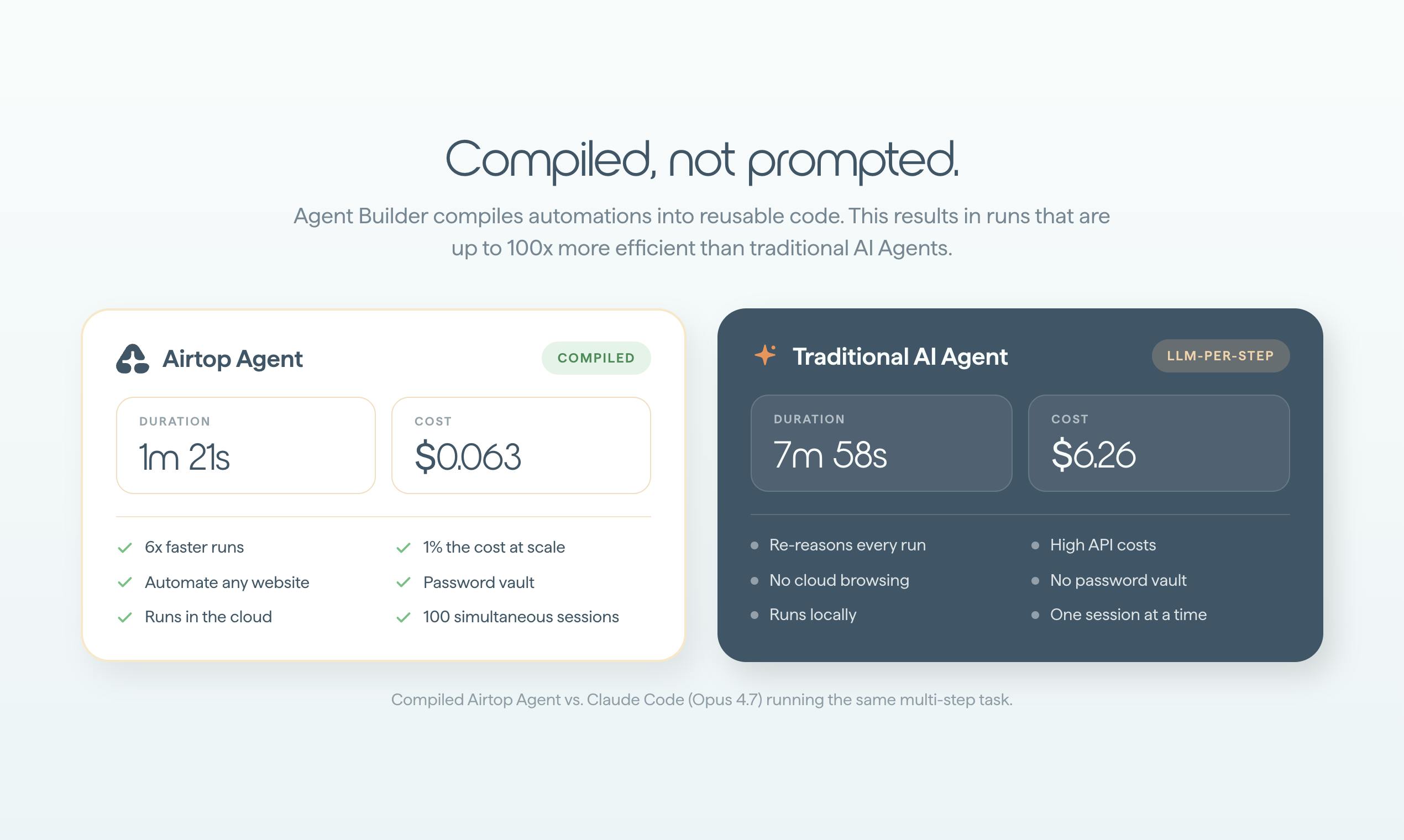
The product addresses a significant limitation in current AI agents: repeatedly asking a model to reason through every action can be slow, expensive, and inconsistent. Airtop instead uses AI primarily at build time and executes more deterministic code at runtime. In one company-reported benchmark, this reduced a task from $6.26 and 7 minutes 58 seconds to $0.063 and 1 minute 21 seconds; this result has not been independently reproduced (Product Hunt).
The strongest investment signal is company and founder quality. CEO Amir Ashkenazi previously founded Adap.tv, which was acquired by AOL, and has extensive product, advertising, search, and startup experience. CTO Daniel Shteremberg has engineering and product experience at Apple, Viv Labs, Zoox, Labelbox, and Switchboard, and previously co-founded an acquired mobile company (Ashkenazi; Shteremberg).
The most important concern is that Airtop is a heavily funded company operating after a substantial pivot. Switchboard raised a $25 million Series A in 2022, bringing total funding above $38 million, for a remote-collaboration product rather than browser automation (FinSMEs). Current revenue, post-pivot growth, retention, burn, and remaining runway are not publicly disclosed.
The product and team justify formal diligence, but not an investment commitment. The decision is DD, focused on whether Airtop has achieved sufficient post-pivot commercial momentum to support its accumulated capitalization and whether its compiled-agent architecture delivers defensible reliability and cost advantages in production.
Product Overview
Agent Builder targets workflows that are difficult to automate because an application lacks an API, exposes only partial functionality, or requires human-like browser interaction. Existing solutions usually involve manual work, fragile scripts, robotic process automation, or an AI agent that reasons through each browser action.
Users describe a workflow in plain English. Airtop builds and tests it, compiles it into reusable code, and runs it on a schedule or trigger. The platform supports authenticated websites, password storage, proxies, CAPTCHA handling, concurrent cloud sessions, run traces, and video records. When execution fails, Airtop creates and tests a repair draft, but the user must approve deployment (Agent Builder).
Public pricing includes Free, Starter at $29 per month, Professional at $189, Enterprise at $558, and custom plans. Limits vary by deployed agents and simultaneous sessions; usage is governed through credits (pricing). Airtop also integrates with systems such as Slack, Google Sheets, Zapier, Make, and n8n and exposes developer APIs and SDKs (official website; GitHub).
A named case study describes Cared.io using Airtop to reconcile invoices between Xero and Cliniko where the available APIs were insufficient. Airtop reports that the automation saved more than ten hours of executive time monthly. This is a useful product-quality signal but remains vendor-produced evidence rather than an independent customer study (case study).
Product Quality Assessment: Strong architecture and clear customer value, with limited independent evidence regarding reliability across large production deployments.
Founder and Team Assessment
Ashkenazi is an experienced repeat founder. His public career history includes founding comparison-shopping and advertising businesses, serving as an eBay executive, founding Adap.tv, and becoming president of AOL Platforms after Adap.tv’s acquisition. His profile also lists Tookee as acquired by LogMeIn (LinkedIn). This background indicates unusually strong fundraising, product, and commercial capabilities.
Shteremberg became Airtop’s co-founder and CTO after serving as Switchboard’s VP of Engineering. His profile includes engineering and product leadership at Apple, Viv Labs, Zoox, and Labelbox. He reports that Closer Labs, where he was co-founder and CTO, was acquired in 2015 (LinkedIn).
LinkedIn classifies Airtop as having 11–50 employees, but an exact current headcount is not publicly verified (company profile). The team appears technically capable, and the company maintains public SDKs, examples, and integrations. However, a founder-reported product pivot involved layoffs, and current hiring velocity is unclear.
Key-person risk is moderate: Ashkenazi’s commercial leadership and Shteremberg’s technical and product judgment are central to the current strategy.
Founder Assessment: Exceptional founder experience and strong technical-commercial balance, offset by execution risk from the company’s prior pivot.
Market Opportunity
The initial segment is operations and automation teams at software-enabled SMBs and mid-market companies that must transfer data or complete recurring actions through browser interfaces. Likely buyers include operations leaders, automation consultants, agencies, and developers building agents.
The United States has 5.58 million employer firms with fewer than 500 employees, although most are too small or insufficiently digital to be realistic Airtop customers (U.S. Census Bureau). As an analyst scenario—not a verified TAM—if 1% were suitable customers, the domestic opportunity would be approximately 55,800 organizations.
At the listed Enterprise price of $6,696 annually, those customers would represent approximately $374 million of annual revenue. International expansion and larger custom contracts could support a significantly larger market. Conversely, adoption may be constrained by security requirements, workflow complexity, and customers preferring automation within existing platforms.
Adjacent opportunities include developer infrastructure, traditional RPA replacement, GTM automation, finance operations, agent execution, and specialized AI employees. Market timing is favorable as model-driven agents create demand for reliable browser execution, but the same trend is attracting substantial competition.
Traction and Growth Signals
Agent Builder launched on Product Hunt on September 3, 2026. A third-party snapshot reported approximately 248 votes and 13 comments, while public ranking trackers disagreed on whether the launch ranked second or fourth. Product Hunt’s official daily leaderboard displayed it as a promoted product without a visible ordinal placement, so no definitive daily rank is used (Product Hunt leaderboard; secondary launch snapshot).
More substantive signals include a named Cared.io use case, public integrations, active SDK repositories, more than 85 product templates, and repeated product releases. LangChain published a technical customer story describing Airtop’s use of LangGraph and LangSmith to develop and test its browser-agent architecture (LangChain).
The company’s earlier funding provides operational validation but does not establish traction for the current product. A secondary database estimates approximately $1.7 million ARR, but no primary evidence supports that figure; it is excluded from this assessment.
Missing metrics include current ARR, post-pivot growth, paying organizations, weekly active users, workflow volume, successful-run rate, renewal rates, net revenue retention, customer concentration, and sales efficiency.
Traction Assessment: Credible product activity and early customer evidence, but post-pivot commercial scale remains unverified.
Competitive Position
Direct competitors include Browserbase, Browser Use, and other managed browser-agent platforms. Browserbase has raised a $40 million Series B and offers browser infrastructure plus Director, a product for generating and deploying browser automations (Browserbase). Browser Use combines open-source agent software with cloud browser infrastructure and usage-based pricing (Browser Use).
Broader competitors include UiPath, Microsoft Power Automate, Zapier, Make, and n8n. UiPath explicitly offers resilient, self-healing UI automation in its enterprise tier, showing that self-healing is not unique to Airtop (UiPath). Free technical alternatives include Microsoft’s open-source Playwright and browser-control code generated by general-purpose coding agents (Playwright).
Airtop’s differentiation is the combination of conversational building, deterministic compilation, managed authenticated browsers, production observability, and repair drafts. Its existing browser infrastructure and patents related to remote or persistent browsers may provide technical advantages, although the ownership and commercial relevance of individual patents require verification.
If the largest automation platform launched the same feature within six months, customers would remain only if Airtop demonstrated materially higher browser success rates, lower execution costs, faster repair, and better handling of authenticated or difficult websites. Those advantages are plausible but not yet independently demonstrated.
Defensibility Assessment: Medium
Business Model and Economics
Airtop uses tiered subscriptions and credits, with expansion driven by deployed agents, concurrency, browser time, proxies, and enterprise requirements. Public annualized price points range from $348 for Starter to $6,696 for Enterprise, before custom usage.
Variable costs include cloud browser compute, proxies, CAPTCHA services, model inference, video and trace storage, support, and failed-run retries. Compiling workflows into code should reduce inference cost relative to model-driven execution, but browser infrastructure remains compute-intensive. The company must verify that credit pricing preserves gross margin as concurrency and session duration increase.
Enterprise contracts could provide meaningful expansion revenue through higher concurrency, security, support, and custom deployment. However, low self-service prices alone cannot support Airtop’s prior fundraising level without substantial volume or enterprise conversion.
Unicorn Path
An 8× forward-revenue multiple is assumed for a high-growth automation and AI-infrastructure company. This is a premium SaaS multiple and would require strong growth, retention, and gross margin.
Required ARR = $1 billion ÷ 8 = approximately $125 million.
At public pricing, Airtop would need approximately:
- 359,000 Starter customers at $348 annually;
- 55,000 Professional customers at $2,268 annually;
- 18,700 Enterprise customers at $6,696 annually; or
- 5,000 enterprise customers at an assumed $25,000 ACV.
The viable route is therefore not primarily low-priced self-service. Airtop must develop custom enterprise contracts, usage expansion, developer-platform revenue, repeatable distribution through automation partners, and retention based on business-critical workflows. It likely needs gross margins above 70% and strong net revenue retention to command the assumed multiple.
Unicorn Path: Conditional
Valuation Assessment
Switchboard’s 2022 Series A raised $25 million and brought total funding above $38 million. The round was led by Icon Ventures, with participation from Sequoia Capital, XYZ Venture Capital, and Spark Capital (FinSMEs). Sequoia continues to list Airtop as a portfolio company formerly known as Switchboard (Sequoia).
The Series A valuation, current valuation, recent financing activity, and remaining investor ownership are not publicly disclosed. Because revenue, growth, burn, and runway are also unavailable:
Valuation Attractiveness: Not Assessable
Required information includes current ARR, post-pivot growth, gross margin, retention, burn, cash balance, runway, liquidation preferences, cap table, current round size, and proposed valuation.
Key Risks
- Post-pivot traction risk: Most disclosed funding preceded the current product.
- Capital efficiency: More than $38 million raised creates a high revenue and exit threshold.
- Competitive replication: Browserbase, UiPath, and automation platforms offer overlapping capabilities.
- Reliability: Browser workflows can fail because of UI changes, anti-bot systems, CAPTCHAs, and authentication.
- Security exposure: Agents handle credentials and sensitive application data.
- Gross-margin uncertainty: Cloud browsers, proxies, retries, and model usage create variable costs.
- Low public pricing: Listed plans may require very high customer volume unless custom ACV is materially larger.
- Website-policy risk: Automated interaction may conflict with third-party terms or access controls.
- Unverified retention: Initial workflow success may not translate into durable recurring usage.
Final Assessment
Venture Potential: 72/100
| Category | Score |
|---|---|
| Market Size and Expansion Potential | 17/20 |
| Traction and Growth Evidence | 10/20 |
| Founder and Team | 15/15 |
| Product Strength | 9/10 |
| Distribution Potential | 10/15 |
| Business Model and Economics | 6/10 |
| Defensibility | 5/10 |
| Total | 72/100 |
The strongest elements are founder quality, product architecture, and market expansion potential. The weakest are post-pivot commercial validation, capital efficiency, and uncertain defensibility.
Evidence Confidence: 64/100
Product capabilities, pricing, founders, prior funding, investors, public integrations, and one customer case study are documented. Performance and security claims are primarily company-reported. Revenue, growth, retention, exact customer count, gross margin, burn, runway, valuation, and current financing terms remain unavailable.
Final Decision: DD
Airtop merits formal diligence because its team, architecture, market, and early customer evidence support a credible venture-scale case. Investment cannot be recommended without verifying post-pivot revenue, customer retention, unit economics, remaining runway, and current financing terms.
Upgrade Conditions
- Verified ARR above $3 million with strong post-pivot growth.
- More than 100 paying organizations with multiple independent references.
- Six-month customer retention above 80%.
- Gross margin above 70% after browser, proxy, CAPTCHA, and inference costs.
- Successful-run rates above 95% on recurring production workflows.
- Enterprise ACV above $20,000 with repeatable sales cycles.
- Evidence that self-healing materially lowers maintenance versus alternatives.
Downgrade Conditions
- Limited revenue despite two years of post-pivot development.
- High burn or less than 12 months of runway.
- Weak renewal or low recurring workflow usage.
- Gross margins materially below SaaS norms.
- Major platforms matching Airtop’s reliability and economics.
- Material security incidents or third-party access restrictions.
Questions for Further Diligence
- What are current ARR, monthly growth, and ARR generated after the Airtop pivot?
- How many paying organizations and weekly active agent builders are there?
- What are 30-, 90-, and 180-day customer retention and net revenue retention?
- What percentage of free accounts convert to Starter, Professional, or Enterprise?
- What are median ACV and customer concentration?
- What percentage of scheduled runs succeeds without intervention?
- How frequently do repair drafts occur, and what percentage are approved?
- What are gross margins after browser compute, proxies, CAPTCHAs, inference, and retries?
- Which acquisition channels produce retained customers, and at what CAC?
- What are current burn, cash balance, and runway?
- How much of the $38 million remains, and how did the pivot affect the cap table?
- What valuation and terms apply to any current financing?