
Table of Contents
Construct Computer Investment Report
Category: Autonomous AI agents, workflow automation, cloud workspaces
Company Stage: Very early / pre-seed; financing stage not independently verified
Founder or Founders: Ankush Singh and Nischal Naik
Headquarters: San Francisco, California, according to the company’s LinkedIn page; legal domicile not publicly disclosed
Funding: Not publicly disclosed
Business Model: Tiered subscription SaaS with bundled model usage, BYOK, and custom enterprise plans
Product Hunt Launch Date: August 23, 2026
Report Date: August 26, 2026
| Investment Metric | Assessment |
|---|---|
| Venture Potential | 59/100 |
| Unicorn Path | Conditional |
| Valuation Attractiveness | Not Assessable |
| Evidence Confidence | 49/100 |
| Final Decision | Watch |
Executive Summary
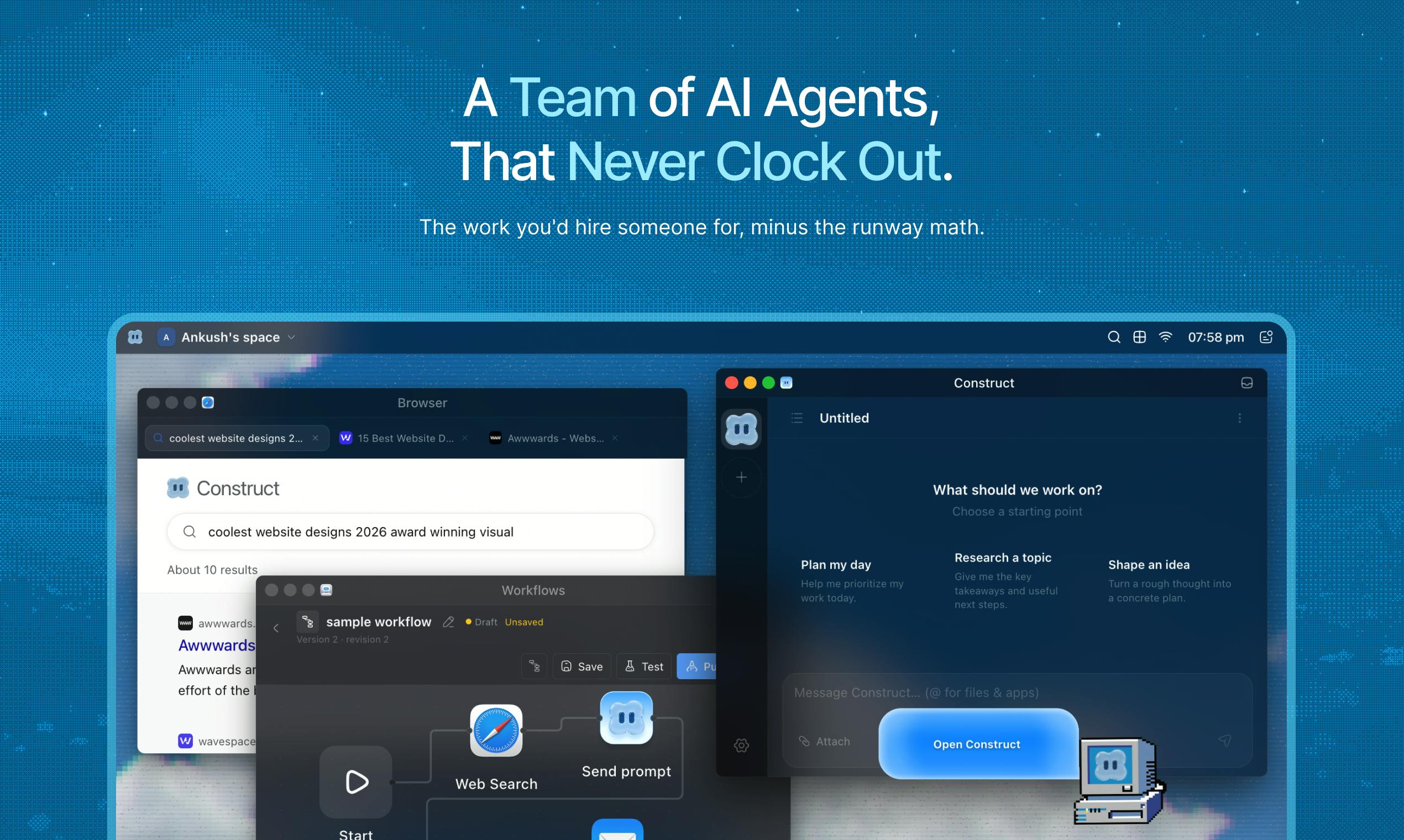
Construct Computer is a cloud workspace in which persistent AI agents can browse the web, execute code, manage files, send email, use connected applications, run scheduled tasks, and build internal tools. It targets solo founders and small teams that want an AI worker rather than a conversational assistant. Users can observe the agent’s desktop, interrupt or take over tasks, and reuse successful processes as workflows (official website).
The product is more substantial than a basic chat interface. Construct combines a browser desktop, ephemeral Linux environments, persistent memory, messaging channels, an agent inbox, workflow scheduling, subagents, and MCP-based extensibility. Public repositories and detailed architecture documentation provide evidence that a technically meaningful system exists, although important backend repositories referenced by the company were not publicly accessible when checked.
The strongest investment signal is the team’s apparent shipping velocity. Construct was founded in 2026, moved from persistent virtual machines to serverless Cloudflare infrastructure, established paid plans, published a broad product surface, and won Product Hunt’s Product of the Day on August 23, 2026 (Product Hunt awards). This demonstrates execution and launch interest, but not sustained product-market fit.
The principal concern is the near-total absence of commercial metrics. The company reported its first paying customer in April 2026 through LinkedIn, but revenue, total paying customers, active users, task completion, retention, gross margin, and customer references remain undisclosed. Construct also competes with substantially better-funded platforms, including ChatGPT agent, Claude Cowork, Manus, Microsoft Copilot Studio, and Genspark.
Product quality appears promising; company quality is not yet sufficiently evidenced; and the venture case depends on whether Construct can deliver reliable recurring work at attractive inference and infrastructure margins. Final decision: Watch, with an upgrade to DD only after meaningful paid-retention and unit-economic evidence.
Product Overview
Construct addresses the gap between AI that advises and AI that completes work. Typical chat products generate instructions or outputs but do not maintain a persistent operating environment, execute scheduled jobs, or manage multi-step work across applications.
Each user receives a cloud workspace with an agent, browser, terminal, file system, code editor, email address, calendar, memory, connected applications, and reusable workflows. The agent can also create private internal applications inside the workspace. Access is available through the web and selected Slack, Telegram, Discord, and email interfaces (terms).
Published pricing is:
- Lite: $7.50 per month on the displayed discounted billing option, up to two agents and 50 steps per task.
- Starter: $39 per month, up to five agents, scheduled tasks, agent email, and 1 GB storage.
- Pro: $199 per month, up to 15 agents, 1,000-step tasks, BYOK, and 3 GB storage.
- Enterprise: Custom pricing, with SSO, private deployment, and custom MCP scoped during sales discussions (pricing).
The homepage separately says plans start at $9 per month, apparently reflecting monthly rather than discounted billing. The billing-period presentation should be clarified, but this is not a material conflict.
Construct replaces combinations of virtual assistants, workflow-automation tools, cloud desktops, AI chat subscriptions, scripts, and manually operated SaaS applications. Its primary benefit is consolidating execution, memory, scheduling, and human supervision in one workspace.
Product quality: Promising and technically ambitious, but task reliability and customer outcomes have not been independently validated.
Founder and Team Assessment
Ankush Singh identifies himself as Construct’s co-founder and CTO. His personal site documents the platform architecture and links to the public repositories, demonstrating direct technical involvement (founder project page). Public profiles describe prior work on AI agents, developer tools, and blockchain projects, but no previous exit or scaled commercial company was verified.
Nischal Naik identifies himself as the other founder and focuses on AI, agent systems, Web3 infrastructure, and distributed systems. Product Hunt maker comments and his LinkedIn profile support his founder role, but detailed prior employment and commercial outcomes were not independently verified.
LinkedIn lists three associated employees and a company-size range of 2–10, including product designer Vibhansh Alok. This is a platform-supplied indicator rather than verified payroll headcount. No reliable hiring page was found.
Technical execution is the clearest strength. The company describes an event-driven architecture using Cloudflare Workers, Durable Objects, R2, D1, Containers, and AI Gateway. Containers sleep when idle, reducing the cost of maintaining persistent-feeling workspaces (architecture article).
Commercial capability is less clear. There is no public evidence of repeatable sales, enterprise procurement, partnerships, or previous go-to-market success. The business also presents geographic ambiguity: LinkedIn lists San Francisco headquarters, founder profiles reference Indian cities, and the terms place disputes under Indian law.
Founder Assessment: Strong early technical execution, but commercial experience, team commitment, and corporate structure require verification.
Market Opportunity
The initial customer is a digitally sophisticated solo founder or 2–20-person team that has recurring research, operations, reporting, communication, and internal-tool tasks but cannot justify additional full-time staff.
A narrow analyst scenario is:
1 million addressable small teams × $468 annual Starter price = $468 million potential annual revenue.
Alternatively:
100,000 automation-intensive teams × $2,388 annual Pro price = approximately $239 million.
These are analytical scenarios, not verified market-size figures. They assume Construct can reach internationally distributed software and internet businesses and that customers accept the current pricing.
Expansion opportunities include departmental deployments, agencies, e-commerce operations, sales operations, customer support, internal tool creation, enterprise agent governance, and an ecosystem of MCP applications. Geographic expansion is inherently possible because the product is cloud-delivered.
Timing is favorable but competitive. GitHub reported more than 180 million developers and rapid growth in AI-assisted development in 2025 (Octoverse). However, the broad demand for AI agents does not prove that small teams will delegate persistent, sensitive workflows to Construct.
The realistic market can support venture-scale revenue, but only if the product becomes a frequently used work system rather than an occasionally used demonstration.
Traction and Growth Signals
Construct launched on Product Hunt on August 23, 2026 and ranked #1 Product of the Day. Reliable vote and comment totals were not available. This is evidence of launch attention only.
The company reported obtaining its first paying customer before public beta in April 2026 (LinkedIn company post). No subsequent paying-customer count or revenue figure was disclosed.
Product activity is visible through frequent blog updates, public source repositories, pricing, terms, privacy documentation, and a functional web application. The public web-desktop repository was created in April 2026 and had two GitHub stars when checked (GitHub). Low repository engagement does not prove low product usage because the core product is proprietary, but it offers little evidence of developer-community adoption.
The company’s LinkedIn page had 35 followers when reviewed. No independent app-store ratings, G2 reviews, traffic estimates, case studies, enterprise contracts, or sustained community discussions were found.
Critical missing metrics include active workspaces, tasks completed, successful-task rate, paid conversion, revenue, cohorts, churn, workload frequency, and acquisition cost.
Traction Assessment: Strong shipping activity and positive launch attention, but commercially unverified.
Competitive Position
Direct competitors include Manus, Genspark, ChatGPT agent, Claude Cowork, and cloud-agent platforms offering browser and computer use. Indirect competitors include Zapier, Make, Microsoft Copilot Studio, virtual assistants, internal scripts, and vertical SaaS products.
Construct’s current differentiation is the integrated cloud computer: persistent memory, visible desktop execution, user takeover, agent email, scheduling, internal-app generation, and installable MCP tools. Its event-driven infrastructure may also deliver a cost advantage over always-on virtual machines.
Pricing is competitive. Claude Cowork is included with Claude Pro at $20 monthly, while ChatGPT, Manus, and Genspark have similarly accessible individual plans. Construct’s $199 Pro tier therefore needs to deliver substantially more completed work, not merely more features.
Switching costs may develop through stored files, memories, workflows, custom applications, email history, and connected accounts. However, no network effect or proprietary data advantage is yet demonstrated. Dependency on Cloudflare, Composio, model providers, MCP, and external SaaS APIs is considerable.
If the largest platform launched the same feature within six months, why would customers continue using Construct? A defensible answer would require measurably better task completion, lower cost, inspectable execution, customer-owned workflows, and model neutrality. Current public evidence does not establish those advantages.
Defensibility Assessment: Low
Business Model and Economics
Construct charges fixed subscription prices while enforcing internal model-cost budgets, task limits, storage quotas, concurrency limits, and session limits. Pro customers can bring keys from OpenAI, Anthropic, xAI, Bedrock, or OpenRouter, moving some model expense to the customer.
Variable costs include model tokens, Cloudflare Workers and Durable Objects, container CPU, storage, browser execution, email, Composio calls, observability, support, and payment processing. The company’s serverless architecture allows containers to sleep when inactive, which should improve margins relative to maintaining a VM for every account.
The key risk is adverse usage selection: customers who find agents valuable may run long, expensive jobs, while low-usage customers may churn. Fixed pricing works only if model and compute costs remain well below subscription revenue across cohorts.
Enterprise plans could provide expansion revenue through additional workspaces, private deployments, SSO, custom integrations, compliance, and support. No enterprise pricing or contracts are disclosed.
Unicorn Path
Assuming a 10× ARR multiple for a fast-growing AI SaaS business with strong retention and gross margins above approximately 70%:
Required ARR = $1 billion ÷ 10 = $100 million.
At the displayed Starter price:
$100 million ÷ $468 annually ≈ 214,000 paying teams.
At Pro pricing:
$100 million ÷ $2,388 annually ≈ 42,000 paying teams.
A blended enterprise model could reduce the required customer count. At an analyst-assumed $20,000 ACV, Construct would need approximately 5,000 enterprise customers. That assumption is not current company pricing.
Reaching this scale requires reliable multi-hour task execution, strong retention, enterprise security, audited controls, repeatable distribution, higher ACV, and gross margins that survive intensive model usage. Construct must also build defensible workflow data or an application ecosystem.
Unicorn Path: Conditional
Valuation Assessment
No reliable public information was found regarding external funding, investors, round size, SAFE cap, post-money valuation, cap table, or current fundraising terms.
Comparable products demonstrate substantial market interest, but their financing cannot responsibly determine Construct’s valuation without ARR, growth, retention, and margins. Agent products also have materially different infrastructure consumption and customer behavior from conventional SaaS.
Valuation Attractiveness: Not Assessable
Required information includes current ARR, monthly growth, gross margin by plan, retention, burn, runway, corporate entity, round size, SAFE or equity terms, investor ownership, and liquidation preferences.
Key Risks
- No verified commercial traction: Only one company-reported early paying customer is public.
- Task reliability: Long autonomous workflows compound model and tool errors.
- Platform competition: OpenAI, Anthropic, Microsoft, Manus, and Genspark can bundle similar capabilities.
- Unproven unit economics: Fixed pricing may be vulnerable to heavy token, browser, and compute usage.
- Security exposure: Agents can access email, files, credentials, terminals, and third-party applications.
- Low initial switching costs: Customers can move routine tasks to larger platforms.
- Third-party dependency: Cloudflare, Composio, model providers, and SaaS APIs affect availability and economics.
- Small-team risk: Product development, security, sales, and support appear concentrated in a few people.
- Corporate ambiguity: Headquarters, legal entity, governing jurisdiction, and founder employment locations need clarification.
- Privacy concern: The privacy policy states that the public website uses unmasked session replay, potentially including form inputs and network data.
Final Assessment
Venture Potential: 59/100
| Category | Score |
|---|---|
| Market Size and Expansion Potential | 17/20 |
| Traction and Growth Evidence | 5/20 |
| Founder and Team | 10/15 |
| Product Strength | 8/10 |
| Distribution Potential | 8/15 |
| Business Model and Economics | 6/10 |
| Defensibility | 5/10 |
| Total | 59/100 |
The strongest elements are product scope, technical velocity, market timing, and pricing breadth. The weakest are commercial validation, competitive defensibility, and unknown unit economics.
Evidence Confidence: 49/100
Product functionality, pricing, policies, technical architecture, founders, and launch ranking are publicly observable. The first paying customer is company-reported. Revenue, users, retention, margins, funding, cap table, and customer outcomes remain unavailable.
Final Decision: Watch
Construct is too early for formal diligence based on public evidence. It presents a credible product and a possible venture-scale market, but no verified traction demonstrates that customers repeatedly delegate valuable work or that such work is profitable.
Upgrade Conditions
- At least $500,000 ARR with sustained organic growth.
- More than 500 paying teams and identifiable non-founder acquisition channels.
- Six-month paid retention above 70%.
- Gross margin above 70%, including model and browser costs.
- Independent customer references showing recurring, completed workflows.
- Enterprise pilots with security and administrative requirements.
- Demonstrated reliability advantage over major bundled agents.
Downgrade Conditions
- Weak post-launch activation or rapid subscription churn.
- Model and infrastructure costs exceeding sustainable plan economics.
- Major platforms replicating the persistent-workspace experience.
- Security incidents involving credentials, email, or autonomous actions.
- Continued absence of a clear legal and corporate structure.
- Founders reducing commitment or product activity declining.
Questions for Further Diligence
- What are current MRR, paying workspaces, and monthly revenue growth?
- What percentages of trials convert to Lite, Starter, and Pro?
- What are 30-, 90-, and 180-day paid retention rates?
- How many tasks does an active customer run weekly, and what percentage complete successfully?
- What are gross margin and model-plus-infrastructure cost by plan?
- Which acquisition channels produced paying customers after Product Hunt?
- What workflows produce the strongest retention and willingness to pay?
- How are external side effects approved, audited, and reversed?
- Are both founders full-time, and what is the exact team structure?
- What are the legal entity, cap table, current burn, and runway?
- What valuation and terms are being sought in the current round?
- What proprietary data, workflow ecosystem, or technical advantage prevents incumbent replication?
Sources
- Construct Computer on Product Hunt
- Official website
- Official pricing
- Terms and product description
- Privacy policy
- Construct GitHub organization
- Web desktop repository
- Construct infrastructure architecture
- Ankush Singh’s Construct project page
- Construct Computer LinkedIn
- Claude Cowork
- Microsoft Copilot Studio pricing