
Table of Contents
Astute Investment Report
Category: B2B marketing software — creator/influencer partnership platform (“new media”)
Company Stage: Pre-seed; product relaunched August 17–19, 2026
Founder or Founders: Vida Stanić (CEO) and Abhishek Manikandan (CTO)[1]
Headquarters: New York, NY, US[2]
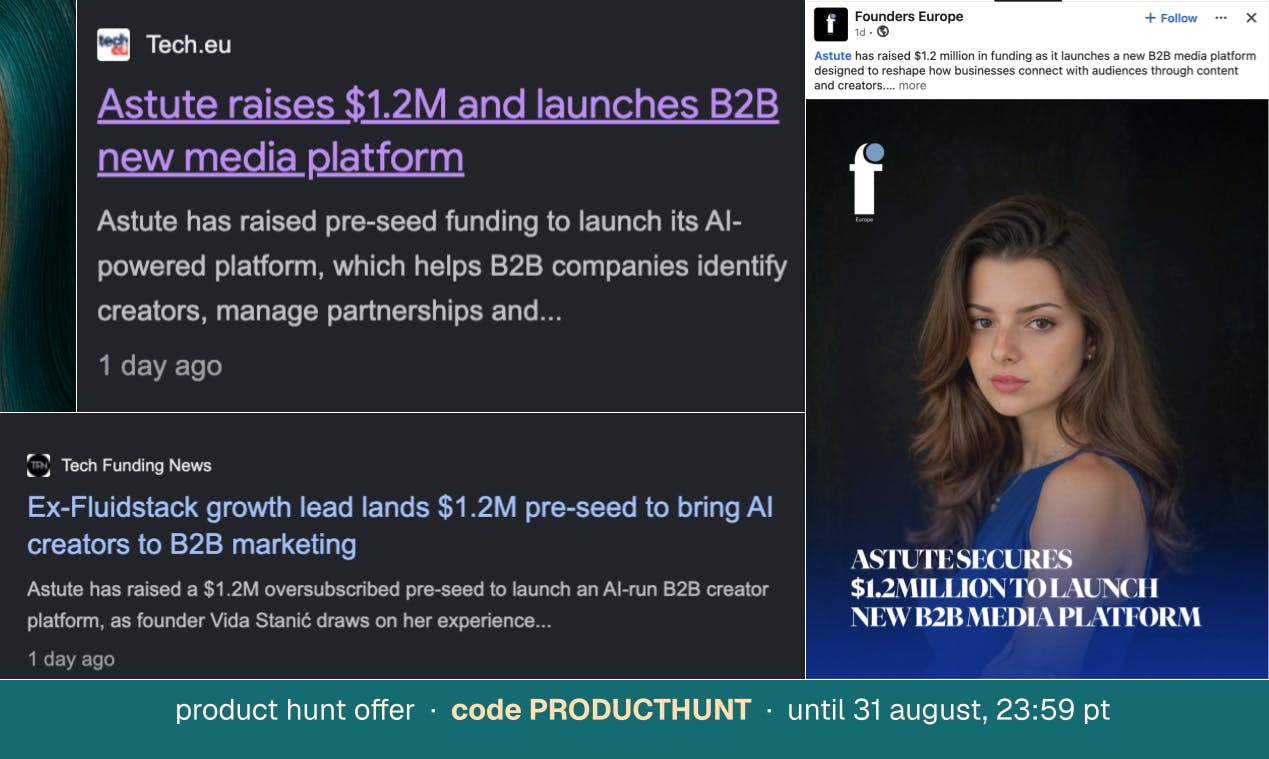
Funding: $1.2M (€1.03M) oversubscribed pre-seed, announced August 17, 2026; investors include Flyer One Ventures, Silicon Gardens, Marathon Fund, Entrepreneurs Roundtable Accelerator (ERA), and strategic angels[1][3]
Business Model: B2B SaaS subscription (Starter plan publicly cited at $199/month); no fees charged to creators[4]
Product Hunt Launch Date: August 19, 2026 (#1 Launch of the Day, ~500 upvotes, ~160 comments)[5][6][7]
Report Date: August 22, 2026
| Investment Metric | Assessment |
|---|---|
| Venture Potential | 51/100 |
| Unicorn Path | Conditional |
| Valuation Attractiveness | Not Assessable |
| Evidence Confidence | 48/100 |
| Final Decision | Watch |
Executive Summary
Astute is a New York-based pre-seed startup building what it calls the first “B2B new media platform”: software that matches B2B companies with independent newsletter writers, podcast hosts, and social creators, then automates outreach, negotiation, contracting, payment, and performance reporting via two AI agents. The wedge is that B2B buyers increasingly form opinions through independent voices rather than ads, PR, and SEO, while the tooling for B2B creator partnerships remains fragmented and manual.[1][3][8]
The strongest positive signal is founder-market fit. CEO Vida Stanić ran growth at Fluidstack during its rise from a $2M to a $2B valuation and previously was the first commercial hire at a pre-PMF B2B SaaS company; CTO Abhishek Manikandan is an Oxford-educated former ML engineer at The Trade Desk who built a B2B engineering audience with 15M+ YouTube views — he has literally been the creator on the other side of the table. The $1.2M round from credible funds (Flyer One Ventures, ERA) adds a second validation signal.[1][8][9]
The central concern is that there is no verifiable commercial traction. The product relaunched three days before this report; revenue, retention, and paying-customer counts are undisclosed, and the “100+ B2B companies” trust claim on the website is company-reported and unverified. The company also enters a market where Berlin-based Passionfroot has a three-year head start, $21M+ raised, 150+ B2B brand customers, and a proprietary creator-performance dataset — and where LinkedIn launched a native creator marketplace in June 2026.[10][11][12][13]
Product Hunt performance was strong (#1 of the day, ~500 upvotes), but per standard caution, this indicates launch interest, not product-market fit. Final decision: Watch.[5]
Product Overview
Astute’s customer is a B2B growth or marketing team — startups are the stated sweet spot — that wants pipeline from creator partnerships but lacks the staff to source, vet, negotiate, and track them. The product scans newsletters, podcasts, and social channels to map where a company, its competitors, and its category are discussed; builds a data-backed creator plan; then executes sourcing, negotiation, briefing, contracts, scheduling, and payment with one consolidated invoice. The company claims a matching pool of 16,000+ B2B creators and monitoring of “more than 1 million creator posts per minute” — both company-reported, and the latter figure is aggressive for a pre-seed infrastructure footprint and should be verified in diligence.[3][4][10]
Measurement is a stated focus: UTM-tagged creator links, optional proxy URLs and conversion pixels, GA integration, plus “AI engine visibility” and earned-media monitoring across social, podcasts, and newsletters. This is a credible answer to the attribution question, though it measures visibility more readily than pipeline. Pricing starts at $199/month (Starter), with free trials used as an acquisition lever; higher tiers exist but were not publicly verifiable at report date. The product replaces a manual workflow (agency retainers, spreadsheets, cold DMs) rather than an incumbent software category.[4]
Founder and Team Assessment
Stanić, 25, was born in Belgrade, moved to the UK at 17 on a full academic scholarship, joined FairHQ as first commercial hire, then Fluidstack as an early commercial hire where she led growth through hypergrowth, entered Entrepreneurs First, and relocated to NYC in January 2026. A podcast interview indicates she previously abandoned an earlier AI startup model despite early customer traction — evidence of pivot discipline, though also a reminder the current thesis is young. Manikandan brings the technical and creator-side credentials noted above. LinkedIn shows 1–10 employees and ~199 followers; a “Founding Operator” role is open, indicating early hiring. Both founders appear full-time; key-person risk is high at this size.[2][8][9][14][15][16]
Founder Assessment: Exceptional founder-market fit and commercial instincts for the stage, but team depth, retention of early hires, and ability to build an enterprise-grade product remain unproven.
Market Opportunity
The initial segment is narrow: B2B startups and scale-ups (roughly Seed–Series C) that already buy or want to buy newsletter/podcast sponsorships. Influencer marketing overall was ~$32.6B in 2025 and is projected at ~$40.5B in 2026; B2B influencer spend is estimated at ~$4.1B in 2026, growing ~47% YoY, making it the fastest-growing subcategory. Third-party estimates of the platform-software layer conflict wildly — from ~$1.15B (MarketsandMarkets) to ~$34B (Grand View) for 2026 — reflecting definitional differences, so these top-down figures should be discounted.[8][17][18][19]
Bottom-up: if 30,000–60,000 B2B companies globally would pay $2,400–$12,000/year for creator-partnership software, the initial software TAM is roughly $70M–$700M ARR — meaningful but not obviously venture-scale on SMB subscriptions alone. Expansion vectors exist: enterprise ACVs, owned-audience/brand-building tooling (on the stated roadmap), AI-search visibility analytics (52% of B2B tech marketers already rank AI answer engines as their top content channel), and potentially payments/take-rate economics. Market timing is genuinely favorable; the question is whether the software layer captures enough of the spend flowing through it.[3][4]
Traction and Growth Signals
Verified: Product Hunt #1 of the day on August 19, 2026 with ~498–519 upvotes and ~160 comments (third-party trackers differ slightly by snapshot time), 800 product followers, and an engaged comment thread with substantive attribution questions. The $1.2M oversubscribed pre-seed is independently corroborated by multiple outlets and an investor quote. Company-reported but unverified: “100+ B2B companies” as customers and 16,000+ creators. Product history shows a first launch in March 2026 and a full relaunch in August 2026 — iteration velocity is a mild positive. Missing and material: revenue, paying customers, retention, conversion from free trial, and post-launch usage. There is no App Store presence (web product) and no public GitHub signal.[1][4][5][6][8][10][20][21]
Traction Assessment: Strong launch attention and investor validation, but commercially unverified.
Competitive Position
Direct competitors: Passionfroot (150+ B2B brands including ElevenLabs, Figma, Replit; $10M+ paid to creators; profitable; $21M+ raised; AI agent Zest and a proprietary Creator Graph); LinkedIn’s native Creator Marketplace (alpha, US/Canada, invite-only, inside Campaign Manager); plus Naano, Favikon, Limelight, Upfluence, Heepsy, insightIQ, and Thinkers360 at various adjacencies. Free/manual alternatives — cold outreach, agencies, spreadsheets — remain the real status quo.[11][12][13][22][23][24]
Astute’s claimed differentiation is end-to-end agentic execution (not just discovery), cross-channel coverage beyond one platform, no creator-side fees, and attribution extending to AI-search visibility. If LinkedIn or Passionfroot replicated the feature set within six months, Astute’s answer would rest on cross-platform data and neutrality — plausible but not yet demonstrated, and Passionfroot’s campaign-data moat is already compounding. Switching costs are low; there is no proprietary data advantage yet.[4][10]
Defensibility Assessment: Low
Business Model and Economics
The model is SaaS subscription from $199/month, explicitly taking no cut or fees from creators; brands pay creator fees directly while Astute charges for sourcing, matching, outreach, admin, and payouts infrastructure. Implied entry ACV is ~$2,400/year. Gross margins should be software-like, but agentic execution carries real variable costs: LLM inference, data enrichment, and — more importantly — human-in-the-loop quality risk, since “agency without the retainer” positioning can drift into high-touch service economics. Not charging a take rate avoids marketplace disintermediation but caps revenue per dollar of creator spend orchestrated; adding payments-based monetization later (as Passionfroot does with its Wallet) is an obvious lever. CAC, conversion, churn, and margin are all undisclosed.[4][11]
Unicorn Path
Assume a 8–10x forward ARR multiple, appropriate for high-growth vertical SaaS/AI tooling. Required ARR for $1B ≈ $100M–$125M.
- At the $199/month Starter price: ~42,000–52,000 paying customers — unrealistic for a B2B niche tool.
- At a blended $12,000/year ACV: ~8,300–10,400 customers — demanding but conceivable with enterprise tiers.
- At $50,000/year enterprise ACV: ~2,000–2,500 customers — requires a credible enterprise motion the product does not yet have.
Reaching this requires: moving upmarket, expanding from partnerships into the broader “new media” platform (owned audiences, AI-visibility analytics), likely adding transaction/payments revenue, and international expansion. Each is stated or implied ambition; none is evidenced yet.
Unicorn Path: Conditional
Valuation Assessment
Round size ($1.2M) and investors are known; post-money valuation and terms are not publicly disclosed. With revenue undisclosed and the product days post-relaunch, no responsible valuation range can be constructed. Valuation Attractiveness: Not Assessable. Required to assess: current MRR/ARR, growth, retention, gross margin, burn/runway, pre-seed post-money or SAFE cap, and ownership structure.[1]
Key Risks
- No verifiable commercial traction; “100+ companies” claim unverified[10]
- Well-funded direct competitor (Passionfroot) with data moat and enterprise beachhead[11]
- Platform replication risk from LinkedIn’s native marketplace[13]
- Service-drift risk eroding SaaS margins (agentic execution may require human ops)
- Attribution credibility risk — overpromising pipeline measurement would damage trust
- Low switching costs and churn-prone SMB segment at $199/month
- Key-person dependency on two founders; team of <10[2]
- Unverified technical claims (1M posts/minute monitoring)[3]
- Creator supply-side liquidity unproven without creator-side monetization
- Limited runway implied by a $1.2M round in a competitive hiring market
Final Assessment
Venture Potential: 51/100
| Category | Score |
|---|---|
| Market Size and Expansion Potential | 13/20 |
| Traction and Growth Evidence | 6/20 |
| Founder and Team | 10/15 |
| Product Strength | 6/10 |
| Distribution Potential | 8/15 |
| Business Model and Economics | 5/10 |
| Defensibility | 3/10 |
| Total | 51/100 |
Strongest: founder-market fit and market timing. Weakest: absent traction evidence and thin defensibility.
Evidence Confidence: 48/100
Verified: funding, investors, founders’ identities and backgrounds, launch metrics, pricing entry point. Company-reported: customer count, creator pool, monitoring scale. Unavailable: revenue, retention, valuation, margins, burn.
Final Decision: Watch
The company is three days past relaunch with credible founders, real investors, and a well-timed thesis, but zero public commercial evidence and a formidable competitor set. This is precisely the profile Watch exists for.
Upgrade Conditions
- Verified $500K+ ARR or 50+ paying customers with cohort retention >70% at six months
- Evidence of ACV expansion beyond $199/month (enterprise contracts)
- Disclosed pre-seed valuation enabling price assessment
- Demonstrated creator-supply liquidity and repeat-campaign rates
Downgrade Conditions
- Free-trial cohort fails to convert; launch attention does not sustain
- Passionfroot or LinkedIn ships equivalent agentic execution
- Margin structure reveals services-heavy delivery
- Any inflation of customer or monitoring claims
Questions for Further Diligence
- Current MRR and paying-customer count; how many of the “100+ companies” pay?
- Free-trial-to-paid conversion and 90/180-day retention by cohort?
- What share of campaigns are rebooked (repeat rate)?
- Gross margin per customer, including inference, enrichment, and any human ops cost?
- How is the “1M posts/minute” monitoring technically and financially achieved?
- What is the mix of self-serve vs. founder-led sales, and CAC by channel?
- Post-money valuation and terms of the $1.2M round; current burn and runway?
- Full-time team count and the Founding Operator hiring plan?
- Why did the March→August relaunch happen — what broke in v1?
- What proprietary performance data accumulates per campaign, and how does it compound vs. Passionfroot’s Creator Graph?
- Roadmap and pricing for enterprise tiers and owned-audience tooling?
- Any creator-side exclusivity, contracts, or supply commitments?
Sources
- Product Hunt — Astute (launch page and maker comments)
- Tech Funding News — Ex-Fluidstack growth lead lands $1.2M pre-seed
- The Recursive — Astute raises over €1M pre-seed
- The Investor Society — Astute raises US$1.2M
- Astute official site and Our Story
- Vida Stanić personal site and LinkedIn launch post
- LinkedIn — Astute company page and Founding Operator job post
- OrangeWip podcast — Ep. 198 Vida Stanić
- Yahoo/PRNewswire — Passionfroot $15M Series A and TechCrunch coverage
- Digiday — LinkedIn B2B creator marketplace
- Nodus — PH daily stats and hunted.space (secondary, launch metrics)
- Digital Applied — influencer marketing statistics (secondary, market sizing)