
Table of Contents
Loqua Investment Report
Category: AI voice dictation and desktop productivity software
Company Stage: Public launch / pre-seed-equivalent; financing stage not disclosed
Founder or Founders: Joshua Zhou (company-reported; background not independently verified)
Headquarters: Wilmington, Delaware mailing address; operating headquarters not publicly disclosed
Funding: Not publicly disclosed
Business Model: Freemium consumer/prosumer SaaS; team and enterprise plans planned
Product Hunt Launch Date: September 11, 2026
Report Date: September 14, 2026
| Investment Metric | Assessment |
|---|---|
| Venture Potential | 48/100 |
| Unicorn Path | Conditional |
| Valuation Attractiveness | Not Assessable |
| Evidence Confidence | 31/100 |
| Final Decision | Watch |
Executive Summary
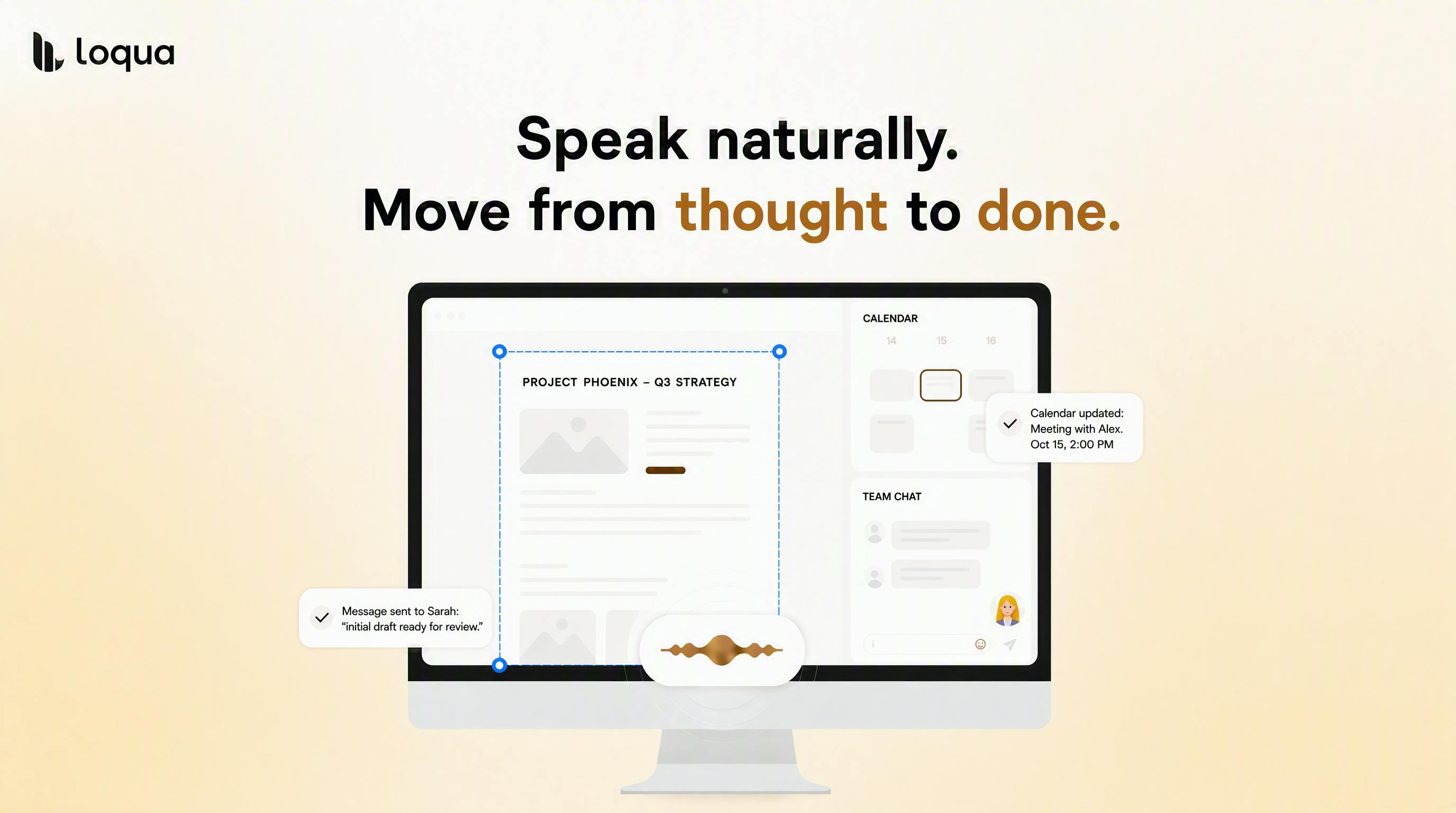
Loqua is a desktop voice-productivity application that converts natural speech into edited and formatted text across other applications. It also provides screen capture-based questions, voice-directed rewriting, translation, text-to-speech, and limited desktop actions. It currently supports macOS and Windows, while mobile, team management, and enterprise plans remain on the roadmap (official website; FAQ).
The product addresses a credible problem: professionals often formulate ideas faster than they can type, while conventional dictation produces text that still requires editing. Loqua’s intended advantage is contextual transformation—adapting tone, structure, and output to the active application—rather than transcription alone.
The strongest investment signal is category validation. Direct competitor Wispr Flow announced a $280 million Series B at a $2 billion valuation and reports more than 60 billion words written, use within almost all Fortune 500 companies, and over 10,000 enterprises (Wispr announcement). These are company-reported figures, but they demonstrate that voice-first productivity can attract substantial adoption and capital.
Loqua itself, however, has almost no verified commercial evidence. It ranked second on Product Hunt on September 11, but revenue, paying customers, active users, retention, conversion, traffic, and post-launch usage have not been disclosed (Product Hunt leaderboard). The website claims “thousands of professionals” use Loqua daily, but no methodology, customer identities, usage dashboard, or independently verifiable reviews support that statement (official website).
Product quality appears promising from the published functionality, but company quality, defensibility, and commercial execution remain unproven. The appropriate decision is Watch, pending evidence that launch attention converts into retained paid usage.
Product Overview
Loqua replaces a workflow in which users dictate rough text, copy it into an AI editor, correct formatting, and paste the result into another application. A global shortcut allows dictation directly into products such as email, Slack, Notion, terminals, and other text fields. The product removes filler words, recognizes abandoned phrases, creates headings and lists, translates speech, and changes tone based on context (official website).
Additional features include:
- Capture to Ask: Select a screen region and ask questions about it.
- Speak to Edit: Highlight text and request a rewrite by voice.
- Command to Go: Create calendar items, open webpages, and perform selected actions.
- Read Aloud: Convert selected text into audio.
- Personal dictionary: Store names, technical vocabulary, and recurring terminology.
The free plan includes 5,000 dictated words and ten Capture-to-Ask requests per week. Pro is presented at approximately $12 monthly or $10 per month when billed annually, with unlimited dictation and full contextual features (pricing page). A 14-day Pro trial requires no credit card.
The product is downloadable for macOS and 64-bit Windows. It requires an internet connection for speech and AI processing; mobile applications are not yet available (download page; FAQ).
Product-quality assessment: Broad and relevant feature design, but accuracy, latency, reliability, and cross-application compatibility lack independent benchmarks.
Founder and Team Assessment
Joshua Zhou identifies himself on Product Hunt as Loqua’s founder and describes his career as focused on speech and LLM research (Product Hunt). No reliable public record was found verifying previous employers, academic research, prior startups, exits, or management experience.
A public LinkedIn search result identifies Ling Miao in growth and product marketing at Loqua, but the full team composition and employment status could not be independently confirmed. The website describes a “dedicated voice AI team with full model iteration capabilities,” without identifying researchers, publications, proprietary models, or benchmarks (official website).
Loqua’s terms identify FlowMind Technology Inc. as the service provider and give a Wilmington mailing address (terms). The same entity also operates the Glinvo AI image/video service, indicating either a multi-product company or product studio rather than an exclusively Loqua-focused organization (Glinvo privacy policy). Founder commitment and allocation of personnel therefore require verification.
Founder Assessment: Potential technical founder-market fit, but credentials, team depth, commercial capability, and full-time focus remain unverified.
Market Opportunity
The initial customer is a heavy-typing professional—founder, developer, product manager, marketer, writer, consultant, or accessibility user—willing to pay approximately $120 annually to reduce typing and editing time.
A bottom-up analyst scenario assumes 10–25 million globally reachable, AI-comfortable professionals with sufficiently high writing volume and willingness to pay. At $120 per year, that implies a serviceable subscription opportunity of approximately $1.2–$3.0 billion annually. This is an analyst assumption, not a verified market-size figure.
Expansion opportunities include mobile dictation, team administration, enterprise security, meeting transcription, APIs, vertical dictionaries, workflow agents, and multilingual markets. The direct competitor’s reported enterprise adoption supports the possibility of moving beyond individual subscriptions (Wispr announcement).
The market can support a venture-scale company, but Loqua must win share in a crowded category rather than merely participate in a large market.
Traction and Growth Signals
Loqua launched on September 11, 2026 and finished #2 Product of the Day (Product Hunt leaderboard). A reliable public vote count was not captured, and the launch is too recent to measure sustained momentum.
The company claims thousands of daily professional users and displays numerous testimonials, but neither the usage claim nor the testimonial identities are independently verified (official website). No reliable public evidence was found for:
- Revenue, MRR, or growth
- Paying customers or conversion
- Daily or monthly active users
- Retention or churn
- Download totals
- Independent app-store reviews
- Website traffic
- Enterprise contracts
- Hiring momentum
- Public GitHub activity
Traction Assessment: Positive launch attention, but commercially unverified.
Competitive Position
Direct competitors include Wispr Flow, Superwhisper, Willow, Monologue, and Aqua; TechCrunch identifies these as active AI-dictation competitors (TechCrunch). Superwhisper offers cloud and local models across macOS, Windows, and iOS for $8.49 monthly or $84.99 annually (Superwhisper pricing). Wispr is already available across desktop and mobile, with team administration and enterprise security controls (Wispr pricing).
Free alternatives include built-in operating-system dictation. Apple’s macOS Dictation enters text across applications, supports auto-punctuation in eligible languages, and may process general dictation on-device depending on configuration (Apple support).
Loqua differentiates through one interface combining polished dictation, screenshot understanding, rewriting, read-aloud, and desktop actions. Nevertheless, switching costs appear low, and no proprietary data, distribution agreement, network effect, or independently demonstrated model advantage has been established.
If a large platform launched equivalent contextual voice editing within six months, customers would continue using Loqua only if it delivered materially higher accuracy, lower latency, better personalization, or deeper cross-application automation. None of those advantages is yet proven.
Defensibility Assessment: Low
Business Model and Economics
The current model is direct freemium SaaS with an estimated paid ACV of $120–$144. Team and enterprise plans are “coming soon,” so present monetization is primarily prosumer subscription revenue (pricing page).
Software gross margins could be attractive, but speech recognition, LLM rewriting, screenshot analysis, text-to-speech, and unlimited usage create variable inference and infrastructure costs. Loqua discloses that third-party AI and cloud providers may process voice, text, prompts, and screenshots, but does not identify providers or per-user costs (privacy policy).
Direct web billing avoids mandatory mobile app-store fees today, although future mobile distribution could introduce platform commissions. Payment-processing fees, support costs, free-tier consumption, and heavy-user inference expense remain unknown.
The key economic question is whether paid revenue rises faster than speech and multimodal processing costs. Gross margin, usage distribution, CAC, payback, and renewal data are required before the model can be underwritten.
Unicorn Path
Assume a 10× ARR multiple, appropriate only for a high-growth subscription company with strong retention, premium gross margins, and category leadership.
Required ARR = $1 billion ÷ 10 = approximately $100 million.
At $120 annual revenue per individual subscriber, Loqua would need approximately:
$100 million ÷ $120 = 833,000 paying subscribers.
Actual requirements would be higher after discounts, payment fees, churn, and any revenue recognized net of refunds. Alternatively, at an enterprise-equivalent $300 per paid seat annually, approximately 333,000 enterprise seats would be required.
Reaching this scale requires mobile distribution, independently superior speech performance, repeatable organic or enterprise acquisition, team administration, security certifications, high retention, and expansion beyond basic dictation into workflows or voice agents. The category has produced a unicorn, but Loqua has not demonstrated the assets that enabled that outcome.
Unicorn Path: Conditional
Valuation Assessment
No reliable funding announcement, investor disclosure, SAFE cap, secondary transaction, or current valuation was found. Revenue and financing terms are also unavailable.
Wispr’s $2 billion financing is a category comparable, not a responsible basis for valuing an unverified launch-stage competitor. Its reported scale, proprietary model investment, enterprise footprint, and $361 million of capital materially distinguish it from Loqua (Wispr announcement).
Valuation Attractiveness: Not Assessable
Assessment requires current ARR, growth, retention, gross margin, burn, runway, round size, valuation cap or post-money valuation, cap table, investor ownership, and liquidation preferences.
Key Risks
- No verified revenue, retention, conversion, or active-user evidence.
- Intense competition from a heavily financed category leader.
- Low switching costs and rapid feature commoditization.
- Unproven accuracy and latency relative to alternatives.
- Potentially high inference costs under “unlimited” usage.
- Desktop-only distribution while competitors support mobile.
- Founder credentials, team size, and commitment are insufficiently verified.
- Enterprise readiness is incomplete; team plans are still forthcoming.
- Sensitive voice and screen data pass through unidentified third-party providers.
- “Zero cloud data retention” marketing requires reconciliation with a privacy policy allowing provider processing and variable retention.
Final Assessment
Venture Potential: 48/100
| Category | Score |
|---|---|
| Market Size and Expansion Potential | 15/20 |
| Traction and Growth Evidence | 4/20 |
| Founder and Team | 5/15 |
| Product Strength | 7/10 |
| Distribution Potential | 7/15 |
| Business Model and Economics | 6/10 |
| Defensibility | 4/10 |
| Total | 48/100 |
The strongest element is a validated category with meaningful consumer and enterprise expansion opportunities. The weakest elements are the absence of commercial evidence and defensibility against better-funded competitors and operating-system features.
Evidence Confidence: 31/100
Verified public evidence covers product availability, features, pricing structure, legal-provider identity, privacy terms, desktop platforms, and Product Hunt ranking. Founder experience, usage claims, and testimonials are company-reported. Market sizing and unicorn customer requirements are analyst estimates. Revenue, retention, funding, valuation, unit economics, cap table, team size, and runway remain unavailable.
Final Decision: Watch
Loqua is too early and insufficiently documented for formal due diligence. The product may be useful and the category can produce venture outcomes, but current evidence supports neither product-market fit nor a defensible path to category leadership.
Upgrade Conditions
- At least $1 million ARR with sustained monthly growth.
- Verified paid conversion and 180-day subscriber retention.
- Gross margin above 70% after inference costs.
- Evidence of repeatable acquisition beyond Product Hunt.
- Enterprise pilots or contracts with customer references.
- Independent benchmarks showing superior accuracy or latency.
- Verified founder credentials, dedicated team, and full-time commitment.
Downgrade Conditions
- Weak post-launch active usage or paid conversion.
- High subscription churn after the trial period.
- Inference costs preventing acceptable gross margins.
- Rapid replication by leading competitors or operating systems.
- Failure to ship mobile and team functionality.
- Material security, privacy, or marketing-claim inconsistencies.
- Evidence that Loqua is a lightly supported product within a broader app portfolio.
Questions for Further Diligence
- What are current MRR, paying subscribers, and monthly revenue growth?
- How many DAU and MAU does Loqua have, excluding trial-only accounts?
- What are 30-, 90-, and 180-day retention by signup cohort?
- What percentage of free-trial users convert, and what is monthly paid churn?
- Which acquisition channels produce retained customers, and what are CAC and payback?
- What is gross margin after speech, LLM, screenshot, hosting, and support costs?
- What percentage of usage comes from the heaviest 10% of users?
- Which speech and LLM components are proprietary versus third-party?
- What measurable accuracy, latency, or zero-edit advantage exists over Wispr and Superwhisper?
- Who works full-time on Loqua, and how is FlowMind’s team divided across its products?
- What are burn, runway, cap table, current valuation, round size, and financing terms?
- Which processors receive voice and screenshot data, and what contractual retention guarantees apply?