
Table of Contents
Lenz Investment Report
Category: AI verification infrastructure / fact-checking API
Company Stage: Early-stage, pre-seed or bootstrapped; commercial stage not publicly disclosed
Founder or Founders: Kosta Jordanov, co-founder and CEO; Victoria Dodeva, co-founder
Headquarters: Sofia, Bulgaria appears to be the operating base; legal headquarters not publicly disclosed
Funding: Not publicly disclosed
Business Model: Subscription SaaS and usage-based API, with custom enterprise contracts
Product Hunt Launch Date: April 3, 2026; latest API-focused launch August 27, 2026
Report Date: August 30, 2026
| Investment Metric | Assessment |
|---|---|
| Venture Potential | 66/100 |
| Unicorn Path | Conditional |
| Valuation Attractiveness | Not Assessable |
| Evidence Confidence | 56/100 |
| Final Decision | DD |
Executive Summary
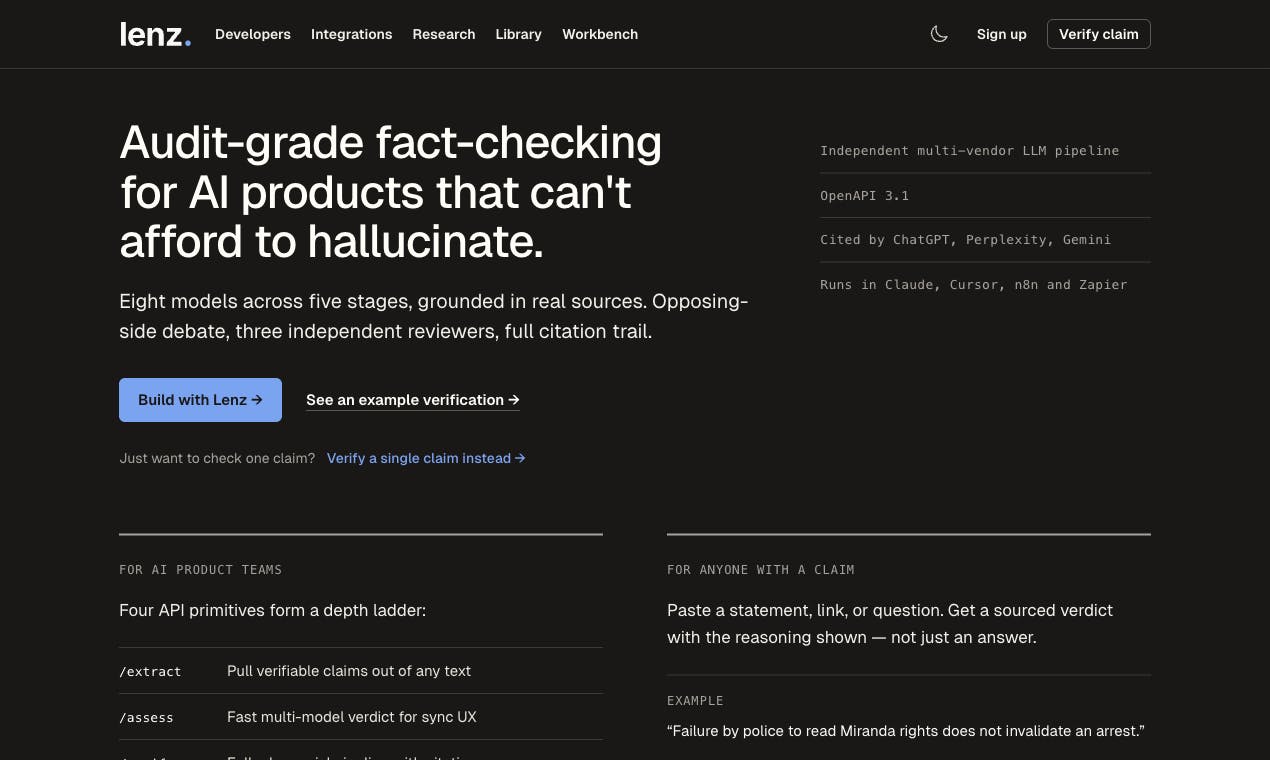
Lenz is an API and web application for checking factual claims in AI-generated or human-written content. It extracts individual claims, retrieves sources, runs multiple models through research and adversarial-review stages, and returns a verdict, confidence assessment, citations, and audit trail. It targets AI product teams, research organizations, publishers, due-diligence providers, and other users for whom inaccurate generated content can create legal, financial, or reputational harm (official website; developer documentation).
Product quality appears promising. Lenz offers clear API primitives, Python and TypeScript SDKs, an MCP server, a CLI, and integrations with n8n, Zapier, Claude, Cursor, and ChatGPT. The product is more transparent than a single-model fact-check because users can inspect its evidence, competing arguments, reviewer outputs, and citations. However, transparent reasoning does not prove that the final verdict is correct.
The strongest investment signal is founder quality. CEO Kosta Jordanov has more than two decades of software and company-building experience. He co-founded FITE, a sports-streaming platform acquired by Triller, and is a founder and board member of publicly traded Wiser Technology (Wiser biography; FITE acquisition announcement). Co-founder Victoria Dodeva reports approximately 15 years of growth and revenue-marketing experience. This is an unusually experienced founding team for such an early product.
The largest concern is lack of commercial evidence. Revenue, paying customers, retention, gross margin, customer acquisition cost, and enterprise deployments are not disclosed. Public developer adoption is still modest. Moreover, Lenz’s research demonstrates that models disagree; it does not establish that Lenz’s multi-model adjudication is more accurate than strong retrieval-augmented alternatives or expert human review.
Lenz has a potentially venture-scale position as an independent trust layer for AI-generated content, but the current $99–$399 self-service pricing and expensive multi-model workflow are unlikely by themselves to create unicorn economics. Enterprise contracts, high-volume API usage, proprietary evaluation data, and recognized assurance standards are necessary. Final Decision: DD, focused on accuracy validation, paid adoption, unit economics, privacy controls, and financing terms.
Product Overview
Lenz addresses a growing operational problem: businesses increasingly place AI-generated answers, reports, and recommendations in front of customers, but single-model systems can produce unsupported or incorrect factual claims. Manual fact-checking is slow, while a second prompt to the same or another model may merely produce another confident opinion.
Lenz provides four API functions:
/extractidentifies atomic, verifiable claims in text./assessreturns a relatively fast three-model assessment in approximately 5–10 seconds./verifyruns a deeper eight-model process, with retrieval, adversarial debate, panel review, citations, and an approximately 90-second stated processing time./askanswers follow-up questions using the verification’s evidence (developer page).
The product is available through a browser Workbench, REST API, Python and TypeScript SDKs, CLI, remote MCP server, n8n node, Zapier app, WhatsApp, and AI-assistant connectors (integrations). The primary benefit is a structured, reviewable verification record that can be inserted before publication, used in CI testing, or generated after a customer reports a questionable output.
Pricing is:
- Free: 100 credits monthly
- Plus: $7.99 monthly for 500 credits
- Developer: $99 monthly or $999 annually for 5,000 credits
- Scale: $399 monthly or $3,990 annually for 20,000 credits
- Enterprise: Custom pricing, volume, SLAs, white-labeling, and integration support
A standard deep verification consumes ten credits, while a fast assessment consumes one. Thus, Developer supports up to 500 standard deep verifications monthly and Scale supports 2,000 (Terms; pricing description).
Founder and Team Assessment
Kosta Jordanov is identified as Lenz’s founder and CEO, while Victoria Dodeva is identified as a co-founder. Jordanov describes himself as a four-time founder. Primary and reputable sources verify two significant outcomes: FITE was acquired by Triller in 2021, and Jordanov is a founder, shareholder, and board member of Wiser Technology (Triller; Wiser). His profile also claims an earlier Arexus acquisition by Framfab, but transaction details were not independently verified sufficiently for this report.
Dodeva’s public profile describes 15 years of growth and lead-generation experience across consumer and B2B technology. Her prior association with FITE suggests that the founders have worked together previously, although her exact Lenz ownership and executive scope are not disclosed.
LinkedIn lists three employees, while a company post depicts a six-person working group including researchers and developers. These figures may reflect contractors or collaborators rather than employees, so exact team size is not verified (LinkedIn company page). A current search for a founding customer-success lead indicates movement toward commercial execution, but also suggests that customer onboarding and sales capabilities are still being built.
Key-person risk is meaningful because Jordanov appears central to product strategy, research, fundraising credibility, and external positioning. His continuing board responsibilities at Wiser should be examined for time allocation and conflicts.
Founder Assessment: Strong prior company-building and exit experience, with relevant technical and commercial credibility; current team depth and full-time allocation require verification.
Market Opportunity
The initial target segment should be defined narrowly as organizations that generate factual text using AI and face material costs from errors: legal-research products, diligence and market-intelligence tools, financial content systems, enterprise copilots, research publishers, and compliance-sensitive report generators.
An illustrative bottom-up market scenario is:
- 25,000–100,000 potentially relevant product teams worldwide
- $5,000–$50,000 annual spending per customer
- Implied addressable revenue of approximately $125 million–$5 billion
These are analyst assumptions, not verified market statistics. The lower end reflects self-service API use; the upper end requires enterprise-wide verification, audit retention, governance, contractual support, and high-volume document processing.
Adjacent markets include AI model evaluation, RAG quality monitoring, misinformation detection, editorial workflows, corporate communications, insurance claims, healthcare content, education, and regulated decision-support systems. Geographic expansion is feasible because the API already supports twelve response languages, although source availability and verification accuracy may vary materially by language (developers).
The category can support venture-backed companies. Patronus AI raised a $17 million Series A for AI evaluation, Galileo raised a $45 million Series B, and Factiverse raised €1 million for automated fact-checking (Patronus; Galileo; Factiverse). However, Lenz’s narrower fact-verification positioning may limit its market unless it expands into broader AI assurance and evaluation.
Traction and Growth Signals
Lenz’s August 27 launch ranked #3 Product of the Day with approximately 250 points. Its Product Hunt profile shows 381 followers and two launches, with the original product appearing to have launched April 3, 2026 (Product Hunt; daily leaderboard). No meaningful body of Product Hunt reviews is available.
The company reports a public library containing thousands of completed verifications. Its research used 1,000 recent eligible user-submitted claims, providing evidence of real product activity, but not paying adoption or retention (research).
Developer distribution remains early. During the 30 days ending August 28, 2026, the lenz-io npm package recorded 586 downloads, while the Python package recorded 920 downloads. Package downloads include upgrades, automation, and internal activity, so they cannot be interpreted as unique users (npm; PyPI Stats). The research repository had one star and one fork, indicating limited open-source reach despite active updates (GitHub).
No named paying customers, enterprise case studies, revenue figures, retention cohorts, or independent accuracy comparisons were found.
Traction Assessment: Demonstrated usage and active product development, but commercially unverified.
Competitive Position
Direct competitors include Factiverse and automated fact-checking services. Broader competitors include Patronus AI, Galileo, Vectara, Cleanlab, Giskard, and other AI-evaluation platforms. Free or bundled alternatives include Google’s Fact Check Tools API, model-native web search, custom RAG pipelines, and human review.
Lenz differentiates through multi-provider debate, source-quality scoring, claim-level outputs, and a visible audit trail. Its research and public verification library can support brand credibility and organic distribution. Integrations make it easier to insert into existing production workflows.
Defensibility is not yet strong. Models with search can imitate a simplified verification workflow, and enterprise evaluation vendors can add fact-checking. Switching costs are limited because Lenz is an API and returns portable outputs. There is no demonstrated network effect.
If OpenAI, Google, Anthropic, or a major evaluation platform launched an equivalent feature within six months, customers would continue using Lenz only if it delivered independently validated accuracy, cross-provider neutrality, stronger auditability, and contractual independence from the model that generated the original content. These advantages are plausible but not yet proven.
Defensibility Assessment: Medium-Low
Business Model and Economics
Lenz earns recurring subscription and potentially enterprise-contract revenue. At current list prices, annual self-service contract values range from approximately $96 for Plus to $999 for Developer and $3,990 for Scale.
The principal economic risk is model cost. A deep verification uses eight model calls across research, debate, and review stages, reportedly takes about 90 seconds, and can include search-provider charges. At $399 per month for up to 2,000 deep checks, list revenue is approximately $0.20 per verification before discounts. That creates a demanding cost structure unless many customers use less than their allowance, calls are highly optimized, or provider costs are unusually low.
The model can improve through unused allowances, cheaper models, caching, batch processing, and enterprise pricing. Conversely, power users could generate weak or negative contribution margins. Gross margin by endpoint and customer cohort is therefore a central diligence issue.
Unicorn Path
A 10× ARR multiple is assumed for a high-growth AI infrastructure company with strong retention and gross margins. This implies:
Required ARR = $1 billion ÷ 10 = approximately $100 million.
At current prices:
- Developer annual plan at $999: approximately 100,000 customers
- Scale annual plan at $3,990: approximately 25,000 customers
- Hypothetical $50,000 enterprise ACV: approximately 2,000 customers
- Hypothetical $100,000 enterprise ACV: approximately 1,000 customers
The self-service-only paths are improbable given the specialized use case and inference costs. A unicorn outcome requires Lenz to become an enterprise AI-assurance platform, not merely a claim-checking utility. It would need high-ACV contracts, proprietary evaluation datasets, recognized accuracy benchmarks, governance and compliance features, human-escalation workflows, international source coverage, and repeatable enterprise distribution.
Unicorn Path: Conditional
Valuation Assessment
No reliable public information was found regarding Lenz’s funding, investors, current round, SAFE cap, post-money valuation, or acquisition discussions.
Valuation Attractiveness: Not Assessable
Responsible assessment requires ARR, growth, gross margin by endpoint, retention, customer concentration, burn, runway, founder ownership, cap table, round size, valuation terms, and liquidation preferences.
Key Risks
- Commercial traction is undisclosed: no verified revenue, customers, or retention.
- Accuracy is not independently established: Lenz’s study measures inter-model disagreement, not Lenz’s own correctness.
- Potentially difficult unit economics: eight-model verification is offered at a low effective price.
- Feature commoditization: model vendors and evaluation platforms can reproduce core workflows.
- Enterprise liability: the product is positioned as audit-grade while its terms disclaim accuracy and reliance.
- Privacy-policy conflict: the April Terms say claims are private by default, while the newer August Privacy Policy says claims are public by default. The newer policy is treated as current, but the inconsistency should be corrected (Terms; Privacy Policy).
- Sensitive-data exposure: submitted claims are transmitted to third-party model providers with their own retention policies.
- Low switching costs: API customers can replace Lenz with internal pipelines or competitors.
- Key-person risk: product credibility and strategy appear closely tied to Jordanov.
Final Assessment
Venture Potential: 66/100
| Category | Score |
|---|---|
| Market Size and Expansion Potential | 16/20 |
| Traction and Growth Evidence | 8/20 |
| Founder and Team | 14/15 |
| Product Strength | 8/10 |
| Distribution Potential | 8/15 |
| Business Model and Economics | 6/10 |
| Defensibility | 6/10 |
| Total | 66/100 |
The strongest element is an experienced founder with prior exit and public-company experience. The weakest elements are unverified commercial traction, uncertain inference economics, and limited evidence that Lenz is more accurate than alternatives.
Evidence Confidence: 56/100
Verified evidence covers product functionality, pricing, integrations, public research, founder identity, prior company outcomes, Product Hunt ranking, and package activity. Team size, customer adoption, and performance claims are largely company-reported. Revenue, retention, unit economics, funding, cap table, valuation, burn, and runway remain unavailable.
Final Decision: DD
Lenz warrants formal diligence because the founder quality, product implementation, and market timing exceed the threshold for passive monitoring. The decision is not “Invest” because valuation, commercial traction, accuracy, retention, and gross margin are unknown. The conditional unicorn path depends on successful movement from low-priced verification calls to enterprise AI-assurance contracts.
Upgrade Conditions
- Verified ARR above $1 million with sustained growth.
- At least 20 referenceable enterprise or production API customers.
- Independent benchmarking showing superior factual accuracy.
- Six-month gross revenue retention above 80%.
- Gross margin above 65%, with a credible path above 75%.
- Enterprise contracts above $25,000 ACV.
- Resolved privacy-policy inconsistencies and appropriate security certification.
- Evidence that proprietary evaluation data improves with usage.
Downgrade Conditions
- Deep-verification costs prevent positive contribution margins.
- Low conversion from free users and package downloads to paid API use.
- High customer churn after initial testing.
- Major platforms bundle equivalent verification at negligible cost.
- Independent testing finds material verdict errors or citation failures.
- Founder commitment is divided across other businesses.
- Material privacy, copyright, defamation, or security incidents.
Questions for Further Diligence
- What are current MRR, ARR, and monthly revenue growth?
- How many paying API customers and active monthly accounts exist?
- What are free-to-paid conversion and 30-, 90-, and 180-day retention?
- What is gross margin for
/assessand/verifyseparately? - How much does each model, search provider, and verification stage cost?
- How has Lenz’s verdict accuracy been tested against expert-labeled ground truth?
- Which customers use Lenz in production, and what are their monthly volumes?
- What is the enterprise pipeline and expected ACV?
- Which founders and team members are full-time, and what roles remain unfilled?
- What are burn, runway, funding history, cap table, and current round terms?
- Why do the Terms and Privacy Policy conflict on default claim visibility?
- What proprietary data or workflow advantage would prevent model vendors from replicating Lenz?