
Table of Contents
GitNexus (Akon Labs) Investment Report
Category: AI coding-agent infrastructure — open-source, MCP-native code knowledge graph (context layer for coding agents), expanding into a commercial coding agent and graph-grounded PR review
Company Stage: Pre-seed, Y Combinator Summer 2026; two-person team; the GitNexus open-source project has been public since early 2025
Founder or Founders: Subham Kundu (CEO; previously CTO at Cignara (YC P26), founding engineer and principal AI engineer, PhD in reinforcement learning) and Abhigyan Patwari (GitNexus author since February 2025; previously CEO/founder at Quantistic, Founders Inc.) ycombinator
Headquarters: San Francisco, California linkedin
Funding: Y Combinator S26 standard investment; no other round publicly disclosed ycombinator
Business Model: Open-source kernel (free) plus a commercial coding agent and automated PR review built on the same graph; pricing not publicly disclosed ycombinator
Product Hunt Launch Date: August 27, 2026 launly
Report Date: August 30, 2026
| Investment Metric | Assessment |
|---|---|
| Venture Potential | 70/100 |
| Unicorn Path | Plausible |
| Valuation Attractiveness | Not Assessable |
| Evidence Confidence | 62/100 |
| Final Decision | DD |
Executive Summary
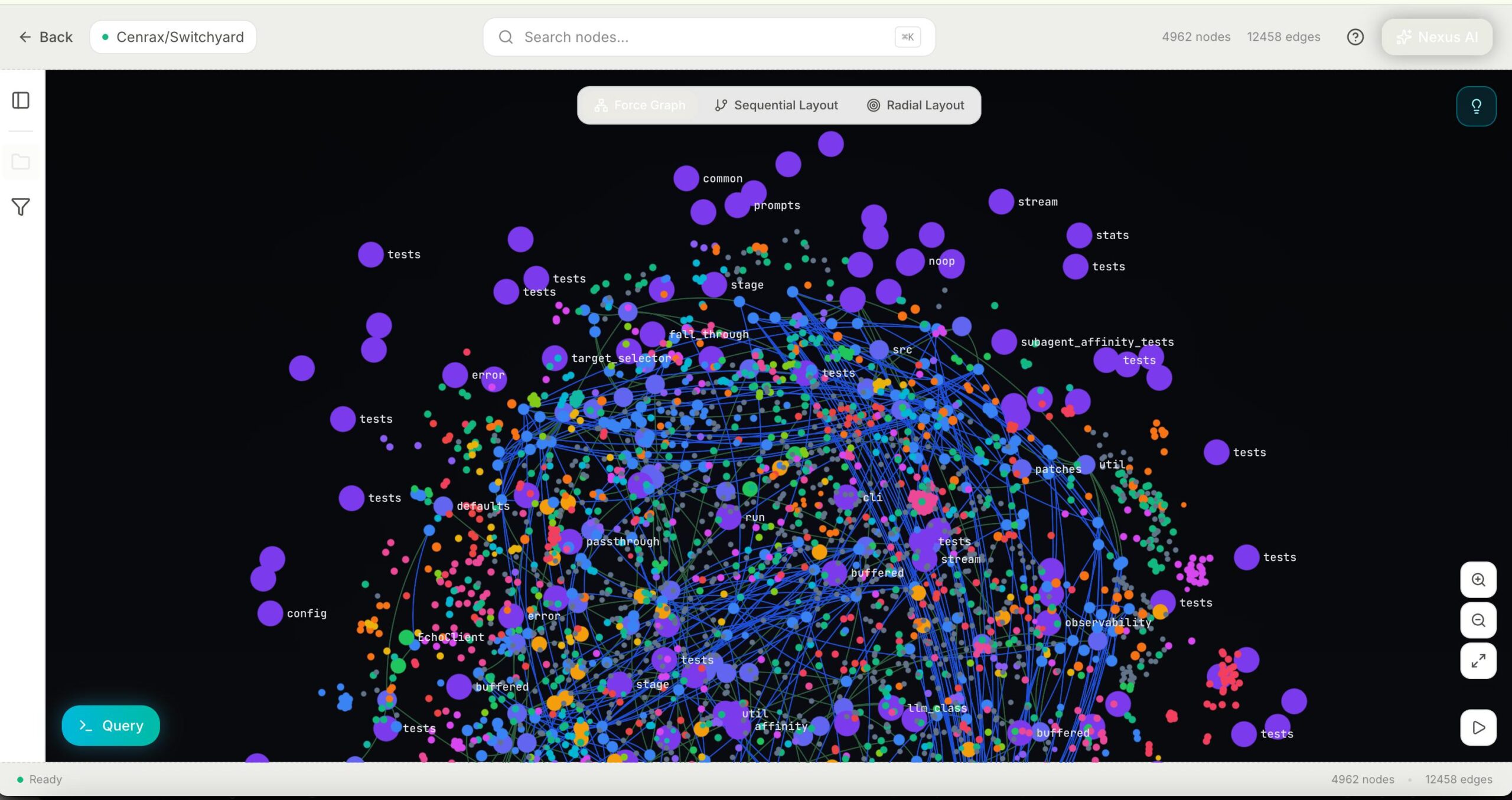
GitNexus indexes a codebase — or an entire organization’s repositories — into a deterministic knowledge graph: every symbol, call, import, inheritance, and execution flow resolved via Tree-sitter AST parsing, stored in an embedded graph database, and exposed to any coding agent through the Model Context Protocol. Agents query exact callers, impact, and blast radius instead of grepping through files and guessing from embeddings. It works with Claude Code, Cursor, Codex, Windsurf, and other major agents, runs locally so code never leaves the environment, and scales to org-wide unified graphs with cross-repo edges. producthunt
The company, Akon Labs, is a two-person YC S26 team in San Francisco whose founders have roughly half a decade of knowledge-graph experience each — one a former YC-company CTO, the other the project’s original open-source author. ycombinator
The strongest positive signal is independently verifiable open-source traction: approximately 45,000 GitHub stars (up from 28,000 in April 2026 — roughly 60% growth in four months), 3,000+ forks, 45 contributors, and named companies using it in production — achieved, per the founders, with zero marketing spend. The company’s public benchmark claims a coding agent solves 68.4% of DeepSWE issues with GitNexus versus 37.0% without, at $0.88 per fix versus $1.79. linkedin
The most important concern is that no commercial evidence exists: no pricing, revenue, paying customers, or defined monetization path is public, and the local-first open-source design that drives adoption may resist conversion to paid layers. Platform risk is real — Cursor, Claude Code, and the model providers are all building native codebase context.
The decision is DD: a proven-large category (Augment Code at $977M; CodeRabbit at $1.5B; Windsurf acquired for ~$3B), meaningful differentiation, verifiable adoption, and an elite technical founding team justify formal diligence centered on monetization, benchmark verification, and enterprise capability. clay
Product Overview
Problem: Coding agents read files, not systems. In large codebases they miss dependencies, break call chains, and ship blind edits — while burning tokens on repeated searches to reconstruct what a static graph could answer in one query. producthunt
How it works: A six-stage pipeline indexes the repository with Tree-sitter, resolves imports, call chains, and type information deterministically, persists the graph in KuzuDB, and clusters symbols into architectural modules via Leiden community detection. An MCP server then exposes tools — query, context, impact, detect_changes, rename, cypher — so agents ask “what breaks if I change this?” and receive exact answers. Multi-repo mode unifies an organization’s codebases into one graph with cross-repo edges. akonlabs
Core features: Deterministic indexing (zero LLMs at ingestion — no hallucination risk); impact and blast-radius analysis; process-grouped search; multi-file rename; org-wide graphs; a fully client-side browser UI; device-level token access controls. producthunt
Target users: Engineering teams running AI coding agents on large or multi-repo codebases; privacy-sensitive enterprises (financial services) benefit from the local-first architecture. producthunt
Pricing: Open source, free; commercial pricing for the agent and PR-review layers is not publicly disclosed. ycombinator
Primary benefit: More accurate agents at radically lower token cost. Replaces: agents’ built-in grep-based exploration and embedding retrieval.
Founder and Team Assessment
Both founders are verified through YC and LinkedIn. Subham Kundu (CEO) was CTO at Cignara (YC P26), has been a founding engineer and principal AI engineer taking products “from 0 to 100” at multiple startups, and is completing a PhD in reinforcement learning. Abhigyan Patwari built GitNexus as an open-source project starting February 2025, is a serial open-source contributor, and previously founded a company at Founders Inc. Both have worked on knowledge graphs for nearly five years. ycombinator
Founder-market fit is excellent on the technical side — the founders are the category’s practitioners. Commercial capability is partially evidenced (Patwari’s prior founder role; Kundu’s CTO experience) but enterprise sales execution is unproven. The team is exactly two people: maximum key-person risk, and the open-source project’s 45 contributors are community, not payroll. ycombinator
Founder Assessment: Elite technical pairing with authentic open-source credibility; commercial and enterprise-scaling capability remains unproven.
Market Opportunity
The initial segment is engineering organizations running AI coding agents on multi-repo codebases — the fastest-growing spending category in software. Category validation is strong: CodeRabbit raised $143 million at a $1.5 billion valuation in August 2026 for graph-adjacent AI code review; Augment Code reached a $977 million valuation on its context engine; Qodo has raised $120 million; Windsurf was acquired for approximately $3 billion. Sourcegraph’s deprecation of Cody’s free tier and pivot to enterprise code intelligence bundles confirms willingness to pay sits at the organizational level. clay
A third-party market estimate places agent-infrastructure SAM around $2 billion with roughly $200 million realistically serviceable for graph/context solutions — an early-stage estimate, but directionally consistent with the comp set. Bottom-up: 2,000–3,000 enterprise organizations at $20–50K annual contracts for org-wide code intelligence implies $40–150M ARR — venture-scale revenue consistent with the category’s existing outcomes. Timing is favorable: token cost pressure and agentic coding failures are both intensifying. launly
Traction and Growth Signals
Open-source traction is exceptional and independently verifiable: ~45,000 GitHub stars (28,000+ as of April 2026, implying rapid four-month growth), 3,000+ forks, 45 contributors, and substantial third-party technical coverage. Named companies — Flowtogen, Macaly — report active production use in the launch comments. The Product Hunt launch reached #12 Product of the Day with 131 votes. Growth is reported as entirely organic. linkedin
Missing metrics: all commercial ones. No revenue, paying customers, pricing, hosted-usage data, or enterprise contracts are public. GitHub stars measure developer interest, not willingness to pay — the conversion from 45,000 stargazers to enterprise contracts is the entire open question.
Traction Assessment: Best-in-class open-source adoption; commercially unverified.
Competitive Position
| Competitor | Position | Notes |
|---|---|---|
| Augment Code | Enterprise context engine | $252M raised, $977M valuation; directly overlapping thesis clay |
| Sourcegraph Cody | Enterprise code intelligence | Deep enterprise distribution; free tier deprecated blog.buildbetter |
| CodeRabbit | AI PR review | $1.5B valuation; adjacent to Akon’s review product finance.yahoo |
| Cursor, Claude Code, Codex, Windsurf | Agent platforms with native indexing | The bundling threat augmentcode |
| Continue.dev, Aider, bloop | Open-source alternatives | Smaller communities launly |
Differentiation is real: deterministic graphs versus embedding retrieval (a genuine architectural argument), zero-LLM ingestion, local-first privacy, multi-repo unification, and agent-agnostic MCP distribution — GitNexus positions as neutral infrastructure for every agent rather than competing with them. Pricing is currently unbeatable (free). producthunt
The platform question: if Cursor or Anthropic shipped equivalent deterministic indexing natively, GitNexus’s answers would be organizational scope (cross-repo graphs), neutrality across agents, and open-source trust. That is a credible — but not comfortable — answer for a two-person company.
Defensibility Assessment: Medium (community moat and architecture; erodible by funded platforms)
Business Model and Economics
The commercial model is not yet public: the open-source kernel is free, with a proprietary coding agent and graph-grounded PR review as the intended revenue layers. Category precedents support the structure — Greptile charges $30/seat/month for code review; Sourcegraph and Augment monetize organizational context at enterprise ACVs. Gross margins should be strong: the graph is precomputed locally, so the kernel itself carries no inference cost; only the company’s own agent and review products would consume tokens. The central economic question is conversion: a local-first, self-hostable product by design minimizes the vendor’s leverage, and monetization may require hosted, org-wide, or enterprise-support layers not yet announced. Token-efficiency positioning aligns revenue with customer savings, a strong value story if pricing is tied to it. ycombinator
Unicorn Path
Assume 15–25x ARR for a leading AI developer-infrastructure company — consistent with recent category financings (CodeRabbit’s $1.5B round; Augment’s $977M at an earlier stage of the market). A $1 billion valuation requires roughly $40–70M ARR — in enterprise terms, 1,500–3,000 organizational customers at $20–45K ACVs, or a blended seat-based model at scale. The category has repeatedly produced unicorn outcomes from similar or weaker starting adoption than GitNexus’s 45,000 stars; Greptile reached a reported ~$180 million valuation from a YC seed in under two years. Required steps: shipping and pricing the commercial layers, converting open-source adoption into organizational contracts, building enterprise GTM, and raising institutional capital — execution within the current model, not a transformation of it. clay
Unicorn Path: Plausible
Valuation Assessment
Valuation Attractiveness: Not Assessable. The only disclosed financing is YC’s standard S26 investment; no round size, valuation, SAFE terms, or revenue exists publicly. Category comps price rapidly and richly, which cuts both ways — they validate the ceiling and raise the risk of overpaying at the next round. Assessment requires: ARR and growth, paying-customer mix, the pricing model for commercial layers, benchmark replication, team expansion plans, and next-round terms. ycombinator
Key Risks
- Monetization undefined — 45,000 stars convert to nothing automatically; a local-first OSS design structurally resists paid hosting
- Platform absorption — Cursor, Claude Code, and model providers are one release away from native deterministic indexing; agentic-search improvements shrink the problem augmentcode
- Self-reported benchmarks — the 37.0%→68.4% DeepSWE gain is company-run on a single-issue benchmark that does not exercise the multi-repo differentiators akonlabs
- Two-person key-person risk — the entire company is two founders ycombinator
- Funded competition — Augment ($252M), CodeRabbit ($1.5B), Qodo ($120M), Sourcegraph all sell overlapping context/review value clay
- Enterprise GTM unproven — no demonstrated sales capability in a category where distribution decides winners
- OSS sustainability — kernel maintenance plus two commercial products on a two-person team
- Licensing uncertainty — future monetization may pressure the license model, risking community backlash
Final Assessment
Venture Potential: 70/100
| Category | Score |
|---|---|
| Market Size and Expansion Potential | 16/20 |
| Traction and Growth Evidence | 14/20 |
| Founder and Team | 11/15 |
| Product Strength | 8/10 |
| Distribution Potential | 12/15 |
| Business Model and Economics | 4/10 |
| Defensibility | 5/10 |
| Total | 70/100 |
Strongest: verifiable, best-in-class open-source adoption in a category with multiple existing unicorns, plus a technically differentiated product and exceptional founder-market fit. Weakest: an entirely unproven business model, two-person capacity, and platform-bundling exposure.
Evidence Confidence: 62/100
Verified: founders and backgrounds, entity, team size, YC affiliation, product architecture (via multiple independent technical write-ups), GitHub adoption trajectory, launch results. Company-reported: benchmark results, “zero marketing” claims, current star count. Unavailable: revenue, pricing, paying customers, hosted usage, funding beyond YC, burn. ycombinator
Final Decision: DD
GitNexus is one of the strongest DD candidates in the current AI-infrastructure cohort: a large, validated market; genuine architectural differentiation; independently verifiable adoption that outpaces funded competitors at the same stage; and founders with rare domain depth. The decision is DD rather than anything higher because every commercial question — pricing, conversion, revenue, enterprise capability — remains open, and the valuation basis does not yet exist. This is precisely the situation diligence is designed to resolve.
Upgrade Conditions
- Disclosed pricing and early revenue for the agent or PR-review layers ($500K+ ARR with growth)
- Named enterprise design partners or production deployments at recognizable companies
- Independent replication of the benchmark gains
- Team expansion including enterprise GTM hires
- A priced round with terms that can be evaluated against traction
Downgrade Conditions
- Cursor, Anthropic, or OpenAI shipping equivalent native code-graph context
- Monetization stalling: commercial layers shipping without measurable conversion
- Benchmark results failing third-party replication
- Either founder deprioritizing the company or contributor activity collapsing
- A licensing change that fractures the community
Questions for Further Diligence
- What is the pricing model for the commercial agent and PR-review products, and what early revenue exists?
- How many organizations run GitNexus in production, and what are weekly active MCP connections?
- What is the star-to-usage conversion, and which companies contribute back?
- Will the DeepSWE results be independently replicated, and when will multi-repo and impact benchmarks be published?
- What is the enterprise deployment story — on-prem, SOC 2, SSO, and access control beyond device tokens?
- How does indexing scale on very large monorepos, and what is the re-index cost and freshness model?
- What is the plan if Cursor or Claude Code ships native deterministic indexing?
- How do you reconcile the local-first architecture with hosted revenue?
- What is the current license, and is any change planned?
- What is the hiring plan, especially for enterprise sales?
- What funding beyond YC exists, and is a round in progress at what terms?
- What is the long-term kernel-versus-product boundary — where does open source stop and paid begin?
Sources
- Product Hunt — GitNexus (Akon Labs) producthunt
- Akon Labs — official website akonlabs
- Y Combinator — Akon Labs company page ycombinator
- Akon Labs — LinkedIn linkedin
- Abhigyan Patwari — founder post linkedin
- MarkTechPost — GitNexus technical analysis marktechpost
- Hoangyell — GitNexus explained (secondary) hoangyell
- TermDock — GitNexus architecture (secondary) termdock
- Launly — launch metrics and market analysis launly
- Reuters via Yahoo — CodeRabbit $1.5B finance.yahoo
- Clay — Augment Code funding profile clay
- Tech-Insider — CodeRabbit/Greptile/Qodo comparison (secondary) tech-insider
- BuildBetter — Sourcegraph Cody enterprise refocus (secondary) blog.buildbetter