
Table of Contents
Experiential Labs Investment Report
Category: AI infrastructure — open-source model gateway, routing, spend governance, and custom-model optimization
Company Stage: Pre-seed / accelerator-stage
Founder or Founders: Kion Fallah and Silen Naihin
Headquarters: San Francisco, California
Funding: Y Combinator S26; approximately $500,000 implied by YC’s standard deal, but no additional funding publicly disclosed
Business Model: Open-source core, hosted inference, $20/month Pro subscription, usage credits, and custom-priced enterprise services
Product Hunt Launch Date: September 2026; exact date not independently verified
Report Date: September 8, 2026
| Investment Metric | Assessment |
|---|---|
| Venture Potential | 75/100 |
| Unicorn Path | Conditional |
| Valuation Attractiveness | Not Assessable |
| Evidence Confidence | 58/100 |
| Final Decision | DD |
Executive Summary
Experiential Labs offers an open-source AI gateway that gives developers one API for hosted, bring-your-own-key, local, and custom models. It adds centralized budgets, model permissions, usage attribution, provider failover, caching, model recommendations, and routing. Its longer-term proposition is more differentiated: use production traces to optimize a router or train a specialized model that the customer owns (official website; GitHub).
The initial customer is an AI-native software company using multiple model providers and facing escalating inference costs, fragmented credentials, weak spend controls, and uncertainty about which model is optimal for each task. The product is technically accessible through an OpenAI-compatible endpoint and can be self-hosted, reducing integration and vendor-lock-in barriers.
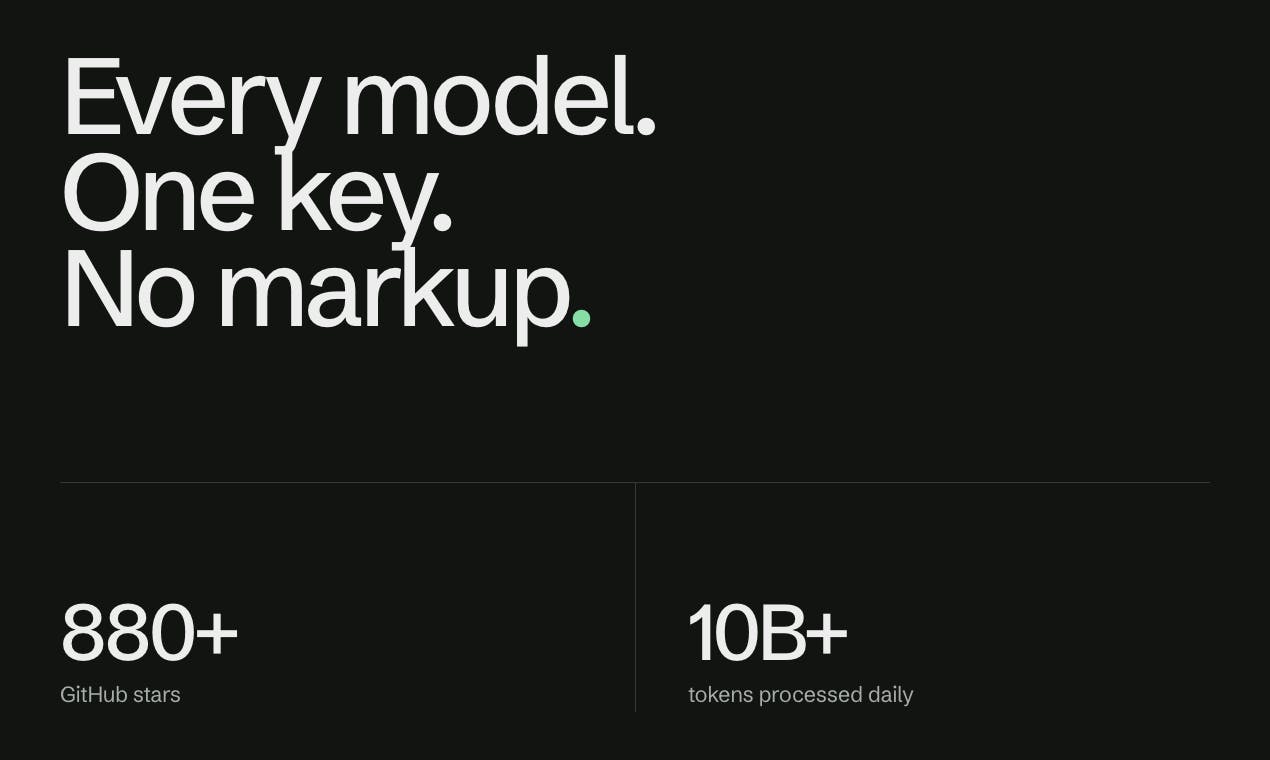
The strongest positive signal is unusually rapid developer adoption. The repository had 2,607 stars and 128 forks as of September 8, 2026, while the Python package recorded 23,625 downloads in the most recent month and 15,048 in the latest week (GitHub API; PyPI Stats). The company separately claims that more than 1,000 developers and 50 companies processed over 10 billion tokens per day shortly after launch; these figures are potentially significant but remain company-reported and unaudited (Product Hunt).
The principal investment concern is monetization. Experiential charges no token markup, offers a $20 monthly Pro plan, and provides an Apache-2.0-licensed gateway that customers can self-host. A meaningful business therefore depends on converting high-volume organizations to enterprise contracts, hosted inference, optimization services, or custom-model engagements. No revenue, retention, paid-customer count, enterprise ACV, gross margin, or conversion rate has been disclosed.
The decision is DD. The team, technical velocity, market timing, and early distribution justify formal diligence. Investment should depend on verifying the reported usage, understanding the economics of zero-markup routing, confirming enterprise demand, and demonstrating that traffic-based model optimization creates defensibility beyond a highly competitive gateway layer.
Product Overview
AI teams commonly use several model providers, each with separate API keys, billing systems, rate limits, and data policies. They must also decide which model offers the best quality, latency, and cost for each workload. Experiential consolidates these functions behind one OpenAI-compatible endpoint.
The platform supports hosted inference, customer-owned provider keys, local models, and custom endpoints. Administrators can issue keys by user or agent, impose spending caps, enforce provider or model allowlists, inspect request costs, and configure failover. The open-source package can be installed locally through Python, while the hosted service uses the same general API interface (GitHub; PyPI).
Its intelligence layer analyzes traffic for caching opportunities, recommends different models, and can optimize routing by prompt or task. The more ambitious enterprise offering uses customer traces to fine-tune a smaller model, with the customer retaining ownership of the resulting weights. The company claims at least 50% lower cost at equal or better quality under an SLA and reports up to 97% lower cost and 50% higher quality on selected tasks. These are company claims without publicly disclosed customer datasets, evaluation protocols, sample sizes, or independent reproduction (YC profile).
Pricing consists of:
- Free: 500 monthly credits, hosted providers, budgets, allowlists, and usage attribution.
- Pro: $20 per month for 2,000 credits, BYOK and local models, caching, model suggestions, auto-routing, policies, and dedicated support.
- Enterprise: Custom committed-credit pricing with SAML/SCIM, private networking, advanced controls, data residency, and custom-model work (pricing).
The product is functional and actively maintained. GitHub showed release v0.7.56 and development continuing through September 7, 2026 (release API; commit API).
Product Quality Assessment: Strong early technical execution and broad functionality, but the optimization and custom-model results require independent validation.
Founder and Team Assessment
Kion Fallah is co-founder and CEO. His profile lists a machine-learning PhD from Georgia Tech and research roles at autonomous-driving company Waabi, including work on simulation systems. This background is relevant to Experiential’s proposed use of task simulations and production traces for model optimization (LinkedIn).
Silen Naihin is co-founder and CTO. His profile identifies him as a founding AI engineer at AutoGPT, where he reports contributing to early agent benchmarking and open-source growth, and as the previous co-founder of Stackwise, a YC W24 company. He has also published work concerning continual learning and safe testing of language-model agents (LinkedIn; CLaaS paper).
Y Combinator lists Experiential Labs as a two-person company founded in 2026 and based in San Francisco (YC). The GitHub contributor record is similarly concentrated: the two founders account for almost all human contributions, alongside substantial automated contributions and only a few minor external contributors (contributors API).
The founders appear full-time, but Silen’s public profile also contains other overlapping founder roles; whether these are stale listings should be verified. No previous realized exit was independently confirmed.
Founder Assessment: Excellent technical and research fit, with demonstrated open-source execution; enterprise sales capability and organizational depth remain unproven.
Market Opportunity
The initial segment is AI-native companies with multiple production agents or applications, meaningful monthly inference spending, and sufficient trace volume to benefit from routing, caching, and model specialization.
Customer willingness to pay is established at the category level. LiteLLM offers a free self-hosted gateway and sells enterprise governance, deployment, and support, while Portkey sells gateway, observability, reliability, and control-plane functionality (LiteLLM pricing; Portkey pricing). OpenRouter’s success demonstrates particularly large demand: TechCrunch reported that it claimed eight million users and 100 trillion monthly tokens before raising $113 million at a reported $1.3 billion valuation in May 2026 (TechCrunch).
A bottom-up scenario can be constructed around 20,000–100,000 organizations with material multi-model workloads. At $5,000–$50,000 annual revenue per organization, the implied market is approximately $100 million–$5 billion annually. This is an analyst scenario rather than a verified market count. The low end reflects small team subscriptions and usage; the high end requires enterprise governance, managed inference, and custom-model contracts.
The gateway market can support venture outcomes, but infrastructure vendors, cloud providers, observability platforms, and model vendors are all entering it. Experiential must capture a valuable layer beyond simple API normalization.
Traction and Growth Signals
Publicly observable signals include:
- 2,607 GitHub stars and 128 forks approximately ten weeks after repository creation (GitHub API).
- 23,625 Python-package downloads in the latest month, including 15,048 in the latest week (PyPI Stats).
- More than 500 contributions from the two founders and rapid releases through v0.7.56 (contributors; releases).
- A Hacker News launch with approximately 220 points and 47 comments, indicating meaningful developer interest (Hacker News).
- 206 Product Hunt followers at retrieval time (Product Hunt makers).
The company reports more than 1,000 developers, 50 companies, and 10 billion tokens processed daily. These metrics are not independently verified, and it is unclear how many organizations are active, paid, using BYOK, consuming promotional credits, or operating in production (Product Hunt).
The most important missing metrics are ARR, paid organizations, token gross profit, cohort retention, production versus test traffic, customer concentration, credit consumption, and conversion from open source or free usage.
Traction Assessment: Strong launch and open-source momentum, but commercially unverified.
Competitive Position
Direct competitors include OpenRouter, LiteLLM, Portkey, Cloudflare AI Gateway, Not Diamond, and provider-specific cloud gateways. Free alternatives include self-hosted LiteLLM and direct integrations with model providers. Larger platforms can bundle spend controls, caching, routing, and observability.
Experiential differentiates through zero token markup, local and BYOK support, open-source deployment, traffic-aware routing, and a pathway from gateway telemetry to customer-owned specialized models. This combination is more defensible than gateway functionality alone.
However, the Apache-2.0 license permits competitors to reuse or fork the core. Switching costs are initially low because the API is explicitly compatible with existing OpenAI clients. Proprietary advantage would need to come from evaluation data, routing performance, model-training workflows, enterprise controls, and accumulated customer-specific learning.
If the largest platform launched the same functionality within six months, customers would retain Experiential only if its router delivered measurable savings or quality gains across providers, or if customers valued neutral infrastructure and ownership of trained models. That case is credible but not yet proven.
One transparency issue merits attention: the current README states that anonymous PostHog telemetry is enabled by default, while a founder stated in the Hacker News discussion that it was off by default (GitHub; Hacker News). The current repository documentation should be treated as authoritative, but the inconsistency should be resolved.
Defensibility Assessment: Medium
Business Model and Economics
Experiential says it earns from Pro subscriptions and hosted inference while adding no markup to routed model tokens (official site). At $20 per month, Pro produces only $240 of annual subscription revenue before usage top-ups. This is insufficient for enterprise-grade support unless most economic value comes from high-volume credits or larger contracts.
Variable costs include provider inference, gateway compute, streaming bandwidth, telemetry storage, evaluations, caching, model fine-tuning, and technical support. Zero token markup means routed traffic alone may contribute little or no gross profit. The economics depend on how credits are priced against provider costs and what margin is earned from hosted capacity, intelligence services, and custom models.
The customer-owned model offering could create larger contracts and tangible ROI, but it also introduces compute expenses, evaluation work, deployment support, and customer-specific services. The company must prove that revenue scales faster than training and support costs.
Unicorn Path
An 8× ARR multiple is appropriate for a scaled, high-growth infrastructure software company with strong retention and healthy gross margins.
Required ARR = $1 billion ÷ 8 = approximately $125 million.
At $240 annual Pro revenue, the company would need approximately 521,000 Pro subscribers, which is not a credible primary route. At a $25,000 enterprise ACV, it would need 5,000 customers; at $100,000 ACV, it would need 1,250.
A unicorn outcome requires Experiential to monetize enterprise inference volume, governance, custom routing, and specialized models—not merely Pro subscriptions. It must demonstrate high gross-margin recurring revenue, measurable customer savings, substantial expansion with token volume, and defensible optimization technology.
The OpenRouter comparison validates the strategic importance of aggregation and routing: Stripe confirmed its acquisition of OpenRouter in August 2026, while TechCrunch reported a $7.5 billion price (TechCrunch). This demonstrates category potential, not that Experiential can reproduce OpenRouter’s scale.
Unicorn Path: Conditional
Valuation Assessment
Experiential is part of YC S26. YC’s standard deal invests $500,000: $125,000 for 7% plus $375,000 through an uncapped MFN SAFE (YC deal). No other financing, valuation, SAFE cap, or current round was verified.
Valuation Attractiveness: Not Assessable
Assessment requires verified ARR, net revenue after provider costs, growth, gross margin, retention, token concentration, burn, runway, cap table, proposed round size, valuation cap, and financing preferences.
Key Risks
- Unverified commercial traction: Reported token volume may generate little revenue under zero-markup pricing.
- Crowded market: OpenRouter, LiteLLM, Portkey, cloud platforms, and model providers offer overlapping functionality.
- Weak gateway-level moat: The core is open source and API switching costs are deliberately low.
- Unit-economics ambiguity: Credits, hosted inference, and provider pass-through economics are insufficiently clear.
- Optimization reliability: Automated model selection may reduce caching efficiency or quality on poorly evaluated tasks.
- Data security: Prompts and traces may contain confidential customer information.
- Custom-model services risk: Fine-tuning and evaluation could become labor-intensive rather than scalable SaaS.
- Team concentration: A two-person team maintains a rapidly expanding infrastructure surface.
- Claim-verification risk: Cost, quality, developer, company, and token-volume claims lack independent audits.
Final Assessment
Venture Potential: 75/100
| Category | Score |
|---|---|
| Market Size and Expansion Potential | 18/20 |
| Traction and Growth Evidence | 14/20 |
| Founder and Team | 14/15 |
| Product Strength | 8/10 |
| Distribution Potential | 11/15 |
| Business Model and Economics | 5/10 |
| Defensibility | 5/10 |
| Total | 75/100 |
The strongest elements are founder quality, development velocity, open-source adoption, and category potential. The weakest are unclear monetization, low self-service pricing, limited commercial evidence, and intense competition.
Evidence Confidence: 58/100
Founders, legal entity, pricing, product activity, open-source adoption, package downloads, and YC participation are verified. Usage and performance figures are company-reported. Revenue, retention, gross margin, enterprise ACV, burn, runway, customer references, and current valuation remain unavailable.
Final Decision: DD
Experiential Labs warrants formal diligence because it combines strong technical founders, rapid developer adoption, a large infrastructure market, and an ambitious optimization layer. Investment remains contingent on validating usage quality, monetization, customer retention, data governance, and financing terms.
Upgrade Conditions
- Verify at least $1 million ARR or a credible enterprise contracted pipeline.
- Confirm the reported 10-billion-token daily volume through provider invoices or logs.
- Demonstrate more than 70% six-month organizational retention.
- Secure at least ten referenceable production customers.
- Establish gross margin above 70%, excluding pass-through inference revenue.
- Independently reproduce routing and custom-model savings.
- Demonstrate expansion revenue as customer token volume grows.
- Resolve telemetry defaults and complete platform-specific privacy documentation.
Downgrade Conditions
- Reported usage is mostly promotional, internal, or nonrecurring.
- Free-to-paid conversion remains weak.
- Enterprise deployments become primarily consulting engagements.
- Provider and training expenses compress gross margin.
- OpenRouter, LiteLLM, or cloud vendors replicate the optimization layer.
- A material customer-data or model-routing security incident occurs.
- Repository momentum declines after launch.
- Public claims prove materially misleading.
Questions for Further Diligence
- What are current ARR, MRR, and monthly net revenue after provider inference costs?
- How many of the reported 50 companies are paid and in production?
- How is the 10-billion-token daily figure calculated and independently reconcilable?
- What are 30-, 90-, and 180-day organizational retention rates?
- What percentage of free users convert to Pro or Enterprise?
- What gross margin is earned on subscriptions, credits, hosted inference, and custom models?
- What are the largest acquisition channels and CAC by channel?
- How many customers use routing optimization versus only basic gateway functionality?
- What independent evaluations support the 50% savings guarantee?
- How are prompts, traces, credentials, and fine-tuned weights isolated and secured?
- What are the current burn, runway, cap table, and fundraising terms?
- Which proprietary assets remain defensible if a competitor forks the gateway?