
Table of Contents
Kane CLI Investment Report
Category: Agentic software testing / developer tools / quality-engineering infrastructure
Company Stage: Growth-stage private company; Kane CLI is an early product within an established platform
Founders: Asad Khan, Jay Singh, Mayank Bhola, and Mudit Singh
Headquarters: San Francisco, California, with major operations in Noida and Bengaluru, India
Funding: $108 million total funding reported; latest disclosed round was $38 million in December 2024
Business Model: Credit-based SaaS, cloud-execution usage, team subscriptions, and custom enterprise contracts
Product Hunt Launch Date: August 13, 2026
Report Date: August 16, 2026
| Investment Metric | Assessment |
|---|---|
| Venture Potential | 83/100 |
| Unicorn Path | Plausible |
| Valuation Attractiveness | Not Assessable |
| Evidence Confidence | 74/100 |
| Final Decision | DD |
Executive Summary
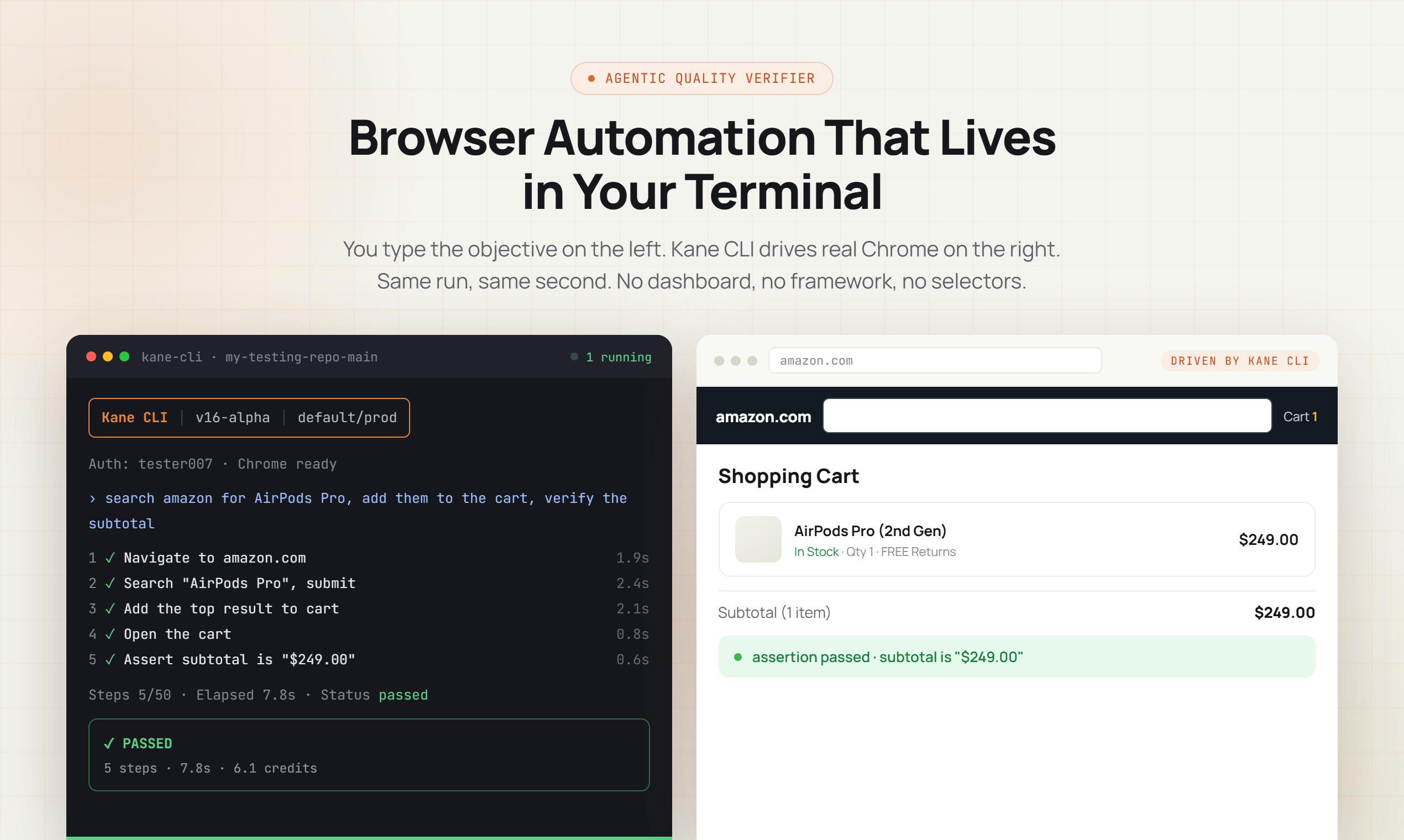
Kane CLI is a terminal-native testing agent that accepts natural-language objectives, operates a real Chrome browser or supported mobile simulator, and returns structured test results and evidence. It is designed for developers, QA engineers, CI pipelines, and coding agents such as Claude Code, Cursor, Codex, and Gemini CLI (official product page; GitHub).
The product addresses a credible and increasingly important problem: AI coding agents can produce changes quickly, but teams still need to verify whether those changes work in a browser. Kane CLI attempts to make that verification callable by both humans and agents, with machine-readable output, exit codes, replayable tests, screenshots, logs, and requirement-linked coverage (GitHub documentation).
The strongest investment signal is not its Product Hunt ranking but its parent company. TestMu AI, formerly LambdaTest, has raised $108 million and reported 15,000 customers, 2.3 million users, and 1.2 billion cumulative tests in December 2024. The company now reports more than 18,000 enterprises, three million users, and 1.5 billion annual tests; these remain company-reported rather than audited figures (2024 funding announcement; company overview).
The principal concern is product-level commercial opacity. Kane CLI’s downloads and repository activity demonstrate developer interest, but no Kane-specific revenue, paid-customer count, retention, credit consumption, or expansion data is public. It is therefore unclear whether Kane CLI is a durable growth engine, an acquisition funnel for KaneAI, or mainly a competitive feature.
The conclusion is DD. TestMu AI is already a substantial venture-backed company with credible distribution and infrastructure. Kane CLI appears strategically coherent, but valuation, company revenue, retention, unit economics, and Kane-specific monetization require formal diligence.
Product Overview
Traditional browser testing typically requires Playwright, Selenium, or another framework, selectors, test code, fixtures, and ongoing maintenance. Kane CLI allows a user or coding agent to specify an objective in natural language; it then launches Chrome, performs the workflow, and returns structured NDJSON results, a pass/fail status, extracted values, and process exit codes suitable for CI (GitHub README).
Persistent tests can be stored as Markdown. Initial runs are authored by the agent, while subsequent successful steps can replay from cached recordings without repeating the LLM work. The product also creates evidence packs containing test definitions, screenshots, DOM information, console and network logs, and failure records. Its assurance workflow can ingest requirements, derive use cases, design tests, and report coverage against acceptance criteria (GitHub documentation).
Kane CLI supports macOS, Linux, and Windows for browser testing. Local mobile testing currently requires Apple-silicon macOS and external Xcode or Android tooling. The public repository is Apache-2.0 licensed, reducing adoption friction but also limiting source-code defensibility (GitHub repository).
The CLI is free to install. TestMu AI’s current KaneAI pricing lists Starter at $19 per agent per month for 2,000 credits, Pro at $99 for 12,000 credits, Team at $199 for 25,000 credits, and custom enterprise pricing. Local browser execution is described as free, while AI authoring and cloud capabilities consume plan credits; this distinction should be confirmed in diligence (pricing).
Product Quality Assessment: Strong workflow design and unusually complete evidence handling, but independent reliability benchmarks are not publicly available.
Founder and Team Assessment
TestMu AI identifies four founders: Asad Khan, CEO; Jay Singh, Chief Customer Officer; Mayank Bhola, Head of Product; and Mudit Singh, Head of Growth. The leadership team also includes dedicated finance, operations, engineering, customer-success, and enterprise-sales executives (company leadership page).
This is a materially stronger organizational profile than a typical Product Hunt launch. The founders have operated the business since the LambdaTest era, raised several institutional rounds, built testing infrastructure, and sold into enterprises. Investors disclosed by the company include Peak XV, Qualcomm Ventures, Titanium Ventures, Premji Invest, Blume Ventures, and Avataar Ventures (company overview).
TechCrunch reported approximately 250 employees in 2022. LinkedIn currently categorizes TestMu AI in the 201–500 employee range and associates roughly 585 profiles with the company, but LinkedIn association is not verified payroll headcount (TechCrunch; LinkedIn). Current full-time headcount is therefore not precisely verified.
Founder Assessment: Strong technical, product, fundraising, and go-to-market execution; the main unknown is not founder capability but current financial efficiency and Kane CLI’s strategic contribution.
Market Opportunity
The initial customer is a software organization using AI-assisted development, CI/CD, and browser or mobile workflows but lacking sufficient automated end-to-end coverage. The economic value comes from reducing manual verification, test-authoring time, flaky-test maintenance, and production regressions.
A bottom-up scenario illustrates the opportunity. Assuming 50,000–200,000 globally addressable software organizations and annual spending of $5,000–$25,000 for agentic test authoring and execution, the addressable revenue range would be approximately $250 million–$5 billion annually. Both customer count and spending range are analyst assumptions, not verified market statistics.
The pricing supports expansion from individuals to teams. Five Pro agents imply approximately $5,940 in annual list-price subscription revenue; 20 Team agents imply approximately $47,760 before enterprise discounts or execution charges. Larger organizations could add cloud concurrency, device access, governance, security, and support.
The opportunity extends beyond browser testing into mobile testing, test management, visual regression, accessibility, API testing, AI-agent evaluation, and requirements assurance. TestMu AI already offers several of these products, providing a credible expansion path (company overview).
Traction and Growth Signals
Kane CLI ranked first on Product Hunt’s August 13, 2026 daily leaderboard (Product Hunt leaderboard). This shows launch-day attention, not product-market fit.
More durable product signals include 231 GitHub stars, 24 forks, and 70 open issues as of August 15, 2026. The repository was created in April 2026 and had a release, version 0.8.3, published on August 14, indicating active development (GitHub API; releases).
The npm package recorded 5,071 downloads between July 11 and August 9, 2026. Downloads may include repeat installations, CI activity, upgrades, and internal usage and should not be interpreted as unique active users (npm downloads API).
At company level, TestMu AI reported 105% year-over-year growth, 15,000 customers, and 2.3 million users in late 2024. Current company pages claim more than 18,000 enterprises and three million users, but no current ARR, net retention, or audited customer count is disclosed (funding announcement; about page).
Traction Assessment: Strong company-level adoption and credible early developer interest, but Kane-specific commercial traction remains unverified.
Competitive Position
Direct competitors include Momentic, mabl, BrowserStack’s agentic testing products, Sauce Labs, and other AI-assisted QA platforms. Momentic, for example, offers plain-English web and mobile tests, CI execution, automatic healing, and codebase-aware coverage (Momentic). Mabl provides AI-assisted web, mobile, API, performance, and accessibility testing with free local runs and usage-based cloud credits (mabl pricing).
The most important free alternative is Microsoft’s Playwright. Playwright now provides a CLI and MCP server for coding agents, alongside test generation, tracing, browser isolation, parallel execution, and cross-browser support (Playwright). Developers can also combine Playwright, Selenium, Puppeteer, or browser-use libraries with general-purpose LLMs.
Kane CLI differentiates through natural-language authoring, structured agent output, requirement-to-coverage workflows, tamper-evident evidence packs, cloud synchronization, mobile support, and access to TestMu AI’s established execution infrastructure. Its installed customer base and enterprise relationships are distribution advantages.
If Microsoft or BrowserStack launched equivalent natural-language verification within six months, customers might remain for TestMu AI’s device cloud, evidence history, test-management integration, and enterprise controls. Individual developers with simple browser-validation needs would have less reason to stay.
Defensibility Assessment: Medium. Infrastructure, workflow history, enterprise relationships, and platform integration matter, but the open-source CLI and rapidly improving free alternatives constrain technical differentiation.
Business Model and Economics
Revenue comes from per-agent subscriptions, credits, cloud execution, and custom enterprise plans. List-price annual revenue ranges from $228 per Starter agent to $2,388 per Team agent, excluding enterprise contracts and other TestMu AI products (pricing).
Gross margin is not publicly disclosed. Variable costs include LLM inference, browser and mobile-device infrastructure, video and screenshot storage, evidence retention, network usage, and support. Cached replay without repeated LLM usage could improve margins, while long agent-authored workflows and remote device execution could increase costs.
The strategic model is attractive if the free CLI generates developer adoption and converts teams into KaneAI, Test Manager, cloud-grid, and enterprise customers. It is less attractive if free local execution dominates and cloud conversion remains low.
Unicorn Path
For a growth-stage SaaS and usage-based infrastructure company, an 8× forward-ARR multiple is a reasonable analytical assumption if growth, retention, and gross margins are strong. At that multiple:
Required ARR = $1 billion ÷ 8 = approximately $125 million.
At a blended company ACV of $10,000, TestMu AI would require approximately 12,500 paying organizations. At $25,000 ACV, it would require approximately 5,000. The company-reported 18,000-enterprise footprint suggests the customer-count requirement may be achievable, but revenue per customer, paid status, product mix, and retention are unknown.
Kane CLI alone is unlikely to support this outcome at individual pricing. The path requires enterprise expansion, multi-product adoption, substantial cloud usage, high retention, and cross-selling across testing, device infrastructure, test management, and AI-agent evaluation.
Unicorn Path: Plausible
Valuation Assessment
TestMu AI raised $45 million in 2022 and $38 million in December 2024, bringing total disclosed funding to $108 million. The latest round was led by Avataar Ventures with Qualcomm Ventures participating (TechCrunch 2022; 2024 announcement).
No reliable current valuation, ARR, SAFE cap, secondary price, or active financing terms were found. BrowserStack’s reported $4 billion valuation is evidence that software-testing infrastructure can support a large outcome, but it does not establish TestMu AI’s value (TechCrunch).
Valuation Attractiveness: Not Assessable
Assessment requires current ARR, growth, gross margin, retention, burn, runway, round size, pre- and post-money valuation, liquidation preferences, and investor ownership.
Key Risks
- Kane-specific monetization is undisclosed: adoption may not translate into incremental revenue.
- Powerful free substitutes: Playwright CLI and MCP can satisfy many developer workflows.
- Feature commoditization: coding platforms and browser-cloud providers can bundle agentic testing.
- Unverified financial performance: current ARR, growth, retention, and gross margin are unavailable.
- Infrastructure economics: LLM reasoning, remote browsers, devices, and evidence storage may pressure margins.
- Reliability risk: probabilistic browser agents may produce false passes, false failures, or inconsistent runs.
- Security exposure: testing may involve credentials, screenshots, DOM content, and network logs.
- Product complexity: maintaining browser, mobile, local, cloud, CI, and enterprise compatibility creates execution burden.
- Open-source replication: Apache-2.0 licensing lowers adoption friction but facilitates copying.
- Valuation risk: $108 million of prior funding may imply a high entry price despite undisclosed financials.
Final Assessment
Venture Potential: 83/100
| Category | Score |
|---|---|
| Market Size and Expansion Potential | 18/20 |
| Traction and Growth Evidence | 16/20 |
| Founder and Team | 14/15 |
| Product Strength | 9/10 |
| Distribution Potential | 13/15 |
| Business Model and Economics | 7/10 |
| Defensibility | 6/10 |
| Total | 83/100 |
The strongest elements are the experienced organization, installed customer base, product breadth, enterprise distribution, and credible market timing. The weakest are Kane-specific commercial evidence, unknown margins, and vulnerability to platform bundling.
Evidence Confidence: 74/100
Funding rounds, founders, product capabilities, public pricing, repository activity, releases, and npm downloads are reasonably verifiable. Customer, user, test-volume, and growth figures are company-reported. Revenue, retention, unit economics, burn, runway, valuation, and Kane-specific paid usage remain unavailable.
Final Decision: DD
The company is strong enough to justify formal diligence, and a venture-scale outcome is credible. However, an investment decision cannot be made without current financials, retention, unit economics, product-level adoption, cap-table information, and financing terms.
Upgrade Conditions
- Verified company ARR and growth consistent with a growth-stage infrastructure company.
- Kane CLI contributing measurable paid conversion or enterprise expansion.
- Gross margin above 70%, including AI and browser-execution costs.
- Strong gross and net revenue retention.
- Reliable independent testing showing low false-pass and false-failure rates.
- Attractive financing terms relative to ARR, growth, and comparable companies.
Downgrade Conditions
- Kane adoption remains predominantly free with weak cloud conversion.
- High inference or browser-infrastructure costs impair margins.
- Playwright, BrowserStack, or coding-agent platforms achieve functional parity.
- Material security or test-data exposure.
- Reported enterprise accounts include substantial inactive or non-paying users.
- Growth or retention is materially below management claims.
Questions for Further Diligence
- What are current ARR, year-over-year growth, and quarterly net-new ARR?
- How many of the reported 18,000 enterprises are paying and active?
- What are Kane CLI’s monthly active users, active teams, and paid conversions?
- What are 30-, 90-, and 180-day retention rates for Kane CLI teams?
- How much expansion revenue has Kane generated across KaneAI, cloud execution, and Test Manager?
- What are gross margin and contribution margin by local, cloud-browser, and mobile execution?
- What proportion of credits funds LLM inference versus TestMu AI infrastructure?
- What are company-wide gross retention and net revenue retention?
- How does Kane’s false-pass and false-failure rate compare with coded Playwright tests?
- What are current burn, cash balance, and runway?
- What is the fully diluted cap table and the proposed round valuation and terms?
- What contractual and technical controls protect credentials, screenshots, logs, and proprietary application data?