
Table of Contents
Reflexio Investment Report
Category: AI-agent infrastructure; behavioral learning; memory and evaluation
Company Stage: Pre-seed/launch-stage; financing stage not publicly disclosed
Founder or Founders: Yi Lu and Guangyu Yang
Headquarters: Sunnyvale, California, United States
Funding: Not publicly disclosed
Business Model: Open-source software with managed SaaS and custom BYOC deployments
Product Hunt Launch Date: September 5, 2026
Report Date: September 8, 2026
| Investment Metric | Assessment |
|---|---|
| Venture Potential | 64/100 |
| Unicorn Path | Conditional |
| Valuation Attractiveness | Not Assessable |
| Evidence Confidence | 49/100 |
| Final Decision | Watch |
Executive Summary
Reflexio is an infrastructure layer intended to make production AI agents improve from user corrections, failed execution paths, expert responses, and successful outcomes. It converts interaction evidence into user profiles and reusable behavioral “playbooks,” retrieves relevant guidance before subsequent agent responses, and evaluates whether retrieved learnings improved results (official website, documentation).
The initial customer is an engineering team operating a conversational, support, research, or workflow agent with repeated tasks and sufficient production traffic to generate learning signals. Reflexio is more than a basic vector-memory store: it adds extraction, aggregation, versioning, evaluation, approval, revocation, and conflict resolution. The software can be consumed as managed SaaS or deployed through open-source and bring-your-own-cloud options.
The strongest investment signal is the combination of technically relevant founders and tangible open-source execution. The repository had 365 stars, 48 forks, and ongoing contributions as of September 7, while the Python package recorded 1,774 downloads in the latest month (GitHub API, PyPI Stats). These are promising developer-interest indicators but do not establish active production usage or revenue.
The primary concern is commercial and empirical validation. Reflexio has not publicly disclosed revenue, paying customers, retention, growth, or named case studies. Its performance evidence is a company-run benchmark on a small, selectively chosen task set and should not be generalized to production agents. The platform also competes with memory, observability, evaluation, and agent-framework vendors that can bundle adjacent functionality.
Decision: Watch. Reflexio has stronger founder and product signals than a typical Product Hunt launch, but the absence of verified customer traction and the early state of its defensibility make formal due diligence premature.
Product Overview
Production agents frequently repeat mistakes because logs and user corrections do not automatically become reusable behavioral guidance. Engineering teams currently address this through prompt changes, manual log review, evaluation datasets, retrieval systems, fine-tuning, or custom memory infrastructure.
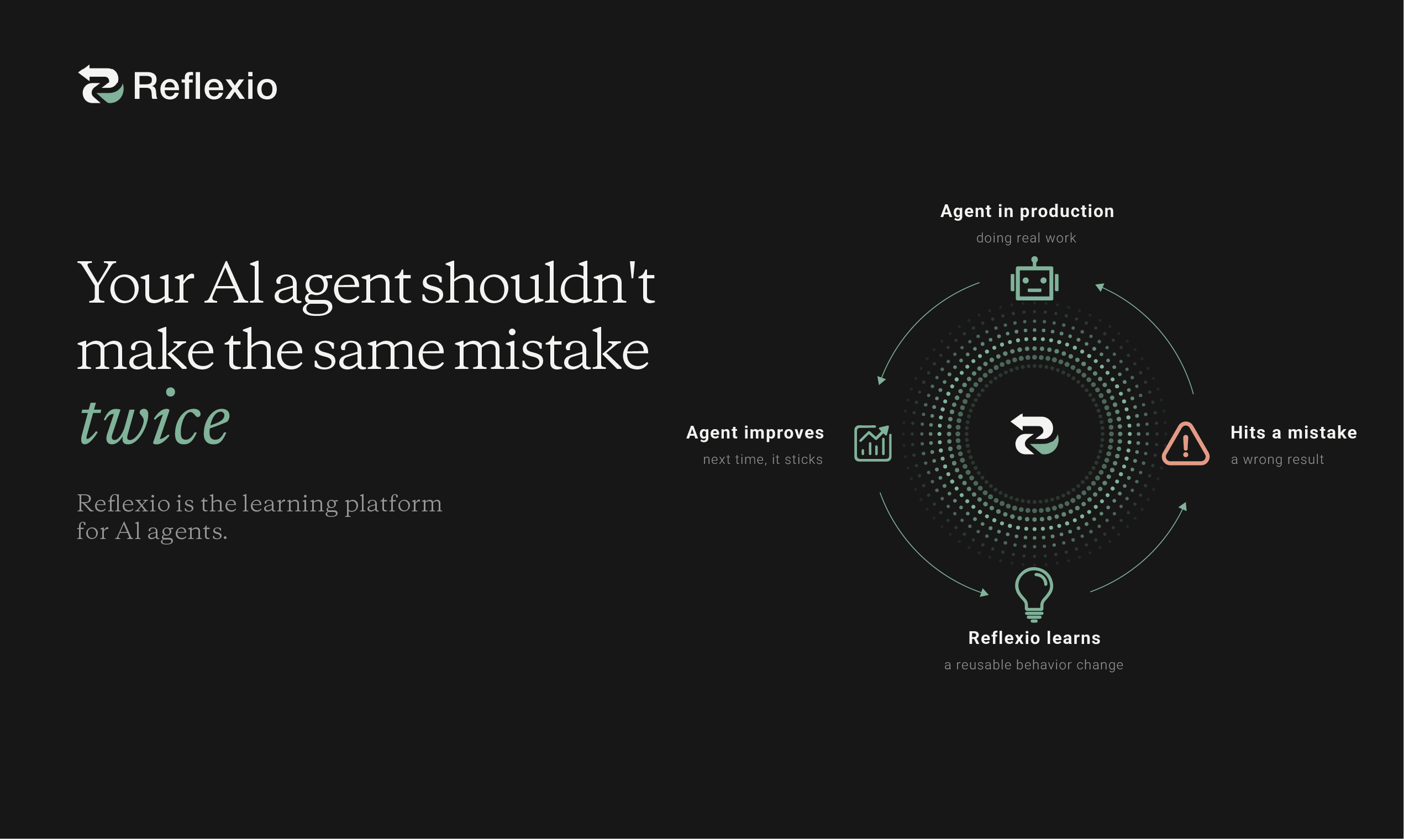
Reflexio adds a retrieve-and-publish loop to an existing agent. The application retrieves relevant profiles and playbooks before inference and publishes the completed interaction afterward. Reflexio then extracts stable user information, identifies reusable behavioral instructions, aggregates recurring lessons, and records evaluation signals (developer documentation).
Core functionality includes:
- User-specific profiles and shared agent playbooks.
- Extraction from corrections and expert-provided ideal responses.
- Hybrid semantic and full-text retrieval.
- Approval, rejection, versioning, and revocation of learnings.
- Shadow comparisons and session-level evaluation.
- Managed, BYOK, customer-database, BYOC, and self-hosted deployment.
- Python SDK, REST API, CLI, and a documented mem0 wrapper.
Pricing is transparent: Free includes 100,000 input tokens, 100 generated learnings, and 1,000 searches monthly; Pro is $299 per month for 10 million input tokens, 10,000 learnings, and 100,000 searches; BYOC pricing is custom (pricing).
The product is functional and verifiable. The Apache-2.0 repository supports local installation through the reflexio-ai Python package, although no formal GitHub releases were published at the time of research (repository, releases).
Founder and Team Assessment
Yi Lu, co-founder and CEO, lists prior roles as a Meta research engineer, Forethought’s head of machine learning, an Apple applied ML scientist working on Siri, and a Microsoft software engineer. He also taught machine learning at the University of Washington (LinkedIn).
Guangyu Yang, co-founder and CTO, lists senior machine-learning roles at Meta and TikTok, an ML engineering role at LinkedIn, and a computer-science PhD from Johns Hopkins (LinkedIn).
The backgrounds provide strong founder-market fit in language models, agent personalization, retrieval, production ML, and large-scale consumer AI. Both profiles show recent transitions into full-time Reflexio roles, providing a positive commitment signal. No previous founder exit was verified, and commercial sales experience remains less demonstrated than technical capability.
LinkedIn lists two associated employees and a company-size band of 2–10. GitHub shows substantial contributions across three principal accounts, but public information does not establish exact employment or team structure (company profile, contributors). No public hiring activity was found.
Founder Assessment: Strong technical and domain fit, with commercial execution and organizational depth still unproven.
Market Opportunity
The initial segment is software companies operating production AI agents with recurring workflows, measurable outcomes, and enough interactions to justify automated behavioral learning.
An illustrative bottom-up scenario—not a verified market estimate—is:
- 20,000 suitable AI-agent teams globally.
- $3,588 annual Pro subscription price.
- Approximately $72 million in annual revenue opportunity at complete penetration.
That narrow self-service segment is insufficient by itself for a credible unicorn outcome. Expansion could include enterprise agent governance, customer-support automation, regulated deployments, evaluation infrastructure, multi-agent knowledge sharing, and usage-based APIs.
A larger scenario of 5,000 mid-market customers paying $15,000 annually would represent $75 million ARR. Alternatively, 2,000 enterprise customers at $50,000 annually would represent $100 million ARR. These figures are analyst scenarios, not forecasts.
Market timing is favorable as companies deploy agents that need observability and iterative improvement. Adjacent category financing also demonstrates investor interest: memory-platform vendor mem0 reported $24 million raised across seed and Series A rounds (mem0 announcement). Nevertheless, category funding does not establish Reflexio’s demand or competitive position.
Traction and Growth Signals
Reflexio ranked #2 on Product Hunt on September 5, 2026, with 575 followers and one review at the time of research (leaderboard, reviews). This represents launch attention, not product-market fit.
The public repository was created April 11, 2026 and reported 365 stars, 48 forks, eight open issues, and a last push on September 6 (GitHub API). The principal public contributors had 252, 137, and 105 attributed contributions, indicating substantial development activity (contributors). PyPI reported 632 weekly and 1,774 monthly downloads; downloads may include CI, repeat installations, and maintainers.
The founders state that Reflexio is being tested with design partners and enterprise customers, but no identities, contracts, usage levels, or customer references are disclosed (founder post). This remains a company-reported claim rather than verified traction.
Product Hunt claims reductions exceeding 30% in failures and 60% in tokens. The detailed company benchmark instead reports a median 50% reduction in steps and 57% in tokens across seven qualifying measurements from four selected tasks. The tasks were selected from five candidates that the base agents could complete, themselves filtered from a 50-task dataset. One task did not show a clean improvement, and the experiment involved repeated versions of the same task rather than live customer traffic (benchmark report). The benchmark is reproducible and unusually transparent, but it is small, company-run, and not independent evidence of production impact.
Revenue, paying accounts, active agents, retention, interaction volume, net revenue retention, and conversion are unavailable.
Traction Assessment: Technically promising with credible developer interest, but commercially unverified.
Competitive Position
Direct and adjacent competitors include:
- mem0, which offers persistent agent memory and plans up to $249 per month (pricing).
- Letta, which builds stateful agents that remember and improve over time (official site).
- LangSmith, which offers production tracing, evaluation, and agent improvement at $39 per seat monthly before usage charges (pricing).
- Langfuse, an open-source observability and evaluation platform with free self-hosting and managed plans (pricing).
- Custom retrieval, prompt-management, fine-tuning, and log-analysis pipelines.
Reflexio’s differentiation is its emphasis on behavioral learning rather than factual memory: reusable rules are extracted from corrections and outcomes, tested against controls, made auditable, and revocable. Its mem0 wrapper also permits coexistence rather than requiring immediate replacement.
Switching costs may grow as customers accumulate proprietary playbooks, evaluations, and historical evidence. However, Reflexio’s open-source license lowers technical lock-in. The primary long-term asset would be the customer-specific behavioral dataset and workflow integration, not the extraction code itself.
If the largest platform launched the same feature within six months, why would customers continue using Reflexio? A credible answer requires materially better cross-framework learning quality, governance, and measured outcomes. Today that advantage is suggested but not independently established. Memory vendors, agent frameworks, observability platforms, and model providers could all bundle similar functionality.
Defensibility Assessment: Medium-Low
Business Model and Economics
The model combines free open-source distribution, a $299 monthly Pro plan, and custom enterprise BYOC contracts. Pro annual contract value is approximately $3,588 before discounts. BYOC could produce substantially higher ACV through deployment, support, security, and governance requirements.
Variable costs include LLM inference for extraction, consolidation, evaluation, query reformulation, embeddings, reranking, storage, and support. Pro includes 10 million input tokens and 10,000 generated learnings monthly, so heavy usage could create material model costs. BYOK and BYOC can transfer portions of inference and infrastructure expense to customers.
The key economic test is whether a customer’s usage and value expand faster than Reflexio’s inference cost. Gross margin cannot be assessed without model mix, caching rates, evaluation sampling, support requirements, and actual usage distributions. Flat pricing may attract adoption but could produce adverse selection from high-volume customers.
There is no App Store dependency. Payment-processing costs should be conventional SaaS expenses, but the payment provider and fee structure are not disclosed.
Unicorn Path
Assuming a 10× ARR multiple, appropriate only for a fast-growing, high-margin infrastructure SaaS company:
Required ARR = $1 billion ÷ 10 = $100 million.
At the current Pro price:
$100 million ÷ $3,588 = approximately 27,900 Pro customers.
That customer count is unlikely for a specialized developer product without exceptional global product-led distribution. A more credible route would be:
- 2,000 enterprise customers at $50,000 ARR; or
- 1,000 enterprise customers at $100,000 ARR.
This requires enterprise-grade security and compliance, measurable production ROI, multi-agent governance, high gross margins, larger integrations, and repeatable enterprise sales. Reflexio would also need its learned-behavior layer to become a durable system of record rather than a feature of a broader agent platform.
Unicorn Path: Conditional
Valuation Assessment
No reliable public evidence was found regarding funding, investors, round size, SAFE cap, current valuation, or fundraising status. Revenue and financing terms are also unknown.
mem0’s funding demonstrates investor appetite for agent-memory infrastructure, but it is not sufficient to determine Reflexio’s fair value because customer scale, revenue, growth, and financing conditions differ.
Valuation Attractiveness: Not Assessable
Assessment requires current ARR, growth, gross margin, retention, burn, runway, round size, valuation or SAFE cap, cap table, liquidation preferences, and employee-option commitments.
Key Risks
- Commercial traction is entirely unverified.
- Large adjacent platforms can bundle behavioral learning.
- Company benchmarks are small and selectively scoped.
- Incorrect generalized learnings could degrade agent safety or accuracy.
- Pro-plan inference and evaluation costs may compress gross margin.
- Production adoption requires access to sensitive conversation data.
- Open-source availability limits code-level defensibility.
- Current Python-centric integration may constrain broader adoption.
- A two-founder organization creates capacity and key-person risk.
- Willingness to pay separately for learning—rather than memory or observability—is unproven.
Final Assessment
Venture Potential: 64/100
| Category | Score |
|---|---|
| Market Size and Expansion Potential | 17/20 |
| Traction and Growth Evidence | 6/20 |
| Founder and Team | 13/15 |
| Product Strength | 8/10 |
| Distribution Potential | 8/15 |
| Business Model and Economics | 7/10 |
| Defensibility | 5/10 |
| Total | 64/100 |
The strongest elements are founder-market fit, technical execution, and a potentially important infrastructure problem. The weakest are missing commercial proof and uncertain defensibility against larger platforms.
Evidence Confidence: 49/100
Verified evidence covers founders, pricing, repository activity, package downloads, documentation, and Product Hunt ranking. Product-impact and enterprise-customer assertions are company-reported. Market sizing, enterprise ACV, and unicorn calculations are analyst assumptions. Financials, retention, customer references, unit economics, funding, legal entity, and valuation remain unavailable.
Final Decision: Watch
Reflexio is close to qualifying for DD on team and product quality, but not on traction. A founder meeting would be reasonable opportunistically; formal diligence should wait for verified production customers, retention, and economic evidence.
Upgrade Conditions
- Five or more referenceable production customers.
- At least $1 million ARR with sustained growth.
- Verifiable reductions in failure rate or cost across multiple customer workloads.
- Six-month paid retention above 70%.
- Gross margin above 70% after inference and support.
- Enterprise contracts at $25,000 or higher ACV.
- Evidence of durable playbook-data or workflow switching costs.
- Repeatable acquisition outside Product Hunt and founder networks.
Downgrade Conditions
- Benchmark improvements fail to reproduce in customer environments.
- High churn after initial trials.
- Model and evaluation costs make Pro usage uneconomic.
- Major memory or observability platforms replicate the workflow.
- Security, privacy, or harmful-learning incidents emerge.
- Repository activity or founder commitment declines.
Questions for Further Diligence
- What are current MRR, paying accounts, and monthly revenue growth?
- How many active production agents publish interactions weekly?
- What are free-to-Pro conversion and 30-, 90-, and 180-day retention?
- Which design partners or enterprise customers can provide references?
- What production evidence supports the failure-rate and token-reduction claims?
- What is gross margin by Free, Pro, and BYOC deployment?
- How much inference cost is incurred per million published tokens and per generated learning?
- How are harmful or overgeneralized learnings detected before deployment?
- What are the primary acquisition channels and customer acquisition costs?
- What proprietary advantage remains if mem0, LangSmith, or a model provider adds comparable playbook extraction?
- What are team structure, hiring plans, burn, and runway?
- What are the legal entity, cap table, current valuation, and proposed round terms?