
Table of Contents
- QApilot MCP for Android Investment Report
QApilot MCP for Android Investment Report
Category: AI-native mobile application testing and QA automation
Company Stage: Early commercial
Founder or Founders: Aditya Challa and Chaitanya Devalapally
Headquarters: Hyderabad, India
Funding: No verified external funding publicly disclosed
Business Model: B2B SaaS subscriptions and enterprise contracts; MCP pricing not publicly disclosed
Product Hunt Launch Date: September 12, 2026
Report Date: September 15, 2026
| Investment Metric | Assessment |
|---|---|
| Venture Potential | 66/100 |
| Unicorn Path | Conditional |
| Valuation Attractiveness | Not Assessable |
| Evidence Confidence | 50/100 |
| Final Decision | DD |
Executive Summary
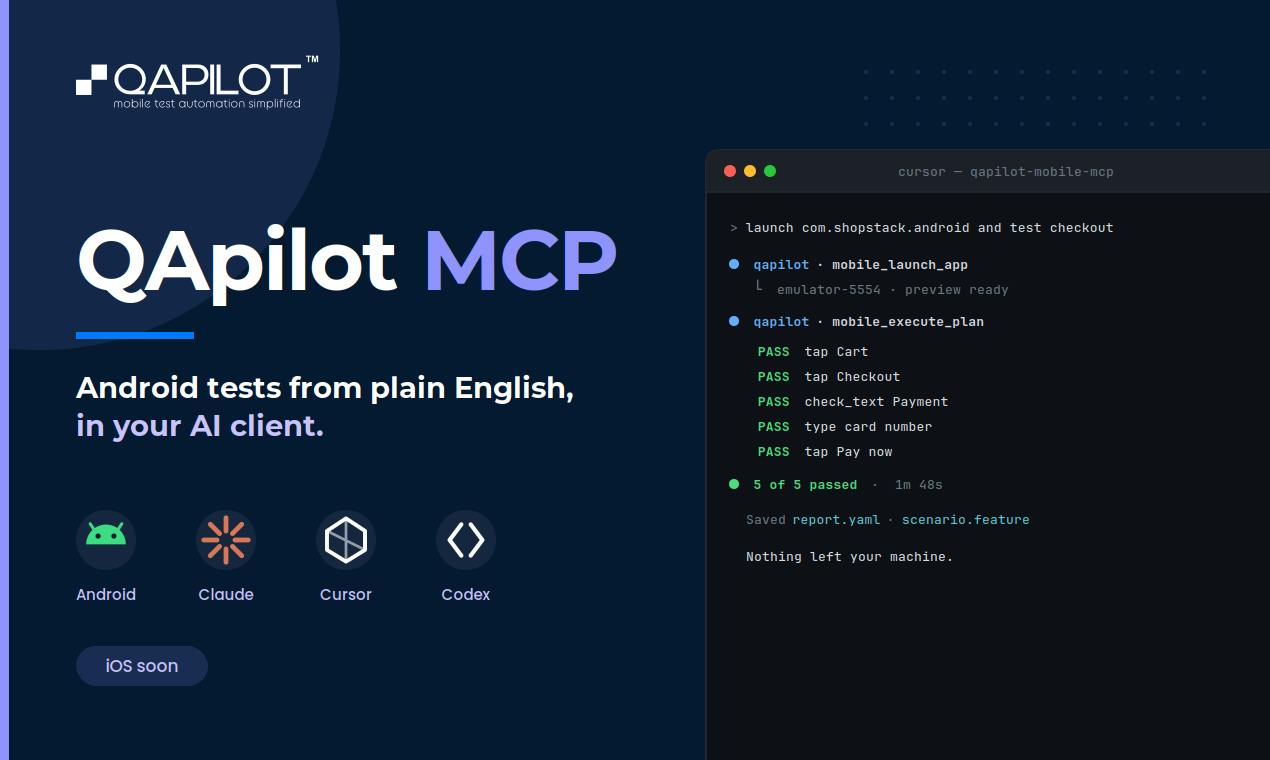
QApilot MCP for Android lets developers instruct Claude, Cursor, Codex, and other MCP-compatible agents to run plain-English tests on locally connected Android devices and emulators. It resolves UI elements, waits for screens to stabilize, retries transient failures, records successful steps, and produces replayable tests and reports (Product Hunt; MCP guide).
The MCP is a developer-distribution layer for QApilot’s broader mobile-testing platform. The full product supports Android, iOS, Flutter, and React Native applications, offering autonomous exploration, a mobile-app knowledge graph, self-healing tests, real-device execution, security analysis, and release-readiness reporting (official website; Release Readiness Suite).
The strongest investment signal is evidence that QApilot predates the MCP launch and has been deployed against complex applications. The company publishes named engagements with Wio Bank, Geml, and GrowSari and reports more than three million executed test steps. A third-party industry interview also describes an automotive customer deployment involving approximately 700 test cases and 80% automation coverage (case studies; TestGuild). These figures remain company- or founder-reported rather than audited.
The principal concern is whether QApilot owns a durable advantage over rapidly improving open-source products and well-funded testing platforms. Maestro already provides an open-source, cross-platform MCP with automatic waiting and persistent YAML tests, while Mobile Next offers an open-source MCP for Android and iOS devices (Maestro GitHub; Mobile MCP GitHub). QApilot must therefore prove that its knowledge graph, mobile-specific reliability, Flutter support, and enterprise workflows produce measurably better outcomes.
The recommendation is DD. The company has sufficient founder-market fit, product substance, and named customer evidence to justify formal diligence, but no investment decision is possible without verified revenue, retention, gross margin, security posture, legal structure, and financing terms.
Product Overview
Mobile testing is unusually difficult because tests must cope with fragmented devices, OS versions, gestures, asynchronous rendering, pop-ups, authentication, biometrics, and non-native frameworks. Traditional Appium automation generally requires technical setup and continued script maintenance.
QApilot MCP moves part of this workflow into the coding agent. A developer describes a test, and QApilot translates it into actions executed through Appium on a local device or emulator. Successful steps can be accepted into QApilot as saved test cases; outputs include screenshots, errors, timing, JSON, YAML, and Gherkin files (MCP guide).
The MCP currently supports native Android only; hybrid applications and WebViews are excluded, with iOS described as forthcoming. It requires Node.js, Java, Android SDK tooling, a device or emulator, and specifically pinned Appium and UIAutomator2 versions. This reduces accessibility compared with one-command alternatives and creates installation and compatibility risk.
The local-execution architecture limits mandatory app uploads and device-cloud dependence. However, account registration, authentication, project selection, usage monitoring, and optional test-case storage interact with QApilot services. “Local” should therefore not be interpreted as fully offline.
Pricing for the MCP is not stated in the official guide. The broader platform is sold through demos, trials, subscription plans, and enterprise order forms, but public dollar pricing is unavailable (terms).
Product Quality Assessment: Technically substantive and focused on real mobile-testing failure modes, but Android-only scope, pinned dependencies, and absent independent reliability benchmarks constrain the current product.
Founder and Team Assessment
QApilot’s official About page identifies Aditya Challa and Chaitanya Devalapally as co-founders and Surendranath Jillella as Head of AI (About). LinkedIn lists the company as founded in 2024 with 11–50 employees (LinkedIn).
Aditya Challa reports approximately 15 years at IMImobile, later part of Cisco Webex, before starting QApilot in June 2024 (LinkedIn). A TestGuild profile credits him with more than two decades across AI, distributed systems, enterprise platforms, and mobile products, although that interview was sponsored by QApilot and should be treated partly as founder-supplied information (TestGuild).
Chaitanya Devalapally concurrently identifies as QApilot co-founder and Executive Vice President at Digitral. This may provide customer access and operating resources but raises questions about founder allocation, corporate ownership, and whether QApilot is independent or a product within an existing services business.
The technical team includes an AI lead and multiple publicly identifiable product and engineering employees. The product’s device automation, Flutter handling, knowledge graph, and self-healing architecture suggest meaningful technical capability.
Founder Assessment: Strong mobile-enterprise and technical experience, but founder allocation, corporate ownership, and independent-company status require verification.
Market Opportunity
The narrow initial customer is a mobile-first company with frequent releases, multiple devices or operating systems, an existing QA team, and business-critical user journeys that cannot tolerate flaky regression tests. Banking, commerce, telecom, automotive, and consumer marketplaces are particularly credible segments.
A bottom-up analyst scenario is:
- 20,000–40,000 eligible mobile-product organizations globally;
- $20,000–$50,000 annual contract value;
- Implied serviceable market of approximately $400 million–$2 billion.
These are analytical assumptions, not verified QApilot figures. Higher contract values may be possible for regulated enterprises requiring device matrices, security reports, CI/CD integration, and forward-deployed support.
The category can produce venture-scale outcomes. BrowserStack reported more than 50,000 customers and four million developer sign-ups when it raised $200 million at a $4 billion valuation (BrowserStack). Tricentis’ acquisition of codeless mobile-testing company Waldo also demonstrates strategic demand, although the transaction value was not disclosed (Tricentis).
QApilot’s adjacent opportunities include iOS MCP support, device-cloud orchestration, mobile security, accessibility, production journey monitoring, API access, and organization-wide release governance.
Traction and Growth Signals
QApilot MCP received approximately 205 Product Hunt points and ranked #3 on September 12, 2026. The company’s earlier CoWork launch ranked #2 on June 27, 2026. The combined Product Hunt profile shows a 4.9 rating from nine reviews (Product Hunt; awards). These signals demonstrate launch execution but not commercial adoption.
More meaningful company-reported operating figures include 20,000+ generated test steps, 230,000+ recorded steps, three million+ executed steps, 3,000+ critical bugs surfaced, and 5,000+ hours saved (official website). The methodology, customer distribution, period measured, and definition of “critical bug” are not independently verified.
Named case studies provide stronger qualitative evidence:
- Wio Bank: 74% of planned sprint automation delivered and 71% of an identity suite automated (Wio case study).
- Geml: full sanity-suite automation and team handoff within two weeks (Geml case study).
- GrowSari: 161% growth in created test steps and 75% growth in active users across unspecified reporting checkpoints (GrowSari case study).
These are published by QApilot, not independent customer audits. Revenue, paying-customer count, renewals, expansion, and customer concentration remain undisclosed.
Traction Assessment: Credible early enterprise usage signals, but commercial scale and retention remain unverified.
Competitive Position
Direct competitors include BrowserStack, LambdaTest, Kobiton, Tricentis, Maestro, Mobile Next, Autify, testRigor, and QA Wolf. Appium, Espresso, XCUITest, and open-source MCP servers are free or lower-cost alternatives. Manual QA and outsourced testing firms are indirect substitutes.
QApilot’s differentiation is a mobile-first knowledge graph combined with autonomous crawling, deterministic element resolution, self-healing, human-approved replanning, and release-readiness reporting. Its support for difficult Flutter, biometric, OTP, and multi-device workflows is potentially valuable.
However, Maestro already offers Android, iOS, web, Flutter, React Native, automatic waiting, MCP integration, and tests stored as human-readable YAML. Mobile Next similarly supports Android and iOS through an open-source MCP. QApilot’s MCP package is distributed from its own API endpoint rather than a public source repository, limiting community inspection and organic open-source distribution.
“If the largest platform launched the same feature within six months, why would customers continue using this product?” The credible answer would be superior mobile reliability, accumulated application knowledge graphs, lower false-pass rates, and deeply embedded enterprise release workflows. Public evidence does not yet quantify these advantages.
Defensibility Assessment: Medium-Low
Business Model and Economics
QApilot appears to use subscription and enterprise order-form pricing. The MCP may function as a free or low-friction developer acquisition channel, but official MCP pricing is not disclosed.
Potential variable costs include device-cloud minutes, Appium execution infrastructure, storage of screenshots and logs, LLM inference, customer onboarding, and forward-deployed engineering. Local MCP execution can reduce cloud-device costs, while enterprise deployments across BrowserStack, LambdaTest, or other farms introduce third-party fees.
The Wio case study describes war-room support, daily synchronization, root-cause analysis, and one-to-one enablement. This may accelerate adoption but could reduce gross margin and make revenue services-heavy. Diligence must separate software subscription revenue from implementation and testing services.
Enterprise expansion revenue could come from additional applications, device matrices, test runs, seats, security reporting, and CI/CD pipelines. Gross margin is not publicly disclosed.
Unicorn Path
Assuming an 8× ARR multiple for a scaled, high-growth testing SaaS company:
Required ARR = $1 billion ÷ 8 = approximately $125 million.
Illustrative customer requirements are:
- 6,250 customers at $20,000 ACV;
- 2,500 customers at $50,000 ACV; or
- 1,250 enterprise customers at $100,000 ACV.
The first two scenarios are difficult for a mobile-only product. The enterprise scenario is possible only if QApilot expands from an Android MCP into a broad release-quality platform encompassing iOS, cross-platform frameworks, device orchestration, security, accessibility, and production monitoring.
A credible path also requires software gross margins above approximately 70%, low services dependency, international enterprise distribution, strong renewal rates, and measurable reliability superior to open-source tools.
Unicorn Path: Conditional
Valuation Assessment
No reliable financing announcement, investor list, round size, SAFE cap, valuation, or fundraising status was found. Tracxn describes QApilot as unfunded, but this is a secondary database rather than definitive financing evidence (Tracxn).
There is also a material corporate-identity discrepancy. QApilot’s terms identify Digitral Private Limited as the service provider, while its privacy policy defines QApilot as +91 AI Private Limited (terms; privacy policy). The contracting entity, IP owner, capitalization, and relationship between these entities must be clarified.
Valuation Attractiveness: Not Assessable
Required information includes ARR, growth, recurring versus services revenue, gross margin, retention, burn, runway, cap table, IP ownership, proposed round size, valuation cap or post-money valuation, and liquidation preferences.
Key Risks
- Revenue, retention, and paying-customer scale are undisclosed.
- Maestro and Mobile Next provide strong open-source MCP alternatives.
- Mobile testing infrastructure vendors can bundle similar agent functionality.
- Forward-deployed implementation may limit SaaS gross margins.
- False passes could undermine customer trust and create release risk.
- The MCP currently supports only native Android applications.
- Corporate-entity and IP ownership are unclear.
- SOC 2 Type II is described as “in progress,” not completed.
- Dependency on Appium and pinned component versions creates maintenance risk.
- Named customer outcomes are company-produced and not independently audited.
Final Assessment
Venture Potential: 66/100
| Category | Score |
|---|---|
| Market Size and Expansion Potential | 17/20 |
| Traction and Growth Evidence | 11/20 |
| Founder and Team | 12/15 |
| Product Strength | 8/10 |
| Distribution Potential | 8/15 |
| Business Model and Economics | 5/10 |
| Defensibility | 5/10 |
| Total | 66/100 |
The strongest elements are founder-market fit, a technically credible product, named enterprise deployments, and a market with demonstrated large outcomes. The weakest are commercial transparency, open-source competition, unclear margins, and uncertain corporate structure.
Evidence Confidence: 50/100
Product functionality, documentation, founders, legal documents, Product Hunt results, and named case studies are publicly verifiable. Usage statistics and customer outcomes are company-reported. Market sizing and customer requirements are analyst assumptions. Revenue, retention, funding, valuation, ownership, and unit economics remain unknown.
Final Decision: DD
Formal diligence is justified because QApilot has more evidence than a typical Product Hunt-only launch: an operating platform, identifiable experienced founders, multiple releases, named customers, and substantial reported usage. Investment is not yet justified because valuation, commercial metrics, corporate ownership, security certification, and defensibility require verification.
Upgrade Conditions
- Verify at least $1 million ARR with predominantly recurring software revenue.
- Demonstrate 90%+ gross logo retention and 110%+ net revenue retention.
- Sustain software gross margin above 70%.
- Provide independent references from Wio and at least two other customers.
- Quantify a materially lower false-pass and flaky-test rate than Maestro/Appium.
- Complete SOC 2 Type II and clarify legal-entity and IP ownership.
- Demonstrate repeatable acquisition outside founder-led implementation.
Downgrade Conditions
- Material customer churn after initial implementation.
- Services revenue dominating recurring platform revenue.
- Failure to deliver reliable iOS and cross-platform MCP support.
- Open-source alternatives closing the reliability gap.
- Excessive device-cloud, AI, or support costs.
- Security incidents involving customer applications or test credentials.
- Misleading usage, customer, or automation claims.
Questions for Further Diligence
- What are current ARR, MRR, and monthly recurring-revenue growth?
- How many paying organizations, active applications, and weekly active users exist?
- What are 30-, 90-, and 180-day retention and net revenue retention?
- How much revenue comes from SaaS versus implementation or QA services?
- What are median ACV, sales cycle, CAC, and CAC payback?
- What are gross margin and per-test costs for local and cloud execution?
- What measured false-pass, false-failure, and flaky-test rates does QApilot achieve?
- What percentage of Wio, Geml, and GrowSari deployments remains active and paid?
- Which entity owns the product and IP: Digitral Private Limited, +91 AI Private Limited, or another company?
- What are founder time commitments, cap-table ownership, burn, and runway?
- What financing is currently being sought, at what valuation and terms?
- How will QApilot defend against Maestro MCP, Mobile Next, BrowserStack, and Tricentis?
Sources
- Product Hunt — QApilot
- Official QApilot website
- QApilot MCP guide
- QApilot About page
- QApilot customer case studies
- Wio case study
- QApilot terms
- QApilot privacy policy
- TestGuild founder interview
- Maestro GitHub repository
- Mobile Next MCP GitHub repository
- BrowserStack financing announcement
- Tricentis acquisition of Waldo