
Table of Contents
Human Behavior Investment Report
Category: AI-native product analytics, session replay, error monitoring, and autonomous software agents
Company Stage: Seed-stage
Founder or Founders: Amogh Chaturvedi, Skyler Ji, and Chirag Kawediya
Headquarters: San Francisco, California, United States
Funding: $5 million seed round; investors reportedly include General Catalyst, Y Combinator, Paul Graham, and Vercel Ventures
Business Model: Sales-led recurring B2B SaaS; pricing negotiated privately
Product Hunt Launch Date: August 13, 2026
Report Date: August 16, 2026
| Investment Metric | Assessment |
|---|---|
| Venture Potential | 74/100 |
| Unicorn Path | Conditional |
| Valuation Attractiveness | Not Assessable |
| Evidence Confidence | 63/100 |
| Final Decision | DD |
Executive Summary
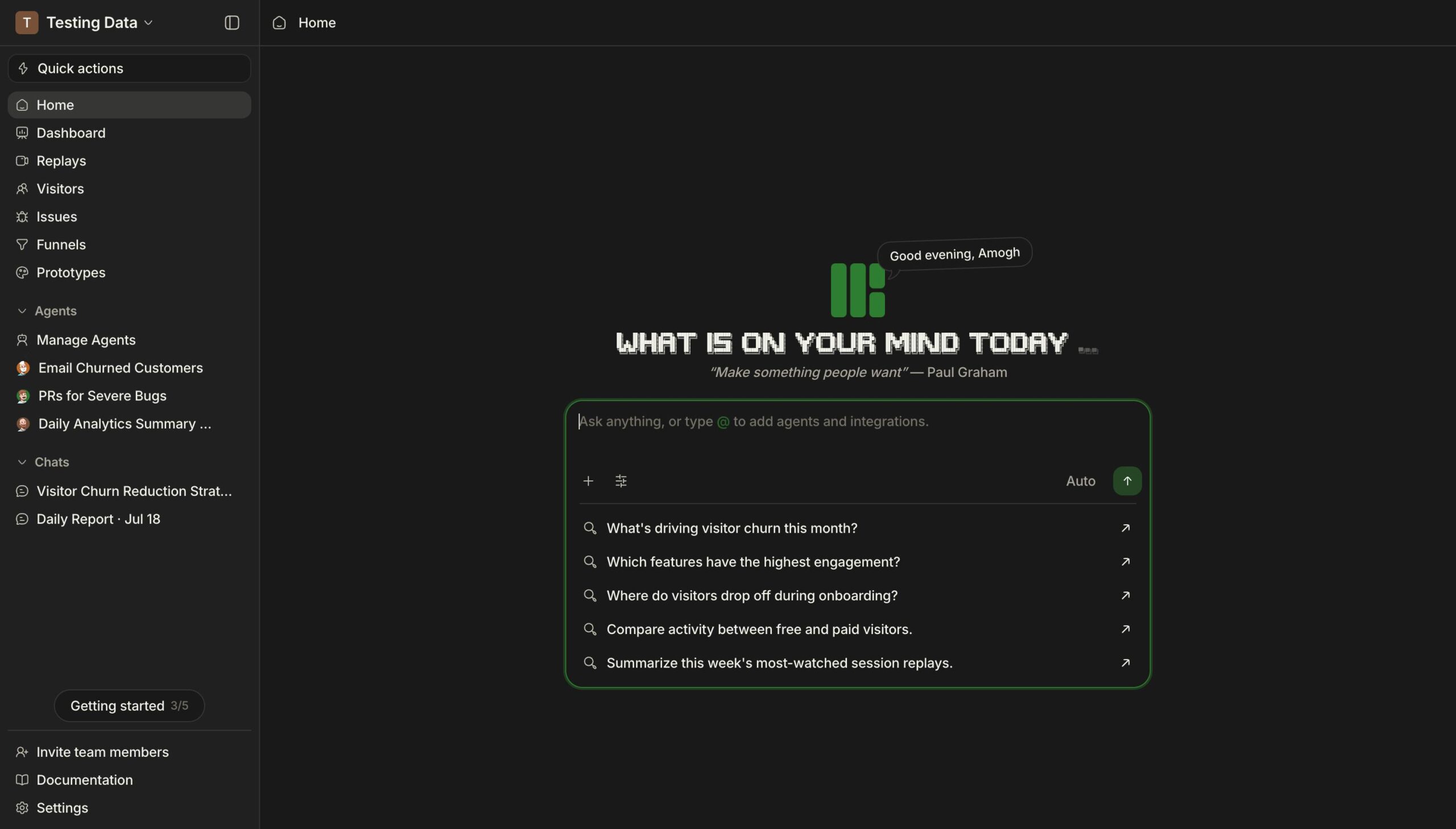
Human Behavior is an AI-native product-observability platform that records web sessions, captures events and application errors, and uses agents to identify problems and initiate actions. Its current product combines session replay, product analytics, error monitoring, and workflow automation. Agents can send findings to communication tools, create tickets, and, according to the company, open code pull requests supported by session evidence (official website; Product Hunt).
The initial customers are product and engineering teams at fast-growing software companies. The product addresses a real workflow problem: quantitative analytics identifies where behavior changed, while conventional session replay requires a person to watch recordings and determine why. Human Behavior attempts to automate both diagnosis and remediation from one captured dataset.
The strongest investment signals are the founders’ speed of execution, a reported prior small acquisition, admission to Y Combinator, and a $5 million seed financing from credible investors. The founders previously built an e-commerce accounting product called Dough and reportedly sold it to Employer.com for a six-figure amount before focusing on Human Behavior (TechCrunch). This supports company quality, although it does not validate Human Behavior’s economics.
The largest concern is commercial opacity. Public pricing is unavailable, and no verified figures were found for revenue, paying customers, retention, growth, gross margin, customer-acquisition cost, or active installations. The company has disclosed usage of its own product and presents named customer logos, but these signals do not establish repeatable product-market fit.
Final Decision: DD. The market, founders, product scope, and financing justify formal diligence. Investment should depend on retained revenue, customer references, agent accuracy, data-protection controls, infrastructure economics, and the current financing valuation.
Product Overview
Human Behavior installs a JavaScript SDK that records DOM-level sessions using rrweb and captures page views, clicks, form submissions, rage clicks, dead clicks, errors, and identified users. Its documentation states that custom business events and user identification require limited additional instrumentation (documentation).
The platform organizes this information into three principal layers:
- Session replay: DOM-based reconstruction synchronized with console, network, event, and error information. Input values are masked in the browser by default (replay product page).
- Issues: Application errors are fingerprinted, grouped, source-mapped, and connected to the sessions in which they occurred. Issues can be transferred to Jira, Linear, or a coding agent (issues page).
- Agents: Users define recurring jobs in natural language, grant selected tools, and schedule or trigger them. Outputs can be sent through Slack, email, SMS, or WhatsApp (agents page).
The customer benefit is less time manually connecting analytics, logs, error monitoring, and replay evidence. The product potentially replaces parts of PostHog, FullStory, LogRocket, Sentry, Mixpanel, and manual product-analysis workflows. Whether it replaces these systems or becomes an additional layer will materially affect willingness to pay and sales friction.
There is no public self-service checkout. Human Behavior negotiates pricing and billing frequency, issues a Stripe invoice, and unlocks the workspace after payment. Recurring billing can be weekly through annual, but plan limits and dollar prices are not published (billing documentation). This supports customized early selling but prevents independent assessment of ACV or pricing efficiency.
Founder and Team Assessment
The founding team consists of CEO Amogh Chaturvedi, CTO Skyler Ji, and COO Chirag Kawediya. The company’s Y Combinator profile describes the founders as having studied computer science at Stanford, Berkeley, and the University of Chicago and having conducted work associated with the Stanford NLP Group and University of Chicago Database Group (Y Combinator).
TechCrunch reported that Chaturvedi and Ji left Stanford and Berkeley respectively, while Kawediya completed his studies. The three met at a hacker house and first built Dough, an e-commerce accounting product. Dough’s reported six-figure sale to Employer.com provides some evidence of commercial execution, although detailed transaction terms and buyer confirmation were not located (TechCrunch).
The founders demonstrate strong technical relevance to AI, data systems, and product analytics. The product’s evolution from replay analysis into a broader observability-and-agent system also indicates rapid iteration. However, they have limited publicly verified experience scaling an enterprise SaaS organization, managing security-sensitive data infrastructure, or building a repeatable sales operation.
Y Combinator originally listed three employees, while LinkedIn now shows additional associated personnel; exact current full-time headcount is not verified (LinkedIn). No reliable public evidence was found concerning senior sales, security, finance, or enterprise customer-success leadership.
Founder Assessment: Strong technical execution and unusually fast early commercialization, but enterprise scaling capability remains unproven.
Market Opportunity
The narrow initial segment is product-led software companies with approximately 20–500 employees, substantial web traffic, frequent releases, and product or engineering teams already paying for analytics, error monitoring, or session replay. These companies experience sufficient user activity to make manual replay review impractical and may pay for automated diagnosis.
Because Human Behavior does not publish pricing, a bottom-up scenario requires explicit analyst assumptions:
- Addressable initial organizations: 20,000–80,000 globally
- Potential annual contract value: $10,000–$50,000
- Indicative initial addressable revenue: $200 million–$4 billion annually
This is not a verified market estimate. The customer count approximates software companies capable of supporting a meaningful product-observability budget, while the ACV range reflects comparable multi-product analytics and monitoring expenditures.
Expansion could include larger enterprises, mobile applications, automated QA, customer support, AI-agent observability, revenue workflows, and developer infrastructure. The same session dataset could support multiple products, increasing ACV if customers consolidate tools rather than treating Human Behavior as an additional analytics expense.
Market timing is favorable: AI-generated code may increase release frequency, while autonomous remediation requires better production context. Nevertheless, the category is crowded, and large incumbents already own substantial data, distribution, and integration surfaces.
Traction and Growth Signals
Human Behavior reportedly raised a $5 million seed round in 2025 from General Catalyst, Y Combinator, Paul Graham, and Vercel Ventures. TechCrunch reported that the round closed in two days, but the valuation was not disclosed (TechCrunch). Investor participation is a team and financing signal, not evidence of customer retention.
The company initially reported selling to product teams at high-growth startups, including Delve and Conduit (Y Combinator). Its current website displays customers or users including Clado, Olive, Freebuff, Attensira, Assemble, Opennote, Stratify, and Gatekeep and includes an attributed Clado testimonial (official website). Contract status, spending, deployment scale, and retention are not disclosed.
On its Product Hunt launch, the company stated that its own agents had analyzed 15,000 internal product sessions during one month and generated 16 pull requests. This is a company-reported product-usage metric, not customer traction. The August 13, 2026 launch ranked fifth on the daily leaderboard with approximately 266 votes at the observed snapshot (Product Hunt leaderboard). The launch demonstrates attention but not sustained demand.
No reliable public figures were found for ARR, customer count, paid installations, monthly analyzed sessions across customers, retention, revenue growth, or expansion revenue.
Traction Assessment: Credible early customer and investor interest, but commercial product-market fit remains unverified.
Competitive Position
Direct competitors include PostHog, FullStory, LogRocket, Amplitude, Heap/Contentsquare, and smaller AI-based session-analysis companies. Indirect alternatives include Sentry for error monitoring, Mixpanel for product analytics, Microsoft Clarity for free session replay, support platforms, and manually written SQL or analytics workflows.
Competition has moved directly toward Human Behavior’s thesis. FullStory’s Subtext product captures sessions and gives coding agents structured access to replay, network, console, and DOM evidence. Its public plans range from free to $250 per month, with allowances for captured sessions and agent reviews (Subtext; Subtext pricing). Microsoft Clarity offers session recordings and heatmaps for free (Microsoft Clarity), while PostHog combines analytics, replay, error tracking, experimentation, and AI within a broader platform (PostHog).
Human Behavior’s principal differentiation is a more closed-loop system: its agents do not merely expose session evidence to another agent but can monitor behavior, contact users, update business systems, and initiate fixes. The unified SDK and dataset may also reduce integration work.
The defense is currently limited. Session capture relies partly on open-source rrweb technology, and established vendors have larger installed bases and more historical data. Switching costs may increase as customers create agents, integrations, issue histories, and workflow-specific memory, but current evidence does not show significant network effects or proprietary data advantages.
If the largest platform launched the same feature within six months, why would customers stay? The credible answer would have to be superior agent accuracy, faster remediation, deeper cross-functional automation, and lower operational complexity. These advantages are plausible but not independently demonstrated.
Defensibility Assessment: Medium-Low
Business Model and Economics
Human Behavior operates a negotiated recurring SaaS model. Sales-led onboarding may support higher ACVs and close customer-specific deployments, but it can also create high acquisition and implementation costs. Published documentation indicates hands-on setup by call or Slack, which may limit scalability unless onboarding becomes standardized.
Variable expenses include session ingestion, DOM and event storage, replay retention, database queries, AI inference, agent execution, integrations, and customer support. Session capture itself can potentially achieve software-like margins, while analyzing every session with multimodal or large-language models could be substantially more expensive.
The company must demonstrate that agent analysis is selective or efficient enough for revenue to grow faster than inference and infrastructure costs. Important unknowns include price per captured session, agent-run limits, storage retention, compute cost per analyzed session, gross margin, and the proportion of accounts requiring founder support.
Expansion revenue could come from higher session volume, additional projects, longer retention, more agent runs, enterprise security, and additional business workflows.
Unicorn Path
An 8× forward-ARR multiple is appropriate as a planning assumption for a fast-growing but highly competitive infrastructure and analytics SaaS company. A materially lower growth rate or gross margin would justify a lower multiple.
\[
\$1\text{ billion} \div 8 = \$125\text{ million required ARR}
\]
With pricing undisclosed, illustrative customer requirements are:
- At $10,000 ACV: approximately 12,500 customers
- At $25,000 ACV: approximately 5,000 customers
- At $50,000 ACV: approximately 2,500 customers
- At $100,000 enterprise ACV: approximately 1,250 customers
The strongest route is not remaining a replay-analysis feature. Human Behavior would need to become a broader customer and product infrastructure platform, expand into enterprise accounts, consolidate existing analytics and monitoring budgets, and obtain meaningful usage-based expansion.
A unicorn outcome would also require strong gross margins, repeatable distribution beyond founder-led sales, international support, enterprise security certification, and defensible performance advantages. PostHog’s expansion from analytics into “customer infrastructure” illustrates the opportunity but also the intensity of competition; PostHog reported a $70 million round at a $920 million valuation in 2025 (PostHog).
Unicorn Path: Conditional
Valuation Assessment
The known financing is a reported $5 million seed round. The post-money valuation, investor ownership, security type, option pool, liquidation preferences, and current fundraising status are not public.
Comparable financing cannot establish Human Behavior’s value without ARR, growth, retention, and margins. FullStory reached a reported $1.8 billion valuation in a 2021 investment, but it was a substantially more mature company (Permira). PostHog’s $920 million financing similarly reflects a broader and more established platform.
Valuation Attractiveness: Not Assessable
Required information includes current ARR, monthly growth, gross margin, retention, cash balance, burn, runway, cap table, round size, SAFE or preferred-equity terms, and proposed post-money valuation.
Key Risks
- Unverified commercial traction: Revenue, paid customers, retention, and growth are unavailable.
- Aggressive incumbent response: FullStory already offers a closely related agentic replay product.
- Potentially high AI and storage costs: Continuous session analysis may pressure gross margin.
- Weak initial defensibility: Core session-capture technology and AI models are accessible to competitors.
- Privacy and regulatory exposure: The SDK processes detailed end-user behavior, identity, and application content.
- Incomplete security maturity: SOC 2 Type II is in progress rather than complete (security page).
- Redaction risk: Input fields are masked, but rendered page text is not masked automatically and must be explicitly designated for redaction (replay documentation).
- Services-heavy onboarding: Founder-assisted installation and negotiated billing may limit efficient scaling.
- Founder and key-person concentration: A small founding team currently appears central to product, selling, and onboarding.
- Product-suite overextension: Competing simultaneously in analytics, replay, monitoring, agents, and coding remediation could dilute execution.
Final Assessment
Venture Potential: 74/100
| Category | Score |
|---|---|
| Market Size and Expansion Potential | 18/20 |
| Traction and Growth Evidence | 12/20 |
| Founder and Team | 14/15 |
| Product Strength | 9/10 |
| Distribution Potential | 9/15 |
| Business Model and Economics | 7/10 |
| Defensibility | 5/10 |
| Total | 74/100 |
The strongest elements are founder execution, product breadth, market timing, and potential to consolidate multiple software categories. The weakest are missing commercial metrics, aggressive competition, unclear unit economics, and limited demonstrated defensibility.
Evidence Confidence: 63/100
Founder identities, YC participation, product documentation, legal entity, headquarters, funding announcement, security posture, and sales-led billing are publicly supported. Customer logos, usage, product performance, and the previous acquisition are principally company- or founder-reported. Revenue, retention, pricing, gross margin, burn, runway, valuation, and financing terms remain unavailable.
Final Decision: DD
Human Behavior has sufficient differentiation, market scope, founder quality, and credible early financing to justify formal due diligence. It is not an “Invest” because valuation, commercial retention, unit economics, cap-table terms, and security readiness cannot be assessed publicly.
Upgrade Conditions
- Verified ARR and consistent month-over-month revenue growth.
- Strong 90- and 180-day customer retention.
- Customer references confirming measurable product or engineering savings.
- Gross margin above 70% after AI, storage, and support costs.
- Repeatable acquisition beyond founder-led sales and YC relationships.
- Completion of SOC 2 Type II.
- Evidence that agents produce accepted fixes with low false-positive rates.
- Multi-product expansion within retained customer accounts.
Downgrade Conditions
- High churn following initial experimentation.
- Low agent accuracy or limited customer use after onboarding.
- Gross margins materially impaired by inference and storage costs.
- Continued manual, founder-intensive implementation.
- Rapid feature parity from FullStory, PostHog, or another incumbent.
- Privacy incidents or failures to redact sensitive user information.
- Product activity declining after the Product Hunt launch.
- Financing terms implying an excessive valuation relative to verified ARR.
Questions for Further Diligence
- What are current ARR, MRR, monthly growth, and recognized revenue?
- How many organizations are paying, and how many have been active during the last 30 days?
- What are logo and revenue retention at 30, 90, and 180 days?
- What are median ACV, sales cycle, expansion rate, and net revenue retention?
- How many sessions and agent runs are processed monthly?
- What are cloud, storage, and model costs per thousand captured and analyzed sessions?
- What is gross margin after infrastructure and customer-specific support?
- How often do agent findings lead to accepted tickets or merged pull requests?
- What percentage of onboarding requires direct founder or engineering assistance?
- Which acquisition channels generate retained customers, and what is CAC by channel?
- What are current team structure, burn rate, cash runway, and hiring priorities?
- What are the cap table, proposed financing valuation, round terms, and investor preferences?