
Table of Contents
Visiby Investment Report
Category: AI Search Visibility / Generative Engine Optimization (GEO) analytics software
Company Stage: Pre-seed or self-funded; product appears recently launched
Founder or Founders: Ash Bagda (Product Hunt hunter and apparent maker; full-stack developer, Jaipur, Rajasthan, India) — company identity not fully verified
Headquarters: Not publicly disclosed (pricing page identifies the product as “Visiby by FNA Technology”; scheduling references to IST and the founder’s location suggest India)
Funding: Not publicly disclosed
Business Model: B2B SaaS subscription (flat monthly tiers)
Product Hunt Launch Date: September 13, 2026
Report Date: September 16, 2026
| Investment Metric | Assessment |
|---|---|
| Venture Potential | 45/100 |
| Unicorn Path | Improbable |
| Valuation Attractiveness | Not Assessable |
| Evidence Confidence | 48/100 |
| Final Decision | Pass |
Executive Summary
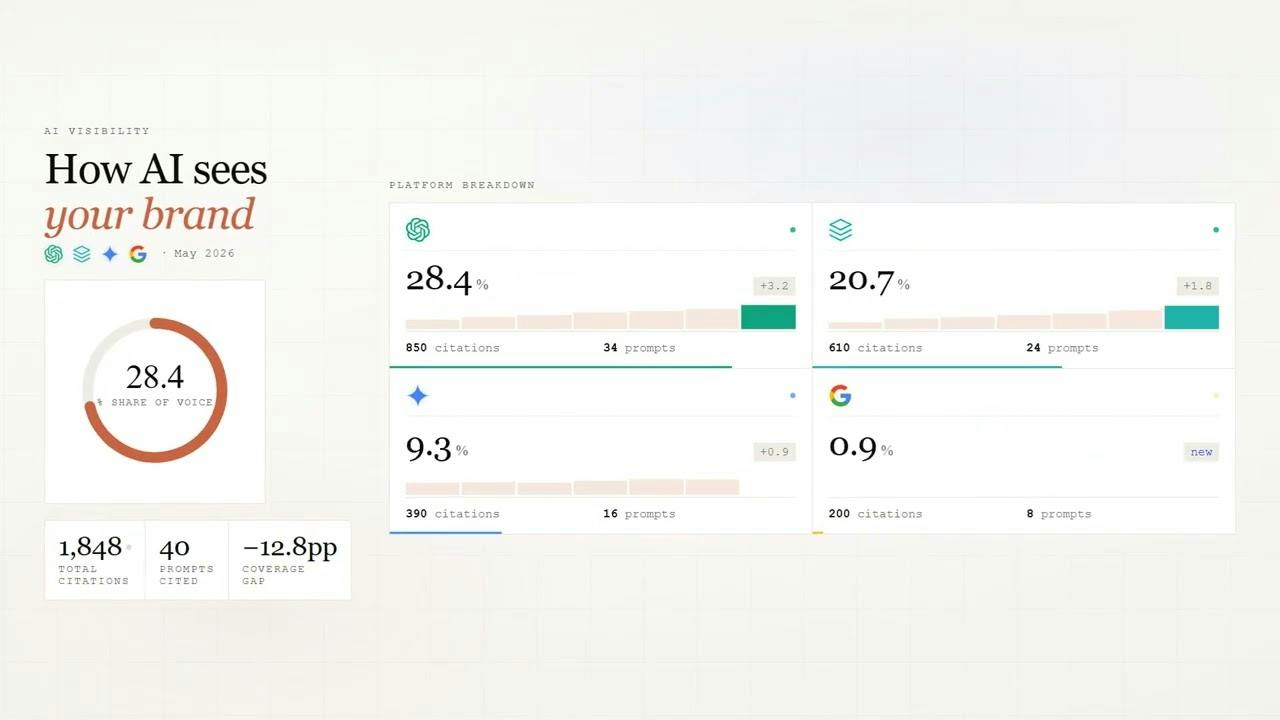
Visiby is a GEO (Generative Engine Optimization) platform that measures how brands appear in AI-generated answers across ChatGPT, Perplexity, and Google AI Overviews. It tracks prompts, brand mentions, citations, and competitor share of voice, then produces a weekly prioritized “action plan” of fixes designed to win more AI citations. Its target customer is the marketing operator at a startup or SMB who has watched organic search traffic migrate into AI answers and has no tooling to see or influence that shift. visiby
The strongest positive signal is timing plus packaging. AI search visibility is a real, fast-emerging budget line, and Visiby bundles tracking, site audits, entity analysis, competitor citation intelligence, and remediation briefs at a flat $49–$249/month — undercutting enterprise platforms like Profound that start near $499/month, while offering more workflow than lightweight monitors. The Product Hunt launch performed reasonably well: 142 upvotes and #5 on the daily leaderboard. visiby
The most important concerns are competitive intensity and company depth. The GEO tooling category is extraordinarily crowded — dozens of entrants including venture-funded leaders (Profound, Otterly), SEO incumbents (Semrush, Conductor, Ahrefs) already bundling AI visibility features, and low-cost specialists. Visiby appears to be a small, India-based team built around a single full-stack developer, with launch-day reliability problems (failed sign-ups, failed report generation), publicly inconsistent pricing and tier descriptions, no disclosed funding, and no verifiable commercial traction. visiby
At current pricing, a $1B valuation implies roughly $140M ARR — on the order of a million SMB subscriptions or a large mid-market/enterprise business in a category where better-capitalized competitors are already established. The realistic outcome for this company as structured is a modest bootstrapped SaaS. Final decision: Pass, with defined conditions under which it could be reconsidered.
Product Overview
Customer problem. Buyers increasingly ask ChatGPT, Perplexity, and Google AI Overviews for recommendations instead of searching. Brands have no visibility into whether they are mentioned, cited, or recommended in those answers, or why competitors are winning — and legacy SEO tools (Semrush, Ahrefs, GA) do not sample prompts or parse model answers. visiby
How it works. During onboarding, Visiby ingests the customer’s website, industry, and named competitors, then uses AI to generate a prompt set (buyer queries, branded questions, “best X for Y” comparisons) that the customer can review and adjust. It then runs those prompts across engines on a weekly autonomous refresh, measuring citation share, which URLs are cited, sentiment, and competitor presence, and fuses the results into a prioritized, effort×impact-priced action plan with content briefs. visiby
Core features. Prompts & Citations Explorer, site audit with action plan, brand entity view across engines, competitor citation and sentiment detail, passage-level citation provenance, content briefs, multi-workspace reporting. visiby
Pricing (verified from the pricing page, with a material conflict noted): Lite $49/month (25 prompts, 1 seat, 1 brand, ChatGPT/Perplexity/AI Overviews, weekly refresh); higher tiers add depth. The company’s own blog describes “Starter at $99/month (100 prompts)” and “Pro at $249/month,” and a Product Hunt commenter caught contradictory tier descriptions, which the team acknowledged as a page “mid-update” while finalizing the lineup. This report treats the pricing page ($49 entry, ~$99–$249 upper tiers) as the current best primary source, but the conflict reduces Evidence Confidence. producthunt
Platforms: Web-based SaaS. No free tier (Product Hunt lists “Payment Required”). producthunt
Founder and Team Assessment
The Product Hunt hunter is Ash Bagda. A LinkedIn profile for an Ash Bagda in Jaipur, India, describes a full-stack MERN developer with enterprise and AI application experience — skills consistent with shipping Visiby, but no founding role, company, or commercial track record is verifiable on that profile. The product is branded “Visiby by FNA Technology,” suggesting it operates under an existing Indian technology company, but no corporate registration, team size, or history for FNA Technology was found. visiby
The team demonstrates genuine full-stack execution: a broad, well-packaged product shipped across five engines with automated pipelines. However, there is no verifiable marketing-software background, no prior company, no exits, and no team page. Maker responses in launch comments were responsive and technically credible. Product references to “Every Tuesday at 07:42 IST” scheduling and a possible agency relationship with the launch team (“Kill Ping”) are consistent with a small India-based operation, but this is inference, not disclosure. visiby
Founder Assessment: Credible technical execution, but the founder’s commercial background, team size, and full-time commitment are unverified, and the operation appears very small.
Market Opportunity
The initial segment is narrow: startups and SMB marketing teams (roughly 1–20 seats) in English-speaking markets who already invest in SEO and now need AI-search visibility — priced at $49–$249/month.
Bottom-up estimate (analyst assumption): assume 1–2 million businesses worldwide spend meaningfully on SEO/content, of which perhaps 5–10% adopt a dedicated GEO tool over the next few years. At a blended ~$1,200/year ARPU, that is a $60M–$240M annual revenue category — large enough for a strong niche business, but far below what would support a category-leading venture outcome unless the product moves upmarket. Enterprise platforms in the same space price at $1,500+/month, indicating the higher-value buyers are above Visiby’s current focus. shadow
Expansion opportunities: agency/multi-brand workspaces, passage-level content optimization APIs, and the adjacent “AI reputation” use case (what models say about you, not just whether they cite you). Geographic expansion is natural (the product already served a Brazilian tester at launch). Timing is favorable — third-party estimates put lightweight GEO monitoring at $29/month and enterprise platforms at $500+/month, with the category forming rapidly. producthunt
Traction and Growth Signals
- Product Hunt: 142 upvotes, #5 of the day, 15 comments, 177 followers at report date. producthunt
- Product is live with published pricing and a functional onboarding flow — verified. visiby
- Launch-quality issues are documented in public comments: repeated “Network Error” on sign-up, failed report generation for a Brazilian site, and inconsistent tier descriptions — acknowledged by the maker. producthunt
- The company publishes comparison content (a pricing guide across nine platforms), indicating an active SEO content strategy. visiby
- Revenue, paying customers, users, retention, conversion, traffic, and search interest: not publicly disclosed; no reliable public information was found.
- No funding announcements, press coverage, GitHub, or hiring signals found.
The most important missing metrics: paying-customer count, retention, and any evidence of acquisition beyond Product Hunt and SEO content.
Traction Assessment: Decent launch attention and live product, but commercially unverified with documented early reliability problems.
Competitive Position
- Direct competitors: Profound, Otterly, Peec, Visto, Geoptie, GeoScout, Shadow, and dozens more GEO platforms. shadow
- Platform threats: Semrush, Conductor, and Ahrefs — each already shipping AI visibility toolkits to their existing customer bases, and all compared against on Visiby’s own capability table. visiby
- Free alternatives: free tiers from several GEO tools, plus manual prompting of ChatGPT/Perplexity. geoscout
Current differentiation: bundled remediation (audits and action plans rather than scores alone), passage-level citation provenance, and flat transparent pricing versus per-feature add-ons — genuine workflow advantages over pure monitors. But there is no proprietary data advantage, no network effect, low switching costs, and the critical question — if Semrush or Profound shipped equivalent action-plan features tomorrow, why would customers stay on Visiby? — has no strong answer beyond price and focus. In a category with dozens of entrants and funded leaders, price-led differentiation compresses quickly. producthunt
Defensibility Assessment: Low.
Business Model and Economics
Flat-tier SaaS with a usage dimension (tracked prompts per month). The company’s own analysis estimates its cost at roughly $0.33 per tracked prompt, implying Lite’s 25 prompts cost only a few dollars in inference per customer per month — suggesting healthy gross margins if prompt generation and refresh pipelines are efficient. Real variable costs are AI inference across three to five engines on weekly runs, plus parsing infrastructure. Whether heavier usage scales revenue faster than inference costs is not assessable from public data; the weekly (not daily) refresh on lower tiers caps cost exposure sensibly. visiby
Customer acquisition currently appears to rely on Product Hunt launches and SEO comparison content — low-cost but slow channels against funded competitors buying paid acquisition. No enterprise motion, API product, or reseller program is visible.
Unicorn Path
Assume a 6–8× ARR multiple for a mature martech SaaS (consistent with public marketing-software comparables; no premium is justified without demonstrated growth). Required revenue: $1B ÷ 7× ≈ $140M ARR.
At Visiby’s current pricing, that implies roughly 1 million Lite subscriptions (~$588/year) or, more plausibly, a mid-market/enterprise business with 10,000–20,000 customers at $7,000–$14,000 ACV — a segment where Profound and the SEO incumbents already compete with far greater capital and distribution. Reaching unicorn scale would require: a funded team, a move upmarket to agency and enterprise contracts, defensible data or workflow lock-in, and survival against incumbents who already own the SEO budget line Visiby is trying to expand. shadow
Unicorn Path: Improbable — the category can in aggregate produce a large company, but not this one at its current structure, pricing, and competitive position without a transformation it shows no signs of attempting.
Valuation Assessment
No funding rounds, investors, or valuations exist in any public source. The company appears self-funded.
Valuation Attractiveness: Not Assessable. There is no financing event to evaluate. Responsible assessment would require: current ARR and growth, paying-customer count, retention, gross margin, any SAFE or round terms, and clarity on the legal entity (FNA Technology) and cap table. Product quality and a #5 Product Hunt placement cannot substitute for any of this.
Key Risks
- Category crowding — dozens of GEO tools, several venture-funded, competing on the same features (most material)
- Incumbent bundling — Semrush, Ahrefs, and Conductor adding AI visibility to products SMBs already pay for visiby
- Unverified traction — no public customers, revenue, or retention
- Product reliability — documented launch failures for sign-up and report generation producthunt
- Pricing instability — publicly inconsistent tiers acknowledged as mid-update, signaling early-stage operational immaturity producthunt
- Small-team execution — one verifiable developer; no disclosed company structure visiby
- Low switching costs — brands can export prompt lists and move tools monthly
- Engine dependency — the product’s value depends on the continued behavior and accessibility of ChatGPT, Perplexity, and Google AI Overviews
Final Assessment
Venture Potential: 45/100
| Category | Score |
|---|---|
| Market Size and Expansion Potential | 14/20 |
| Traction and Growth Evidence | 4/20 |
| Founder and Team | 6/15 |
| Product Strength | 6/10 |
| Distribution Potential | 6/15 |
| Business Model and Economics | 6/10 |
| Defensibility | 3/10 |
| Total | 45/100 |
Strongest element: a real, timely market with sensible flat-rate packaging and a broad feature set relative to price. Weakest elements: minimal verified traction, no apparent distribution advantage, and near-zero defensibility in the most crowded niche in martech.
Evidence Confidence: 48/100
Verified: product existence and feature set, published pricing (with a self-acknowledged inconsistency in tiers and engine coverage), launch statistics (142 upvotes, #5), hunter identity and profile. Company-reported only: capability comparisons against competitors, cost-per-prompt claims in its own blog. Unknown: legal entity and team size, funding, revenue, customers, retention, founder’s commercial history. The pricing conflict was acknowledged by the company itself and is treated as a material data-quality flag.
Final Decision: Pass
Venture Potential of 45/100 places Visiby in the niche/bootstrap band; the Unicorn Path is Improbable; Valuation is Not Assessable; and Evidence Confidence is limited. The GEO category is genuine and growing, but it is already the most crowded sub-segment of marketing software, with funded specialists and incumbent SEO platforms converging on the same feature set. Visiby’s advantages — flat pricing and bundled action plans — are replicable within one release cycle. A small, unverifiable team with launch-day reliability issues and no disclosed funding is not positioned to win a land war against Profound, Semrush, or Conductor. This is likely a viable bootstrapped SaaS, not a venture-scale candidate today.
Upgrade Conditions
- Verified evidence of 1,000+ paying customers or $100K+ ARR with sustained growth
- Demonstrated retention above 80% at six months in a category with low switching costs
- A repeatable acquisition channel beyond Product Hunt and SEO content (e.g., agency partnerships)
- Movement upmarket with agency or mid-market multi-brand contracts
- A disclosed funding round and named team with marketing-software experience
Downgrade Conditions
- Semrush or Ahrefs shipping equivalent action-plan features at existing price points
- Continued product instability or pricing inconsistency
- Evidence of stalled customer growth three to six months post-launch
- The founder deprioritizing Visiby for other FNA Technology work
Questions for Further Diligence
- What are current MRR and paying-customer counts by tier?
- What is free-trial-to-paid conversion, and what is 90-day logo retention?
- How many prompts does the median customer run weekly, and what is the inference cost per customer?
- What is the team size behind FNA Technology and Visiby, and who besides Ash Bagda works on it full-time?
- What are the agency/multi-brand plans, and what ACV do agencies generate today?
- How are engine coverage and refresh cadence priced, and what happens when a new engine (e.g., Claude, Gemini) is added?
- What is the customer acquisition cost and volume by channel — Product Hunt, SEO content, or referrals?
- Has any external capital been raised, and what is the cap table?
- How does Visiby handle engine API terms-of-service risk for automated prompt sampling?
- What distinguishes the product, concretely, from Profound’s or Peec’s offering at double the price?
- What was the cause of the launch-day sign-up and report failures, and what has since been fixed?
- What is the 12-month roadmap — upmarket, API, or breadth of engines?
Sources
- Product Hunt — Visiby (primary launch page, maker comments)
- Visiby homepage (product, positioning, capability table)
- Visiby pricing page (verified tiers; “Visiby by FNA Technology”)
- Visiby blog — AI visibility tool pricing comparison (company-reported pricing landscape)
- Hunted.space — Visiby launch dashboard (secondary; upvotes and ranking)
- Ash Bagda — LinkedIn (hunter identity; self-reported)
- Shadow Inc — Best GEO tools 2026 (secondary; competitor landscape)
- ValueAI Labs — GEO agency vs GEO tool (secondary; competitor context)