
Table of Contents
- GhostWriter by MyHandler Investment Report
GhostWriter by MyHandler Investment Report
Category: Local-first AI personal assistant / ambient capture / AI writing (Windows desktop)
Company Stage: Pre-revenue or very early revenue; solo-founder project launched March 2026
Founder or Founders: Tery Emilson, solo developer (Brantford, Ontario, Canada)
Headquarters: Ontario, Canada (operated as a sole proprietorship; no separate legal entity disclosed)
Funding: Not publicly disclosed
Business Model: Freemium subscription with usage credits; on-device AI unlimited, cloud AI metered
Product Hunt Launch Date: September 13, 2026 (hunted by Chris Messina)
Report Date: September 16, 2026
| Investment Metric | Assessment |
|---|---|
| Venture Potential | 44/100 |
| Unicorn Path | Improbable |
| Valuation Attractiveness | Not Assessable |
| Evidence Confidence | 48/100 |
| Final Decision | Watch |
Executive Summary
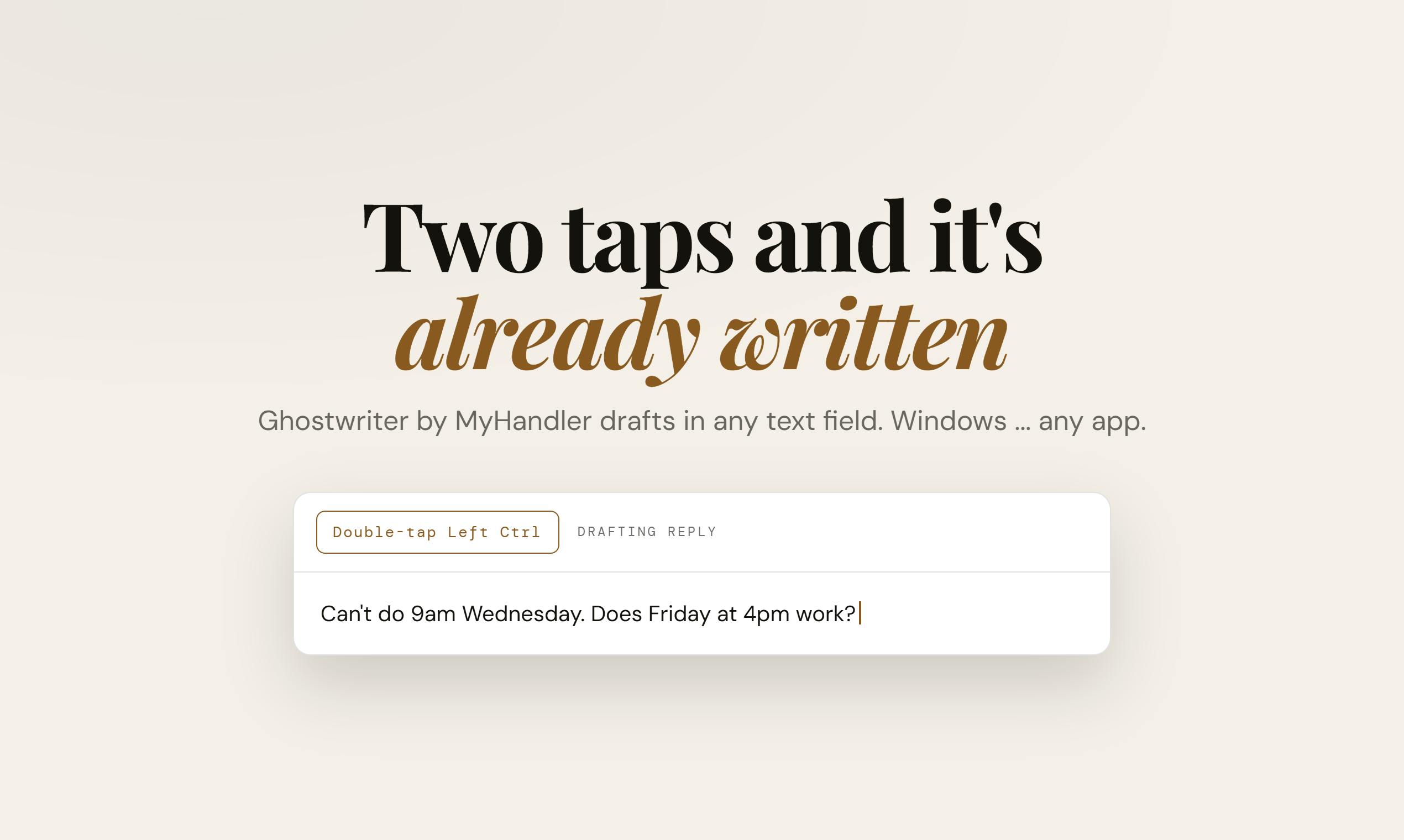
GhostWriter is the flagship feature of MyHandler, a Windows-only “local-first” AI assistant that continuously indexes a user’s screen text, files, email, calendar, meetings, and messaging channels into an AES-256-encrypted SQLite vault on the user’s own machine. GhostWriter adds a writing surface: double-tap Left Ctrl in any text field and the system reads the surrounding thread, infers the intended reply, checks it against the user’s calendar, drafts it in the user’s voice, and types it — never sending it. The company positions itself as the local-first, Windows-first answer to Rewind (acquired by Meta and shut down in December 2025), Littlebird, Granola, and Microsoft Recall. myhandler
The target customer is the privacy-conscious knowledge worker — lawyers, journalists, doctors, founders — who refuse to upload their digital life to a cloud AI. The strongest positive signal is architectural authenticity: text-only capture via accessibility APIs (not screenshots), local transcription, a default on-device model (Qwen 3), and optional zero-data-retention cloud inference via Groq — a genuinely differentiated design rather than a privacy badge. The founder is a 30+ year software veteran with a track record of shipping and selling small software businesses, corroborated in part by third-party listings of his earlier product, abcDB. myhandler
The most important concerns are scale and concentration. MyHandler is a one-person company founded in March 2026, with no disclosed users, revenue, or funding, a Product Hunt launch that finished #114 of the day with roughly a dozen comments, and a business model capped at prosumer price points ($19–$79/month). The ambient-capture category is being reshaped by platform players (Microsoft Recall, Meta’s acquisition of Rewind/Limitless) and open-source alternatives (Screenpipe), while corporate IT policies increasingly ban exactly this kind of tool. hunted
A $1B outcome would require roughly 600,000+ paying subscribers at current pricing — implausible for a solo, self-funded, Windows-only project. The realistic ceiling without a team, capital, and a compliance-grade enterprise motion is a strong indie business. Final decision: Watch — the architecture thesis is credible and the founder is unusually transparent, but there is nothing yet to diligence commercially.
Product Overview
Customer problem. Cloud AI assistants that are genuinely useful require access to email, files, meetings, and screen context — data that privacy-sensitive professionals (legal, medical, journalistic, financial) and their compliance policies will not surrender to third-party servers. myhandler
How it works. MyHandler reads screen text through Windows accessibility APIs, transcribes meetings on-device, indexes local documents, and pulls channels (Gmail, Outlook, Slack, Teams, SMS, Telegram, Discord, calendars) through an encrypted relay that deletes its copy after sync. Everything lands in an encrypted local vault with the key in Windows Credential Manager. GhostWriter consumes this context: it identifies whether the user owes a reply, continuation, or fresh answer, maps senders, cross-checks proposed times against the calendar, and types the draft at the cursor for the user to edit and send. Password fields are skipped; incognito browsing is ignored; apps can be excluded. myhandler
Pricing (verified from the pricing page): Free ($0; 300 credits/month, 3 channels, 1 voice minute), Personal $19/month (2,000 credits), Business $39/month (5,000 credits, MCP support), Executive $79/month (15,000 credits). Credits meter cloud AI only — 6 per chat, 3 per GhostWriter draft, 1 per transcription minute — while on-device AI is unlimited and free. Note a conflict: the same page’s metadata and a comparison page reference “$15/month” and “Free / $29 / $79 / $199+” respectively; this report uses the pricing-table body ($19/$39/$79) as the most reliable primary source, and treats the discrepancy as a minor data-hygiene flag. myhandler
Platform: Windows 10 and 11 only; macOS and Linux stated as planned, with a Mac version “scaffolded” but undated. myhandler
Replaces: Rewind/Limitless (discontinued), Microsoft Recall (Copilot+ hardware-gated), and the manual workflow of keeping notes across tools — for the Windows user who wants memory without cloud storage. myhandler
Founder and Team Assessment
Tery Emilson is identifiable and consistent across primary sources: the Product Hunt launch, the about page, LinkedIn, and the terms/privacy documents, which state MyHandler.ai is operated by Tery Emilson in Ontario. LinkedIn shows MyHandler.AI founded March 2026, concurrent with a six-plus-year role as senior developer at Entryline.com — raising a question about full-time commitment. myhandler
Founder-reported history: software since the late 1980s; built and sold a distribution company, started and sold a cellular retail business, shipped FuturePAGE (paging software) and abcDB, a mobile database used in 110+ countries that earned a Microsoft HQ invitation in 2004. The PH launch claims abcDB was the top Pocket PC database for a decade. Third-party corroboration exists for abcDB’s existence and publisher (“Tery and Orlean Emilson”) but not for market-share claims. No exits, valuations, or funding events are verifiable. myhandler
This is a strong technical generalist with real commercial instincts — he has repeatedly shipped and sold self-built software. But he is a single, self-described solo developer (“When something breaks, you’re emailing me”), building a category that requires deep per-OS engineering, security auditing, and enterprise trust-building. Key-person risk is absolute: the company is one person. myhandler
Founder Assessment: Authentic, experienced, and unusually transparent technical founder, but a solo operation with unverified full-time commitment and no team to scale.
Market Opportunity
The initial segment is narrow: privacy-constrained Windows knowledge workers — solo lawyers, journalists, consultants, physicians, small-firm finance — who (a) generate heavy written communication, and (b) cannot use cloud AI assistants under professional confidentiality obligations. A secondary segment is privacy-motivated prosumers.
Bottom-up estimate (analyst assumption): assume 5–15 million such professionals across North America and Europe with meaningful willingness to pay, and a realistic capture of 1–2% at a blended ~$250/year (Personal/Business mix) over several years — an addressable opportunity on the order of $125M–$750M in annual revenue at full maturity of the niche. That can support a substantial business, but the low end does not clear venture-scale thresholds without expansion.
Expansion levers: macOS/Linux (undated), an enterprise/compliance tier for law firms and clinics (where the privacy architecture could justify $50–100+ per seat), and regulated-industry distribution partnerships. Timing is favorable: the Rewind/Limitless shutdown left a local-first vacuum, and rising alarm over ambient-capture privacy creates demand for on-device alternatives. Timing is also unfavorable: Microsoft Recall keeps improving and ships with the OS. myhandler
Traction and Growth Signals
- Product Hunt: launched September 13, 2026, hunted by Chris Messina; finished approximately #114 on the day with roughly 11 comments and 102 followers — a low-attention launch. hunted
- Product is downloadable and live with published pricing — verified. myhandler
- Founder engagement in launch comments is detailed and responsive, with credible technical answers about capture scope. producthunt
- Revenue, paying customers, downloads, retention, conversion, traffic, search interest: not publicly disclosed; no reliable public information was found.
- No GitHub, no job listings (consistent with solo status), no press coverage found.
The most important missing metrics: free-to-paid conversion, paying-customer count, and any evidence of organic acquisition beyond the founder’s own comparison-page SEO. The #114 placement is a weak signal even by launch-attention standards.
Traction Assessment: Live product with engaged maker, but traction is negligible on available evidence.
Competitive Position
- Direct competitors: Littlebird (cloud), Granola (meetings only), Wispr Flow (dictation). myhandler
- Platform threats: Microsoft Recall (OS-bundled, hardware-gated today) and whatever Apple/Meta ship next; Meta’s acquisition of Rewind/Limitless signals platform appetite for this category. reuters
- Free/open-source alternatives: Screenpipe (open-source local ambient capture, with a paid desktop client) and a growing local-first stack. freevoicereader
Differentiation is real: text-only accessibility-API capture (lighter and less creepy than screenshot recording), local encrypted vault ownership, unlimited on-device AI, and Windows-first focus — a platform the Mac-centric competitors skipped. Pricing is aggressive at $19 versus cloud assistant incumbents. But there are no network effects, no proprietary data (the whole point is that the company holds none), low switching costs, and the critical question — if Microsoft ships a polished Recall for all Windows PCs, why would customers pay $19/month to a solo developer? — has only a partial answer: privacy architecture, cross-platform independence, and channel breadth. That is positioning, not a moat. myhandler
Defensibility Assessment: Low.
Business Model and Economics
Freemium subscription with metered cloud credits is economically sensible for this architecture: the costly part (local inference) runs on the customer’s hardware for free, and the company pays only for optional Groq cloud calls — meaning gross margin on Personal plans should be healthy, and the credit structure (3 credits per GhostWriter draft, 6 per chat) ties revenue to the costliest usage. Whether usage growth increases revenue faster than inference costs is not assessable from public data, though the unlimited-local fallback design limits the company’s marginal cost exposure. myhandler
Concerns: prosumer ACV of $228–$948/year caps revenue per customer; the free tier is generous (300 credits, 3 channels); and the buyers who most need this product often work inside corporate IT environments where screen-capture tools are banned or require security review — lengthening sales cycles the solo founder cannot staff. basilai
Unicorn Path
Assume a 6–8× ARR multiple for a mature prosumer/SMB software business (consistent with public productivity-software comparables; no premium applies without demonstrated growth). Required revenue: $1B ÷ 7× ≈ $140M ARR.
At verified pricing, that implies roughly 600,000+ Personal subscribers ($228/year) or a blended mix with meaningful Business/Executive volume — versus a realistic serviceable niche estimated in the low hundreds of millions of dollars annually. Reaching unicorn scale would require: a real team, external capital, macOS/Linux shipping, a compliance-grade enterprise tier at materially higher ACV (regulated verticals), and surviving Microsoft Recall — a transformation the current one-person, self-funded structure cannot execute.
Unicorn Path: Improbable — not impossible in the category, but implausible for this company as currently structured.
Valuation Assessment
No funding history, investors, rounds, or valuations exist in any public source; the company appears to be founder-funded. myhandler
Valuation Attractiveness: Not Assessable. Assessment would require: current ARR and growth, paying-customer count, conversion and retention, gross margin, any SAFE or round terms, founder ownership, and evidence the founder is willing to raise and dilute at all. Nothing can be responsibly priced from Product Hunt performance or product quality.
Key Risks
- Platform replication — Microsoft Recall maturing into default Windows functionality (most material)
- Solo-founder execution ceiling — one person maintaining a security-sensitive, multi-channel capture product
- Corporate IT / compliance bans on ambient screen capture, blocking the highest-value users basilai
- Negligible verified traction — #114 launch, no disclosed users or revenue hunted
- Security liability — a local encrypted vault aggregating an entire digital life is a high-value target; a single breach would be fatal to a privacy-first brand
- Free open-source competition — Screenpipe and local-first stacks commoditizing capture freevoicereader
- Windows-only ceiling with undated Mac/Linux roadmap
- Ambient-recording legal exposure (consent laws) landing on a company with no legal team
Final Assessment
Venture Potential: 44/100
| Category | Score |
|---|---|
| Market Size and Expansion Potential | 12/20 |
| Traction and Growth Evidence | 3/20 |
| Founder and Team | 8/15 |
| Product Strength | 7/10 |
| Distribution Potential | 5/15 |
| Business Model and Economics | 6/10 |
| Defensibility | 3/10 |
| Total | 44/100 |
Strongest element: a genuinely differentiated local-first architecture built by a credible, transparent founder in a category with a fresh vacuum (Rewind’s shutdown). Weakest elements: a one-person team, near-zero verified traction, and a defensibility profile that depends on Microsoft choosing not to compete.
Evidence Confidence: 48/100
Verified: founder identity and location, legal structure (sole proprietorship, Ontario), product existence and feature set, published pricing (with an internal pricing-page inconsistency noted), launch date and performance, solo-team status. Founder-reported only: career history, abcDB market position, “selling companies.” Unknown: revenue, users, retention, conversion, funding, burn, valuation, roadmap dates. No third-party financial corroboration exists anywhere.
Final Decision: Watch
Venture Potential is 44/100 (niche/bootstrap profile today), the Unicorn Path is Improbable at current scale, Valuation is Not Assessable, and Evidence Confidence is moderate at best. The product thesis — full local-first ambient memory on Windows — is credible and timely, and the founder’s transparency is a positive character signal. But there is no commercial evidence to diligence, the launch performed poorly, and the structure (one person, no capital) cannot support venture-scale execution. Watch, with the following conditions.
Upgrade Conditions
- Verified evidence of paying customers (e.g., 1,000+ paying, or $20K+ MRR)
- Free-to-paid conversion above ~5% with retention beyond six months
- A Mac or Linux version actually shipping, proving multi-OS execution capacity
- A compliance-oriented tier with named legal, medical, or financial customers
- The founder hiring or raising capital, indicating intent to build beyond solo scale
Downgrade Conditions
- Microsoft Recall becoming available on standard Windows hardware with local-only processing
- No measurable user growth six months post-launch
- Evidence of a security incident or vault vulnerability
- The founder deprioritizing the product or remaining part-time on Entryline work
- Screenpipe or another open-source project matching the feature set
Questions for Further Diligence
- How many users have installed, and how many are on paid plans today?
- What is free-to-paid conversion, and what is 90-day retention by cohort?
- How many GhostWriter drafts per week does the median active user generate?
- What are Groq inference costs per paying user, and what is realized gross margin per tier?
- What percentage of users run with cloud AI fully disabled — and does that correlate with retention?
- Is the founder full-time on MyHandler, and what is the Entryline commitment?
- Has any security audit or third-party review of the vault been performed?
- What enterprise or firm inquiries, if any, have arrived from regulated industries?
- What would a team look like — which roles would you hire first, and would you raise capital?
- What is the realistic Mac/Linux timeline, and what is the engineering dependency?
- How do you plan to handle corporate IT bans and consent-law exposure for meeting transcription?
- What happens to the business if Recall ships to all Windows 11 PCs in 2027?
Sources
- Product Hunt — GhostWriter by MyHandler (primary launch page and maker comments)
- MyHandler.ai homepage (product, architecture, comparison table)
- GhostWriter product page (feature mechanics)
- MyHandler pricing page (verified pricing and credit structure)
- About the founder — Tery Emilson (self-reported background; primary)
- Tery Emilson — LinkedIn (identity, timeline)
- MyHandler terms and privacy policy (legal entity, jurisdiction)
- Hunted.space launch dashboard (secondary; launch ranking)
- abcDB Professional listing — softwaresea (secondary; abcDB corroboration)
- Reuters — Meta acquires Limitless (category context)
- Rewind/Limitless shutdown timeline (category context)
- FreeVoice Reader — local AI meeting tools (secondary; open-source competitor landscape)