
Table of Contents
GLM-5.3 Investment Report
Category: Frontier foundation models, agentic coding, and cybersecurity AI
Company Stage: Public company; Z.ai / Zhipu AI listed in Hong Kong in January 2026
Founder or Founders: Jie Tang and Zhang Peng
Headquarters: Beijing, China
Funding: Multiple private rounds followed by a Hong Kong public listing; current primary-financing terms are not applicable to a conventional early-stage round
Business Model: Usage-based model APIs, coding subscriptions, enterprise AI solutions, model deployment, and related platform services
Product Hunt Launch Date: August 15, 2026
Report Date: August 18, 2026
| Investment Metric | Assessment |
|---|---|
| Venture Potential | 82/100 |
| Unicorn Path | Clear |
| Valuation Attractiveness | Expensive |
| Evidence Confidence | 78/100 |
| Final Decision | Pass |
Executive Summary
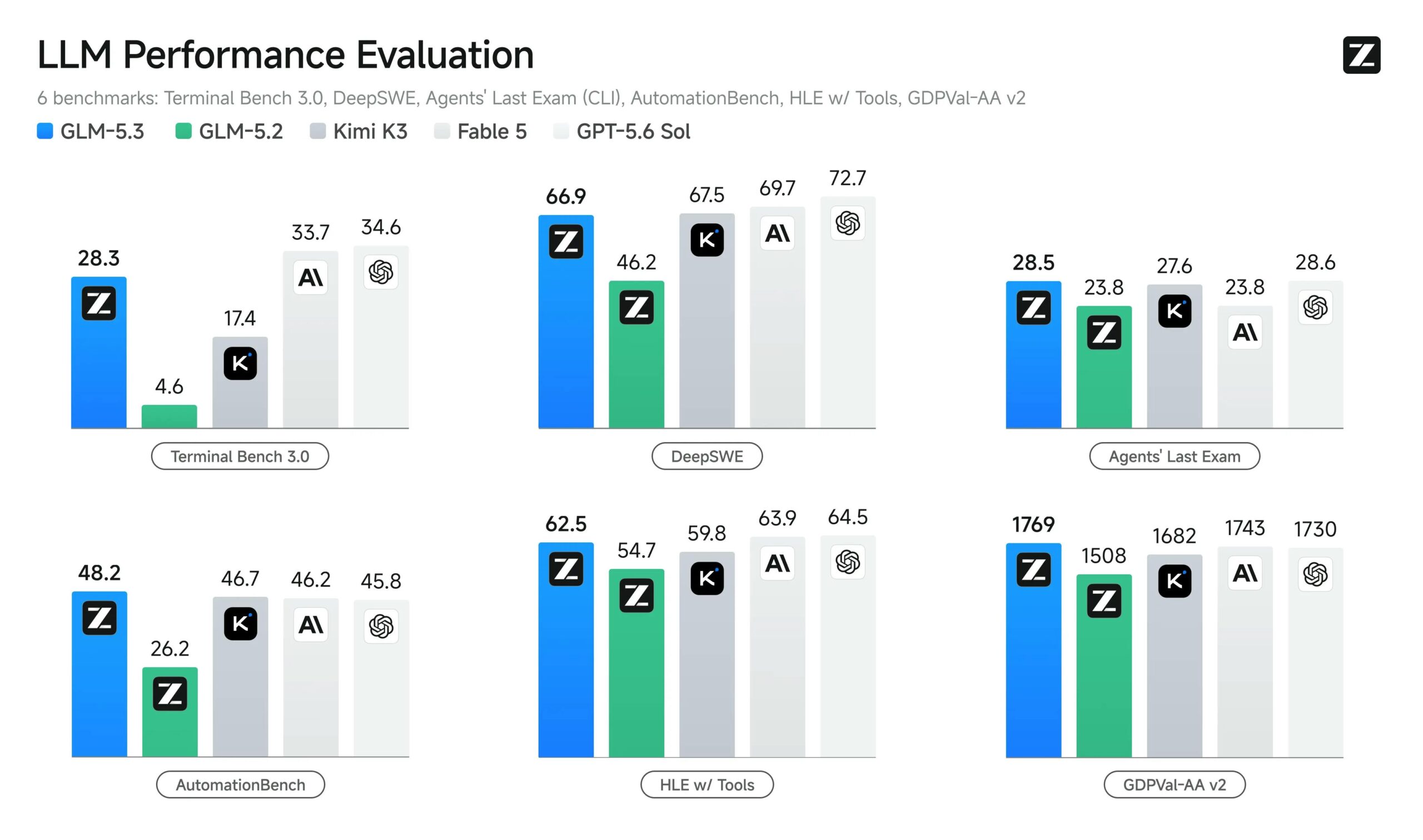
GLM-5.3 is the newest model in Z.ai’s GLM family and is positioned around advanced agentic engineering and cybersecurity. Public reporting says Z.ai delayed release of the model weights by two weeks after internal testing showed strong vulnerability-discovery and exploit-reasoning capability. Axios reported an 84.5% result on CyberGym and a tiered-access program for selected security partners while safety controls are strengthened. These are company-selected benchmark results and should not be treated as independent proof of production superiority. Axios
The product belongs to Z.ai, formerly Zhipu AI, a major Chinese foundation-model developer founded by Tsinghua-affiliated researchers. The company has a broad model platform, consumer and developer distribution, enterprise relationships, and a history of releasing model weights. Its official developer documentation already lists GLM-5.3, although the accessible pricing table does not yet show a GLM-5.3 price. GLM-5.2 is priced at $1.40 per million input tokens and $4.40 per million output tokens, illustrating Z.ai’s aggressive price positioning. Official pricing
The strongest investment signal is that this is not an isolated Product Hunt project. Z.ai has a substantial research organization, a mature model lineage, public-market financing, API distribution, and an Apache-2.0 GLM-5 series repository. The GLM-5 repository shows thousands of stars and hundreds of forks, while official materials describe open deployment through vLLM, SGLang, Transformers, and Ascend-oriented frameworks. GLM-5 GitHub
The central investment concern is price and fit. Z.ai is already a public, very highly valued company rather than an early-stage startup. Caixin reported a market value near HK$930 billion following GLM-5.2, while third-party reporting also describes continued losses and enormous infrastructure requirements. Regulatory, export-control, cybersecurity, and governance risks are material. Caixin
Final decision: Pass for an early-stage venture portfolio. This is a strong company and a credible frontier product, but it is outside the mandate, already far beyond unicorn status, and appears priced for exceptional execution. Pass is not a negative product judgment.
Product Overview
GLM-5.3 is intended for long-horizon agentic work, coding, and security analysis. The controlled cyber release is notable because it acknowledges dual-use risk: a model capable of finding vulnerabilities can help defenders and attackers. Z.ai says selected security partners will initially receive controlled access and that public weights will follow after additional safeguards. Axios
The surrounding GLM-5 platform supports API access and self-deployment. The prior GLM-5.2 model offers a one-million-token context, configurable reasoning effort, and open weights. Its 744-billion-parameter mixture architecture activates approximately 40 billion parameters. GLM-5.3’s final weight license, parameter details, independent benchmark results, production latency, and public API price were not sufficiently verified at the report date. Official GLM-5 repository
Target customers include software developers, AI-native businesses, cybersecurity teams, enterprises deploying private models, and Chinese organizations requiring domestic infrastructure. The product competes on capability, price, openness, and compatibility with local hardware.
Founder and Team Assessment
Jie Tang and Zhang Peng are publicly associated with founding and leading Zhipu AI. The company emerged from Tsinghua University research and has developed knowledge-graph products and successive GLM generations. Its Hong Kong listing document describes commercialization beginning before the current generative-AI wave and explains how model releases expanded customer reach and valuation. Hong Kong listing document
Technical capability is strongly evidenced by a multi-generation model portfolio, research publications, open repositories, and production APIs. Commercial capability is more credible than at an early startup because the company has institutional customers and public-market scrutiny. However, exact GLM-5.3 team ownership, safety governance, employee retention, founder control, and current executive incentives require updated diligence.
Founder Assessment: Strong research and company-building capability, with governance and geopolitical complexity that exceeds normal early-stage diligence.
Market Opportunity
The relevant market is foundation-model inference, coding agents, private enterprise deployment, and AI-enabled cybersecurity. The initial GLM-5.3 customer is likely a sophisticated developer or security organization that values strong coding performance, low API cost, open deployment, or Chinese data residency.
A bottom-up illustration: 5,000 large organizations spending $1 million annually on model APIs, deployment, and support would represent $5 billion of annual revenue opportunity, before consumer subscriptions and smaller developers. This is an analyst scenario, not Z.ai revenue guidance.
The market supports a very large company, but scale requires continuing frontier-model investment while prices decline. Growth in usage does not guarantee attractive economics if compute, energy, model training, and customer acquisition grow at similar rates.
Traction and Growth Signals
Z.ai has far stronger evidence than a normal Product Hunt launch: multiple production model generations, public API pricing, developer subscriptions, open repositories, research papers, a public listing, and broad press coverage. The official GLM-5 repository shows meaningful community adoption and supports common inference frameworks. Product Hunt activity is immaterial relative to those signals.
GLM-5.3-specific commercial traction remains unavailable. No verified API volume, paid-customer count, revenue contribution, latency distribution, customer retention, or independent production comparison was found. The two-week weight-release delay means post-launch adoption is not yet measurable. Benchmark claims show capability, not revenue or sustained customer value.
Traction Assessment: Strong company-level commercialization evidence, but GLM-5.3-specific adoption is too new to assess.
Competitive Position
Direct competitors include OpenAI, Anthropic, Google Gemini, DeepSeek, Alibaba Qwen, Moonshot Kimi, MiniMax, and other open-weight model labs. Indirect competition includes smaller specialized coding and security models, cloud-provider model marketplaces, and enterprises training internal models.
Z.ai differentiates through aggressive API pricing, open-weight distribution, Chinese-language and domestic-infrastructure positioning, and a complete developer platform. Open weights create distribution but reduce exclusivity; rival hosts can serve the same model, and benchmark leads can disappear within months.
If the largest platform launched the same feature within six months, customers might remain for lower cost, on-premises deployment, Chinese ecosystem integration, and model transparency. Global buyers may still prefer providers with clearer governance, stronger enterprise certifications, or lower sanctions risk.
Defensibility Assessment: Medium
Business Model and Economics
Revenue comes from token usage, coding plans, enterprise projects, private deployment, and platform services. The official table prices GLM-5.2 at $1.40 per million input tokens, $0.26 per million cached-input tokens, and $4.40 per million output tokens. GLM-5.3 pricing was not displayed in the accessible table. Z.ai pricing
The economic challenge is intense price competition combined with frontier training and inference cost. Gross margin depends on accelerator utilization, caching, quantization, routing, energy, and enterprise-service intensity. Z.ai’s ability to operate on Chinese accelerators may reduce supply dependence but can raise engineering complexity and power requirements.
Unicorn Path
The company has already exceeded a $1 billion valuation, so the classification is Clear rather than hypothetical. The question is whether current value is sustainable.
For a mature frontier-model company, an illustrative 15× revenue multiple would require roughly $8 billion of annual revenue to support a $120 billion valuation. This is an analyst framework, not a verified current revenue figure. Achieving it requires global-scale inference, durable enterprise contracts, strong gross margin, and continued technical leadership despite rapid commoditization.
Unicorn Path: Clear
Valuation Assessment
The company is publicly traded, so market price replaces private-round valuation. Caixin reported a market value near HK$930 billion in June 2026. That figure is time-sensitive, and current market capitalization should be refreshed before any trade.
Valuation Attractiveness: Expensive. The reported value embeds extraordinary growth and durability. A responsible decision requires current audited revenue, loss, cash flow, share count, dilution, segment margins, and real-time market capitalization. This report does not provide a target price.
Key Risks
- Extremely high public valuation and expectation risk.
- Frontier-model training and inference require enormous capital and energy.
- API price competition can compress gross margin.
- Open weights accelerate adoption but weaken exclusivity.
- U.S. export controls and entity-list restrictions constrain hardware and global partnerships.
- GLM-5.3’s cyber capability creates misuse and regulatory exposure.
- Benchmark claims may not translate to production reliability.
- Domestic accelerator dependence may reduce performance efficiency.
- Global customers may face data-governance and procurement concerns.
- Public shareholders face volatility unrelated to Product Hunt performance.
Final Assessment
Venture Potential: 82/100
| Category | Score |
|---|---|
| Market Size and Expansion Potential | 19/20 |
| Traction and Growth Evidence | 16/20 |
| Founder and Team | 13/15 |
| Product Strength | 9/10 |
| Distribution Potential | 11/15 |
| Business Model and Economics | 7/10 |
| Defensibility | 7/10 |
| Total | 82/100 |
The strongest elements are technical depth, distribution, and market scale. The weakest are capital intensity, geopolitical exposure, and uncertain economics at the reported valuation.
Evidence Confidence: 78/100
Verified: company identity, public-company status, official API pricing, model repositories, and GLM product history. Company-reported: benchmark results and vulnerability counts. Third-party reported: current market value and cyber-release details. Unavailable or insufficiently current: audited 2026 revenue, GLM-5.3 usage, model-level margin, and real-time market capitalization.
Final Decision: Pass
Z.ai is already a major public company and does not fit an early-stage venture mandate. Its reported valuation also leaves limited tolerance for execution setbacks. Investors seeking public-market exposure require a separate securities analysis.
Upgrade Conditions
- A mandate explicitly permitting public growth investments
- Audited revenue and margin supporting the market valuation
- Independent GLM-5.3 production benchmarks
- Clear international compliance and data-governance controls
- Evidence of durable revenue beyond model-release cycles
Downgrade Conditions
- Material safety incident involving released weights
- Severe export-control or sanctions escalation
- Margin collapse from price competition
- Loss of benchmark leadership without retained customers
- Governance or disclosure failures
Questions for Further Diligence
- What are audited 2026 revenue, growth, gross margin, and cash burn?
- What share of revenue is API, subscription, enterprise deployment, and services?
- What are GLM-5.3 latency, cost, and margin per million tokens?
- How many production customers use GLM-5.3, and what is net retention?
- What independent evaluations reproduce the cyber and coding results?
- What safeguards remain effective after weights are public?
- What are current accelerator supply, utilization, and energy commitments?
- How do export controls affect model development and customer access?
- What data-retention and government-access rules apply internationally?
- What current market capitalization and diluted share count should investors use?
- What founder voting control and related-party governance exist?
- Why will customers remain if Qwen, DeepSeek, or Western labs match price and performance?