
Table of Contents
Keysake Investment Report
Category: Language-learning software and macOS input method
Company Stage: Pre-product or private beta; public installer unavailable
Founder or Founders: Not publicly disclosed
Headquarters: Not publicly disclosed
Funding: No reliable public information was found
Business Model: Free product; future monetization not publicly disclosed
Product Hunt Launch Date: September 18, 2026
Report Date: September 22, 2026
| Investment Metric | Assessment |
|---|---|
| Venture Potential | 44/100 |
| Unicorn Path | Conditional |
| Valuation Attractiveness | Not Assessable |
| Evidence Confidence | 32/100 |
| Final Decision | Watch |
Executive Summary
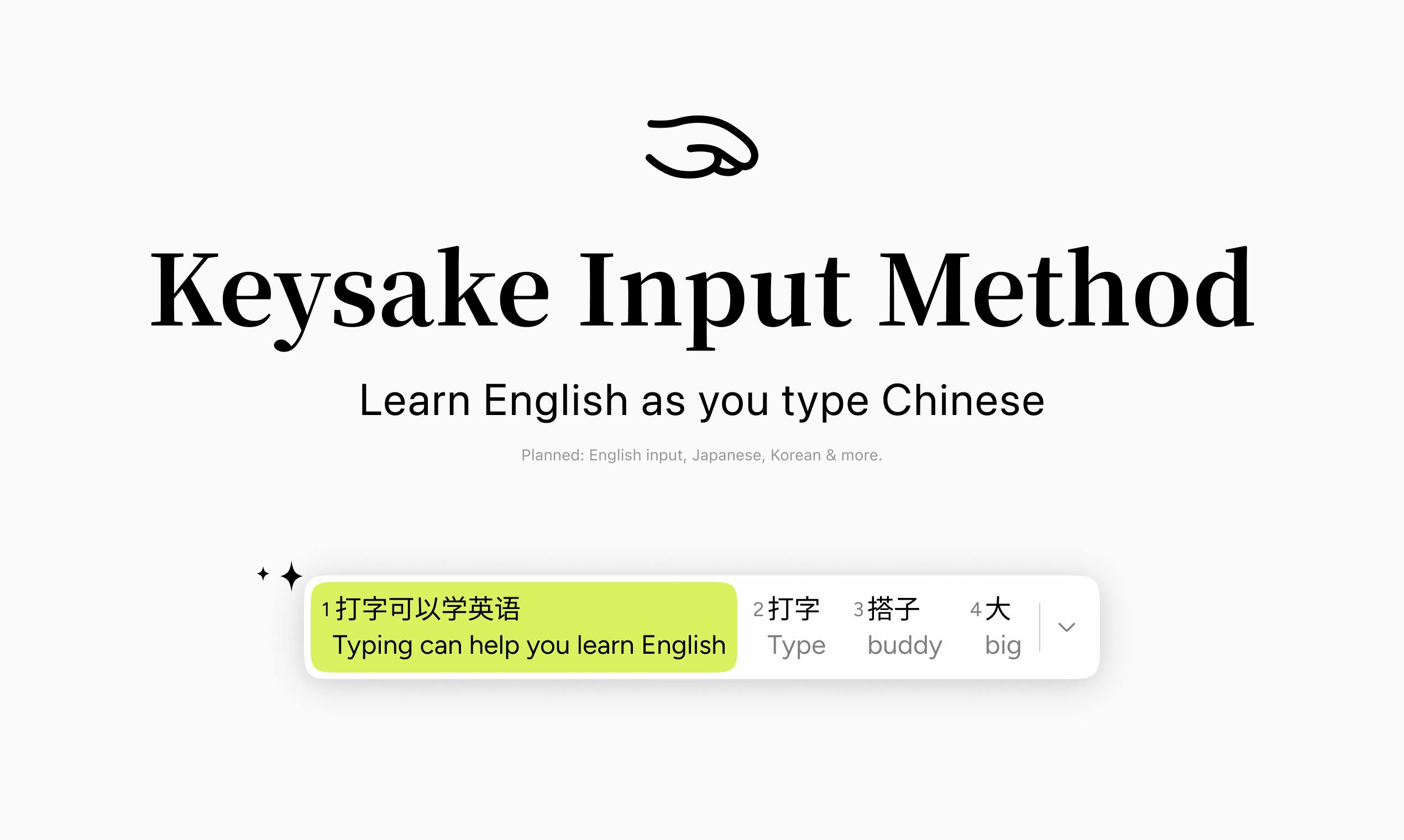
Keysake is a proposed macOS input method that helps Chinese speakers learn English during ordinary typing. As users compose Chinese messages or notes, it displays corresponding English expressions and allows them to save words, phrases, or complete sentences for later review. The concept embeds language learning into an existing daily behavior rather than requiring a separate lesson or study session (Keysake).
The product is initially aimed at Chinese-speaking Mac users learning English. Its strongest product idea is contextual relevance: learning material comes from what the user is already trying to communicate. Keysake also says it uses Apple’s on-device translation technology, so typed content does not need to be sent to the cloud for translation (Keysake FAQ).
However, the publicly accessible website identifies itself as a “design preview” and states that an installer is not connected. No App Store listing, downloadable binary, independent customer review, usage data, pricing page, legal terms, or privacy policy was found. Therefore, product functionality and product quality cannot presently be independently verified.
Keysake placed seventh on Product Hunt’s September 18 leaderboard and received approximately 256 votes. That indicates initial interest in the concept but not product adoption, since the official download flow does not currently provide a usable installer (Product Hunt leaderboard, Product Hunt).
The investment case is further constrained by the absence of identifiable founders, a legal entity, team information, funding history, monetization, and commercial metrics. The appropriate decision is Watch, not DD: the idea is differentiated enough to monitor, but there is not yet a verifiable product or company to underwrite.
Product Overview
Keysake addresses a real weakness in traditional language-learning products: lessons and vocabulary lists are often disconnected from what learners actually need to say. Keysake proposes to turn the user’s ordinary Chinese typing into contextual English-learning material.
The advertised workflow is:
- The user types Chinese through the Keysake macOS input method.
- Keysake displays a natural English expression alongside the Chinese input.
- The user can save a word or phrase through a contextual menu.
- Double-tapping the space bar saves the completed sentence.
- A collection allows the user to revisit saved material.
- Planned “Smart Insights” will explain sentence structure and grammar.
The official website says that Keysake currently supports Chinese input with an English-learning output and a Chinese-language interface. English input, English-to-Chinese learning, Japanese, and Korean are planned but unavailable (Keysake).
The proposed customer benefit is convenience rather than comprehensive instruction. It replaces the sequence of typing a sentence, opening a translator or dictionary, copying the result, and manually saving vocabulary. It does not yet appear to replace structured courses covering speaking, listening, pronunciation, assessment, or curriculum progression.
Keysake is described as free on Product Hunt. No paid plan, usage limit, subscription, advertising model, or enterprise offering is disclosed. More importantly, the official download dialog says: “This is a design preview. An installer is not connected yet.” Consequently, the public product is not presently verifiable as usable.
Product Quality Assessment: The interaction concept is thoughtful, but implementation quality cannot be assessed without a downloadable product.
Founder and Team Assessment
No founder identity, executive biography, legal entity, headquarters, employee count, or hiring information could be reliably linked to Keysake. The official website does not contain an About page, company address, legal terms, privacy policy, support contact, or team information.
No relevant LinkedIn company page or founder profile was found. No public GitHub repository could be reliably associated with the product. There is also no reliable evidence of previous companies, exits, technical credentials, commercial experience, or full-time founder commitment.
The website’s source contains Chinese-language development comments, but this is not sufficient evidence of the creator’s identity, location, or organizational structure. It would be inappropriate to infer that Keysake is associated with another company or founder merely because it launched near other products in the same Product Hunt event.
The inability to verify the team creates substantial key-person and execution risk. A native input method requires operating-system engineering, privacy safeguards, language expertise, distribution, and ongoing compatibility maintenance. None of those organizational capabilities can currently be assessed.
Founder Assessment: Not assessable; founder identity, technical background, commercial capability, and commitment are unverified.
Market Opportunity
The narrow initial customer is a Chinese-speaking Mac user who is actively learning English and regularly writes Chinese messages, notes, or documents. This is a materially smaller segment than the overall global language-learning market because it is constrained by:
- Native or fluent Chinese language
- Active interest in English learning
- Regular desktop typing
- macOS ownership
- Willingness to install a third-party input method
- Willingness to pay for contextual learning
No reliable public estimate of this exact segment was found. A scenario analysis is therefore more responsible than presenting a generic language-learning market report.
At a hypothetical annual subscription price of $60:
- 100,000 paying users would generate $6 million annually.
- 500,000 paying users would generate $30 million annually.
- 2 million paying users would generate $120 million annually.
These are analyst scenarios, not forecasts or company metrics. Existing language-learning products demonstrate consumer willingness to pay: WordUp offers a paid vocabulary subscription, while Duolingo reported that approximately 9% of monthly active users were paid subscribers at the end of 2025 (WordUp, Duolingo 2025 Form 10-K). Keysake has not demonstrated comparable engagement or conversion.
The initial Chinese-to-English Mac segment could support a meaningful subscription business, but venture-scale revenue would probably require Windows and mobile products, additional source and target languages, structured review, speaking practice, and broader learning outcomes.
Traction and Growth Signals
Keysake launched on Product Hunt on September 18, 2026, ranked seventh for the day, and accumulated approximately 256 votes. Product Hunt’s event listing also displayed approximately 86 comments or discussion interactions, depending on the interface presentation (Product Hunt leaderboard, Product Hunt GPT-6 Astra Challenge).
This activity should be treated as concept validation rather than product traction. The official site’s disconnected installer makes it unclear how many Product Hunt visitors could actually install or use the product.
No reliable public evidence was found for:
- Downloads or installations
- Registered or active users
- Paying customers
- Revenue or revenue growth
- Retention or usage frequency
- App Store ratings or reviews
- Independent product reviews
- Product updates or release history
- Customer testimonials
- Partnerships
- Hiring
- Website traffic
- Funding
The Product Hunt launch generated attention, but there is no evidence of sustained post-launch activity or commercial demand.
Traction Assessment: Positive concept-level launch interest, but no verifiable product or commercial traction.
Competitive Position
Keysake competes with several categories:
- Structured language-learning apps: Duolingo, Babbel, Busuu and similar products
- Vocabulary tools: WordUp, Anki and Quizlet
- Contextual browser learning: Toucan, which inserts target-language vocabulary into normal web browsing (Toucan)
- Translation tools: Apple Translate, Google Translate and DeepL
- Free operating-system alternatives: Apple’s built-in Chinese input sources and system translation functions (Apple Chinese Input Method Guide)
- Manual alternatives: Copying text into a translator and saving vocabulary in notes or flashcards
Keysake’s principal differentiation is that it operates at the input-method layer. This potentially reaches across messaging, email, notes, browsers, and other applications. The user learns expressions related to immediate communication needs rather than consuming predetermined lessons.
That differentiation is useful but not inherently durable. Apple controls the operating system, input framework, and on-device translation technology on which Keysake relies. Apple or a major Chinese input-method provider could add bilingual suggestions directly. Translation quality is also dependent on Apple’s underlying technology, limiting Keysake’s control over a central component of the experience.
Switching costs are low unless Keysake builds a valuable personal learning history, adaptive curriculum, spaced-repetition system, or proprietary dataset connecting real-world intent with learning outcomes. None of these advantages is currently verified. Network effects are absent.
If the largest platform in this market launched the same feature within six months, users would have little reason to remain unless Keysake provided substantially better pedagogy, personalization, saved-history value, or cross-platform continuity.
Defensibility Assessment: Low
Business Model and Economics
Keysake is currently presented as free. No monetization plan is disclosed.
A plausible future model would be freemium consumer subscription software, with free real-time translations and paid grammar explanations, vocabulary review, spaced repetition, pronunciation, or multi-language support. This is an analyst assumption, not a company-announced model.
The use of Apple’s on-device translation could support favorable variable economics because translation does not require a cloud request for every keystroke. However, the planned grammar and sentence-analysis features may require AI inference unless they are also executed locally. The future architecture and cost per active user are unknown.
Distribution through a direct Mac installer could avoid App Store commissions but creates installation-trust and security friction. App Store distribution would improve trust and discovery but could introduce platform fees and review constraints.
Consumer acquisition may be difficult. Language-learning applications compete aggressively for attention, and Keysake’s passive-learning proposition may produce weak habitual engagement unless users consistently retain and review saved material. Paid conversion, renewal, acquisition cost, and gross margin are not assessable.
Unicorn Path
Assume an 8× ARR multiple for a scaled consumer subscription company with strong growth, recurring revenue, and attractive gross margin. The multiple is an analyst assumption; Keysake has not demonstrated the operating characteristics necessary to receive it.
Required ARR = $1 billion ÷ 8 = approximately $125 million.
At a hypothetical $60 annual subscription:
Required paying users = $125 million ÷ $60 = approximately 2.1 million.
At $100 annually, approximately 1.25 million paying users would be required. These figures are before considering discounts, refunds, payment fees, customer support, and AI costs.
Reaching this scale would require a transformation from a free Chinese-to-English Mac utility into a global, cross-platform language-learning system. Necessary developments would include:
- Windows, iOS, and Android support
- Multiple source and target languages
- A paid subscription with demonstrated conversion
- Structured review and measurable learning outcomes
- Speaking, listening, and pronunciation functionality
- Repeatable international distribution
- Strong retention and habitual use
- A proprietary personalization or pedagogical advantage
The path is mathematically possible, but it depends on substantial expansion beyond the currently described product.
Unicorn Path: Conditional
Valuation Assessment
No funding round, investor, valuation, SAFE cap, secondary transaction, acquisition offer, or current fundraising process was found. Revenue and ownership are also unknown.
There are relevant public and private language-learning comparables, but they cannot support a responsible valuation range without knowing whether Keysake has a functioning product, active users, revenue, retention, or a legally constituted company.
Valuation Attractiveness: Not Assessable
Required information includes current ARR, paid-user count, growth, retention, gross margin, monthly burn, runway, founder ownership, cap table, financing instrument, round size, valuation cap or post-money valuation, and liquidation preferences.
Key Risks
- No publicly usable product: The official installer is explicitly not connected.
- Unverified team: Founder identity and execution capability are unknown.
- No commercial validation: Revenue, users, retention, and conversion are undisclosed.
- Narrow initial segment: The product currently serves only Chinese-to-English learners on macOS.
- Unproven willingness to pay: The launch is free and no premium proposition exists.
- Platform dependency: Keysake relies on macOS input APIs and Apple’s translation technology.
- Low defensibility: Translation and bilingual suggestions can be replicated or bundled.
- Weak learning-outcome evidence: No data demonstrates improved vocabulary or proficiency.
- Privacy and trust: An input method can potentially encounter sensitive typed content, yet no complete privacy policy or legal terms were found.
- Retention risk: Passive exposure may not generate sustained review or measurable progress.
Final Assessment
Venture Potential: 44/100
| Category | Score |
|---|---|
| Market Size and Expansion Potential | 12/20 |
| Traction and Growth Evidence | 4/20 |
| Founder and Team | 2/15 |
| Product Strength | 7/10 |
| Distribution Potential | 7/15 |
| Business Model and Economics | 5/10 |
| Defensibility | 7/10 |
| Total | 44/100 |
The strongest element is the product concept: contextual learning inside an existing typing workflow may reduce study friction. The weakest elements are the absence of a downloadable product, unverified team, no monetization, and no commercial traction.
Evidence Confidence: 32/100
The product concept, intended platform, current language direction, local translation claim, planned features, and Product Hunt activity are publicly documented. Product functionality is not independently verifiable because the official installer is unavailable.
Founder identity, legal entity, headquarters, team size, funding, revenue, users, retention, gross margin, burn, runway, and valuation remain unknown. Most third-party directory coverage repeats the official description and does not provide independent evidence.
Final Decision: Watch
Keysake is too early for formal due diligence. It presents a differentiated learning interaction, but there is not yet enough evidence of a functioning product or investable company. The current venture case is substantially weaker than the apparent quality of the concept.
Upgrade Conditions
- Release a signed, publicly downloadable macOS application
- Establish a verifiable legal entity and disclose the founding team
- Reach at least 25,000 monthly active users outside launch-week traffic
- Demonstrate 90-day retention above 30% for activated users
- Validate a paid plan with at least 5% free-to-paid conversion
- Show recurring engagement with saved vocabulary and sentence review
- Publish a credible privacy policy and security architecture
- Expand to Windows or mobile without compromising the input-method experience
- Demonstrate measurable learning outcomes against translation-only alternatives
Downgrade Conditions
- The installer remains unavailable after the launch period
- Product development becomes inactive
- Users do not revisit saved material
- Paid conversion is negligible
- Apple or a major input-method provider bundles an equivalent feature
- Input-method permissions create material privacy or security concerns
- Product claims materially exceed actual functionality
Questions for Further Diligence
- Who founded Keysake, and what are the founders’ technical and language-learning backgrounds?
- Is there a registered legal entity, and where is it incorporated?
- Why is the public installer not connected, and when will a signed release be available?
- How many users have installed and activated the private or launch build?
- What are current daily and monthly active users and 30-, 90-, and 180-day retention?
- How often do users save and later review words, phrases, or sentences?
- What paid features and annual price are being tested?
- What conversion, renewal, and customer-acquisition assumptions support the business model?
- Which features run entirely on-device, and is any typed content stored or transmitted?
- What is the planned differentiation if Apple adds bilingual suggestions to macOS?
- What are current burn, runway, team structure, and founder commitment?
- Has the company raised capital, and what are the cap table, valuation, and proposed financing terms?