
Table of Contents
Sider Omni Sidebar Investment Report
Category: AI desktop agent and productivity software
Company Stage: Growth-stage, bootstrapped private software company; Omni is a newly launched product
Founder or Founders: Joel Liu; Rick Fan is publicly identified as a co-founder
Headquarters: Boston, Massachusetts, United States
Funding: Company-reported as bootstrapped; no external financing publicly verified
Business Model: Freemium consumer and team subscriptions with usage credits
Product Hunt Launch Date: September 18, 2026
Report Date: September 22, 2026
| Investment Metric | Assessment |
|---|---|
| Venture Potential | 75/100 |
| Unicorn Path | Plausible |
| Valuation Attractiveness | Not Assessable |
| Evidence Confidence | 64/100 |
| Final Decision | DD |
Executive Summary
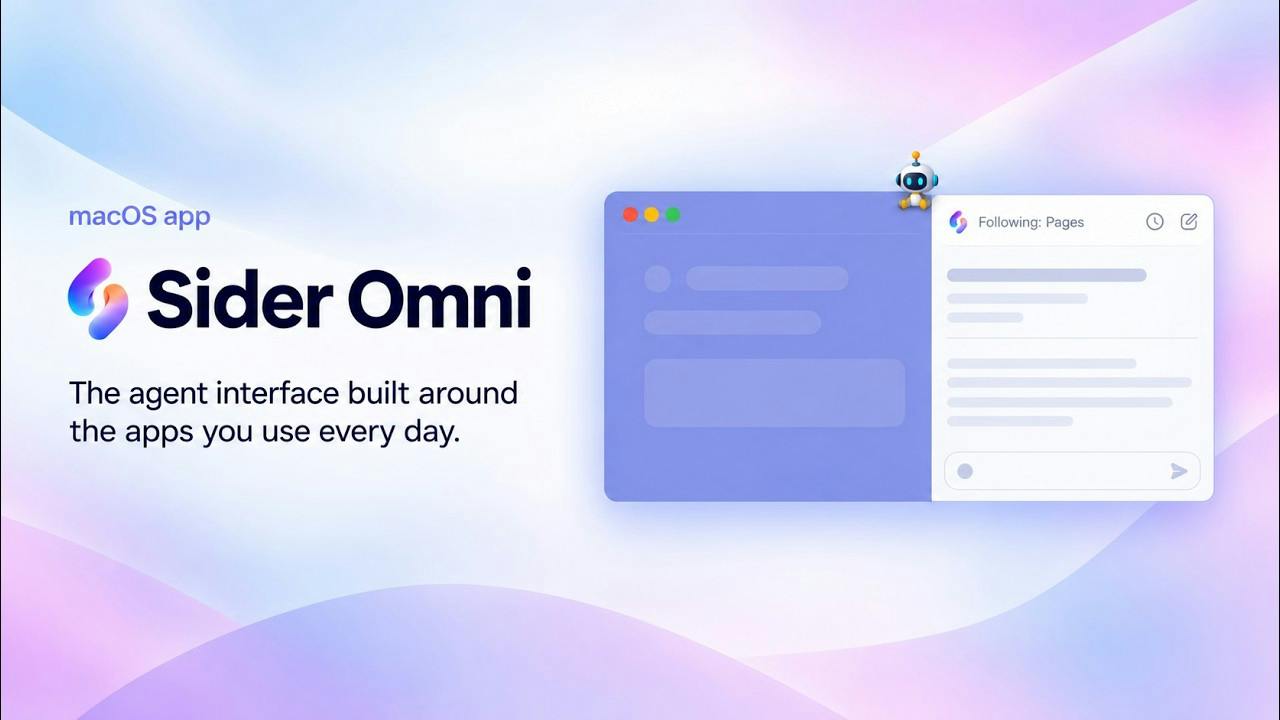
Sider Omni is a macOS desktop agent that attaches an AI sidebar to the user’s active application window. It can inspect visible context, answer questions about the current document or application, and perform tasks such as extracting information, drafting email responses, summarizing documents, and working across multiple windows. Each window can maintain its own agent and context (Sider Omni).
The product targets Mac-based knowledge workers who repeatedly move information among browsers, documents, email, spreadsheets, presentation software, and AI chat applications. Its primary benefit is reduced context switching: rather than uploading files or copying content into a separate chatbot, users can invoke an agent beside the application in which they are already working.
Omni itself is too new to have meaningful commercial evidence. However, it is not being launched by an unknown pre-seed team. The broader Sider product has a substantial installed base: its Chrome extension reports more than six million weekly active users, a 4.9 rating from approximately 114,400 ratings, and support for Chrome, Edge, Safari, Windows, macOS, iOS, and Android (Chrome Web Store). Sider separately claims more than ten million active users across its ecosystem, although this broader figure is company-reported and not independently audited (Sider pricing).
The strongest investment signal is therefore distribution rather than proprietary model technology. Sider has already reached millions of users, accumulated substantial marketplace review volume, established paid plans, and shipped products across multiple operating systems. This materially lowers the distribution risk associated with launching Omni.
The principal concern is defensibility. Omni depends on third-party frontier models, requires high-trust screen and accessibility permissions, and competes with platform owners that increasingly provide native desktop agents. The company also provides no verified revenue, retention, paid-conversion, gross-margin, or valuation information. The decision is DD: the company’s existing distribution and apparent capital efficiency justify formal diligence, but investment cannot be recommended without financial and cohort data.
Product Overview
Omni addresses the fragmented workflow created when users must transfer context from an active application into a standalone AI assistant. After installation and authorization, a user selects a window and opens the Omni avatar positioned at the window’s upper-right corner. The sidebar remains attached when that window moves, resizes, or enters full-screen mode (Sider Omni).
Core capabilities include:
- One persistent AI sidebar per application window
- Screen and application-context interpretation
- Document, email, spreadsheet, presentation, and PDF assistance
- Cross-window tasks when explicitly requested
- Parallel execution of multiple tasks
- Selection among multiple third-party AI models
- Local storage of conversations and artifacts through a Mac runtime
Supported workflows shown on the official page include Word, Excel, PowerPoint, Outlook, Apple productivity apps, Notion, Obsidian, Slack, Safari, Chrome, Preview, and PDF Expert. The currently verified Omni platform is macOS.
No standalone Omni price is published. The broader Sider service offers individual plans at $10, $25, $50, and $100 per month, differentiated by usage credits and cloud-computer capacity. All plans advertise access to chat, browser automation, website customization, and content generation (Sider pricing). Whether every Omni capability is included at every tier is not clearly disclosed.
Product quality appears strong at the interaction-design level. The per-window context model is more coherent than a generic floating chatbot. Nevertheless, independent tests of task completion, hallucination rates, application compatibility, latency, and failure recovery were not found.
Founder and Team Assessment
Joel Liu is publicly identified as CEO of Vidline Inc., Sider’s legal operator. His profile reports that he became Vidline’s CEO in 2021 and previously co-founded the web research and bookmarking product Diigo, where he worked from 2013 through 2021 (Joel Liu). This is relevant experience in browser-based productivity, information capture, and consumer software distribution.
Rick Fan publicly describes himself as a Sider co-founder focused on marketing and sales. His profile reports prior programming work at Diigo and an MCA degree from Chongqing University (Rick Fan). Together, the disclosed backgrounds suggest unusually strong founder-market fit for browser and desktop productivity software.
Sider’s LinkedIn page specifies a 51–200 employee range but shows only 13 associated profiles. Neither figure provides a verified operating headcount, and the geographic distribution of engineering, support, and commercial teams is not publicly clear (Sider LinkedIn).
Founder posts describe Sider as fully bootstrapped. No independently verified venture round was found. If confirmed, reaching the reported user scale without institutional capital would be a meaningful execution and capital-efficiency signal. Previous exits, current ownership, and the founders’ complete cap table are not publicly disclosed.
Founder Assessment: Strong consumer-product and browser-distribution experience, with credible execution signals but limited transparency regarding team composition and ownership.
Market Opportunity
The initial segment is Mac-based professionals who regularly use multiple productivity applications and pay for AI assistance. This includes researchers, consultants, analysts, developers, salespeople, marketers, and managers handling documents, email, spreadsheets, presentations, or web research.
A practical bottom-up calculation can begin with Sider’s company-reported ten million active users. This figure is not independently audited, but it provides a more relevant distribution base than a generic top-down AI market estimate.
Illustrative scenarios:
- 10 million active users × 5% paid conversion × $240 annual revenue = $120 million annual revenue
- 10 million active users × 2% paid conversion × $120 annual revenue = $24 million annual revenue
These are analyst scenarios, not actual Sider metrics. The range illustrates why paid conversion, plan mix, and retention are critical. Current individual pricing supports annual gross revenue per payer of $120–$1,200 before discounts, model costs, refunds, payment fees, and unused credits.
Adjacent opportunities include Windows support, enterprise desktop deployment, shared organizational knowledge, team administration, workflow templates, browser automation, and vertical agents. International distribution is already plausible because the existing extension supports 55 languages and the mobile applications support broad language coverage (Chrome Web Store, Apple App Store).
The realistic market can support venture-scale revenue. The unresolved question is whether Sider can monetize its large free audience while preserving adequate gross margin and retention.
Traction and Growth Signals
Sider has materially stronger public traction than a typical Product Hunt launch:
- The Chrome extension reports more than six million weekly active users and approximately 114,400 ratings at 4.9/5 (Chrome Web Store).
- The company claims more than ten million active users and more than 100,000 five-star ratings across the wider product ecosystem (Sider pricing).
- The iOS application has a 4.7/5 rating from approximately 4,300 ratings (Apple App Store).
- Google Play reports more than one million downloads and 20,600 reviews (Google Play).
- The Chrome extension was updated on September 18, 2026, indicating continued product maintenance.
The six-million figure refers specifically to weekly browser users, while the ten-million figure appears to cover the wider Sider ecosystem. The scopes can coexist, but both originate from Sider-controlled descriptions rather than audited analytics.
Omni finished fifth on Product Hunt’s September 18 leaderboard with approximately 376 votes and 128 comments (Product Hunt newsletter). This is useful evidence of launch interest but insignificant relative to Sider’s existing distribution and does not establish Omni retention.
No reliable public information was found regarding ARR, monthly growth, paying accounts, conversion, churn, cohort retention, net revenue retention, or Omni-specific active users.
Traction Assessment: Strong verified distribution and marketplace engagement, but commercially incomplete because revenue and retention are undisclosed.
Competitive Position
Direct and adjacent competitors include ChatGPT’s macOS application, Claude Desktop, Microsoft Copilot, Raycast AI, Apple Intelligence, Monica, Merlin, MaxAI, and HARPA AI.
ChatGPT can access supported active applications through its “Work with Apps” capability (OpenAI). Microsoft offers a native macOS Copilot application, while Apple is integrating personal context and onscreen awareness into macOS itself (Microsoft, Apple). Raycast offers a deeply integrated Mac productivity launcher with AI plans starting at $10 per month (Raycast pricing).
Omni’s clearest differentiation is its window-attached interface, one-agent-per-window architecture, cross-window execution, and multi-model selection. Sider also has a substantial pre-existing distribution channel through its browser extension.
Switching costs are currently limited. Chat history and workflow familiarity provide some retention, but no proprietary data network effect is evident. Much of the underlying intelligence comes from third-party models available to competitors.
If the largest platform launched the same feature within six months, customers would continue using Omni only if it maintained superior cross-application reliability, broader model choice, better workflow execution, or lower effective pricing. Existing distribution helps, but the user-interface concept itself is replicable.
Defensibility Assessment: Medium-Low
Business Model and Economics
Sider operates a credit-based freemium subscription model. Individual paid plans range from $10 to $100 monthly. A team plan with centralized purchasing, membership controls, and usage monitoring has also been announced, but current team pricing and enterprise contract values are not publicly disclosed (Sider pricing; Sider LinkedIn).
Principal variable costs likely include third-party model inference, search or data services, cloud-computer capacity for browser agents, storage, bandwidth, payment processing, and customer support. Actual model contracts and unit costs are unknown.
The credit system should help limit expensive usage and protect gross margin. However, higher-priced plans include dedicated cloud computers, making infrastructure cost more substantial than for a conventional lightweight browser extension. It is not known whether revenue increases faster than inference and cloud-compute costs.
Mobile in-app purchases expose part of the business to app-store commissions. Web and directly distributed desktop subscriptions can reduce that dependency.
Customer acquisition appears to combine organic extension-store discovery, Product Hunt launches, content marketing, and affiliates. Sider offers affiliate commissions of up to $45 per subscription sale, indicating an active paid distribution channel, but channel mix and customer acquisition cost are not disclosed (Sider affiliate program).
Unicorn Path
An established, growing AI productivity subscription business with durable retention and acceptable gross margin might support an 8× ARR multiple. This is an analyst assumption reflecting both SaaS characteristics and the lower defensibility and higher inference costs of a model-aggregation product.
Required ARR = $1 billion ÷ 8 = approximately $125 million.
At an illustrative blended annual revenue per paying user of $240, Sider would require approximately 521,000 paying users. At $120 annually, it would require approximately 1.04 million paying users.
Relative to the company-reported ten million active users, this implies approximately 5%–10% paid penetration, depending on plan mix. That is demanding but not inherently implausible. It would require strong renewal rates, sustained user activity, limited model-cost inflation, and continued differentiation from platform-native assistants.
Enterprise expansion could lower the required account count, but Sider would need stronger administration, security documentation, data controls, deployment tools, auditability, and customer support. No SOC 2 certification or equivalent enterprise-security evidence was found.
Unicorn Path: Plausible
Valuation Assessment
No verified institutional financing was found. Founder communications characterize Sider as bootstrapped, but audited capitalization records were unavailable. Current revenue, profitability, secondary transactions, acquisition offers, fundraising status, and valuation are not publicly disclosed.
A third-party source estimates historical ARR, but the estimate is unsupported by verifiable financial records and is not used in this analysis.
Valuation Attractiveness: Not Assessable
A responsible valuation assessment requires current ARR, growth, paid-user count, gross margin after inference costs, retention, cash flow, burn, cap table, founder ownership, any outstanding SAFEs or debt, and current financing terms.
Key Risks
- Undisclosed monetization: Large user counts may not translate into sufficient paid conversion or durable revenue.
- Platform replication: Apple, OpenAI, Microsoft, Anthropic, and other platform owners can integrate screen-aware desktop agents.
- Limited proprietary technology: Omni primarily orchestrates external frontier models rather than owning the foundation layer.
- Gross-margin pressure: Heavy users can create substantial inference, search, and cloud-computer costs.
- Screen-access privacy: Omni requires accessibility or screen-recording permissions to interpret sensitive workplace content.
- Enterprise readiness: No publicly verified SOC 2 certification, security audit, enterprise SLA, or data-residency offering was found.
- Low switching costs: Users can substitute competing sidebars or native assistants with limited migration friction.
- Claim verification: Ten million active users and bootstrapped status are company-reported and not independently audited.
- Product complexity: A broad suite of chat, browser-agent, creation, coding, and desktop features may dilute execution.
- Third-party dependency: Pricing, availability, and policy changes from model providers can affect functionality and margins.
Final Assessment
Venture Potential: 75/100
| Category | Score |
|---|---|
| Market Size and Expansion Potential | 17/20 |
| Traction and Growth Evidence | 16/20 |
| Founder and Team | 11/15 |
| Product Strength | 8/10 |
| Distribution Potential | 14/15 |
| Business Model and Economics | 5/10 |
| Defensibility | 4/10 |
| Total | 75/100 |
Distribution is the strongest component of the case. The weakest elements are uncertain unit economics and limited defensibility against operating-system and foundation-model providers.
Evidence Confidence: 64/100
The legal operator, founders, product availability, pricing, marketplace ratings, app-store downloads, and cross-platform presence are reasonably well supported. User totals and bootstrapped status are company-reported. Revenue, paid conversion, retention, gross margin, headcount, profitability, cap table, and valuation remain unavailable.
Final Decision: DD
Sider’s existing audience, review volume, paid product infrastructure, experienced founders, and capital-efficiency claim justify formal due diligence. Omni alone would merit only a Watch decision, but the wider company’s distribution materially improves the venture case.
An investment decision is premature because valuation, revenue quality, cohort retention, inference economics, security posture, and financing terms are unknown.
Upgrade Conditions
- Verified ARR and monthly growth by plan
- Cohort evidence showing more than 70% six-month paid retention
- Sustainable free-to-paid conversion across the existing user base
- Gross margin above 70% after model and cloud-computer expenses
- Significant Omni usage beyond launch-week experimentation
- Referenceable team or enterprise customers
- Verified enterprise-security controls and external audits
- Evidence that cross-window workflows outperform native platform assistants
Downgrade Conditions
- Paid conversion materially below management expectations
- High renewal churn after initial subscriptions
- Model and cloud costs causing structurally weak gross margins
- Apple, OpenAI, or Microsoft replicating Omni’s core workflow
- Loss of browser-extension distribution or marketplace standing
- Material privacy or screen-recording security incidents
- User-growth claims proving materially overstated
Questions for Further Diligence
- What are current ARR, MRR, year-over-year growth, and cash profitability?
- How many of the reported ten million active users are daily, weekly, and monthly active?
- How many paying users exist, and what is conversion by browser, mobile, and desktop?
- What are 30-, 90-, and 180-day retention rates for free and paid cohorts?
- What are logo retention and net revenue retention for team customers?
- What are gross margins by plan after model, search, and cloud-computer costs?
- What percentage of active Sider users have installed and repeatedly used Omni?
- What are customer acquisition cost and payback period by organic, app-store, and affiliate channels?
- How does Omni technically distinguish active-window context from information sent to third-party model providers?
- What security certifications, penetration tests, and enterprise data controls are available?
- What are the current cap table, founder ownership, profitability, burn, and runway?
- Is the company raising capital, and if so, what are the valuation, security, and proposed round terms?
Sources
- Sider Omni official page
- Sider Omni on Product Hunt
- Sider pricing
- Chrome Web Store listing
- Apple App Store listing
- Google Play listing
- Sider Terms of Use
- Sider Privacy Policy
- Sider LinkedIn
- Joel Liu profile
- Rick Fan profile
- Business Insider profile of Sider’s platform risk
- OpenAI Work with Apps
- Raycast pricing