
Table of Contents
Anomalo Investment Report
Category: Enterprise data quality and observability, expanding into agentic data analytics
Company Stage: Growth-stage private company (latest disclosed round is a Series B plus extensions)
Founder or Founders: Elliot Shmukler (CEO) and Jeremy Stanley (Chief Scientist)
Headquarters: Palo Alto, California (CRN)
Funding: About $82M disclosed, plus a Snowflake Ventures investment of undisclosed size
Business Model: Enterprise B2B SaaS, sold through sales, with cloud-marketplace procurement and a new free-to-start product
Product Hunt Launch Date: Around September 22, 2026 (Anomalo Analyst) (Silicon Florist)
Report Date: September 25, 2026
| Investment Metric | Assessment |
|---|---|
| Venture Potential | 66/100 |
| Unicorn Path | Conditional |
| Valuation Attractiveness | Not Assessable |
| Evidence Confidence | 55/100 |
| Final Decision | DD |
Executive Summary
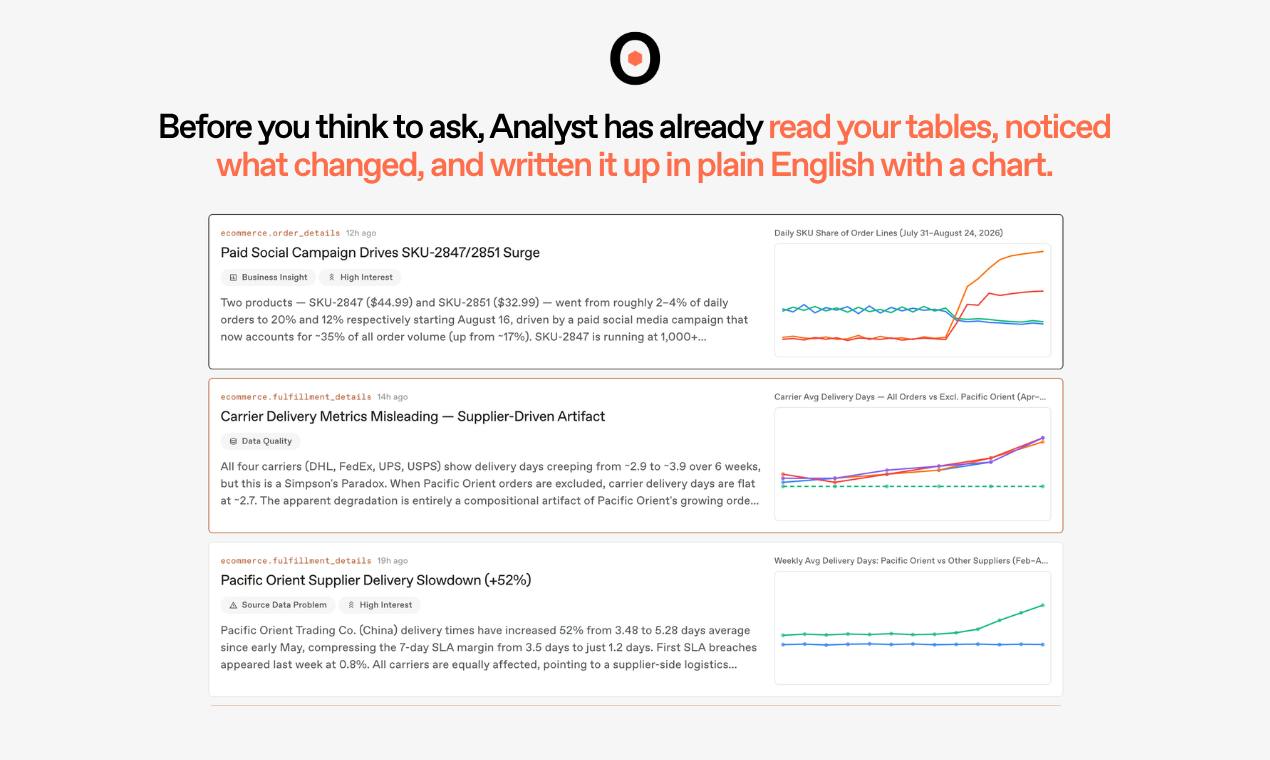
Anomalo sells software that watches the data stored in company data warehouses (Snowflake, Databricks, BigQuery). It uses unsupervised machine learning to spot data that is broken or unusual, and it explains the likely cause. The Product Hunt launch was not for the core platform. It was for Anomalo Analyst, a free-to-start tool that sends business users a feed of meaningful changes in their data, written up by AI agents and checked against the underlying data (Product Hunt).
The core buyers are enterprise data teams. Named customers include Block, Discover, Notion, Atlassian and Casey’s (Anomalo, BusinessWire). Analyst reaches further, to analysts and business managers, which widens the potential market beyond data engineering.
The strongest positive signal is backing from both major data platforms. Databricks Ventures joined the Series B, Snowflake Ventures invested later, and the CEO has said about 60% of revenue comes from customers who also use Snowflake (CRN). The company also reported 177% year-over-year ARR growth at fiscal Q3 2023. That figure comes from the company and is now nearly three years old.
The biggest concern is competition and the risk of being absorbed by platforms. Monte Carlo, Bigeye, Soda, Sifflet and Coalesce compete directly. Datadog bought Metaplane. Snowflake ships its own basic data-quality functions. No current ARR, valuation or priced round after 2024 has been disclosed.
Decision: DD. The team, customer list and strategic investors justify formal due diligence. Whether the company is on a path to $1B depends on growth since 2024 and on whether the expansion into agentic analytics works, and neither can be checked from public information.
Product Overview
The customer problem is that data breaks silently. Stale, incomplete or shifted tables corrupt dashboards, ML models and AI agents. The traditional fix is hand-written rules, which are fragile and only catch problems someone anticipated. Anomalo instead learns what “normal” looks like for each table and flags deviations without rules (About).
In April 2026 the company relaunched as an “agentic platform” with nine agents. They cover table observability, data-quality rules, incident response, proactive insights, conversational analytics, dashboards, documentation, KPI monitoring and experiment evaluation (BusinessWire). The platform page still labels some of these as “coming soon” (Platform). A competitor states that four of the nine were unreleased as of April 2026 (Coalesce, secondary/biased).
Analyst works in three steps. Statistical models rank what changed in the data, deliberately without using LLMs. An AI agent then writes up the change. A separate verification agent checks every claim in the write-up against the data (Analyst page).
Pricing for the core platform is not published and requires a demo. Analyst is “free to start,” but its paid tiers are not disclosed. Snowflake customers can buy Anomalo through the Snowflake Marketplace using committed spend (Anomalo).
Founder and Team Assessment
Shmukler was Chief Growth Officer at Instacart and VP of Product and Growth at Wealthfront, and before that held product roles at LinkedIn (First Round Review). Stanley worked with him at Instacart. He is described as CTO in older materials and as Chief Scientist now (About). The founders experienced the problem firsthand at Instacart, so founder-market fit is credible.
The company has built a dedicated sales leadership layer, including a President of Global Field Operations and a VP of Global Sales. Headcount is not disclosed. One third-party estimate puts it at 53 employees (Latka, unverified). No previous founder exits were found.
Founder Assessment: Strong operators with direct experience of the problem and a proven ability to raise money; whether they can scale enterprise sales is only partly proven.
Market Opportunity
The initial segment is large enterprises running cloud data warehouses with thousands of tables that feed analytics and AI. The following figures are analyst assumptions:
- Addressable accounts: roughly 15,000–25,000 mid-to-large enterprises worldwide on Snowflake, Databricks or BigQuery.
- Annual contract value (ACV): roughly $75K–$250K for data quality.
- Core market: about $1.1B–$6B a year.
Analyst and the agentic suite target analytics and business-intelligence spending, which is much larger. The timing is favorable because companies deploying AI agents need reliable data underneath them. Snowflake, however, notes that it already offers native data-quality metric functions, which could cap spending on basic checks (Snowflake).
Traction and Growth Signals
Verified or company-reported:
- $5.95M seed round (Crunchbase News).
- $33M Series A led by Norwest (October 2021), $33M Series B led by SignalFire (January 2024) and a $10M extension led by Smith Point Capital (November 2024) (CRN).
- 177% ARR growth year over year at fiscal Q3 2023 (Anomalo).
- Number of Fortune 500 customers “more than doubled” over a year (Smith Point).
- Fortune 500 Snowflake customers using Anomalo grew 200% (CRN).
- Published case studies with Nationwide, Discover and ADP (Platform).
Third-party estimates, which conflict: annual revenue of $6.6M (Latka), $12.6M (Growjo) and $15M (Owler). None is used in this report.
Launch attention: Analyst was trending near the top of Product Hunt on launch day. The final vote count and ranking were not verified. This says nothing about enterprise product-market fit.
Most important missing metrics: current ARR, net revenue retention (NRR), logo churn and Analyst’s free-to-paid conversion.
Traction Assessment: Credible enterprise traction through 2024, but current growth is commercially unverified.
Competitive Position
Direct competitors: Monte Carlo (valued at $1.6B in 2022), Bigeye, Sifflet, Soda and Coalesce Quality (Monte Carlo).
Platform threats: Snowflake’s native data metric functions; Datadog, which acquired Metaplane (Datadog); and general-purpose LLM analytics tools that compete with Analyst.
Differentiation: Anomalo checks the actual content of data, not just metadata, and its detection engine is statistical rather than LLM-based. It runs natively inside Snowflake, and it is deeply partnered with both of the leading data platforms.
Switching costs: Moderate. Once many tables are monitored and incident workflows are built around the tool, replacing it is disruptive.
Criticisms (from a competitor, so biased): opaque pricing, monitoring only after data lands rather than before code is merged, and lock-in to proprietary AI integrations (Coalesce).
If Snowflake shipped equivalent ML anomaly detection within six months, why would customers stay? Plausible reasons are support across multiple warehouses, detection depth built over years, and existing enterprise workflows. Snowflake Ventures says its investment is not a step toward an acquisition and aims to encourage Snowflake adoption (CRN). That same motive means Snowflake could bundle the capability itself if it ever became strategic.
Defensibility Assessment: Medium
Business Model and Economics
Revenue comes from enterprise subscriptions. ACV, gross margin and customer acquisition cost (CAC) are all undisclosed.
Running inside Snowflake means customers pay the warehouse compute costs, which helps Anomalo’s gross margin. The agentic products add LLM inference costs that the core product did not have. Analyst limits this by using statistical models to screen changes and calling LLMs only to write up and verify findings. Whether usage-based costs stay below revenue growth is unverified.
Marketplace drawdown shortens procurement for Snowflake customers but increases dependence on Snowflake. The move to free-to-start Analyst is an attempt at product-led growth; the conversion economics are unknown.
Unicorn Path
Assumed multiple: 8–12x ARR, which is appropriate for enterprise infrastructure SaaS growing faster than 40% with good NRR. This implies $85M–$125M in ARR is needed to justify $1B.
Customer count required (using the $75K–$250K ACV assumption above): about 340–1,700 enterprise customers. That is roughly 2–8% of the assumed addressable accounts, and it assumes gross margin of 70% or more.
Pure data quality may not reach this scale against Monte Carlo and the platforms’ own features. Reaching it probably requires several changes: raising ACV through the agentic suite, selling into analytics budgets, turning Analyst users into enterprise pipeline, and staying neutral across warehouses. Monte Carlo reached a $1.6B valuation at the 2022 market peak, which shows a unicorn outcome in this category is possible but not guaranteed.
Unicorn Path: Conditional
Valuation Assessment
Known investors: Norwest, SignalFire, Databricks Ventures, Snowflake Ventures, Smith Point, Foundation Capital, Two Sigma Ventures, Village Global and First Round Capital (BusinessWire).
Latest round: A Series B extension from Snowflake Ventures in 2025, of undisclosed size. The CEO described the company as “very well capitalized” at that point.
Valuation: No post-money valuation has been disclosed. A $59M figure from Latka is unverified and is not used. Total funding is also disputed: Growjo cites $121M, which conflicts with the $82M reported by CRN.
Valuation Attractiveness: Not Assessable. Assessing it would require current ARR, growth, NRR, gross margin, burn, runway, preference stack, last post-money valuation and proposed round terms.
Key Risks
Ranked from most to least material:
- Platform bundling: Snowflake and Databricks could expand their native data-quality features, or Datadog could extend Metaplane.
- Stale growth evidence: the last hard growth figure is from 2023, and no priced round has been disclosed since 2024.
- Snowflake concentration: about 60% of revenue comes from Snowflake customers.
- Crowded competition: well-funded direct rivals include Monte Carlo, and Sifflet reportedly runs campaigns targeting Anomalo customers.
- Agentic execution risk: several of the nine agents were not released at announcement.
- LLM analytics commoditization: Analyst competes with general-purpose AI analytics tools.
- Inference costs: AI features could erode gross margin.
- Pricing friction: sales-only pricing slows mid-market adoption.
- Preference overhang: about $82M+ raised could make modest exit outcomes unattractive.
Final Assessment
Venture Potential: 66/100
| Category | Score |
|---|---|
| Market Size and Expansion Potential | 14/20 |
| Traction and Growth Evidence | 11/20 |
| Founder and Team | 12/15 |
| Product Strength | 8/10 |
| Distribution Potential | 10/15 |
| Business Model and Economics | 6/10 |
| Defensibility | 5/10 |
| Total | 66/100 |
The strongest parts of the case are the team, the enterprise logos and the strategic alignment with both leading data platforms. The weakest parts are recent traction evidence and defensibility against platforms bundling the same capability.
Evidence Confidence: 55/100
Funding rounds, investors, founders, headquarters and product capabilities are verified. Growth rates, Fortune 500 expansion and customer scale (“10B+ rows daily”) are reported only by the company. Revenue estimates from third parties conflict and are unreliable. Current ARR, retention, margin, burn, valuation and headcount are unavailable.
Final Decision: DD
The company has a real enterprise customer base, credible founders, strategic backing from Snowflake and Databricks, and a product expansion that could raise contract values. That is enough to justify a founder meeting and data requests. It falls short of Invest because valuation and terms are unknown, current growth is not verifiable, and platform risk is significant.
Upgrade Conditions
- Verified ARR above $30M with growth of 50% or more year over year.
- NRR above 120%.
- Gross margin above 75% after AI costs are included.
- Snowflake-linked revenue below 50%.
- At least six of the nine agents generally available and generating paid expansion revenue.
- Measurable conversion of Analyst users into paying accounts.
Downgrade Conditions
- Snowflake or Databricks launches comparable ML-based content monitoring.
- ARR growth below 25%.
- Declining NRR.
- A flat or down round.
- Senior go-to-market or founder departures.
- Evidence that the agentic features remain largely on the roadmap.
Questions for Further Diligence
- What are current ARR and growth in each of the last eight quarters?
- What are gross and net revenue retention by cohort, and what is enterprise logo churn?
- What are median and top-decile ACV, and how has ACV changed since the agentic launch?
- What share of new ARR is procured through Snowflake or Databricks marketplaces?
- How many Analyst signups have there been since launch, how many are weekly active, and what share has converted into enterprise pipeline?
- What is gross margin after LLM inference costs, and how does it vary with the number of tables monitored?
- Which agents are generally available, and which have paying users?
- What are the win/loss rates against Monte Carlo, Sifflet and Bigeye, and against Snowflake’s native data metric functions?
- What are CAC payback and sales-rep productivity?
- What are current burn, runway and headcount?
- What was the last post-money valuation, what is the preference stack, and what terms are proposed for the next round?
- Do any strategic investors hold information rights or rights of first refusal that could constrain an acquisition?
Sources
- Product Hunt – Anomalo
- Anomalo About page
- Anomalo Analyst
- Anomalo Platform
- Series B announcement
- Smith Point Capital extension
- CRN – Snowflake Ventures investment
- Snowflake Ventures blog
- BusinessWire – Agentic platform launch
- First Round Review – Shmukler profile
- Monte Carlo Series D
- Datadog acquires Metaplane
- Coalesce – Anomalo alternatives (secondary, competitor-authored)
- Growjo, Owler, Latka (secondary estimates, unverified)