
Table of Contents
Humalike x GTA RP Investment Report
Category: AI NPC and conversational-agent infrastructure for FiveM roleplay servers
Company Stage: Early commercial product; financing stage not publicly disclosed
Founder or Founders: Martí Carmona Serrat (co-founder); Michał Stradczuk (Founding Engineer); Ignacio Borrell (Founding Product Engineer)
Headquarters: The company says its team operates from Spain. Soofte, Inc. is a Delaware corporation; formal headquarters not separately disclosed.
Funding: Not publicly disclosed. A maker says early investors in ElevenLabs and Revolut back Humalike; round size, names, and terms are not published.
Business Model: Server subscriptions based on monthly interactions, with a free testing tier
Product Hunt Launch Date: 2026/09/27
Report Date: October 8, 2026
| Investment Metric | Assessment |
|---|---|
| Venture Potential | 58/100 |
| Unicorn Path | Conditional |
| Valuation Attractiveness | Not Assessable |
| Evidence Confidence | 54/100 |
| Final Decision | Watch |
Executive Summary
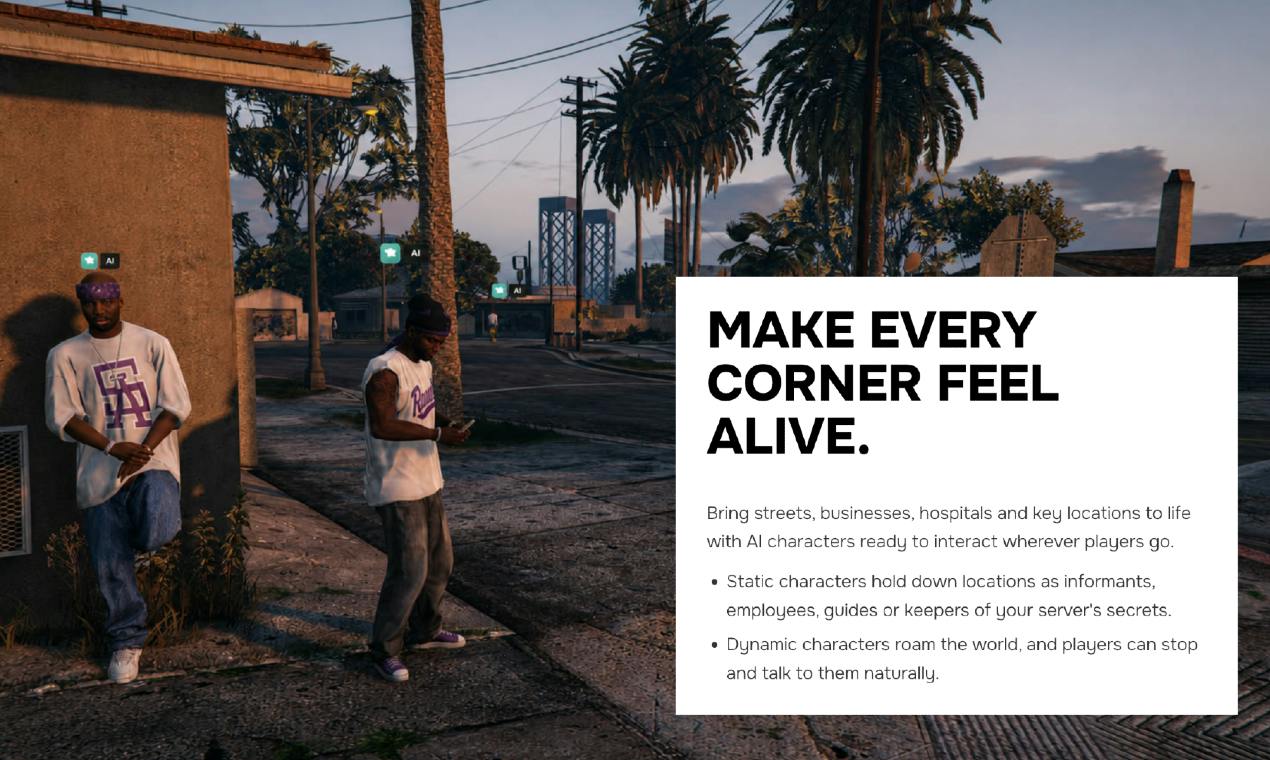
Humalike x GTA RP adds persistent, voice-enabled AI characters to FiveM, the multiplayer server framework used for GTA V roleplay. Server operators can use characters as guides, informants, witnesses, or shopkeepers. They remember players and react to game events, addressing a real roleplay problem: worlds feel empty when few human players are online. The official product page and public resource repository describe the current implementation.
The best signal is a live StrefaRP deployment followed by an open product with framework integrations and published pricing. Humalike reports 20,000+ conversations and 300,000+ turns there over about three weeks. These are company-reported usage figures, not audited paid-customer or retention data. Product Hunt ranked the launch #1 for the day and showed 359 votes. That indicates launch attention, not product-market fit. Product Hunt.
The product is more than a demo, but the venture case remains unproven. Humalike charges $79 or $119 monthly, yet does not disclose customer count, conversion, renewal, inference costs, or gross margin. A broader AI-character infrastructure business could scale; the current FiveM add-on at these prices is a much narrower opportunity.
The team has relevant gaming and engineering context, and the live deployment offers a useful proving ground. However, there is no public proof of repeatable paid adoption, durable usage, or attractive service economics. Watch is appropriate pending those data.
Product Overview
The product installs as a FiveM server resource and provides a dashboard to create and place NPCs. Official materials describe persistent character identities and memory, player-specific relationships, proximity voice, reactions to weapons, clothing, gunfire, and server events, plus ESX, QBCore, Qbox, and standalone support. The intended buyer is the server operator, not an individual GTA player. The public repository documents OneSync, WebRTC voice, and integration requirements. Official FiveM page; GitHub.
The official page lists a free tier with 1,000 test interactions, Starter at $79/month for 25,000 interactions, and RP at $119/month for 50,000; an extra 50,000 interactions costs $119. Billable-interaction definitions, overage behavior, and service-level commitments are not public. Pricing.
Founder and Team Assessment
Product Hunt identifies Martí Carmona Serrat as co-founder, Michał Stradczuk as Founding Engineer, and Ignacio Borrell as Founding Product Engineer. Stradczuk says he previously ran a GTA roleplay server; his public profile lists Revolut and the University of Warsaw. This supports gaming and technical relevance, but does not verify prior company outcomes or Humalike’s commercial execution. Product Hunt maker posts; Stradczuk profile.
The team describes itself as small and operating across Spain and Poland. Headcount, full-time commitment, hiring plans, and commercial ownership are not disclosed.
Founder Assessment: Strong product and gaming-context signals; commercial execution and team depth remain unverified.
Market Opportunity
The initial customer is a FiveM roleplay server owner seeking NPCs that fill service roles and create interactions during low-player periods. The buyer must run a compatible server, trust third-party AI in a moderated community, and believe it improves player experience enough to justify recurring spend. FiveM provides a resource ecosystem, but a reliable count of active, addressable roleplay servers and their software budgets was not established. Cfx/FiveM documentation.
At current prices, annual revenue per paying server is $948–$1,428 before discounts. This can support niche software, but a large venture outcome requires many paying servers or expansion into other games, studio contracts, and developer APIs. Humalike’s broader site mentions gaming characters, companions, and behavioral infrastructure, but does not establish those as revenue lines. Company site.
Traction and Growth Signals
Humalike reports 20,000+ conversations, 300,000+ turns, and about 40 days of aggregate talk time at StrefaRP in three weeks. The figures show product usage if accurate, but are not 20,000 customers or paying users. Public materials do not show paid conversion, revenue, cohort retention, server renewals, or adoption beyond the initial deployment. Product Hunt maker comments.
The launch ranked #1 for the day with 359 displayed votes. The Product Hunt company page shows no reviews. The public GitHub resource documents implementation work, but its four stars are not a commercial traction measure. Product Hunt; GitHub.
Traction Assessment: A live use case is promising, but paid demand and post-launch retention remain unverified.
Competitive Position
Convai and Inworld offer developer platforms for interactive AI characters. Other alternatives are scripted NPC resources, bespoke server scripts, or human moderators and players. Convai pricing; Inworld.
Humalike’s current differentiation is FiveM-specific integration combined with memory, voice, and event awareness. The repository shows implementation depth, but no measured switching costs, cross-server network effects, exclusive data advantage, or broad engine distribution. Larger platforms could add server integrations, while FiveM changes could affect the product’s addressable base.
If a large platform launched the same feature within six months, Humalike would need to retain customers through better roleplay outcomes, reliability, memory quality, and embedded workflows—not merely more natural dialogue.
Defensibility Assessment: Low to Medium
Business Model and Economics
Subscriptions are tied to interaction allowances. The company lists AWS, Gemini, Anthropic, Deepgram, and ElevenLabs among its sub-processors for hosting, model inference, speech recognition, and voice synthesis. These create usage-linked costs, but cost per interaction, gross margin, and usage distribution are undisclosed. Pricing; sub-processors.
Recurring economics could be attractive if servers renew and usage stays predictable. Heavy voice and model usage could instead erode margins. The free tier lowers trial friction but leaves conversion unknown. The company states GDPR compliance and that SOC 2 Type II and ISO 27001 are in progress. Voice, transcripts, identifiers, and persistent memories require clear consent, retention, moderation, and deletion controls. Security; data processors.
Unicorn Path
Assume 10× ARR solely as an illustrative high-growth software multiple, not a valuation of Humalike. A $1 billion valuation would then require about $100 million ARR. At $119/month, that is roughly 70,000 paying servers; at $79/month, about 105,000, before discounts and variable costs.
The current FiveM-only product does not show a credible route to that volume. The path is Conditional on expansion to multiple game engines or a reusable behavioral API sold to studios and other AI products, probably at much higher contract values. The company’s broader positioning suggests this direction, but commercial validation is absent.
Valuation Assessment
No reliable public source reviewed here discloses the latest financing round, valuation, SAFE cap, or revenue. The makers’ backing statement is not a substitute for named investors or terms. Valuation Attractiveness is Not Assessable. Assessment requires ARR and growth, retention, gross margin, burn, runway, customer concentration, round size, cap, post-money valuation, and investor rights.
Key Risks
- Narrow market: FiveM-only focus and sub-$1,500 annual revenue per server constrain scale.
- Unproven renewal: One public deployment does not establish repeatable paid retention.
- AI costs: Voice and model inference scale with usage; margin data is unavailable.
- Platform dependency: Distribution depends on FiveM, GTA V, server frameworks, and platform policies. Cfx docs.
- Immersion and moderation: Erratic or unsafe dialogue could harm tightly managed communities.
- Privacy: Voice, transcripts, identifiers, and memories require consent and deletion controls. Sub-processors.
- Integration support: Multiple frameworks and custom scripts could make onboarding labor-intensive.
- Commoditization: General character platforms and custom scripts can replicate visible features.
- Financing opacity: Round terms, runway, ownership, and named investors are unknown.
Final Assessment
Venture Potential: 58/100
| Category | Score |
|---|---|
| Market Size and Expansion Potential | 13/20 |
| Traction and Growth Evidence | 7/20 |
| Founder and Team | 10/15 |
| Product Strength | 9/10 |
| Distribution Potential | 8/15 |
| Business Model and Economics | 6/10 |
| Defensibility | 5/10 |
| Total | 58/100 |
Product quality and live implementation are the strongest elements. The narrow beachhead, missing commercial metrics, and unproven economics are the weakest. Multi-game or studio/API expansion is necessary for a large venture outcome.
Evidence Confidence: 54/100
Official pages and the public repository support product details, pricing, legal entity, and technical integrations. Usage is company-reported and repeated in secondary coverage. Revenue, paying customers, retention, margin, funding terms, valuation, team size, and CAC remain unavailable; no third-party financial estimate is treated as fact.
Final Decision: Watch
The product merits follow-up, but public evidence is insufficient for DD. Product Hunt ranking is treated only as launch interest. Price and financing terms are unknown, while a FiveM-only model appears too narrow for venture scale.
Upgrade Conditions
Move to DD after multiple independent paid server customers renew for six months; cohort retention and free-to-paid conversion are disclosed; gross margin exceeds 70% after inference and voice costs; customers provide references; and acquisition and installation become repeatable. A credible multi-game or studio contract pipeline would strengthen the scale case.
Downgrade Conditions
Move toward Pass if the initial deployment fails to produce renewals, usage costs exceed revenue, support remains bespoke, or FiveM compatibility and policies constrain distribution. Reassess immediately after any material failure in consent, privacy, or data deletion.
Questions for Further Diligence
- How many servers are live and paying at each tier?
- What are trial conversion, monthly churn, and six-month server retention?
- How are conversations, turns, and billable interactions defined?
- What are unique player counts and usage concentration at StrefaRP?
- What are model, speech, hosting, and support costs per interaction?
- What gross margin does each plan produce, including heavy usage?
- What are CAC, sales cycle, acquisition channels, and installation time?
- Which founders are full-time, and what roles are missing?
- What are the round terms, cap table, runway, and named investors?
- How are consent, underage users, voice retention, and deletion handled?