
Table of Contents
Vidaya Investment Report
Category: Consumer digital health / AI-powered health-data aggregation
Company Stage: Pre-seed or bootstrapped early stage; financing stage not publicly disclosed
Founder or Founders: Kevin Amrelle and Duddu Venkata Ramana, Ph.D.
Headquarters: Raleigh, North Carolina
Funding: Not publicly disclosed
Business Model: Consumer subscription; potential future B2B wellness-provider and insurer partnerships
Product Hunt Launch Date: August 16, 2026
Report Date: August 19, 2026
| Investment Metric | Assessment |
|---|---|
| Venture Potential | 54/100 |
| Unicorn Path | Conditional |
| Valuation Attractiveness | Not Assessable |
| Evidence Confidence | 49/100 |
| Final Decision | Watch |
Executive Summary
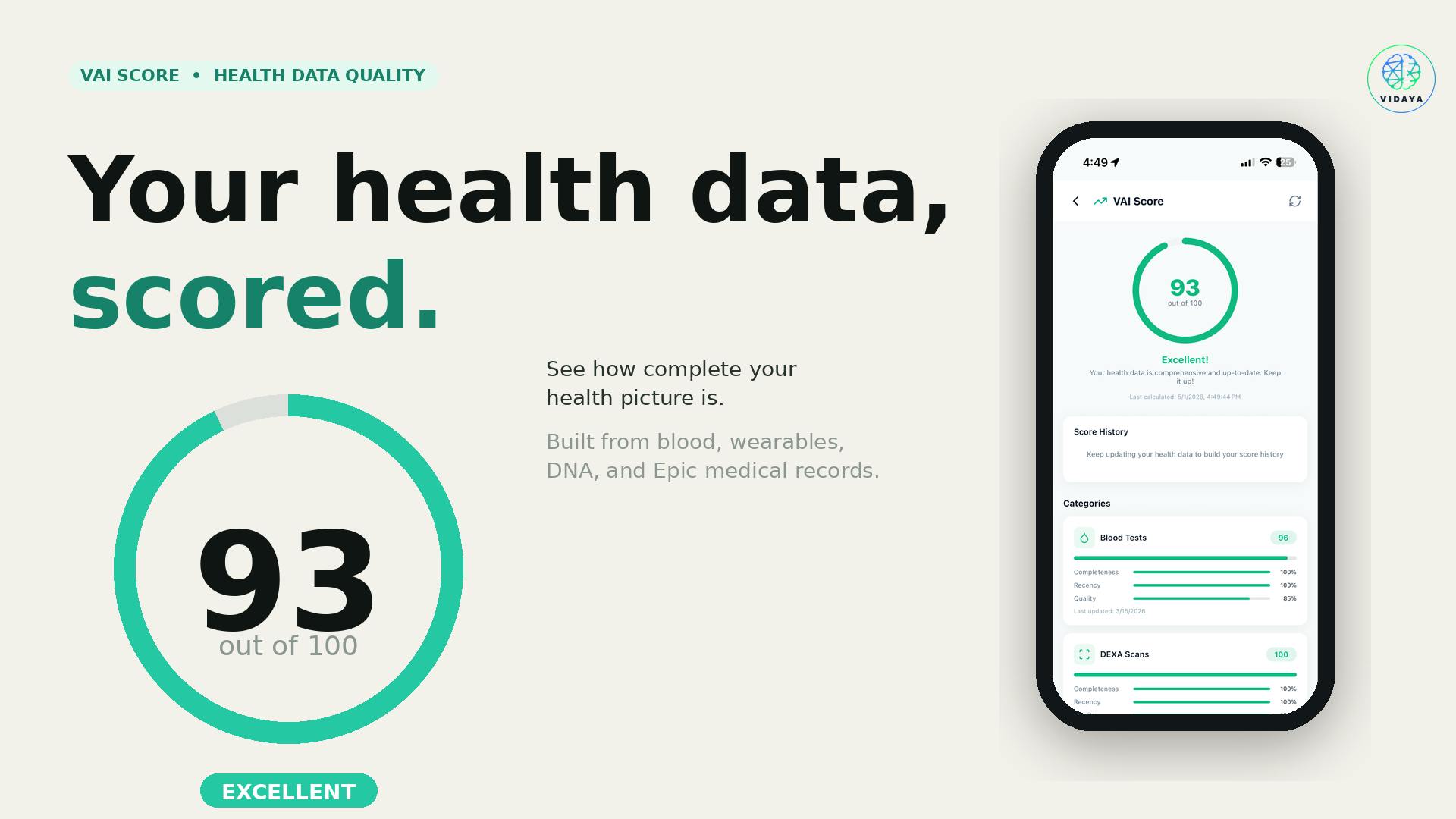
Vidaya, previously named Vitality AI Health, aggregates wearable, laboratory, genetic, nutrition, supplement, environmental, and medical-record data into one consumer dashboard. It provides trend analysis, a healthspan score, biological-age estimates, and an AI assistant that answers questions using the user’s connected data (official website; Product Hunt).
The product addresses genuine fragmentation: consumers commonly manage data across Apple Health, Garmin, Oura, laboratory portals, DNA services, nutrition apps, and spreadsheets. Vidaya’s ability to combine multiple categories—rather than analyzing only a wearable or blood panel—offers a clearer proposition than another standalone wellness dashboard.
The strongest early signal is the pace of product development. The company has recently shipped DNA analysis, trend views, peptide tracking, an AI diet and fitness coach, and broader data integrations. It also reported exceeding 3,000 users before the Product Hunt launch, although this is a company-reported figure with no active-user, retention, or payment breakdown (LinkedIn company page).
The principal investment concerns are low-priced consumer economics, intense competition, health-data liability, and uncertain founder commitment. Both founders’ official biographies describe concurrent executive roles at large financial institutions, and part of the engineering team is supplied through an outside development partner (team page). No revenue, conversion, retention, funding, or unit-economic data are publicly available.
Decision: Watch. Vidaya appears to be a functional and improving product, but its current evidence supports an early consumer experiment rather than a validated venture-scale company.
Product Overview
Vidaya serves health-conscious consumers who already collect data from multiple wearables, laboratories, DNA services, or medical portals but struggle to interpret the combined record.
Users connect data sources or upload health documents. Vidaya then organizes biomarkers and wearable readings, displays changes over time, calculates composite scores, and lets users question “Vaya,” its AI health assistant. Supported categories include Apple Health, Garmin, Oura, WHOOP, Fitbit, blood tests, DNA, supplements, medications, nutrition, and medical records (integrations and partners).
The product is available through the web and Google Play; the company also represents that it is available on iOS. The Google Play listing describes subscriptions and premium analytics purchased through the web, but publicly visible installation and review evidence is limited.
Pricing is $10 monthly or $89 annually, with a 30-day trial and money-back positioning. The Product Hunt promotion temporarily reduced the annual plan to $39 (Product Hunt launch). No permanent free plan is clearly documented.
The alternative is a mixture of free platform dashboards, laboratory PDFs, individual wearable apps, spreadsheets, and advice from clinicians or coaches. Vidaya’s principal customer benefit is not creating more data but connecting existing data into one longitudinal view.
Product quality: Promising breadth and understandable consumer value, but the medical usefulness and accuracy of cross-source AI conclusions have not been independently validated.
Founder and Team Assessment
Kevin Amrelle’s public profile shows extensive data-science and AI experience, including current employment as an Executive Director for AI/ML and generative AI at Wells Fargo and previous data-science roles at Bank of America. His profile also lists multiple simultaneous startup projects (LinkedIn).
Co-founder Duddu Venkata Ramana is described by Vidaya as an enterprise data-science executive and adjunct professor at UNC Charlotte. The official team page also lists a CISO, marketing lead, and two engineers supplied through Bitrupt, an external product-engineering partner. Exact employment status, equity ownership, and time allocation are not disclosed.
The founders appear technically capable, but neither public biography demonstrates full-time commitment to Vidaya. There is also limited evidence of clinical expertise on the core leadership team; cybersecurity and AI expertise do not substitute for medical product validation. No verified prior technology-company exits were found.
Founder Assessment: Strong AI and analytics capability, but healthcare commercialization experience and full-time commitment remain unproven.
Market Opportunity
The initial segment is consumers who own one or more premium wearables, periodically purchase blood tests, and are willing to pay for longitudinal health optimization. This is narrower—and more commercially relevant—than the general wellness market.
A bottom-up analyst scenario assumes 15–40 million reachable consumers across the United States and other affluent English-speaking markets with sufficient health data and willingness to consider aggregation software. At a 3%–7% paid adoption rate and $89 annual revenue per subscriber, the implied addressable subscription revenue is approximately $40 million–$249 million. These are analyst assumptions, not company forecasts or verified market figures.
The initial consumer subscription segment could support a meaningful company, but reaching venture scale requires strong retention and distribution. Adjacent opportunities include employer wellness, clinician dashboards, longevity clinics, laboratory referral revenue, insurance partnerships, premium testing, and population-level analytics. Heads Up Health already pursues practitioner-oriented health-data aggregation with plans beginning around $299 per month (official listing).
Market timing is favorable because wearable and consumer laboratory adoption is expanding. However, greater health-data availability also benefits large incumbents and increases regulatory scrutiny.
Traction and Growth Signals
Vidaya ranked #4 Product of the Day on August 16, 2026 and had roughly 250 Product Hunt points and one review at the time of research (daily leaderboard; reviews). This is launch attention, not evidence of retention or commercial demand.
The company reported more than 3,000 users after approximately five weeks of a launch campaign. An older company profile referenced 100-plus early-access members, creating an apparent difference that may reflect growth or inconsistent definitions. The latest 3,000-user figure is used here, but neither number is independently verified, and “user” may mean registration rather than active or paying subscriber.
Product activity is stronger than commercial evidence. Public updates document frequent feature releases, and the website provides a working interactive demonstration. The company reports integrations through Terra and infrastructure involving Supabase and AWS, while its privacy policy identifies Google Gemini, Stripe, Google OAuth, and other processors (privacy policy).
The most important missing metrics are paying subscribers, monthly active users, connected-data users, trial conversion, renewal, churn, revenue, acquisition costs, and engagement with the AI coach.
Traction Assessment: Active product development and company-reported user growth, but commercially unverified.
Competitive Position
Direct competitors include Welltory, InsideTracker, Function Health, Guava, Healsens, Heads Up Health, and other longevity dashboards. Indirect competition comes from Apple Health, Google Health Connect, Oura, WHOOP, Garmin, laboratory portals, ChatGPT-style health analysis, clinicians, and spreadsheets.
Vidaya is priced competitively. Welltory’s annual plan is approximately $99 (pricing), while InsideTracker’s platform membership is $149 annually before many laboratory costs (membership). Function Health charges $365 annually but includes extensive laboratory testing and clinician review (pricing).
Vidaya’s differentiation is breadth of data aggregation at a low price. However, integrations can be replicated, composite health scores may not be durable intellectual property, and AI models are supplied by third parties. The company references patent application 19/389,347, but enforceability and scope were not independently assessed.
“If the largest platform in this market launched the same feature within six months, why would customers continue using this product?” Today, the answer is weak. Vidaya could retain users through superior cross-platform neutrality, longitudinal records, trust, and personalized correlations, but it has not yet demonstrated substantial switching costs, proprietary clinical data, network effects, or brand authority.
Defensibility Assessment: Low
Business Model and Economics
The current model is consumer subscription revenue at $89–$120 annually before promotions, refunds, payment fees, and discounts. At 3,000 total registered users, theoretical annual revenue would be $267,000 if every user purchased the $89 plan—but that is not a revenue estimate because paid conversion is unknown.
Variable costs include wearable-data connectivity, cloud storage, document processing, Gemini inference, customer support, and security compliance. AI costs may remain manageable at moderate chat frequency, but users uploading extensive medical histories or frequently querying longitudinal data could produce higher costs.
Selling subscriptions through the web may reduce app-store commissions, although it could add conversion friction. Consumer health acquisition can also be expensive because products must build trust before users upload sensitive records. Potential B2B plans could raise annual contract value, but would require stronger clinical validation, security audits, procurement capability, and possibly integrations with covered healthcare entities.
Unicorn Path
An 8× revenue multiple is assumed for a high-growth consumer health subscription company. This is lower than a premium enterprise SaaS multiple because consumer churn, acquisition costs, medical risk, and platform dependence generally reduce predictability.
Required annual revenue = $1 billion ÷ 8 = $125 million.
At $89 per year, Vidaya would require approximately 1.4 million full-price annual subscribers. Allowing for promotions, payment costs, refunds, and a lower blended net price would likely increase the requirement to approximately 1.5–1.8 million paying subscribers.
That scale is improbable through the current consumer dashboard alone. A credible route would require international distribution, strong annual retention, laboratory or testing revenue, clinician and employer products, high-value B2B contracts, and a proprietary longitudinal health-data advantage.
Unicorn Path: Conditional
Valuation Assessment
No reliable public information was found regarding outside funding, investors, SAFE terms, secondary sales, current fundraising, or valuation. Revenue and gross margin are also unknown.
Valuation Attractiveness: Not Assessable
Assessment would require verified ARR, paid conversion, cohort retention, gross margin, CAC, burn, runway, founder ownership, option pool, current round size, valuation cap or post-money valuation, and liquidation preferences.
Key Risks
- Unknown paid conversion and subscription retention.
- Founders appear to maintain concurrent executive employment.
- Low differentiation from established health dashboards and platform incumbents.
- Sensitive health-data breach and privacy exposure.
- AI-generated correlations could be inaccurate or interpreted as medical advice.
- Dependence on third-party wearable APIs, Terra, cloud providers, and Gemini.
- Consumer acquisition costs may exceed low annual subscription revenue.
- Limited independently verified usage and customer-review evidence.
- Engineering dependence on an external development partner.
- Expansion into clinical use could increase FDA, FTC, HIPAA, and state-law obligations; the FTC explicitly applies its Health Breach Notification Rule to many consumer health apps (FTC).
Final Assessment
Venture Potential: 54/100
| Category | Score |
|---|---|
| Market Size and Expansion Potential | 15/20 |
| Traction and Growth Evidence | 7/20 |
| Founder and Team | 8/15 |
| Product Strength | 7/10 |
| Distribution Potential | 7/15 |
| Business Model and Economics | 6/10 |
| Defensibility | 4/10 |
| Total | 54/100 |
The strongest elements are the understandable user problem, integration breadth, and technically experienced founders. The weakest are unverified commercial traction, uncertain commitment, consumer distribution economics, and limited defensibility.
Evidence Confidence: 49/100
Verified information includes the legal entity, founders, product availability, pricing, Google Play listing, privacy policy, and Product Hunt ranking. User count, HIPAA compliance, product benefits, and patent status are principally company-reported. Revenue, retention, funding, valuation, active usage, gross margin, CAC, burn, and runway remain unavailable.
Final Decision: Watch
Vidaya is too early for formal diligence based solely on public evidence. A venture-scale market may exist, but the company has not demonstrated that consumers will connect sensitive data, use the product frequently, renew subscriptions, or generate attractive acquisition economics.
Upgrade Conditions
- At least 10,000 paying subscribers or $1 million ARR.
- More than 70% annual subscriber retention.
- Verified trial-to-paid conversion above 10%.
- Gross margin above 70% after data-integration and AI costs.
- Repeatable acquisition with a payback period below 12 months.
- Independent security audit and documented healthcare compliance.
- Evidence that both founders are substantially committed full-time.
- Successful B2B pilots with clinics, employers, or laboratories.
Downgrade Conditions
- Weak engagement after initial data connection.
- High annual churn or dependence on discounted subscriptions.
- A material privacy, security, or AI-safety incident.
- Apple, Oura, Function Health, or another platform replicates the aggregation proposition.
- Loss of critical wearable or medical-record integrations.
- Unverifiable user or compliance claims.
Questions for Further Diligence
- What are current MRR, paying-subscriber count, and monthly revenue growth?
- Of the reported 3,000 users, how many are active, have connected data, and are paying?
- What are trial-to-paid conversion and 30-, 90-, 180-day, and annual retention?
- How often do retained users open Vidaya or query Vaya?
- What are CAC and conversion by Product Hunt, organic search, affiliates, and paid social?
- What is gross margin after Terra, Gemini, cloud, payment, and support costs?
- What clinical methodology supports the Healthspan, biological-age, and VAI scores?
- What security audits, penetration tests, HIPAA assessments, and breach-response procedures have been completed?
- What are the founders’ weekly time commitments, employment restrictions, and IP-assignment arrangements?
- How much of engineering is owned internally versus delivered by Bitrupt?
- What are burn, runway, cap table, financing history, current valuation, and round terms?
- What proprietary data or workflow would prevent Apple, Oura, or Function Health from displacing Vidaya?